.svg)
Confused by access control policies? Think of them as the bouncer for your company's data, deciding who gets in and what they can do. Without clear rules, your sensitive information is at risk from hackers and insider threats, a major problem for compliance audits.
Why You Need Strong Access Control Policies
Your business runs on data like customer lists and financial records. A data breach can be a business-ending event, and it's not always an outside hacker. A shocking number of breaches come from internal employees who already have access.
This is where a solid access control policy saves the day. It defines who can access what, shrinking your risk from both inside and outside threats. It’s not just a good idea; it’s a requirement for compliance frameworks like SOC 2 and HIPAA.
Understanding Common Access Control Models
Not all access control policies are the same. Picking the right one is like choosing the right lock for your server room. Let's break down the most common models so you can find the right balance between security and letting your team work.
Role-Based Access Control Explained Simply
Role-Based Access Control (RBAC) is the most popular model because it's simple. You create "roles" like "Developer" or "Sales Rep" and assign permissions to those roles, not to individual people. When a new developer joins, you just add them to the "Developer" role, and they get all the access they need.
RBAC is great, but misconfigurations are a common weakness we find during penetration tests. Small businesses often learn this the hard way during a SOC 2 audit. A simple mistake can leave a huge security hole for an attacker to exploit.
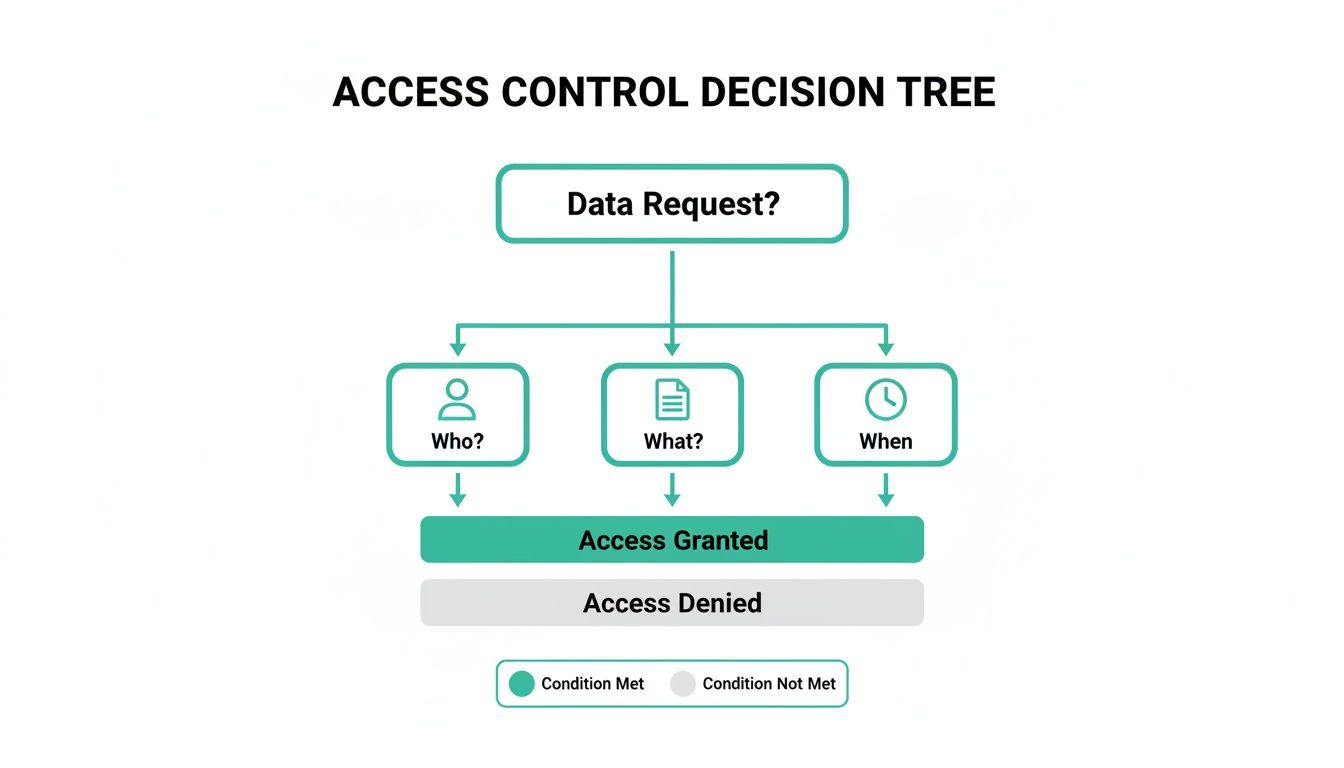
A good policy considers who is asking for data, what they want, and when they are asking for it.
Attribute-Based Access Control Explained Simply
Attribute-Based Access Control (ABAC) is more dynamic. It makes decisions based on multiple "attributes" or details about the user, the data, and the environment. It's like a smart security system for your data.
For example, ABAC can create a rule like, "Only allow managers in Finance to access confidential reports from an office IP address during business hours." This is powerful for complex setups but also harder to manage than RBAC. A policy is just a document until you test it, and an attacker will always look for the weakest link.
How to Build a Simple Access Policy
Creating an access control policy doesn't have to be a headache. It's about writing down clear rules on who gets to access what and why. The goal is a simple guide that tightens your security and satisfies auditors.
The most important rule is the Principle of Least Privilege. This just means giving people the absolute minimum access they need to do their jobs, and nothing more. Following this one concept dramatically reduces your risk.

A policy is just a document until you test it. An attacker won't care what your policy says; they will look for the gaps. Traditional pentesting firms are slow and expensive. Our OSCP, CEH, and CREST certified pentesters deliver affordable manual penetration tests with a detailed report in just one week. Get in touch through our contact form to get started.
How Policies Help You Pass Compliance Audits
For most companies, an access control policy is a hard requirement for compliance frameworks like SOC 2, PCI DSS, or HIPAA. A clear policy is the best evidence you can show an auditor that you are serious about protecting data.
Auditors need to see in black and white that you have a process for managing access. It proves you are proactively managing risk. Walking into an audit without a documented policy is a recipe for failure.
A documented policy is a great start, but it's not enough. You have to test it to find the gaps an attacker would exploit. A policy might say a former employee's access is revoked, but our pentest will confirm if it actually happened.
Putting Your Access Control Policy Into Action
A written policy is useless if it just sits in a folder. You need to bring your access control policies to life with real enforcement and monitoring. This turns your rules into an active defense that protects your data every day.
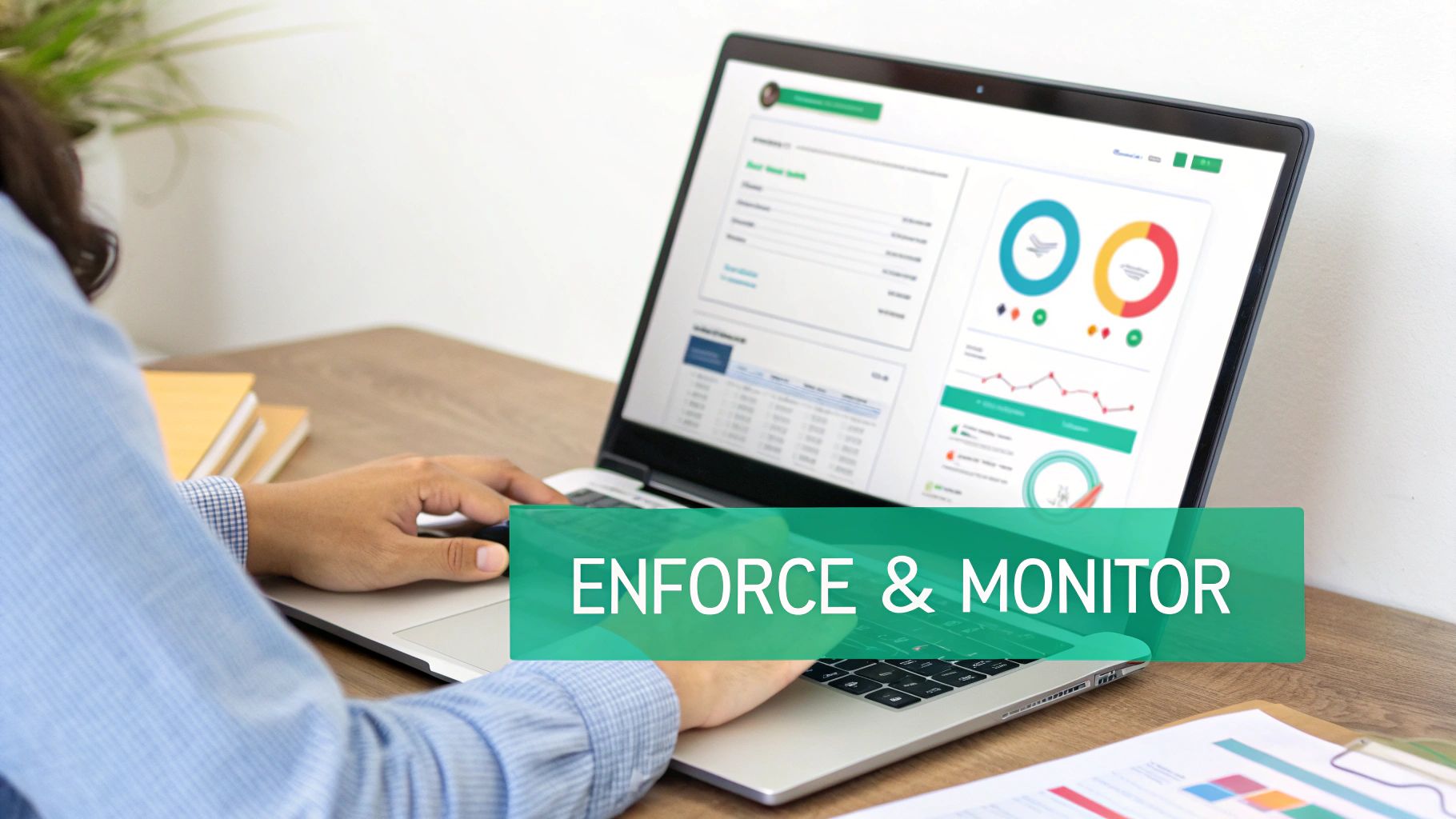
The goal is to build a process that makes security part of your daily operations. Manually managing access is slow and full of errors. Using an Identity and Access Management (IAM) system automates the process, granting and revoking access based on roles.
You also need to fight "privilege creep," which happens when employees collect permissions over time and end up with far more access than they need. To prevent this, conduct quarterly access reviews where managers confirm their team members still need the access they have.
A policy is just a theory until it's battle-tested. Our affordable manual pentests, conducted by OSCP and CREST certified experts, find the gaps an attacker would exploit. We deliver a detailed report in one week so you can fix vulnerabilities fast.
Find Policy Gaps with Affordable Penetration Testing
You've written your access control policies, but how do you know they actually work? You need to test them against a real-world attack before a hacker does. This is exactly what penetration testing is for.
Our OSCP, CEH, and CREST certified pentesters act like real attackers, trying to bypass your controls to find critical misconfigurations that automated scanners miss. We look for things like excessive user permissions, ways to escalate privileges to gain admin control, and active accounts for former employees.
Think of a pentest as a fire drill for your security. It’s a safe way to see how your defenses hold up under pressure so you can fix problems before a real breach. Traditional pentesting firms are slow and expensive, often taking months to deliver a report. We're the affordable alternative built for speed and value.
After the test, you get a detailed, actionable report in just one week. It explains each vulnerability and provides clear steps to fix it. This report is the hard evidence you need to prove to auditors for SOC 2 or HIPAA that your controls are effective. Don't wait for a breach to find your weaknesses. Get in touch through our contact form to see how our fast, affordable penetration testing can help.
Answering Your Most Common Policy Questions
We get a lot of questions about managing access control policies. Here are the clear, no-nonsense answers for IT managers, founders, and compliance officers who need to get security right.
How Often Should We Review Our Policies?
You should review all user access permissions at least quarterly. For critical systems or teams with high turnover, monthly reviews are even better. The main policy document itself should be reviewed and updated annually.
What Is the Biggest Mistake Companies Make?
The most common and dangerous mistake is “privilege creep.” This happens when employees collect more access rights over time but their old, unneeded permissions are never revoked. Regular access reviews are the best defense against this.
Can a Small Startup Use Shared Logins?
No. Using shared accounts is a massive security and compliance red flag because it destroys accountability. You can’t trace actions back to a specific person. Auditors for standards like SOC 2 will immediately fail any controls that rely on shared accounts.
A policy is just a theory until it’s tested. How do you know if your controls truly hold up under pressure?
At Affordable Pentesting, our OSCP, CEH, and CREST-certified experts provide manual penetration tests to find the real-world gaps an attacker would exploit. We deliver a detailed, actionable report in just one week, giving you the proof you need for auditors and the peace of mind that your defenses are actually working.
Validate your security affordably and quickly. Find out more about our pentesting services.