.svg)
Moving to the cloud is smart, but it opens security holes you can't see. Most breaches happen from simple mistakes, not master hackers, and traditional pentesting firms are too slow and expensive to help you find them. We deliver affordable, manual pentests in under a week, giving you a clear report on your real-world cloud computing and security risks.
Your Cloud Is More Exposed Than You Think
Moving to the cloud with services like AWS, Azure, or GCP is great for growth but changes the security game. You can no longer protect a single office network. Your data is now spread out, creating blind spots that attackers love to find.
The problem is cloud environments are complex and easy to mess up. A single wrong setting or a user with too much access can expose your most sensitive data to the internet. These aren't fancy hacks. They're common mistakes our certified pentesters find every day.
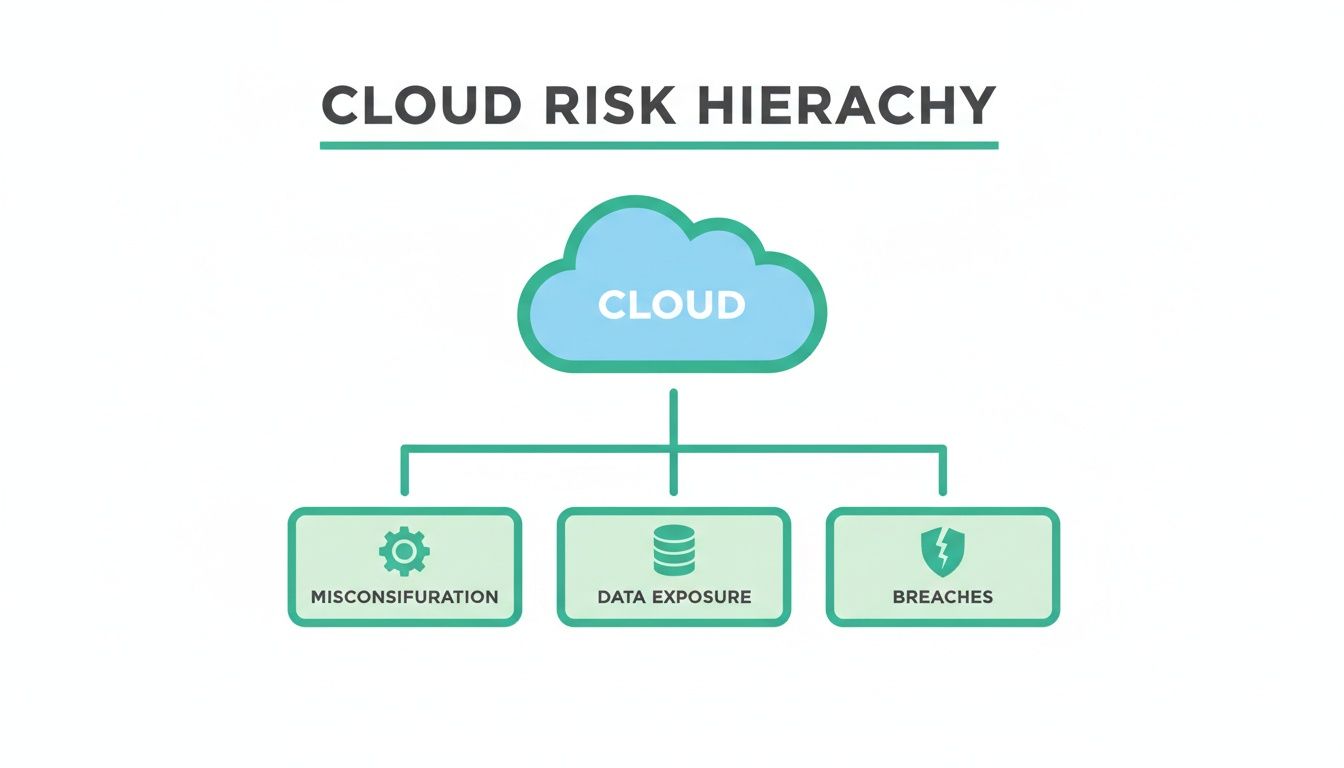
It all starts with the basics. Simple misconfigurations, accidental data exposure, and breaches are the main dangers you face. These aren't just theories. Most companies are already dealing with these security gaps.
Don't assume your cloud provider handles all security. They secure their infrastructure, but you are responsible for securing what you put inside it. This shared responsibility model is where most security gaps appear.
Top Cloud Security Risks You Must Address
Here’s a quick rundown of the most common security headaches businesses run into. These are the core issues our team focuses on because they are the most likely ways an attacker will get in.
You don’t need a huge budget or months of waiting to find these problems. An affordable, manual penetration test is the fastest way to see your real risks. Our OSCP, CEH, and CREST certified team finds these vulnerabilities and gives you a simple, actionable report in under a week.
For more on the basics, check out our guide on cloud security fundamentals.
Unlocked Doors in Your Cloud Environment
When people think about cloud computing and security risks, they imagine complex hacks. The reality is much simpler. Attackers usually get in through digital doors that were left wide open by accident.
These unlocked doors are almost always created during setup or daily work. Let's look at the three most common culprits our certified pentesters find. They are the usual suspects behind almost every cloud breach.
Misconfigurations are simple mistakes with huge consequences. It’s like buying a new vault but forgetting to set the lock. Anyone can walk up, open it, and take what they want. In the cloud, this happens when a developer accidentally sets a storage bucket with sensitive data to "public."
Weak identity and access management (IAM) is another huge problem. This is like giving every employee a master key to every room in the building. If one low-level account is compromised, attackers suddenly have the keys to your entire kingdom. The best defense is giving people access to only what they need to do their jobs.
To prevent these issues, implementing robust Role-Based Access Control (RBAC) is critical. It ensures the right people have the right access.
Finally, insecure APIs are a big risk. Think of APIs as digital waiters taking orders from an application to a server. An insecure API is like a waiter who gives food to anyone who asks, without checking if they are a paying customer. Attackers use this backdoor to request sensitive data or take over accounts.
These issues are simple human errors, which means they can be found and fixed. Our team of OSCP, CEH, and CREST certified pros specializes in affordable manual pentesting to find these exact problems. We deliver a clear report in under a week, so you can lock these doors fast.
How Your Sensitive Data Becomes Exposed
You trust the cloud with your most valuable data. But a simple mistake can leave it all wide open. One of the most dangerous cloud computing and security risks we see is the public exposure of sensitive information, usually from a misconfigured storage bucket or database.
Think of your cloud storage as a warehouse. By default, the doors are locked. But one wrong click can leave the main loading door open for anyone on the internet to walk in. This isn't a sophisticated hack; it's an everyday error our pentesters find all the time.

This isn't a theoretical problem. The 2025 Wiz cloud data security report shows that many cloud environments have exposed sensitive data. When data is left exposed like this, it’s only a matter of time before an attacker finds it.
Exposed data is even more dangerous when combined with other weaknesses. It’s one thing to leave a warehouse door open. It’s much worse if that same warehouse also has a broken security camera. This is the jackpot for an attacker, and it's what our OSCP and CEH certified pentesters are trained to find.
Data exposure happens in simple ways. An engineer might forget to turn a security setting back on after testing. A developer could push code with a default "public" permission. The real risk is how multiple small mistakes can create a catastrophic breach.
Automated scanners can find some of these issues, but they miss the context. A scanner can’t tell if an open port leads to harmless test data or your entire customer database. That’s where a human expert comes in.
Our certified pros conduct manual pentests to think like an attacker. We don't just find flaws, we explore what they lead to. We deliver a clear report in under a week, showing you exactly where your data is exposed and how to fix it.
Protecting your databases is a critical first step, and you can learn more in our guide on database security best practices. Ready to find your hidden risks? Reach out via our contact form.
Why Neglected Cloud Assets Are a Goldmine
As your company grows, so does your cloud footprint. New servers get spun up for projects and then forgotten. These "zombie" assets are a huge liability, sitting there unpatched and unmonitored.
Think of it like an old, abandoned shed on your property. It’s the first place an intruder would check because the lock is probably rusted. In the cloud, these forgotten systems expand your attack surface with entry points no one is watching.
This digital sprawl creates a huge management headache. You can't protect what you don't know you have. These forgotten servers miss security patches and updates, making them easy targets for automated attacks.
This is a rapidly growing crisis. The 2025 State of Cloud Security Report from Orca Security shows many cloud assets are completely neglected and full of known vulnerabilities. This is how cloud computing and security risks quietly multiply.
Attackers love forgotten assets because they are the path of least resistance. They run scanners 24/7 looking for systems with known, unpatched vulnerabilities. Once they find a zombie asset, they can use it to launch deeper attacks, steal old data, or hijack your resources to mine cryptocurrency.
A single neglected asset can unravel your entire security posture. It’s the weak link in the chain that attackers are constantly searching for.
Automated tools miss the context of these forgotten assets. They might flag an old server but can't tell you which one poses the biggest danger. This is where human intelligence is critical. Our OSCP, CEH, and CREST certified pentesters think like an attacker to figure out which forgotten asset provides the best entry point.
This manual approach is the only way to prioritize what needs fixing first. We deliver a clear, actionable report in under a week, showing you which zombie assets to shut down immediately. Our affordable model means you get this human insight without the high price tag.
Meeting Compliance Demands at a Low Cost
If you handle sensitive data, you need to meet standards like SOC 2, HIPAA, or PCI DSS. Failing an audit leads to big fines, shutdowns, and lost customer trust. Many companies think getting through a cloud compliance audit has to be slow and expensive, but that's not the case.
Many of the cloud computing and security risks we've discussed, like data exposure and bad access controls, are red flags for auditors. When an auditor sees a public database, they see a company that isn't taking security seriously.
Penetration testing is required for most compliance frameworks. It’s the only way to prove your security controls actually work. A pentest report is concrete evidence that you’ve actively tested your defenses. It answers the auditor's question: "How do you know your security is effective?"
When navigating rules like the GDPR compliance guidelines, you need to understand the full scope of requirements.
Traditional pentesting firms create a huge bottleneck. They are slow and expensive, which can be a deal-breaker for a startup needing to prove compliance now. You shouldn't be held back by a pentesting firm that can't keep up.
We built our service to solve this problem. We deliver high-quality, manual penetration testing quickly and affordably. Our OSCP, CEH, and CREST certified experts know what auditors look for. We can deliver a comprehensive, audit-ready report in under one week.
You get the third-party validation you need to satisfy auditors for SOC 2, HIPAA, and other standards. Stop letting compliance be a roadblock. Contact us through our form to see how affordable and fast a real pentest can be.
Find and Fix Your Cloud Flaws In One Week
Knowing about cloud computing and security risks is one thing. Finding and fixing them is what actually matters. Traditional penetration testing firms are slow, expensive, and their reports are often confusing.

We built our entire process to be different. It’s fast, affordable, and delivers the clarity you need. We know security can't wait, which is why we guarantee a comprehensive pentest report in your hands within one week. No more waiting around while your systems are exposed.
Top-tier security shouldn't be expensive. We structured our model to be the affordable alternative. We focus on manual testing performed by certified experts who hold industry-leading certifications like OSCP, CEH, and CREST.
This expertise means we find the real-world vulnerabilities that automated scanners always miss. You can see our method in our guide on the cloud penetration test process.
Our reports are written for humans. We ditch the jargon and give you clear, step-by-step guidance on how to fix what we find. We prioritize everything based on business risk, so your team knows what to tackle first.
We focus on finding the same vulnerabilities an actual attacker would exploit. Our goal is to identify the critical weaknesses that could lead to a real breach. Stop overpaying for slow, confusing security assessments. It’s time to see how affordable and fast a real manual pentest can be.
Ready to find and fix your cloud vulnerabilities for good? Get in touch with us through our contact form.
Your Top Cloud Security Questions Answered
Let's tackle the questions we hear most often from IT managers, CISOs, and founders about cloud security.
The biggest cloud security risk is simple misconfiguration. This isn’t about sophisticated hackers. It's about basic setup mistakes like leaving a storage bucket public or giving users too many permissions. Our manual pentests are designed to find these exact overlooked mistakes.
For most businesses, a pentest at least once a year is the baseline. You should also test after any major change to your cloud infrastructure. Our fast and affordable model makes it practical to test more often without blowing your budget.
Automated scanners are blind to complex flaws that only a human expert can find. A scanner can't think like a real attacker. Our certified pentesters chain together multiple low-risk findings to simulate a high-impact breach, something a scanner can't do.
This is where we change the game. Traditional firms can take weeks or months to deliver a report. We provide your complete, actionable report within one week of starting the test. Our process is built to give you the clear results you need to start fixing things right away.
Stop waiting months for slow, expensive pentesting that just delivers confusing results. At Affordable Pentesting, we provide fast, clear, and affordable manual penetration tests that give you the actionable insights you need in under a week. Secure your cloud, satisfy auditors, and protect your business without the high price tag.
Find out how affordable real security can be by reaching out through our contact form at https://www.affordablepentesting.com.