.svg)
A flat network is a disaster waiting to happen. If one device gets infected, malware can spread everywhere, giving an attacker access to your most sensitive data. This is a huge liability, especially if you handle data under SOC2, PCI, or HIPAA rules. Traditional security firms charge a fortune and take months to test your network, often finding very little.
We're different. This guide gives you a simple, actionable list of network segmentation best practices. Think of it like building walls inside your network to trap attackers. And once you've built them, our affordable, manual pentests can prove they actually work. You get a detailed report from our certified pentesters in just one week.
Adopt a Zero Trust Network Architecture
The old way of securing networks, the "castle-and-moat" model, is broken. It assumes everyone inside the network can be trusted. A Zero Trust approach assumes no one is trustworthy, inside or out. Every user and device must prove who they are before getting access to anything.
Microsegmentation is how you make Zero Trust happen. It means chopping your network into tiny, isolated zones, sometimes as small as a single application. If one zone is breached, the attacker is trapped there and can't move to other parts of your network. This containment is essential for passing compliance audits like PCI DSS or HIPAA.
To get started, don't try to boil the ocean. Begin by isolating your most critical systems, like a customer database. Then, once you have your security rules in place, you need to test them. Our affordable pentests, done by OSCP and CEH certified pros, give you a report in one week to prove your controls work.
Map Physical Gear to Logical Business Needs
Good network segmentation isn't just about firewalls and switches. It's about making sure your technical setup matches your business needs and data rules. This means drawing a clear line from your physical hardware to the logical purpose it serves, like protecting the finance department's data.
This approach makes compliance audits much easier. For example, a hospital can create a "Patient Data Zone" that includes all the servers and firewalls protecting sensitive health information. This shows auditors you know where your critical data is and have the right controls in place to protect it, which is key for HIPAA.
Before you start, figure out how your sensitive data moves across the network. Create simple diagrams to show the link between your hardware and your business segments. The final step is to validate your work. Our certified pentesters provide affordable tests to ensure your segments can't be bypassed, with a full report delivered in a week.
Use Application-Centric Segmentation Strategy
Instead of building network zones around old-school things like IP addresses, build them around your applications. This approach creates a secure bubble around each app or service. It's a smart way to do network segmentation because it ties security directly to the business tools you rely on.
This is perfect for SaaS or e-commerce companies. A healthcare company can put its electronic health record (EHR) app in its own segment to simplify HIPAA compliance. An online store can do the same for its payment processing app to meet PCI DSS rules. The security rules follow the app, no matter where it's hosted.
To do this right, you need to know how your applications talk to each other. Use tools that map these connections to help you create the right security policies. After you've set it up, regular pentesting is crucial to make sure no one can break out of an application's bubble and access other parts of your network.
Enforce Role-Based Access with Segmentation
Giving people too much network access is a classic mistake. You can fix this by combining Role-Based Access Control (RBAC) with your network segments. This simply means users can only access the parts of the network they absolutely need for their job. An accountant doesn't need access to the developer's network, and vice-versa.
This is a powerful way to meet compliance rules. A hospital can give doctors access to patient records but block them from the billing systems. A software company can make sure one customer can't see another customer's data. This makes it much easier to prove to auditors that you are controlling access properly.
Start by defining the different roles in your company and what each role needs to access. Connect these rules to your main user directory, like Active Directory. This makes it easy to add or remove access as people join or leave the company. Finally, test your setup. Our pentesters can affordably try to break your rules and report back in a week.
Implement Data Classification-Driven Segmentation
Not all data is the same, so you shouldn't protect it all the same way. This practice involves sorting your data into categories like "public," "internal," or "confidential." Then you build network segments with security controls that match how sensitive the data is. This is a core part of any good data protection strategy. Implementing robust network segmentation is a crucial component of advanced cybersecurity frameworks for safeguarding sensitive data, a concept further explored here.
This is a must-do for compliance. A financial company can create a super-secure zone just for credit card data to meet PCI DSS rules. This means you focus your strongest and most expensive security tools where they matter most. It stops you from over-protecting harmless data while leaving your crown jewels vulnerable.
First, create a simple data classification policy that everyone understands. Use automated tools to find and tag sensitive data across your network. Then, use technology to enforce the rules based on those tags. The final step is to prove it works. Our OSCP and CREST certified pentesters can affordably test your high-value zones and give you a report in one week.
Create a DMZ for Internet-Facing Services
A Demilitarized Zone (DMZ) is like a buffer zone between your internal network and the wild west of the internet. It's where you put all your public-facing services, like your website or email server. If one of these services gets hacked, the attacker is trapped in the DMZ and can't easily get to your important internal systems.
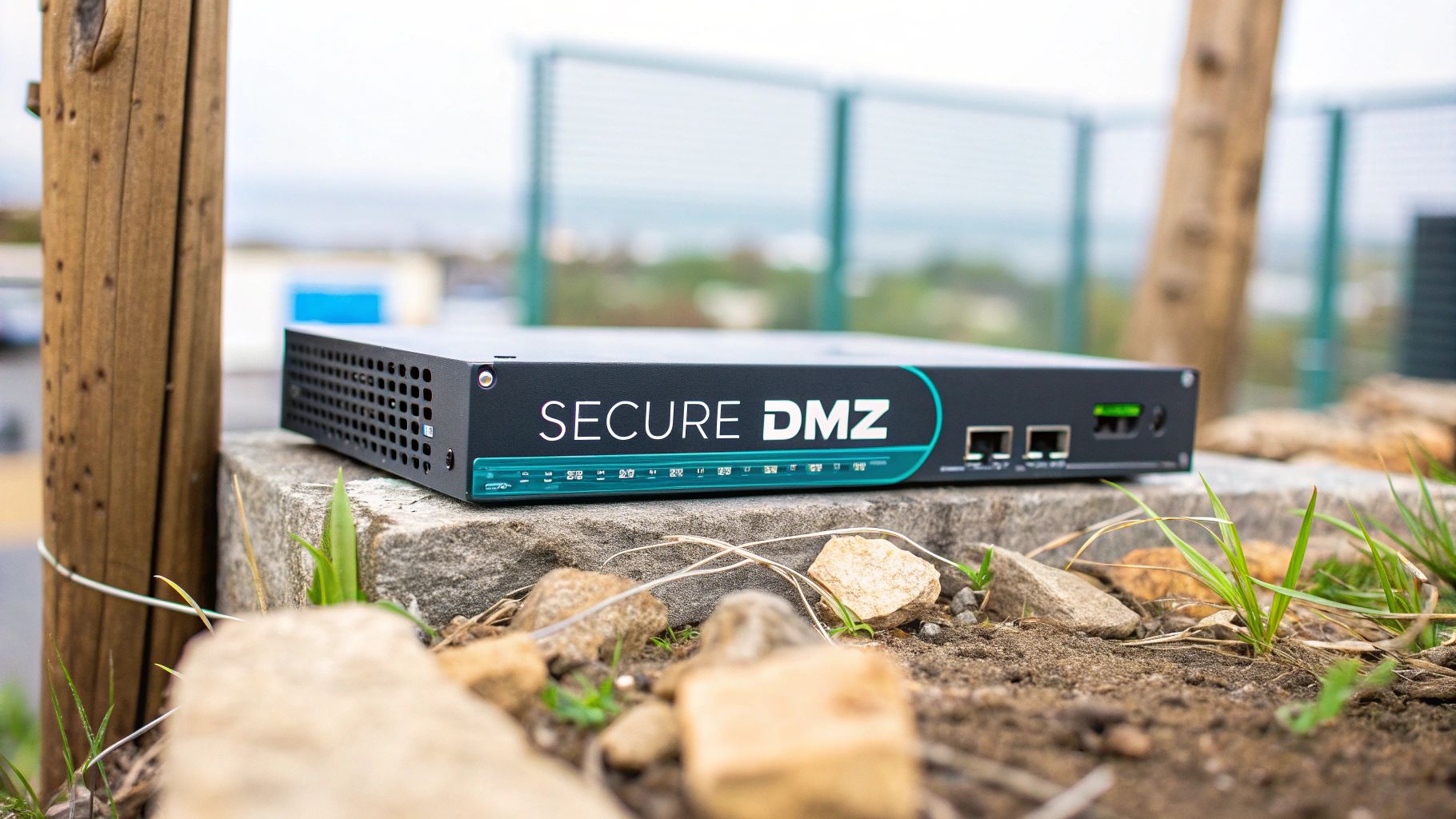
This setup is vital for protecting sensitive data. A software company can place its application servers in a DMZ to meet SOC 2 compliance requirements. A hospital can put its patient web portal in a DMZ to protect private health information, helping to satisfy HIPAA rules. It's a simple way to limit the damage from an attack.
Be strict about what goes in the DMZ. Only put services there that absolutely need to be public. Tightly control the traffic going from the DMZ to your internal network. Block everything by default and only allow what is absolutely necessary. Then, get it tested. Our affordable pentests can check your DMZ for weaknesses and deliver a report in under a week.
Separate Your Dev, Test, and Prod Environments
A core security practice is to create separate network zones for your development, testing, and production environments. This stops a bug in a new piece of code from crashing your live website. It creates a safe pipeline to build and test software without risking your real business operations.

This separation is a requirement for many compliance standards. PCI DSS, for example, demands that development and production networks are kept apart. For healthcare, it ensures that fake patient data used for testing never mixes with real patient data. A breach in a test environment should never become a path into your production systems.
Don't ever use real production data for testing. Always use fake or anonymized data. Restrict access so developers can't touch production systems unless they have a very good, temporary reason. The only way to know for sure that these zones are truly separate is to test them. We offer fast, affordable pentests that do just that, with a report in your hands in a week.
Isolate Guest and Third-Party Vendor Networks
Giving guests and vendors access to your network is often necessary, but it's risky. They could accidentally bring malware into your systems. The solution is to create a completely separate, isolated network just for them. This ensures their devices can never touch your important company servers.
This is a simple but powerful security win. A hospital can give a contractor Wi-Fi access without ever worrying about them getting near patient records. A retailer can give a supplier access to an inventory system without them getting anywhere near credit card data. It's a key control for compliance frameworks like HIPAA and PCI DSS.
Use a captive portal to make guests agree to your usage policy before they connect. Keep logs of who connects and what they do. This gives you an audit trail if something goes wrong. Most importantly, don't just assume the guest network is isolated. Our certified pentesters can quickly and affordably confirm it, providing a report in one week.
Validate Segmentation with Penetration Testing
Setting up network segments is great, but it's not a one-and-done job. You have to continuously check that your security rules are still working. Network configurations can change, and mistakes can happen. Regular penetration testing is the only way to be sure your segments are actually stopping attackers.
This is a hard requirement for compliance. PCI DSS requires regular pentesting to prove your credit card data environment is properly isolated. A SOC 2 audit needs proof that your security controls are working over time. Proactive testing lets you prove your security works, which is much better than just assuming it does.
When you hire pentesters, tell them to focus on breaking your segmentation rules. The goal is to see if a hacked computer in one zone can reach a critical server in another. Don't let high costs or slow timelines stop you from getting this proof. Our team of OSCP and CEH certified experts provides affordable pentests and delivers a detailed, audit-ready report in under a week.
Maintain Documentation and Change Management
A great network segmentation plan is useless if it's not written down and managed well. You need clear documentation and a formal process for any changes. This ensures every security rule has a clear purpose and owner. Without it, your network quickly becomes a confusing mess of old rules and security holes.
Good documentation is mandatory for most compliance audits. Auditors for SOC 2 and PCI DSS will ask to see your network diagrams and firewall rule lists. They want to confirm that you have a plan and are sticking to it. Keeping this information up-to-date makes audits smoother and shows you have a mature security program.
Use tools to create clear, version-controlled diagrams of your network. Keep all your security policies in one central place. Enforce a rule that no changes can be made to your firewall without proper review and approval. Then schedule regular reviews to make sure your documentation still matches reality. Finally, use a pentest to find any gaps between your documents and the real world.
Network Segmentation Best Practices — 10-Point Comparison
Zero Trust Network Architecture with microsegmentation is one of the strongest security approaches, but it is also one of the hardest to implement. It usually requires a full redesign of how a network is built and constant adjustments to security policies over time. This approach also requires a lot of resources such as identity and access management systems, segmentation tools, monitoring software, and experienced security staff. When implemented correctly, it greatly reduces lateral movement within a network and creates a strong compliance posture. This approach is most commonly used by large enterprises that handle sensitive data like healthcare records, payment information, or SOC 2 regulated systems. One major advantage of this method is that it enforces very strict least privilege access and provides strong evidence that can be used during audits.
Physical-to-logical segmentation mapping focuses on clearly connecting physical network components to logical security controls. This approach has a high level of complexity because it requires detailed mapping of systems and strong change control to make sure documentation stays accurate. The resources needed are more moderate and usually include inventory tools, network access control systems, and time spent on documentation. The outcome of this approach is clearer audit trails and easier compliance mapping. It is especially useful for organizations that need to show how their architecture directly supports their security controls. A key advantage is that it aligns the network design with business functions, which helps during audits.
Application-centric segmentation is focused on how applications communicate rather than where they are located on the network. This approach is difficult to implement because it requires understanding application dependencies and creating dynamic security policies. It often requires moderate to high resources such as application discovery tools, service meshes, and coordination between security and development teams. The main outcome is reduced risk between applications and better support for secure development practices. This approach works best for web applications, microservices, and SaaS or payment platforms. Its main advantage is that security follows how the application behaves, which allows faster onboarding of new applications.
Role-based access control combined with segmentation is built around assigning access based on job roles. This approach has moderate to high complexity because roles must be clearly defined and regularly reviewed. The resources required are moderate and usually include identity or privileged access management systems and review processes. This approach results in more granular access controls and reduces the risk of insider threats. It is most effective in organizations with clearly defined roles such as healthcare or financial institutions. A major advantage is that it simplifies onboarding and offboarding while still providing strong audit trails.
Data classification-driven segmentation focuses on protecting data based on its sensitivity. This approach has moderate complexity because organizations must create a classification program and make sure controls are enforced correctly. It usually requires moderate resources such as data discovery tools, data loss prevention systems, and employee training. The outcome is better protection for sensitive data and a smaller impact if a breach occurs. This approach is best suited for industries that handle sensitive data like payments, healthcare, and finance. Its main advantage is that security efforts are focused on the most important data.
DMZ and internet-facing segmentation is designed to protect internal systems from external threats. This approach has moderate complexity and focuses on designing secure boundaries and configuring monitoring tools. The resources needed usually include web application firewalls, intrusion detection or prevention systems, bastion hosts, and logging tools. The main outcome is reduced exposure of internal systems and clearer control of external traffic. This approach is ideal for organizations with internet-facing services such as e-commerce sites or public APIs. One key advantage is that it shields internal networks while making external audits easier.
Environment-based segmentation separates development, testing, and production systems. This approach has moderate complexity because it requires managing multiple environments and enforcing deployment controls. The resources required are also moderate and often include duplicate infrastructure, infrastructure-as-code tools, and environment-specific controls. While the security impact is not as high as other methods, it improves system stability and prevents development or testing issues from affecting production. This approach is commonly used in software development, fintech, and healthcare SaaS environments. Its main advantage is preventing development access from impacting production systems.
Guest network and third-party vendor segmentation focuses on limiting access for external users. This approach has low to moderate complexity and mainly involves onboarding processes and network access control policies. The resources required are relatively low and usually include captive portals, access control tools, and logging systems. The outcome is better protection of internal systems from contractors or guests. This approach is useful for organizations that work with vendors, auditors, or provide guest Wi-Fi access. A key advantage is allowing collaboration without exposing sensitive systems.
Segmentation combined with continuous validation and penetration testing focuses on proving that security controls actually work. This approach has high complexity because it requires constant testing, monitoring, and fixing weaknesses. It also requires high resources such as penetration testers, red teams, and automated security tools. The outcome is strong evidence that controls are effective and continuously improving. This approach is best suited for regulated environments that must demonstrate security effectiveness. Its main advantage is identifying gaps before they become serious security or compliance issues.
Documentation and change management support all segmentation strategies. This approach has moderate complexity and depends on consistent documentation and approval processes. The resources required are low to moderate and usually include diagramming tools, version control systems, and governance processes. The outcome is better audit readiness and fewer configuration mistakes. This approach is important for any organization with compliance requirements. Its main advantage is maintaining clear traceability and enabling faster response during incidents.
Ready to Prove Your Segmentation Works?
Building a strong network segmentation strategy is one of the best things you can do for your security. It turns a wide-open network into a series of secure compartments that trap attackers. We've covered the key ideas to make this happen, from big-picture thinking to daily security habits.
It all starts with a Zero Trust mindset, where you check everything and trust nothing. It continues by carefully mapping your hardware to your business needs. We then looked at how to build segments around your applications, user roles, and sensitive data. These network segmentation best practices are the real-world steps to a stronger defense.
From creating a safe DMZ to separating your test and live environments, each step adds a layer of protection. Isolating guest and vendor networks closes off easy entry points. Good documentation ensures your hard work doesn't fall apart over time. Together, these actions shrink your attack surface, contain breaches, and make audits easier.
A great segmentation plan is only as good as its weakest point. Without real-world testing, you're just guessing, and attackers and auditors love to exploit guesswork.
The goal isn't just to build segments, it's to be confident they work. You need to prove that a hacked laptop in one zone can't reach your critical database in another. You need to verify your firewall rules are doing their job. This validation is non-negotiable for real security and for passing audits like PCI DSS, HIPAA, and SOC 2.
The last and most important of the network segmentation best practices is constant validation. Regular, manual penetration testing is the only way to find the small mistakes that automated tools miss. It gives you the hard evidence you need to prove to everyone that your network is truly secure. Don't assume your segmentation works; prove it.
Implementing these practices is a huge step, but auditors and attackers don't care about theory. At Affordable Pentesting, our certified OSCP, CEH, and CREST pentesters provide fast, affordable, and manual penetration tests to validate your network segmentation controls. Get the actionable report and compliance evidence you need in just one week by filling out our contact form at Affordable Pentesting.