.svg)
Struggling with PCI DSS vulnerability scanning requirements? Traditional firms are slow, expensive, and deliver confusing reports. We provide affordable, manual pentesting from certified experts with reports in one week, so you can get compliant without the headache.
Understanding Your PCI DSS Scanning Duties
Meeting PCI DSS rules can feel like a huge burden. You need to check for security holes from both the outside (external scans) and the inside (internal scans). It sounds complicated, but the idea is simple: lock all your digital doors and windows.
Traditional security companies make this painful. They charge a lot, take months to send a report, and often find very little. We are the affordable alternative, delivering fast, clear results from certified professionals (OSCP, CEH, CREST).
External Scans Are Your Public Facing Checkup
Think of an external scan as checking your building from the street. It looks for unlocked doors or open windows that anyone could use to get in. These scans are mandatory and must be done quarterly by a special company called an Approved Scanning Vendor (ASV).
The ASV uses tools to check your website and servers for weaknesses a hacker could exploit. You must get a passing report from them every three months to stay compliant. Waiting weeks for this report from a slow vendor can put your entire compliance timeline at risk.
The rollout of PCI DSS 4.0's vulnerability scanning mandates packs a punch, with many changes becoming effective by March 31, 2025. E-commerce merchants on SAQ A, who were previously exempt, now need quarterly external scans by ASVs, creating a new challenge for thousands of small businesses. You can discover more about these PCI 4.0 changes and how they might affect you.
Internal Scans Check for Insider Threats
Internal scans are like checking for unlocked doors inside your building. They find security holes that could be used by someone already on your network, like a disgruntled employee or malware. These scans must also be done every quarter.
Failing to do both external and internal scans leaves you wide open to attack and guarantees you will fail your PCI audit. We provide fast, affordable manual pentesting to help you meet these requirements with reports in a week, not months. For a deeper look at this process, start with understanding vulnerability management.
Choosing Your ASV Partner for External Scans

Let's be clear: you absolutely must use an Approved Scanning Vendor (ASV) for your quarterly external scans. An ASV is a company officially certified by the PCI Council to test your internet-facing systems for security holes. Your internal IT team cannot do this for you.
Think of an ASV as the official inspector for your digital property. Picking the wrong one can trap you in a frustrating cycle of slow reports and confusing results. A good partner delivers clear, actionable reports quickly so you can fix things and get compliant.
Under the new PCI DSS 4.0 standards, the rules have tightened up a bit. Here is what you actually need to do to stay in the clear:
- Frequency: You need a passing scan at least once every 90 days (quarterly).
- The "Significant Change" Rule: If you install a new server, change your firewall, or upgrade your web app, you need to run a scan now, not just wait for the next quarter.
- The Passing Grade: To pass, you cannot have any vulnerabilities with a CVSS score of 4.0 or higher. In the world of security, that basically means anything rated "Medium," "High," or "Critical" has to be fixed.
- The 12-Month Rule: When it’s time for your annual assessment (or SOC2 audit), you need to show four consecutive quarters of passing reports. You can’t just run four scans in December and call it a year.
Meeting New Authenticated Internal Scan Rules
PCI DSS 4.0 now requires authenticated internal scans. This is a big change. Before, a scan was like looking at a computer from the outside. Now, the scan needs to log in with a username and password, just like an employee would.
This gives you a much deeper and more honest look at your security. It finds problems like missing software patches or weak settings that are invisible from the outside. This is the level of detail auditors expect to see, so you can't skip it.
PCI DSS version 4.0 dropped a bombshell on vulnerability scanning: Requirement 11.3.1.2 now mandates authenticated internal scans, with a hard deadline of March 31, 2025. These scans use credentials to log into systems, providing a far more comprehensive vulnerability sweep than ever before.
How We Help You Meet The PCI Pentest Requirement
This new rule can feel like a ton of extra work, especially for small IT teams. We are the affordable alternative built for speed. Our certified ethical hackers (OSCP, CEH, CREST) perform these scans and deliver a clear report within a week.
We show you exactly what to fix to meet the tough PCI DSS 4.0 rules without the high costs. Our guide on running an internal network pentest offers more context.
How to Remediate and Verify Vulnerabilities
Finding security holes is only the first step. For PCI DSS, you have to actually fix them. This process should be a simple cycle: find the problem, fix the problem, and then run another scan to prove it's fixed. This verification step is non-negotiable for an auditor.
The basic flow for an authenticated scan, which kicks off this remediation cycle, is straightforward. It moves from providing credentials to a detailed system scan, and finally to a report that tells you what to fix.
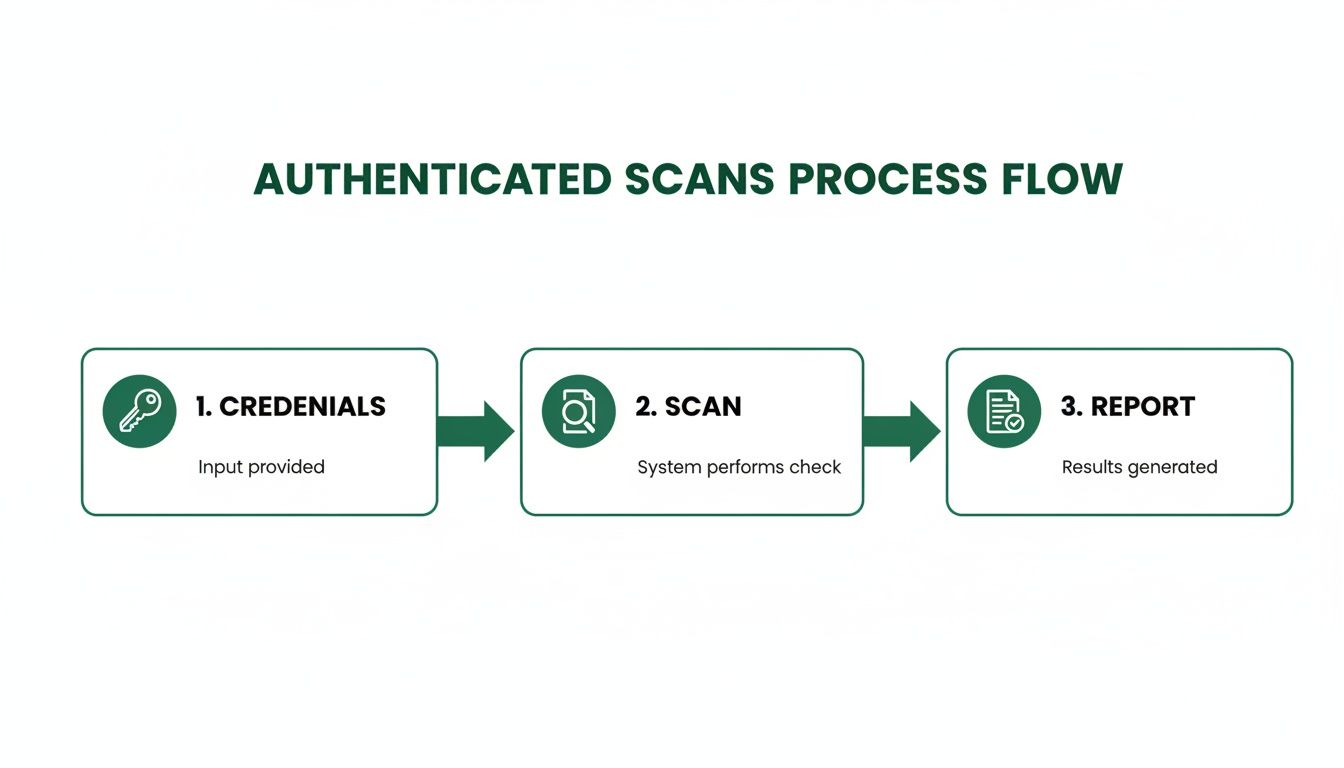
This process shows how structured input (credentials) leads to a detailed analysis (the scan) and results in an actionable output (the report) you need to get compliant.
Getting Fast Verification Without The High Cost
With old-school pentesting firms, this fix-and-verify loop is slow and expensive. You wait weeks for a report, then wait again for a re-test, all while paying extra fees. That’s a huge problem for startups and lean teams on a deadline.
We break this cycle. Our reports arrive within a week with clear instructions. A re-test is included in our affordable packages, so you can confirm your fixes and get a passing report without delays or surprise costs. See our guide on the vulnerability management process steps for more details.
Creating Your Audit Ready Compliance Reports
Your PCI compliance is only as good as the reports you show an auditor. If you can't prove you did the scans and fixed the problems, it's like it never happened. You need a clear paper trail for everything.
For external scans, you must have a passing report from your ASV for each quarter. If a scan fails, you also need to show the passing rescan report that proves you fixed the issues. For internal scans, you need to document the entire process yourself, including when scans were run and how you fixed each finding.
How Our Reports Make Your Audits Easier
Traditional security reports are often dense and confusing. We do things differently. Our reports are designed for clarity and action, making them easy for your team to understand and perfect for auditors.
Our reports are built to satisfy auditors for multiple frameworks, including PCI DSS, SOC 2, and ISO 27001. Our certified pentesters (OSCP, CEH, CREST) deliver these audit-ready reports within a week. If you're ready for a faster, more affordable path to compliance, fill out our contact form to get started.
Skip the High Costs of Your PCI Compliance
Meeting PCI DSS vulnerability scanning rules often feels like a choice between two bad options. You can pay a fortune to a big, slow security firm, or you can try to do it yourself and risk failing your audit. We offer a better way.
We are the affordable alternative for businesses that need to get compliant quickly without breaking the bank. Our OSCP, CEH, and CREST certified pentesters deliver clear reports within a week. We provide real expertise focused on finding the vulnerabilities that actually matter for your audit.
A Clear Path to Passing Your PCI Audit
Our job isn't just to find problems; it's to help you fix them. We provide straightforward guidance your team can actually use. Plus, every pentesting package includes a re-test at no extra charge to verify your fixes.
Stop overpaying for compliance reports that are slow and confusing. Our goal is to give you a clear, fast, and affordable path to acing your PCI audit. If you're tired of high prices and slow service, let's talk. Reach out through our contact form.
Common Questions About PCI Vulnerability Scanning
Getting PCI compliant can feel confusing, so let's answer the most common questions in simple terms. This will help you understand exactly what you need to do to protect your business and pass your audit.
What is the difference between scans?
Think of your network like a house. An external scan checks for unlocked doors from the outside, like a hacker on the internet would. An internal scan checks for weaknesses from the inside, like someone who already has access to your office Wi-Fi.
How often do we need these scans?
The rule is simple: you need both internal and external scans at least once every quarter (every 90 days). You also need to run a new scan after any big change to your network, like adding a new server or changing firewall rules.
What happens if we fail a PCI scan?
Don't panic, it's common. A failed scan is just a to-do list. Your report will show you what to fix, starting with the most critical issues. After your team fixes them, you must run a rescan to get a clean report that proves the problems are gone.
Can our team just run the internal scans?
Yes, you can run your own internal scans, but the person doing it must be qualified. For external scans, you have no choice—you must use an official Approved Scanning Vendor (ASV). Using a certified third party for both looks much better to an auditor because it provides an unbiased expert opinion.
At Affordable Pentesting, we deliver the expert assessments you need to satisfy every PCI DSS scanning requirement, without the enterprise price tag or long wait times. Our certified ethical hackers provide clear, actionable, and audit-ready reports within a week. Get the testing you need by visiting https://www.affordablepentesting.com and filling out our contact form.