.svg)

Let's be honest, finding a good pentest vendor is frustrating. The old way of doing penetration testing is broken. It's painfully slow, shockingly expensive, and often leaves you with a useless report right before a big audit.
You need a partner who gets it. You can't wait months for results or pay enterprise prices for a straightforward pen test. This guide will show you how to find a team that delivers affordable manual pentests from certified experts and gets you an audit-ready report in under a week.
Why Traditional Pentesting Is Broken
Your search for a new pentest vendor likely started with a bad experience. Maybe your last test took three months and found nothing useful. Or perhaps you're a startup founder who just needs a quick, affordable penetration test to satisfy a customer or a SOC 2 deadline.
Traditional vendors are slow and expensive. They operate on timelines that feel completely disconnected from the real world. A critical flaw could be actively exploited while you’re stuck waiting for a piece of paper, and that’s a massive risk for your business.

How To Define Your Pentest Scope
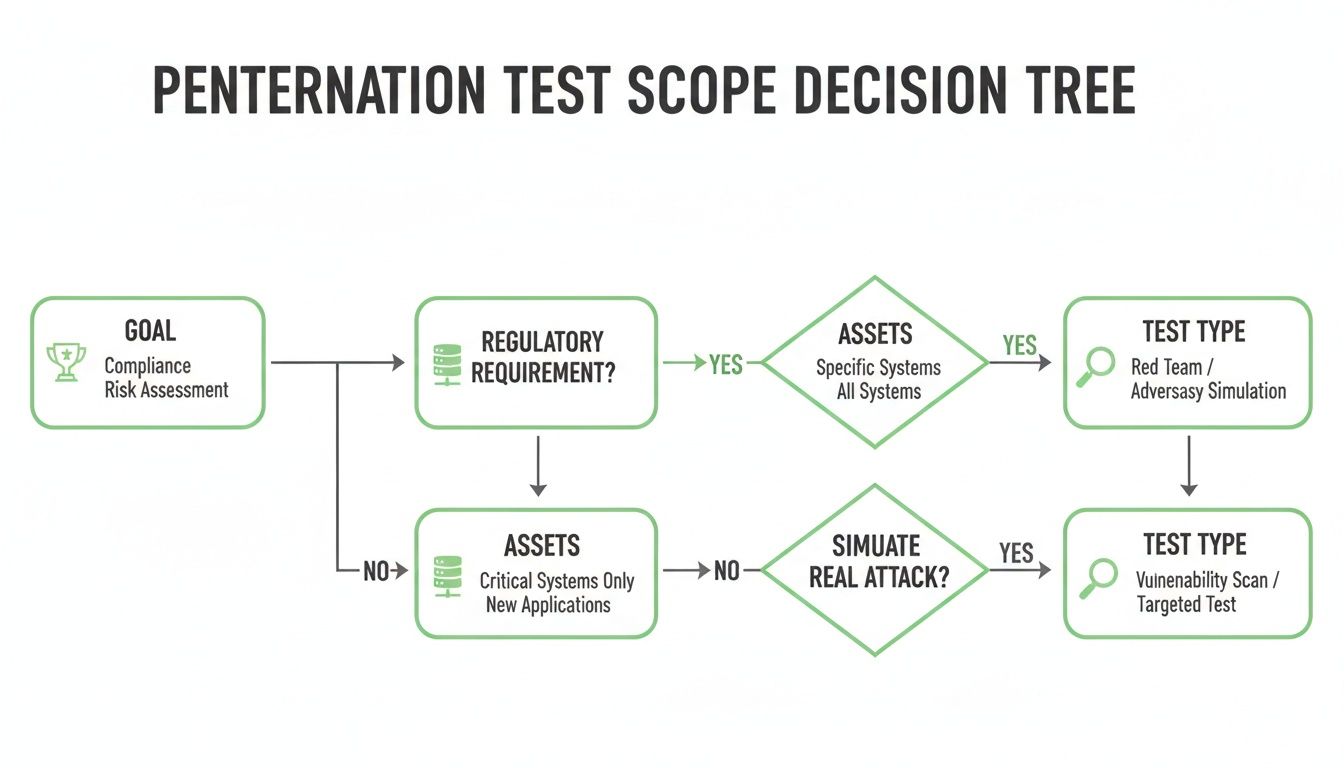
Before you even talk to a vendor, you need to answer one question: what exactly are we testing? Defining your scope is the most important step in getting a fair price and a useful report. A vague scope leads to surprise costs and wasted time.
Think of it like building a house. You wouldn't ask a contractor for a quote without a blueprint. In penetration testing, your scope is that blueprint. It tells the pentesters exactly what they should be trying to break into.
Identify and List All Your Assets
Once you know your goal, list the specific assets you want tested. Don't just say "our website." Get specific. This list becomes the core of your request to any potential pen testing vendor, making sure you get an accurate and affordable quote.
A good asset list includes details like URLs, login credentials for different user roles, and API documentation using tools like Swagger or Postman. The more detail you provide upfront, the more accurate your quote will be. This prevents a vendor from guessing and saves you from paying for testing you don't need.
Match Your Scope To Compliance Needs
Compliance is a huge driver for pen testing. If you need a pentest for an audit like SOC 2, PCI DSS, or HIPAA, your scope isn't a suggestion—it's a requirement. You have to ensure the test covers every single system and application that falls under that regulation.
For example, PCI DSS demands that any part of your network that processes or stores cardholder data gets tested. Miss one component, and you could fail your audit. Always confirm the exact scope with your compliance team before you engage a pentest vendor. For a deeper look, check our guide on how to prepare for your first pentest.
How to Evaluate a Pentest Vendor
Not all penetration testing services are the same. A big firm might charge a fortune, only to have a junior analyst run an automated scanner. If you want to avoid that trap, you need a clear checklist to find a reliable partner that delivers an affordable and thorough security assessment.
The global penetration testing market is exploding because companies need to secure assets for compliance like SOC 2 and PCI DSS. This demand is for expert hackers who find complex flaws that automated tools miss. You can read the full research on the penetration testing market to see these trends for yourself.
Verify Your Pentesters Are Certified
The first question you should ask any potential pentest vendor is about their team's certifications. These prove that the ethical hackers testing your systems have real, hands-on skills. A certification means the pentester has passed a tough, practical exam.
Look for these specific certifications: OSCP, CEH, and CREST. The OSCP (Offensive Security Certified Professional) is the top tier, requiring a 24-hour live hacking exam. If a vendor is cagey about their team's certifications, it's a major red flag.
Demand a Focus on Manual Testing
Next, dig into their methodology. Ask them straight up: "Do you perform manual penetration testing?" This is a critical question. Many low-cost providers just run an automated vulnerability scanner and rebrand the output as a pen test report.
Automated scanners can't find complex business logic flaws. You need a skilled human pentester for that. A true pen test should be 80% manual effort, not the other way around. Don't be afraid to press for details, as we explain in our guide on automated vs manual pen testing.
Always Ask For a Sample Report
Finally, always ask for a sample report. The final report is the single most important thing you get from a penetration test. A great report is your roadmap to getting more secure; a bad one is just a waste of money.
A quality report is clear, actionable, and prioritizes findings so your team knows what to fix first. If a vendor's sample report is a 100-page document full of jargon, keep looking. You can see what a good one looks like in our article on what makes a great penetration testing report.
Spot Red Flags in a Pentest Vendor
Picking the wrong pentest vendor is an expensive mistake. It can lead to a false sense of security, failed audits, and a lot of wasted time and money. You need a transparent partner focused on actually improving your security, not just checking a box.
Knowing the red flags will save you from a bad investment. Watch out for prices that are too good to be true, vague methodologies, and vendors who refuse to share sample reports. These are signs of a low-quality provider who will likely just run an automated scan.

Why Low Prices Are A Big Problem
If a quote for a penetration test looks unbelievably cheap, it probably is. An extremely low price is the single biggest red flag. It’s a near-certainty that the vendor is just running an automated vulnerability scanner, something you could do yourself.
A proper, manual pentest involves hours of focused work by a skilled, certified professional. You're paying for their expertise to simulate a real-world attack. A rock-bottom price means they are skipping the manual testing part entirely, which scanners always miss.
Get Your Report in a Week
Just as important as price is the timeline. Old-school firms are notorious for their sluggish processes, often taking weeks or even months to deliver your final report. In security, that kind of delay is a massive problem.
A modern, efficient pentest vendor should deliver a detailed, actionable report within one week of finishing the hands-on testing. Speed matters, and you should demand it. You can learn more about penetration testing market trends and see why this is so important.
Your Pentesting Questions Answered
Choosing a pentest vendor can be confusing. Let's cut through the noise. Here are the straight-up answers to the questions we hear every day from founders, IT managers, and compliance officers trying to get a project done.
A vulnerability scan is an automated checklist, while a penetration test is a manual attack simulation by a certified ethical hacker. For compliance audits like SOC 2, a manual pentest is almost always required. A scan tells you a door might be unlocked; a pen test tries to open it.
What is the difference between a vulnerability scan and a pen test?
Think of a vulnerability scan like an automated checklist. It finds known weaknesses and gives you a list of potential problems. It's fast, but it's not very smart.
A penetration test is completely different. A certified ethical hacker manually simulates a real-world attack. They don't just find weaknesses; they exploit them to see how far they can get. A scan gives you a list of maybes, while a manual pentest confirms which vulnerabilities are a real risk.
How much should a quality pen test cost?
The cost always comes down to the scope, but you shouldn't have to pay massive enterprise rates for a high-quality manual penetration test. A focused web app pentest for a startup or SMB should be affordable and predictable.
Always insist on a fixed-price quote based on a clearly defined scope. This protects you from surprise fees and ensures you know exactly what you’re paying for. To get a better sense of why this is so critical, check out these 5 Reasons Your Business Can Benefit Of Penetration Testing.
How long does a typical penetration test take?
The hands-on hacking part usually takes a few days to a week. But the most important part is how quickly you get the report. A modern, efficient pentesting partner should deliver a complete, actionable report within one week of finishing the test.
Anything longer is a major red flag. It signals an inefficient process that doesn't respect your deadlines for things like SOC 2 or other compliance audits. You can find more details in this list of the 7 Top Penetration Testing Companies.
Ready for a pentest that’s fast, affordable, and audit-ready? We deliver manual penetration testing from certified experts with reports in under a week. Get a quote today and see how simple security can be.