.svg)
A cybersecurity risk assessment is a simple checkup for your company's digital health. It’s a process to find, analyze, and handle online threats before they cause a real disaster. Think of it not as an IT chore, but as a business plan to protect your money, data, and reputation.
Why a Risk Assessment is Your Best First Move
Let’s skip the jargon. Imagine your business is a house. A risk assessment is like hiring a pro to check every door, window, and alarm. You need to know where your valuable stuff is and who might try to steal it.
This process helps IT managers and startup founders invest smartly. You’ll know whether you need stronger locks or a better camera system instead of just guessing where the next threat will come from.
This proactive approach is the difference between reacting to a break-in and preventing one from happening in the first place. It gives you a clear roadmap showing exactly what to protect and why.
Move from Guesswork to a Clear Security Strategy
Without a proper assessment, security spending is often based on fear or scary headlines. You might buy expensive software you don't need while leaving a critical database wide open. A risk assessment replaces that guesswork with a logical, data-driven strategy.
It helps you answer the big questions. What are our most important digital assets? What are the worst things that could happen to them? Where are our biggest weak spots right now? This clarity lets you put your budget where it will have the biggest impact.
Meet Compliance Rules and Build Customer Trust
A cybersecurity risk assessment is often the first step for meeting compliance standards like SOC 2, PCI DSS, and HIPAA. Auditors want proof that you understand your specific risks and have a plan to manage them. A documented assessment is that proof.
This process also builds trust with customers, partners, and investors. It shows you take security seriously, which is a huge competitive advantage. After your assessment, the next step is a penetration test to see if your defenses actually work.
Follow These Four Core Risk Assessment Steps
Every good cybersecurity risk assessment follows a simple four-step process. It's not a complicated audit. It’s a game plan to protect your business by knowing what you have, figuring out what could go wrong, and deciding what to fix first.
This cycle helps you find, analyze, and handle threats before they cause real damage.
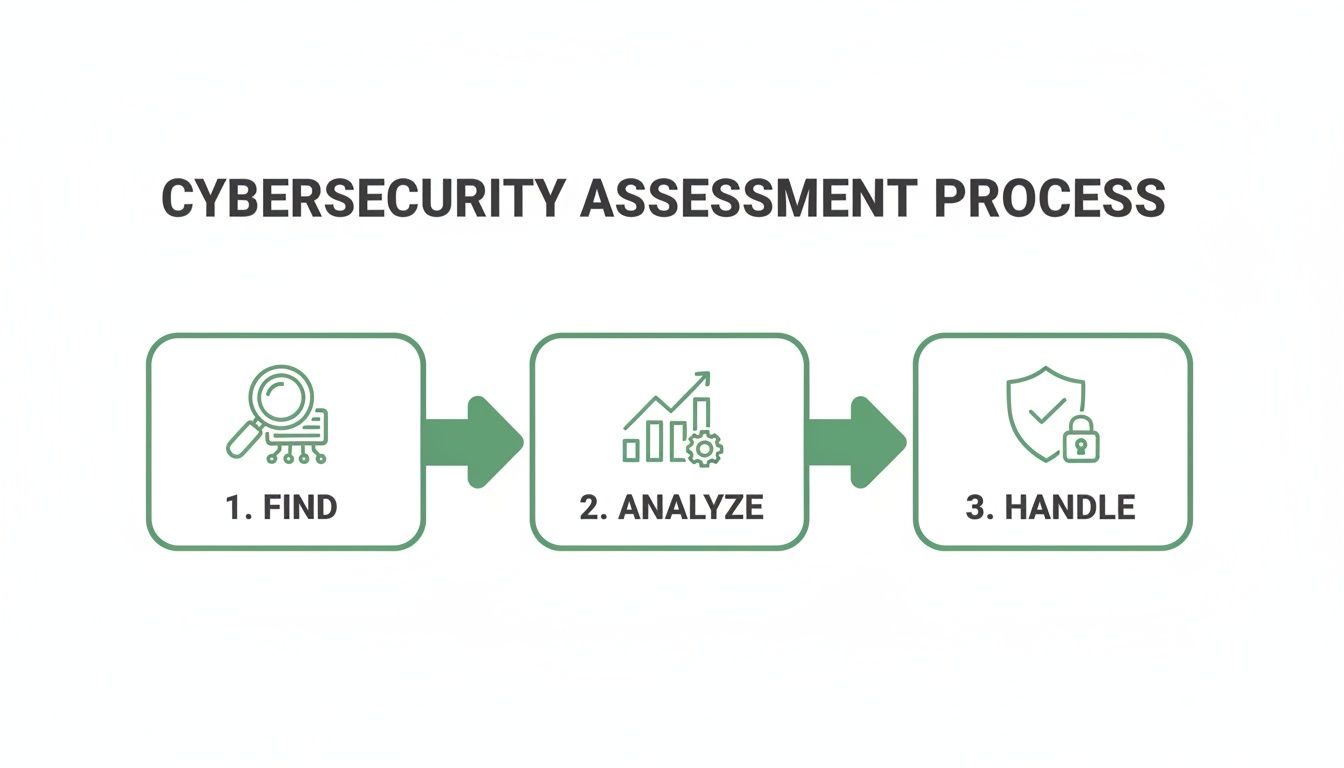
This loop of finding, analyzing, and handling risks is the foundation of any strong security program. It’s a continuous process, not a one-time task.
Step 1 Identify Your Most Important Assets
You can't protect what you don't know you have. The first move is to list everything valuable to your business, especially the data that keeps your company running.
Your asset list should include customer data like names and payment details, your company's secret sauce like source code, and the critical apps that would stop your business if they went down. This inventory becomes your map, showing you what to protect.
Step 2 Figure Out All the Potential Threats
Now that you know what you're protecting, brainstorm all the bad things that could happen to those assets. A threat is anything that could harm your company by exploiting a weakness. Think like a hacker for a minute.
Threats come from everywhere. They include external hackers trying to steal passwords, an unhappy employee misusing their access, or even a simple server crash. Listing these potential problems helps you start planning for them.
Step 3 Find All of Your Security Weaknesses
This is where you find the gaps in your defenses. A vulnerability is a specific weakness that a threat could exploit, like an unlocked window. Finding these is the most important part of a cybersecurity risk assessment.
Automated scanners can find common issues, but they miss the complex flaws that a human attacker would find. This is where an affordable manual penetration test provides incredible value. A certified OSCP, CEH, or CREST professional actively tries to break into your systems, just like a real hacker would.
Step 4 Prioritize the Biggest Risks to Fix First
Finally, you bring it all together. Risk is what happens when a threat meets a vulnerability. You need to figure out which problems pose the biggest danger so you can prioritize your time and budget.
For example, a flaw in your customer database that could be hit by ransomware is a high-priority risk. The financial and reputation damage would be huge. This final step turns your findings into an action plan, especially with a clear report from an affordable penetration testing service in your hands within a week.
Make Sense of Common Security Frameworks
Security frameworks are just blueprints for building a strong defense. Instead of guessing what to do, you follow a structured path that others have used to protect their businesses and meet compliance goals.
These frameworks provide a step-by-step guide that helps any organization, including startups, make smart security decisions. Following a framework shows auditors and customers that you have a mature security program.
This structured approach is how you turn a cybersecurity risk assessment into a security plan that actually works.
The NIST Cybersecurity Framework Explained Simply
The NIST Cybersecurity Framework is a popular blueprint in the U.S. It's a flexible, common-sense guide to help you manage and reduce risk, not a strict set of rules.
The framework is built around five simple functions: Identify, Protect, Detect, Respond, and Recover. Part of the "Protect" and "Detect" steps involves actively testing your defenses. This is where a manual pen test becomes essential, giving you real proof that you are actively hunting for weaknesses.
Understanding the ISO 27001 Global Standard
While NIST is big in the U.S., ISO 27001 is the top international standard for information security. Think of it as a global seal of approval that shows customers you have a formal, well-managed security program. When making sense of common security frameworks that guide data sanitization, an authoritative resource is the NIST SP 800-88.
Meeting ISO 27001 requires regular vulnerability assessments and penetration testing. You have to prove you are consistently testing your security controls. An affordable penetration testing service, with reports delivered within a week, helps you meet these demands without breaking your budget. Our expert pentesters hold key certifications like OSCP, CEH, and CREST, ensuring your pen testing meets global standards. Learn more in our guide on the cybersecurity risk management framework.
Quick Glance at Key Risk Assessment Frameworks
Each framework offers a different way to view risk, but they all help you make smarter, more defensible security decisions.
How Risk Assessments Drive Your Compliance Goals
Compliance frameworks like SOC 2, PCI DSS, and HIPAA can feel like a maze of rules. But at their core is a simple truth: you can't protect what you don't understand. A cybersecurity risk assessment is the map you need to navigate compliance and prove your security is solid.
Think of it this way: compliance is about managing risk, not just checking boxes. You can't meet your goals until you identify, analyze, and prioritize your unique security threats. This process gives you the logic behind every security control, turning a painful audit into a real security upgrade.
Connect Your Risks to Specific Compliance Rules
Each compliance standard has its own focus, but they all start with risk. A cybersecurity risk assessment translates vague requirements into concrete actions that auditors will respect.
For SOC 2, it's about handling customer data securely. For PCI DSS, it's about protecting credit card information. For HIPAA, it’s about safeguarding patient health information. In every case, the assessment is your roadmap to building a security program that is both logical and defensible.
Prove Your Defenses with a Penetration Test
Auditors want proof that your security controls actually work. A penetration test is your most powerful asset here. A professional pen test report is hard evidence that you've tested your defenses against real-world attacks.
When a certified ethical hacker with credentials like OSCP, CEH, or CREST simulates an attack, their report proves you are proactively hunting for weaknesses. This isn't just a good idea; it's often a requirement. For example, PCI DSS Requirement 11.3 demands regular penetration testing.
Manage Risks from Your Vendors and Partners
Your compliance duties don't stop at your own company. Auditors for frameworks like SOC 2 are looking at how you manage risks from vendors. With nearly a quarter of organizations suffering incidents caused by their partners, you can't afford to ignore it. You can see more vendor risk statistics on c-risk.com.
A full cybersecurity risk assessment must include your key vendors. A pen test on third-party integrations can uncover hidden flaws. This shows auditors you have a mature understanding of your entire security ecosystem. We cover this in our guide to third-party risk assessment.
Turn Your Assessment Into Actionable Next Steps
A risk assessment report is just a document until you use it. The point is to create a clear to-do list that helps you fix the biggest problems first. This is where you make your security better in the real world.
Your report will likely have a long list of findings. Don't get overwhelmed. Sort them by risk score and focus on what's both likely to happen and would cause the most damage. This is how you focus your team’s energy where it matters most.

From Theory to Reality with Penetration Testing
After you have a prioritized list, the next step is a penetration test. A risk assessment tells you where an attacker might strike, but a pen test shows you exactly how they would do it. It moves you from "what if" to "here's how we got in."
This hands-on test is the best way to confirm your assessment's findings. A pen testing report gives you undeniable proof of your security gaps, which is much more powerful than a list of "potential" issues from a scanner.
Why an Affordable Manual Pentest is So Important
You don't need to spend a fortune to get great results. An affordable manual pen test is the smart choice for startups and small businesses. You get actionable findings from a certified expert without the massive price tag.
Look for a pentesting partner that provides certified professionals with OSCP, CEH, or CREST certifications. They should use manual expertise to find flaws automated tools miss, and deliver a clear report within a week. This mix of affordability, expertise, and speed helps you fix things fast. To help organize everything, you can also use our free cybersecurity risk assessment template.
Turn Your Findings Into a Real Defense Strategy
The goal of a penetration test isn't to get a perfect score. It's to find your weaknesses before a real attacker does. Every finding is a chance to make your organization stronger.
By validating your risk assessment with a fast, affordable, and thorough penetration test, you create a powerful security loop. You identify risks, prove they exist, fix them, and then test again. This cycle is the foundation of a security program that actually protects your business.
Your Common Questions About Risk Assessments
Have questions? We've got answers. Here are some of the most common things IT managers and startup founders ask about the risk assessment process.
How Often Should We Run a Risk Assessment?
A good rule of thumb is to run a full cybersecurity risk assessment at least once a year. But you also need to run a new one after any major business change, like launching a new product or moving to the cloud. For compliance frameworks like PCI DSS, annual assessments and pen testing are required.
What is the Difference Between an Assessment and a Pen Test?
A risk assessment is the high-level strategy, while a penetration test is the real-world attack simulation. The assessment identifies what's important and what could go wrong. A pen test is where an ethical hacker actively tries to break in to exploit those weaknesses. An assessment says a window might be unlocked; a pen test confirms they climbed through it.
Can We Just Do a Risk Assessment Ourselves?
You can definitely start the process internally, especially with identifying your assets. Your team knows your business best. But when it comes to finding vulnerabilities, you need an outside expert. Your team has blind spots and won't think like an attacker. A professional penetration tester with certifications like OSCP brings a fresh, adversarial mindset.
Why Should We Bother with a Manual Pentest?
Automated scanners only find the obvious, low-hanging fruit. They can't think or understand business context. A manual penetration test, done by a certified ethical hacker, finds the complex flaws that automated tools always miss. These are the vulnerabilities that matter most. An affordable manual pen testing service gives you expert insights without the high price, with a clear report delivered in a week.
Ready to see if your risk assessment holds up against a real-world attack? At Affordable Pentesting, we deliver fast, thorough, and affordable manual penetration tests with reports from certified experts in days, not weeks. Get the proof you need to satisfy auditors and secure your business. Get in touch with us through our contact form today to learn more.