.svg)
Think of an internal penetration test as an authorized ethical hacker checking your security from the inside. While external tests check your digital doors and windows from the street, an internal pen test simulates what a disgruntled employee or an attacker who already slipped past your defenses could do.
The goal is simple: find dangerous weak spots inside your network before a real attacker does. It's a security check-up that shows you what a hacker with insider access could actually steal or break.
What Is An Internal Pen Test Exactly?
An internal penetration test is a security assessment that starts from inside your company’s network. The whole point is to see what a malicious actor could accomplish if they already had a foothold, like access to an employee's laptop or a guest Wi-Fi connection.
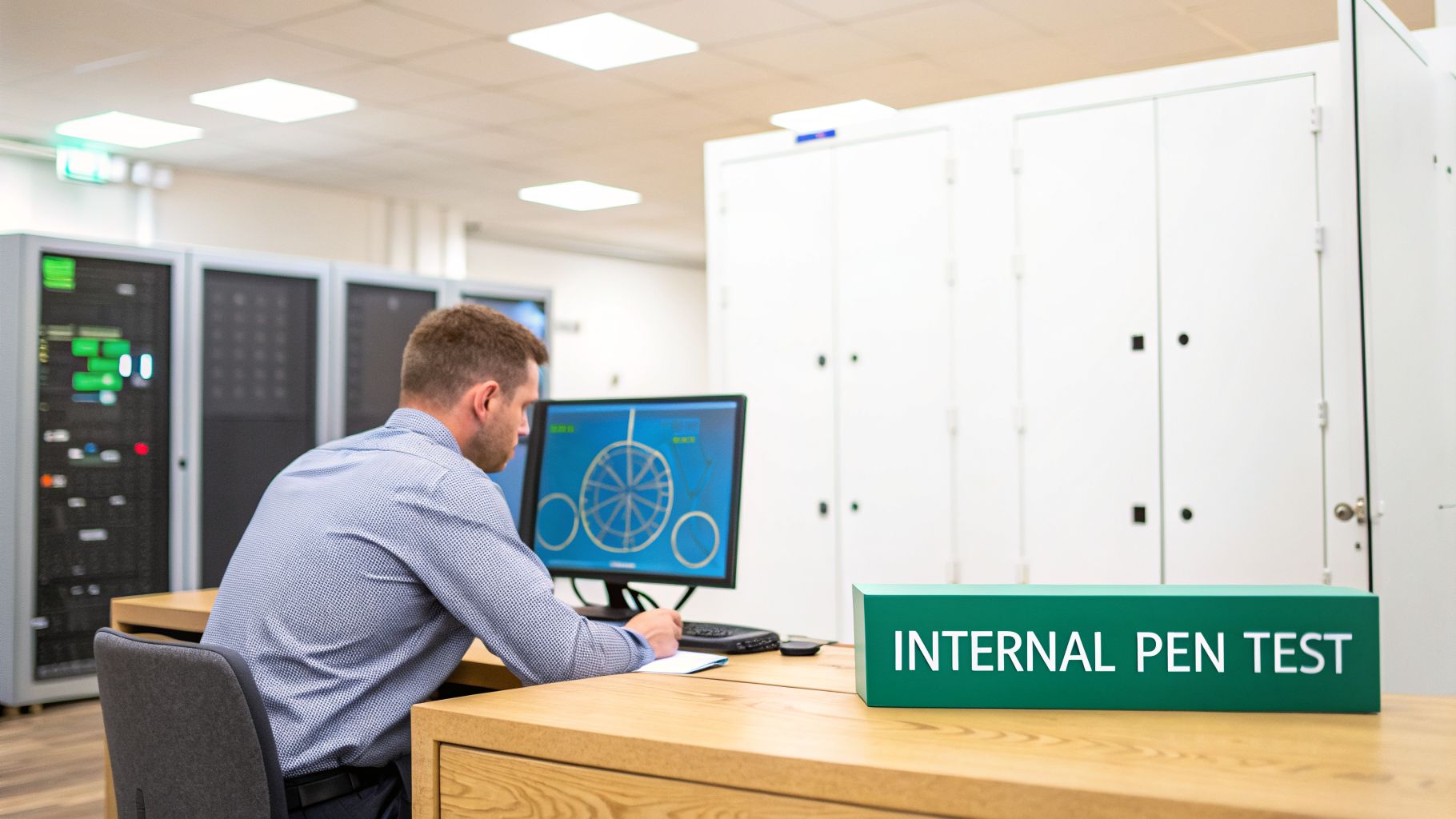
Unlike external tests that only see your public-facing defenses, an internal pen test reveals vulnerabilities that are invisible from the outside. It answers the critical question: "If someone gets in, how much damage can they actually do?" This is the exact proof auditors and clients want to see.
Finding Flaws Where Automated Scanners Cannot
Automated tools are okay for finding obvious issues, but they completely miss the complex flaws that lead to major breaches. Our manual approach, led by certified OSCP, CEH, and CREST professionals, goes much deeper. We think like real attackers to uncover issues that matter.
A proper internal pen test is the ultimate stress test for your security. It doesn't just look for problems; it actively tries to exploit them to show you the real-world risk in a safe, controlled way. This hands-on approach is what separates a meaningful penetration test from a basic vulnerability scan.
How Internal and External Pen Tests Differ
To put it simply, here’s a quick breakdown of how these two critical tests differ. An internal pen test simulates an insider threat, while an external one simulates an outside attacker. For a deeper dive, check out our guide on internal vs external penetration testing.
While both are essential, the internal pen test often reveals shocking vulnerabilities because it assumes the perimeter has already been breached. This is a scenario that's becoming more common every day.
A Critical Step for Security and Compliance
For businesses that handle sensitive data, internal pen testing isn't just a good practice, it's often a requirement. Compliance frameworks like SOC 2, HIPAA, and PCI DSS demand that you prove your internal network is secure against insider threats.
Our affordable pen test helps you meet these strict compliance mandates without the high costs and long waits of traditional security firms. We provide the clear, actionable findings you need to fix what matters most, fast.
Why Your Business Needs An Internal Pen Test
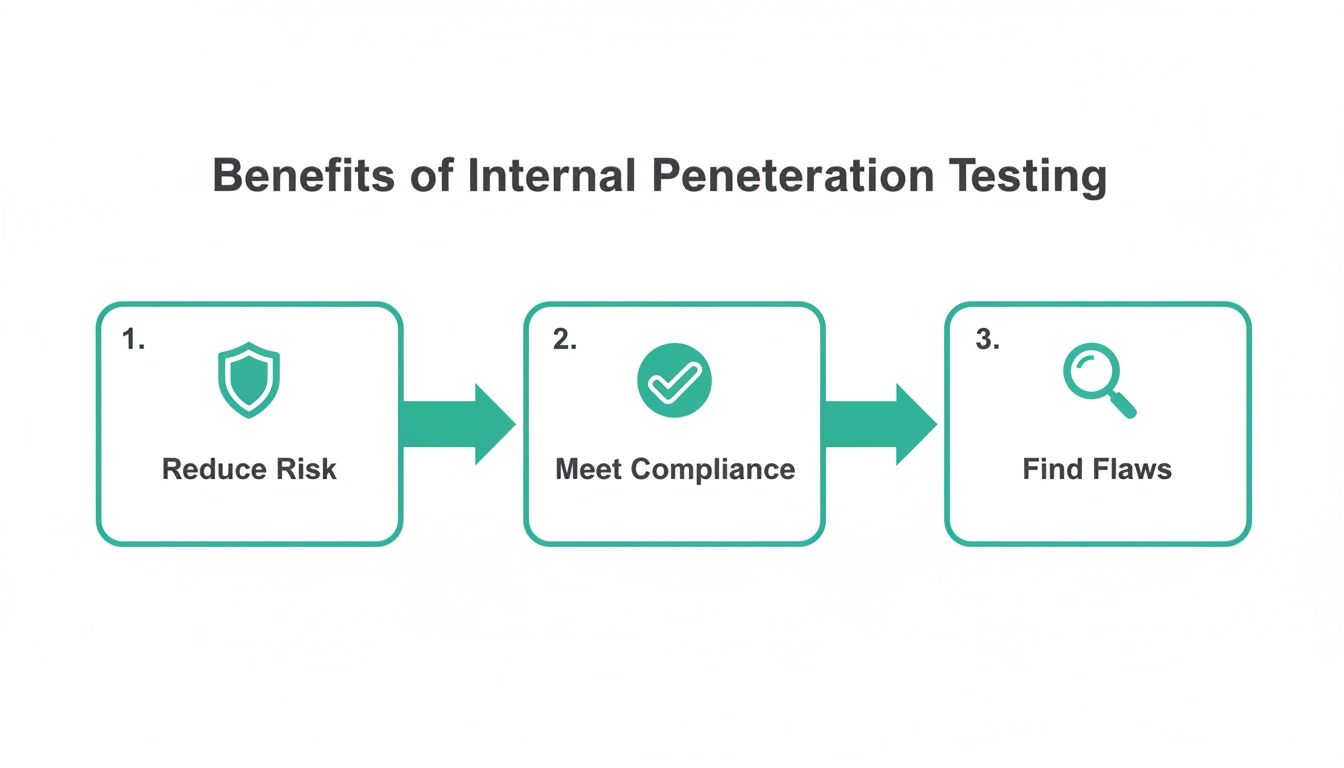
An internal pen test is much more than a box-ticking exercise for compliance. It’s a critical tool for cutting down real-world business risk. For IT managers and founders, it delivers clear, actionable insights into your security from an attacker's point of view.
Many businesses focus all their energy on external defenses, like a castle with high walls. But they often neglect the dangers that come from within. An internal penetration test assumes an attacker has already bypassed the perimeter and shows what they could actually accomplish.
Go Beyond Scans and Find Real Flaws
Automated scanners only scratch the surface. They’re designed to find common vulnerabilities but almost always miss the unique business logic flaws or complex misconfigurations that lead to serious breaches. A manual penetration test performed by a certified expert is completely different.
Our OSCP, CEH, and CREST certified pentesters think just like attackers. They chain together multiple low-risk vulnerabilities to create a high-impact security event, the same way a real adversary would. This manual approach is essential for discovering critical issues that scanners overlook.
Satisfy Compliance Mandates With Confidence
Meeting strict compliance standards is non-negotiable for many businesses, and an internal pen test is often a core requirement. Frameworks like SOC 2, HIPAA, and PCI DSS demand that organizations prove they are securing their systems from the inside out.
Our affordable pentesting services provide the detailed evidence auditors need to see. We deliver a comprehensive report in about a week, helping you nail your compliance requirements quickly and without the massive costs of traditional security firms.
How Our Fast And Affordable Pentesting Works
We get it. You need a thorough internal penetration test, but you don't have months to wait or a huge budget. Traditional security firms love to drag out the process and deliver confusing reports. Our approach is different: fast, clear, and effective, with an actionable report in about a week.
Our entire process is built around efficiency and clarity. We skip the unnecessary overhead and focus on what matters most: finding and fixing the real-world vulnerabilities inside your network. This means you get the security insights you need to protect your business without the usual frustration.
Our Simple Four-Phase Pentest Methodology
Our expert pentesters, all holding certifications like OSCP, CEH, and CREST, follow a proven methodology to ensure nothing is missed. Think of it as a strategic mission to find weak spots before an attacker does. We combine automated tools with deep manual testing to uncover what scanners miss.
- 1. Reconnaissance: We start by mapping out your internal network. This is like creating a blueprint of a building to understand the landscape.
- 2. Vulnerability Scanning: Next, we use specialized tools for an initial scan. This helps us identify known vulnerabilities to guide our manual pen test.
- 3. Manual Exploitation: This is where our expertise shines. Our team manually tries to exploit the weaknesses we've found, just like a real attacker.
- 4. Post-Exploitation: Once we gain a foothold, we see how far we can go. This phase demonstrates the true business impact of a vulnerability.
A Pen Test Report You Can Actually Understand
The final step is delivering your report. Forget those 100-page documents filled with technical jargon. Our reports are written for humans. We clearly detail what we found, how we found it, and provide straightforward, prioritized recommendations on how to fix everything.
We deliver this report in about a week from the start of the pen test. Our goal is to empower you to take action immediately. If you're ready to see how simple a penetration test can be, reach out through our contact form.
Common Vulnerabilities We Find Inside Your Network
During our internal penetration tests, we see the same critical security flaws pop up again and again. These aren't just theoretical risks; they're real-world gaps our certified pentesters find every day that leave businesses wide open.

The problems are often simpler than you'd think. It usually comes down to weak passwords, missing security patches, and basic network misconfigurations. Individually, they're small oversights. Together, they create massive security holes.
Missing Patches and Outdated Software Flaws
One of the most dangerous vulnerabilities we find is unpatched software. The moment a security update is released, attackers have a roadmap to target any company that hasn't applied the patch yet. It gives them a guaranteed way in.
This isn't just about your servers. We often find outdated software on employee workstations, printers, and other forgotten devices. A single unpatched laptop can be all an attacker needs to get a foothold and move across your entire network.
Weak and Reused Passwords Create Risk
You’d be shocked how often "Password123" is the key to the entire kingdom. Weak, default, or reused passwords are a huge problem. Our team of OSCP, CEH, and CREST certified experts are pros at finding and cracking these credentials during a test.
We don't just stop after finding one weak password. We show you how it can be used to unlock multiple systems, demonstrating how a small mistake can escalate into a full-blown data breach. The goal is to find these before a real attacker does.
How Network Misconfigurations Expose Data
Misconfigurations are the silent killers of network security. These are simple setup mistakes that accidentally expose sensitive information. A classic example we find all the time is an open file share that lets anyone on the network access confidential HR files or customer data.
Another critical issue is flat, poorly segmented networks. Without proper walls in place, an attacker can easily pivot into sensitive areas. You can learn more in our guide on network segmentation best practices. Our internal pen testing services pinpoint these errors and give you clear steps to fix them.
Using Internal Pen Testing For Compliance
Let’s be honest, meeting compliance requirements is often the biggest reason businesses need an internal pen test. Standards like SOC 2, PCI DSS, HIPAA, and ISO 27001 all require regular internal security testing to prove you’re protecting data from the inside out.
We don’t just help you check a box for an auditor. Our whole approach is built on helping you understand why these tests are critical for your security and compliance goals. An internal penetration test delivers the concrete proof you need to pass audits without breaking the bank.
How Internal Pentesting Supports Regulations
Think of compliance frameworks as a rulebook for managing risk. An internal penetration test proves you are protected against an insider threat, which is exactly what auditors need to see. This is why a strong penetration testing report is your best evidence for an audit.
Here’s how an internal pen test directly supports major compliance mandates:
- PCI DSS: Requirement 11.3 specifically calls for internal penetration testing at least once a year.
- HIPAA: The Security Rule requires a thorough risk analysis, and a pen test is a core part of this.
- SOC 2: To meet the Security Trust Service Principle, you must show systems are protected against unauthorized access.
- ISO 27001: This standard requires organizations to regularly test and evaluate their information security controls.
Get Your Compliance Report Without High Costs
It’s no surprise that compliance is the main driver for 75% of penetration tests. For companies in finance and healthcare, these tests are mandatory. You can dig into more penetration testing statistics to see the trends. We know meeting these mandates can be a massive financial strain.
That’s exactly why we built our services to be affordable, fast, and thorough. Our comprehensive reports deliver the clear evidence your auditors need, all within a week. You get the proof you need to pass your audits without the shocking price tag.
Get Your Pen Test Report In One Week
Choosing between your budget, your timeline, and your security is a nightmare. Traditional penetration testing firms are famous for sky-high prices, painfully slow timelines, and reports that somehow find nothing. We built our service to fix that exact problem.
Our team is stacked with OSCP, CEH, and CREST certified professionals who deliver what those big firms can’t: fast, affordable, and thorough penetration testing. We don’t have massive overhead. We just have a lean, manual pen test process designed to find the critical vulnerabilities automated tools always miss.
Fast Affordable and Effective Pentesting
Our whole approach is about cutting out the fluff and getting straight to what matters. For you, that means a high-quality, actionable report lands on your desk in about a week. You can fix what’s broken, give auditors the proof they need, and secure your business without the drama.
Why wait months for a report you can barely understand? We break down complex findings into simple, straightforward language. You’ll know exactly what the problem is, why it’s a risk, and precisely how to fix it. This is how a modern pen testing service should work. For a complete overview, check out our guide on affordable pentesting.
Your Internal Pen Testing Questions Answered
If you're wondering about internal pen testing, you're in the right place. Here are direct answers to the questions we hear most often from IT managers, founders, and compliance officers.
How Often Should We Conduct An Internal Pen Test?
For most companies, an annual internal pen test is the right rhythm. However, you should test more often if your network changes significantly. And if you're dealing with compliance standards like PCI DSS, they often mandate a test at least once a year.
How Long Does An Internal Penetration Test Take?
Old-school security firms can take weeks or even months. We think that's broken. Our process is built for speed. For a typical internal network, we deliver a comprehensive, easy-to-read report in about one week from the moment we start.
What Is The Difference Between A Pen Test And A Vulnerability Scan?
A vulnerability scan is just an automated tool, like a spell checker for your network. It’s a decent first pass, but it’s guaranteed to miss things that really matter. An internal penetration test is a manual, human-driven process where our certified ethical hackers think like actual attackers.
A vulnerability scan tells you a window is unlocked. A penetration test shows you how an attacker could climb through that window, find the keys to the server room, and walk out with your most sensitive data.
Why Choose An Affordable Manual Penetration Test?
A high price tag doesn't guarantee quality. Many expensive security firms just run the same automated tools you could run yourself. We do things differently. Our model is built around expert, manual testing from OSCP, CEH, and CREST certified professionals.
We’ve cut the enterprise overhead to deliver a more thorough and affordable pen test. You get the insights you need to secure your network and meet compliance without draining your budget.
Ready to see how a fast, affordable, and thorough internal penetration test can strengthen your security and simplify compliance? At Affordable Pentesting, we deliver actionable reports in about a week. Get a no-nonsense quote by filling out the form on https://www.affordablepentesting.com.