.svg)
You don't need to spend $20,000 or wait six weeks to get an API pentest done. API penetration testing services typically cost $5,000 to $20,000, and if you scope the work properly, you can get a solid manual penetration test, an audit-ready report, and a turnaround in seven days without the usual enterprise nonsense.
You're probably here because an auditor wants proof, your team is shipping fast, and the quotes you've seen feel detached from reality. One firm wants multiple sales calls. Another wants a giant scope document before they'll even tell you the price. A third offers a suspiciously cheap "pen testing" package that is really just an automated scan with a PDF attached.
That model is broken for startups and SMBs.
You need a real pen test by a human who knows APIs, can explain findings in plain English, and can give your compliance team something usable for SOC 2 or PCI. You also need the work done fast, because compliance deadlines don't care that a big consulting firm is booked out.
Why Your API Needs a Penetration Test Now
If your product has an API, that API is part of your attack surface whether you like it or not. This is not a nice-to-have item for later. It is part of how you protect customer data and part of how you answer audit questions without sounding unprepared.
The reason is simple. API calls now make up 71% of all overall web traffic, which is why API security testing has become a core part of compliance work for frameworks like SOC 2 and PCI DSS, according to GMI Insights on the PTaaS market.
Auditors care about proof
A policy document doesn't prove your API is secure. A vulnerability scanner screenshot doesn't either. Auditors usually want evidence that someone tested the application in a meaningful way and documented what they found.
That means a real penetration test report. Not fluff. Not a recycled template. A report that shows scope, method, findings, risk, and remediation.
If your security basics still need work outside the pentest itself, this short resource on practical cybersecurity steps for businesses is worth reading before the engagement starts. It helps non-security teams stop making the same preventable mistakes.
Practical rule: If your app exposes data or actions through an API, your auditor will eventually ask how you tested it.
APIs break in ways websites don't
A normal website pen test looks at the visible app. Buttons, forms, sessions, pages. API testing goes deeper into the plumbing. It checks what happens when someone skips the user interface and talks straight to the backend.
That's where ugly problems live. Weak authentication. Broken authorization. Endpoints that return too much data. Functions that let one user access another user's records.
If you're a SaaS company, this matters even more because your customer trust depends on invisible controls working properly. That's why it's smart to pair an API review with broader thinking like Affordable Pentesting's SaaS guide, especially if your audit scope covers your full application stack.
The short version is this. Your API is not the side door. For a lot of companies, it's the front door.
What an API Penetration Test Actually Checks
Think of your API like the kitchen window at a restaurant. Customers don't cook the food. They place orders through a system, and the kitchen sends the result back. Your mobile app, web app, and integrations are the waiters. The API is the window where all those orders pass through.
An API pentest checks whether someone can abuse that window. Can they ask for a meal they didn't pay for. Can they reach into the register. Can they get the secret recipe because the kitchen trusts requests it shouldn't trust.
What gets tested
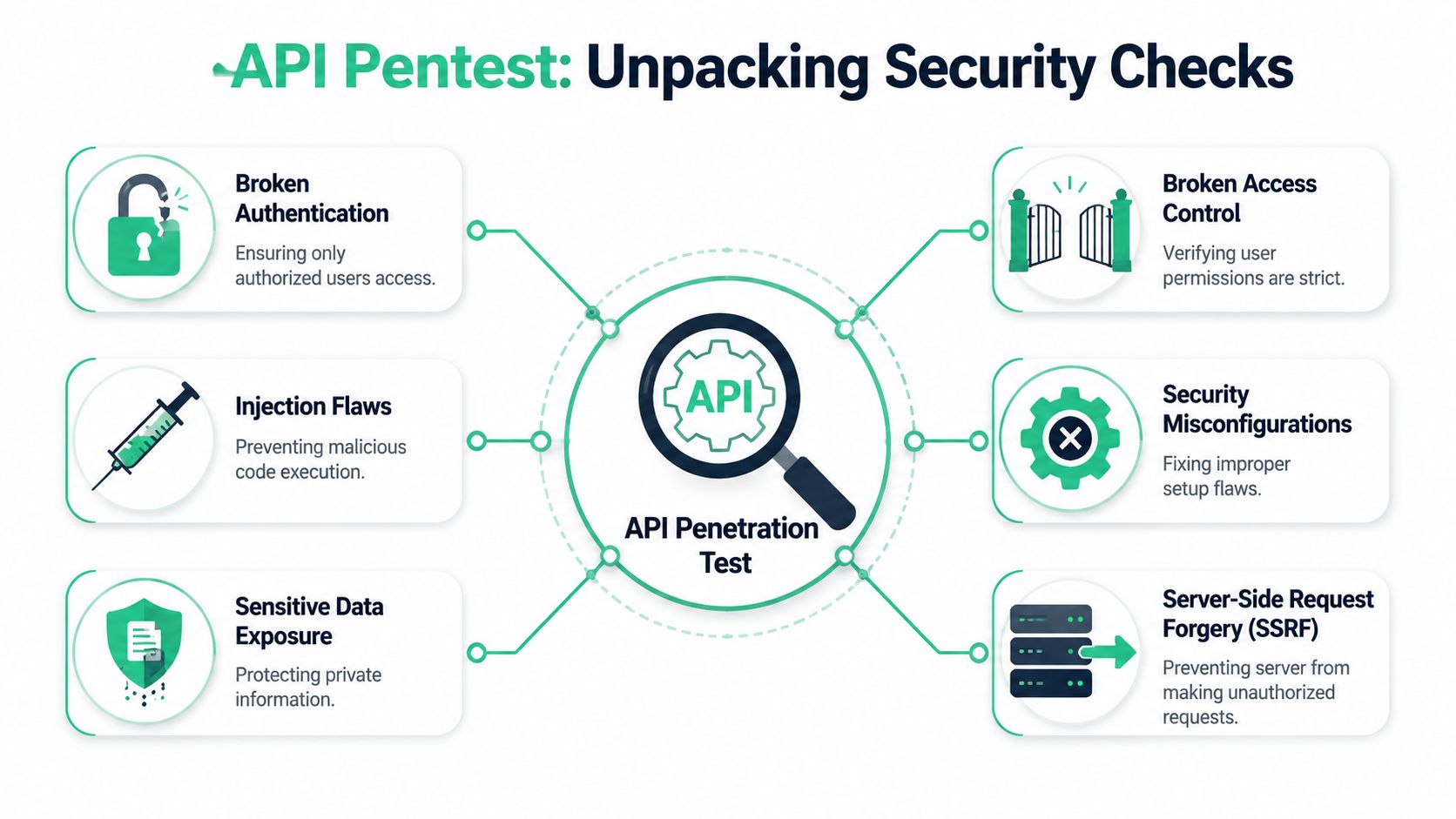
API penetration testing simulates real attacks against REST, SOAP, and GraphQL APIs and follows a structured process of reconnaissance, enumeration, vulnerability analysis, and exploitation to help satisfy frameworks like PCI DSS and SOC 2, as outlined in Vaadata's API penetration testing methodology.
In plain English, that usually means checking things like:
- Authentication flaws that let attackers log in as the wrong user or keep using bad tokens
- Authorization bugs where a normal user can read, edit, or delete another user's data
- Injection issues where the API accepts malicious input
- Rate limiting problems that let someone hammer an endpoint without control
- Security misconfigurations that expose debug behavior, unsafe methods, or internal functionality
If your team gets confused by API terminology, send them this plain-language guide to API language. It helps product and engineering people speak the same language before the engagement starts.
How this differs from a website pen test
A website pen test is like checking the restaurant's front door, windows, locks, and customer area. That's useful. But it doesn't tell you whether the kitchen is handing food to anyone who shouts loudly enough through the service hatch.
That's why API testing should not be treated as interchangeable with general web application penetration testing services. There is overlap, but APIs have their own abuse cases and their own failure modes.
Most ugly API findings aren't flashy. They're simple trust mistakes buried in backend logic.
A good tester also uses the OWASP API Security Top 10 as a practical checklist. That gives your internal team a familiar frame of reference and gives auditors a testing approach they recognize.
Stop Overpaying for Slow API Pentesting
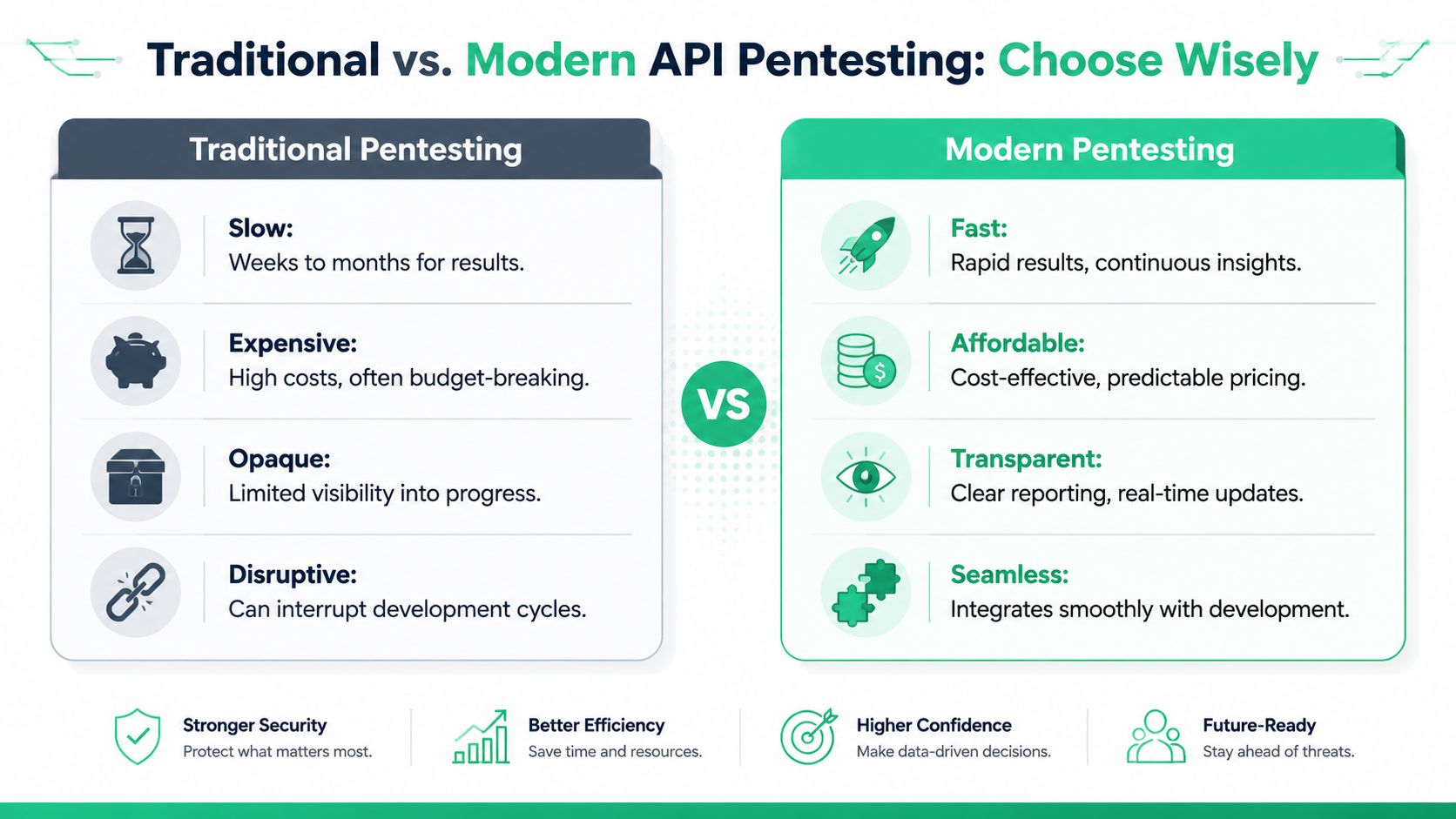
A lot of traditional firms sell pentesting like it's enterprise legal work. Long scoping calls. Slow kickoff. Junior tester does the work. Senior person signs the report. Then you get billed like they performed surgery.
That pricing model makes no sense for a startup trying to close a customer deal or finish a compliance review.
The old model is inefficient
One reason costs get ridiculous is that old-school manual testing often burns huge amounts of time with poor coverage. A 2023 study found it took more than 154 hours, or 20 working days, to manually test only 40% of an API with 40 endpoints, with average costs reaching as high as $25,000, according to Equixly's analysis of manual API pentesting costs.
That's the part founders hate, and they're right to hate it. You're paying a lot and still not getting confidence that the important business logic got examined properly.
What smart buyers should reject
If you're shopping for API penetration testing services, reject vendors that show these signs:
| Problem | What it usually means |
|---|---|
| Vague pricing | They want room to inflate scope later |
| Long timelines | Your project is small to them |
| Automated-only output | You're buying a scan, not a pentest |
| No clear retest path | Fix validation becomes another invoice |
The better model is straightforward. Tight scope. Senior tester. Clear schedule. Useful report. Retest when you fix the issues.
If a vendor can't explain exactly what happens in the first week, they're probably not set up to move quickly.
Fast doesn't mean shallow. Cheap doesn't mean fake. It means the engagement is run by people who know how to scope API work cleanly instead of wrapping a simple job in enterprise ceremony.
Our Manual API Penetration Testing Methodology
A proper API penetration test should combine automation and human judgment, but the human part is what finds the expensive problems. Scanners are good at tripping over obvious flaws. They are not good at thinking sideways.
That's why I care more about who is testing than what logo is on the sales deck. Look for certified pentesters with OSCP, CEH, or CREST backgrounds who can reason through workflows, permissions, and weird edge cases.
What a manual tester does that a scanner misses
A scanner can hit endpoints and compare responses. That's useful. It might catch missing headers, common injection patterns, or exposed methods.
A human tester asks nastier questions.
Can a basic user switch an account ID and read another tenant's data. Can a coupon flow be abused so a $500 item gets purchased for $5. Can a password reset flow be chained with a token handling flaw. Can rate limits be bypassed by changing request patterns or moving between endpoints.
Those are business logic flaws. They happen when the system follows the written code but still does something the business never intended.
How the work usually unfolds
A serious manual pen test often includes work like this:
- Recon and endpoint mapping using the docs you provide, plus direct discovery where needed
- Auth testing against OAuth, JWT, API keys, session handling, and privilege boundaries
- Access control abuse with multiple accounts at different roles to test what each user can really do
- Input abuse and fuzzing to see how the API behaves with malformed, unexpected, or hostile requests
- Workflow testing to find broken assumptions between endpoints
What matters most: A real tester doesn't just ask "Is this endpoint vulnerable?" They ask "What can an attacker accomplish if two small flaws are chained together?"
That is the difference between compliance theater and useful security work.
One option in this space is Affordable Pentesting for API security, which focuses on manual testing for issues like broken authorization and exposed data paths. Whether you use that service or another provider, the point is the same. Make sure a qualified human is doing the work.
Checklist for Choosing an API Pentest Vendor
Most buyers ask the wrong first question. They ask, "What's your price?" The better first question is, "What exactly am I getting for that price?"
A vendor can charge less because they're efficient. They can also charge less because they're dumping your API spec into a tool and calling it pen testing. You need to know which one you're buying.
Questions that filter out bad vendors
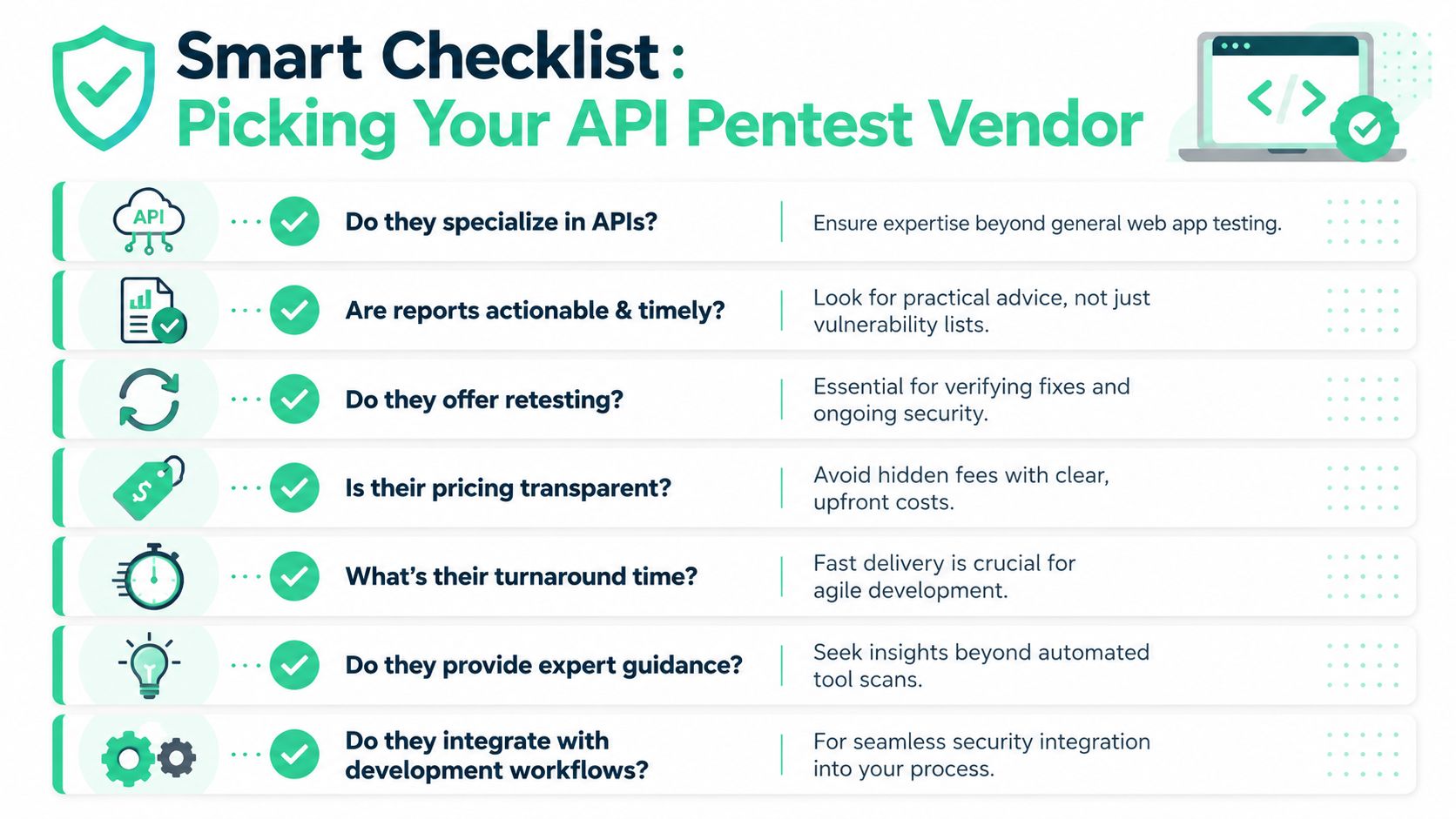
Use this list on your next sales call.
Will a senior tester perform the work
If they dodge this, expect a junior analyst plus light automation.Do you specialize in APIs
Website testing experience helps, but API work has its own patterns and failure points.Can you deliver a final report in seven business days
Slow delivery kills deals and drags out audits.Is retesting included
You don't want to pay again just to confirm your fixes worked.Is the report useful to engineers and auditors
A real report should explain impact, reproduction, and remediation without vague filler.Do you require endless presales meetings
If buying the test is painful, the engagement probably will be too.
Good answers sound simple
A decent vendor should be able to tell you the scope, the inputs they need, the timeline, and the report format without burying you in jargon. If they can't explain their own process clearly, don't trust them to explain your risk clearly.
Here is the practical benchmark I use:
| Ask this | Good answer |
|---|---|
| Who does the testing | Named senior tester or clearly defined senior-led team |
| What do you need from us | API docs, credentials, scope, test accounts |
| How fast can you start | Clear kickoff window |
| What do we get at the end | Audit-ready report plus remediation guidance |
You should also expect plain communication. If your founder, engineering manager, and compliance lead can't all understand the findings, the report has failed.
Our Simple API Pen Test Engagement Workflow
It is commonly assumed that a penetration test will disrupt development, break staging, or turn into a giant project. It doesn't have to. A clean engagement is short, controlled, and boring in the best way.
The workflow is simple when both sides do their part.
What you send first
Effective API penetration testing starts with the basics. You share your OpenAPI or Postman collection, authentication material like API keys, and access under an NDA so the tester can systematically check for authorization bypasses and related flaws, as described in Blaze Information Security's API pentest preparation guide.
You should also provide test accounts with different roles. If your app has admin, manager, and standard user permissions, the tester needs all three. That is how they verify whether role boundaries are upheld.
What the engagement looks like
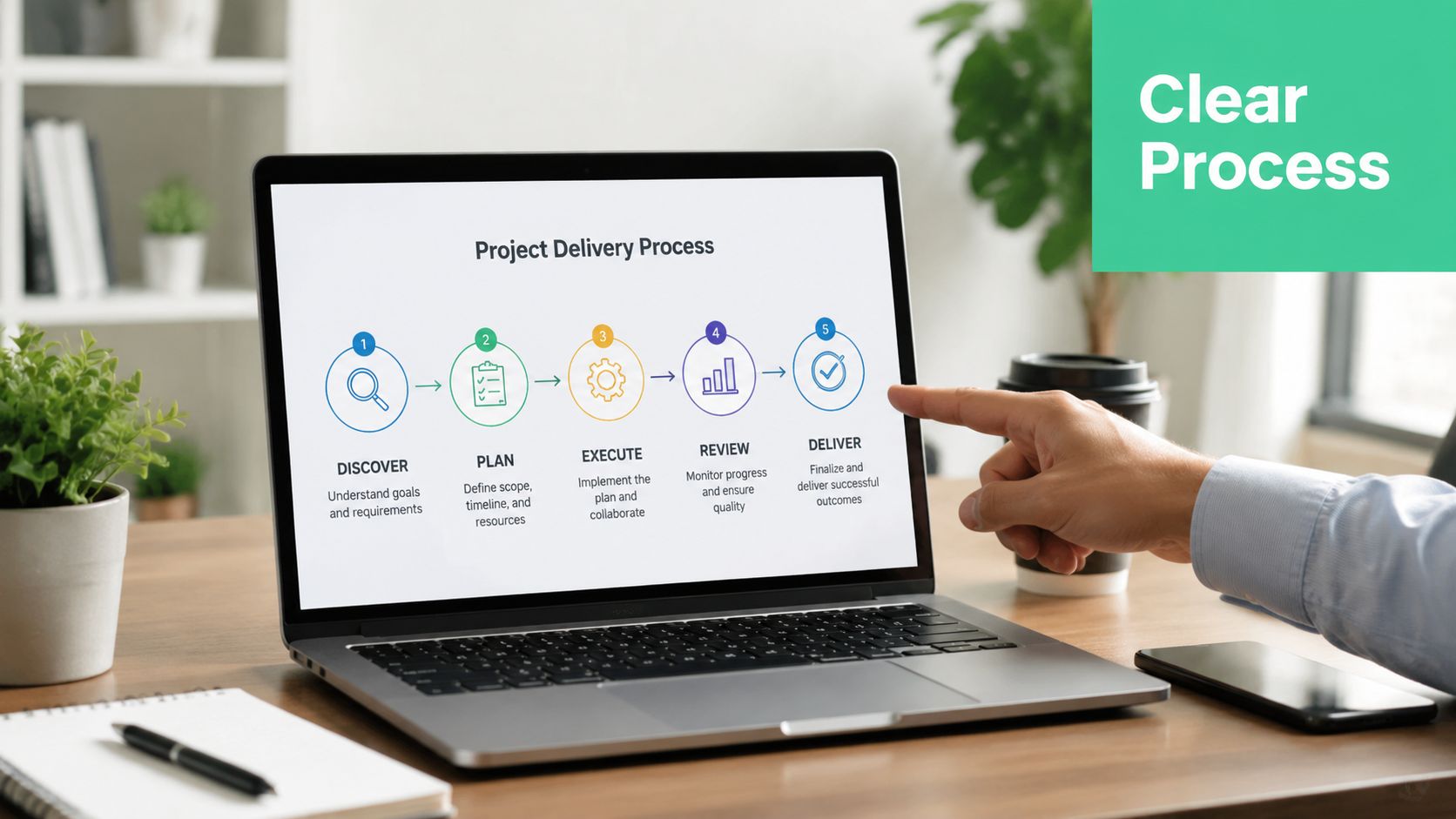
A fast API pen test usually follows this rhythm:
Scope gets locked
You define which APIs, environments, and auth methods are in play. This avoids pointless drift.Kickoff happens quickly
The tester confirms access, validates the docs, and checks whether the environment is safe to test.Manual testing starts
The tester walks the endpoints, auth flows, permissions, business logic, and error handling.Findings get written clearly
You receive an audit-ready report with evidence, severity, and remediation guidance your engineers can act on.Retest closes the loop
After fixes, the tester validates remediation so you have clean evidence for customers or auditors.
A good engagement should feel organized, not mysterious. You should always know what's being tested and what comes next.
If you want this to move quickly, don't make the tester guess. Good docs, clean credentials, and a stable test environment save time and reduce noise.
Understanding API Penetration Testing Service Costs
Let's get to the number everyone cares about.
API penetration testing services typically cost between $5,000 and $20,000, depending on complexity and the number of APIs. Large external tests can exceed $30,000, which is exactly why SMBs should be careful about overbuying, according to Blaze Information Security's penetration testing cost breakdown.
What actually changes the price
Price should move based on scope, not theatrics. The biggest cost drivers are usually:
How many APIs and endpoints exist
More surface area means more manual validation.How complex the auth model is
Multi-role access, token handling, and tenant separation take real time to test properly.How much business logic matters
Billing, healthcare, finance, and sensitive workflows need deeper human review.How clean your documentation is
Good API specs reduce wasted time and keep cost under control.
The mistake most companies make is buying too much process and too little testing. You don't need a giant consulting package if your real requirement is straightforward. You need a scoped manual pen test, a report your auditor will accept, and a retest so you can close findings fast.
What to insist on before you sign
Don't buy based on price alone. Buy based on price plus deliverables.
Ask for these in writing:
- A fixed scope so the quote doesn't balloon later
- A clear turnaround so your audit doesn't stall
- Manual testing confirmation so you're not paying pentest pricing for scanner output
- Retesting terms so remediation doesn't become a second project
- An audit-ready report that your compliance team can use
If the proposal is fuzzy, the engagement will be fuzzy too. Keep it simple. For most startups and SMBs, the right answer is not the biggest firm. It's the firm that can test the right endpoints, find real issues, and get you a clean report fast.
If you need a manual API pentest without the slow sales cycle, use the Affordable Pentesting contact form and ask for a scoped quote. Keep it simple: send your API docs, tell them your audit deadline, and ask for a report in seven days with retesting included.