.svg)

Your company probably has more internet-facing stuff than you think.
A few months ago, the team spun up a staging app for a product demo. Marketing launched a microsite. A developer connected a cloud service to test an API. Someone in ops opened remote access for a vendor and forgot to close it. None of that felt dramatic at the time. Then an auditor asks for asset inventory, or worse, an attacker finds the thing nobody remembered.
That mess has a name. It's your attack surface. And attack surface management is how you stop guessing, stop overpaying for vague security work, and start getting control fast.
Your Digital Footprint Is Bigger Than You Think
Fast-growing companies create exposure the same way they create product features. One quick decision at a time. A new login page here, a cloud workload there, a forgotten subdomain nobody owns anymore. The risk isn't just the obvious production app. It's the junk around it.
A founder usually sees the business. An attacker sees entry points. They don't care which asset is "important" to you. They care which asset is exposed, weak, and ignored.
The problem usually starts small
A typical SMB stack isn't huge, but it sprawls fast:
- Public websites: Main site, landing pages, support portals, investor pages
- Cloud assets: Storage, compute, containers, test workloads
- Access systems: VPNs, SSO portals, admin panels, remote support tools
- Forgotten extras: Old dev environments, retired apps, abandoned domains
It's not laziness that causes teams to lose control. They lose control because growth beats process.
That's also why shadow IT keeps biting smaller companies. If you need a plain-English breakdown, this guide on managing shadow IT for SMBs is worth your time. It maps the actual compliance and security problems that show up when teams buy or deploy tools outside normal review.
Unknown assets create dumb risk. You can't secure a system your team doesn't know exists.
The practical move is simple. Start with visibility. Before you buy another platform, before you book a broad penetration test, before you panic about every scanner alert, get a current list of what you expose to the internet.
That starts with asset discovery and basic external review. For many teams, external scanning is the crucial cybersecurity first step because it shows what outsiders can already see without needing credentials or insider access.
Treat it like a business cleanup
This isn't a luxury project for giant enterprises. It's basic operational discipline. If an asset is live, it needs an owner. If it has no owner, shut it down. If it stores data or handles logins, review it first.
Attack surface management matters because it turns a fuzzy security problem into a manageable list. That's what busy teams need. Not theory. A list.
What Is Attack Surface Management Simply Put
Attack surface management means finding the digital doors into your business, checking which ones are exposed, and repeating that process often enough that new doors don't slip past you.
The easiest way to think about it is a house.
Your company is the house. Your attack surface is every front door, side door, window, garage entrance, and little gap someone could use to get in. Attack surface management is the routine of walking the property, making a list, testing the locks, and fixing what shouldn't be open.
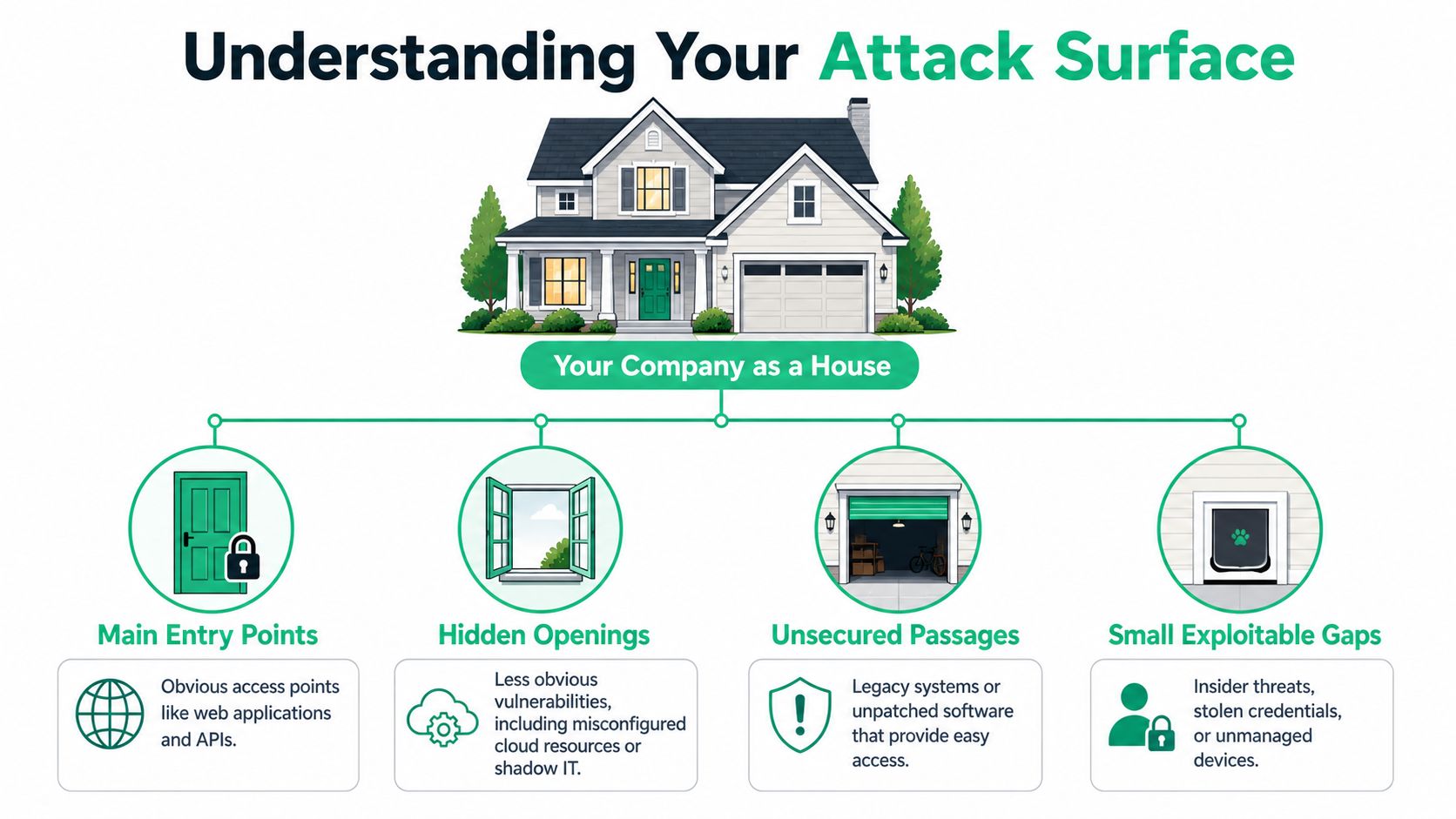
What counts as part of the attack surface
The focus is often placed only on the main app. That's too narrow. An attack surface includes anything an attacker could use to get access, steal data, or move deeper into your environment.
That usually includes:
- Web apps and APIs: Customer portals, dashboards, mobile backends, partner integrations
- Login systems: Admin pages, SSO pages, VPN portals, support access
- Cloud resources: Public buckets, exposed services, test deployments, unmanaged workloads
- Identity exposure: Employee credentials found in leaks, weak passwords, reused accounts
- Third-party entry points: Vendor tools, shared services, connected platforms
Some of these are obvious. Some aren't. A forgotten support subdomain can be just as useful to an attacker as your main production app if it's weak enough.
The three jobs ASM actually does
Attack surface management isn't mysterious. It does three practical things.
Discovery
Find what exists. Domains, subdomains, portals, apps, cloud assets, public repos, exposed services.Exposure review
Check what looks risky. Is it public? Is it outdated? Does it expose login, data, or remote access? Is it even supposed to be online?Ongoing monitoring
Repeat the process. New assets appear. Old assets change. Teams launch things without telling security.
Plain rule: If it faces the internet, assume someone else can already see it.
That last part is where companies usually fail. They do one inventory, save a spreadsheet, and call it done. But your environment changes every week. So your attack surface changes every week too.
Why simple beats fancy
A lot of security vendors overcomplicate this. You don't need a giant dashboard to understand the basic idea. You need a reliable habit.
Start with your primary domains. Expand into subdomains, app endpoints, login pages, public cloud resources, and vendor-connected systems. Ask one question for each asset: should this exist, should it be public, and who owns it?
That's attack surface management in plain English. It's not magic. It's housekeeping with consequences.
Why ASM Matters for Compliance and Risk
A founder finds out about a forgotten admin portal the same week an auditor asks for proof of asset review. That is how small companies fail audits and get breached at the same time.
ASM fixes the root problem. You cannot secure, test, or document what you have not identified first. For small and midsize businesses, that makes ASM the cheapest place to start. It cuts waste, shrinks scope, and gives every later security step a clear target.

Auditors care about proof that your process works
SOC 2, HIPAA, PCI DSS, and ISO 27001 all push toward the same basic standard. Know what is exposed. Review it on a schedule. Assign ownership. Fix what creates real risk.
A pentest report helps, but it does not solve this by itself. Traditional security programs often spend heavily on one-off assessments while missing the simple question an auditor will ask first: what internet-facing systems do you have?
A documented ASM process gives you evidence you can use:
- Asset visibility: You maintain a current list of public-facing systems
- Regular review: New exposures get checked instead of sitting unnoticed
- Risk-based decisions: Internet-facing login pages, admin panels, and data-handling systems get priority
- Clear accountability: Every exposed asset has an owner who can fix it or retire it
That is what maturity looks like. Not a stack of PDFs. A repeatable operating habit.
ASM lowers risk by cutting waste before you pay for testing
Unknown assets create two bills. One arrives from an attacker. The other arrives from your own security budget.
If an old server, stale API, or abandoned portal is still public, you are paying to defend something that should probably be gone. Shut it down and the problem disappears. Keep it online and you keep paying for monitoring, patching, scanning, and pentesting.
The cheapest finding is the system you remove before anyone has to test it.
That is why ASM should come before broad pentesting for SMBs. It makes pentesting faster, cheaper, and more useful because testers spend time on live business risk instead of dead infrastructure. It also gives you cleaner audit evidence, since you can show how you define scope instead of guessing your way through it.
Analysts at Fortune Business Insights on the ASM market expect the ASM market to grow sharply over the next several years. The reason is simple. Companies are under more pressure to control internet exposure and prove they are doing it.
Smaller teams get more value from ASM, not less
SMBs do not need a giant platform and a six-month rollout. They need a fast way to find exposed systems, assign owners, and remove junk before it turns into audit pain or breach fallout.
This matters even more if you handle customer records, card data, or health information. Auditors will expect control over exposed assets. Attackers already do. If your budget is tight, start with ASM, then use the cleaned-up inventory to scope a focused pentest. That sequence saves money and produces better results.
If your team also deals with employee data exposure or public identity traces, PeopleFinder's advanced guide is a useful reference for understanding how easy public-facing information is to map. The lesson is the same. If outsiders can find it, you need to account for it.
How to Inventory and Measure Your Attack Surface
Start with a spreadsheet. Not a six-figure platform. Not a giant procurement cycle. A spreadsheet works because it forces clarity.
List every internet-facing thing your company owns or operates. If you don't know whether something is exposed, put it on the list anyway and verify it. You can clean up later.
Build the first inventory by hand
Your first pass should include the obvious stuff and the weird stuff.
Look for these categories:
- Domains and subdomains: Main websites, app URLs, support portals, old campaign pages
- Public applications: Customer apps, admin panels, APIs, staging environments
- Cloud assets: Storage, hosted services, public compute workloads, exposed management interfaces
- Code and collaboration exposure: Public repositories, developer tools, documentation portals
- Third-party connected systems: Payment tools, support tools, identity providers, partner integrations
For each item, track a few basic fields in plain language:
| Asset | Owner | Public or internal | Handles data or login | Still needed |
|---|---|---|---|---|
| Customer portal | Product team | Public | Yes | Yes |
| Old demo site | Unknown | Public | No | Maybe |
| Vendor access page | IT | Public | Yes | Yes |
This is boring work. Do it anyway. Boring work prevents expensive incidents.
Use a simple score, not guesswork
Once you have the list, measure it. Carnegie Mellon researchers created a formal way to calculate an attack surface metric by summing entry and exit points and applying a damage potential to effort ratio, as described in the OWASP Attack Surface Analysis Cheat Sheet. The point isn't to turn your team into mathematicians. The point is to stop treating all assets the same.
Use a lightweight version:
- Damage potential: If this asset gets compromised, what happens?
- Attacker effort: How hard would it be to abuse?
- Exposure level: Is it public, authenticated, or tightly restricted?
- Business value: Does it touch sensitive data or critical operations?
You can score each one as low, medium, or high. That's enough to make better decisions fast.
If an asset is public, handles login, and nobody clearly owns it, move it to the top of the list.
Add context people forget
Most inventories miss the human side. That includes employee accounts, leaked credentials, and public personal details that help attackers target staff. Good attack surface work isn't only about servers and apps.
If your team needs a better sense of how public personal data can be pieced together, PeopleFinder's advanced guide is a useful example of how much information can be assembled from scattered sources. That's exactly why identity exposure belongs in the conversation.
A useful inventory doesn't need to be perfect. It needs to be current enough to drive action. Once you know what's exposed and which assets carry the most downside, you can scope a focused pen test, pentest, or penetration test instead of paying someone to wander around your environment looking for targets.
Integrating ASM with Pentesting and Development
A founder approves a pentest, pays real money, and gets back a report full of findings on systems nobody cares about while the customer login app, old admin portal, or exposed API barely gets attention. That happens when the tester has to spend the first chunk of the engagement figuring out what you own.
Attack surface management fixes that. It gives pentesting a target list tied to business risk, not guesswork. For SMBs, that matters because wasted testing time is wasted budget.

Better pentesting starts with better scoping
Traditional security firms often burn hours on discovery before they test anything meaningful. You still pay for those hours. A current asset inventory cuts that waste and puts the effort where it belongs. Public apps, login flows, exposed APIs, admin panels, and any system tied to audit scope.
That changes the result fast.
Instead of asking a tester to "look around," give them a shortlist with context:
- Test these public-facing apps
- Hammer these authentication paths
- Review this API, this admin interface, and this remote access point
- Prioritize anything in compliance scope
That is how you get a useful report, faster remediation, and a better shot at passing an audit without paying for a bloated engagement.
Focus on the systems that open everything else
Modern ASM programs often align with CTEM and rank assets by where they matter in an attack path. Cycognito's overview of CTEM and kill-chain based ASM explains why that helps teams focus on the assets attackers are most likely to use first.
For a small team, the recommendation is simple. Put testing time on choke points.
Examples:
- SSO portals: One weak point can expose multiple systems
- VPN and remote access: These sit at the edge and get targeted constantly
- Shared APIs: A single exposed integration can spill data across products
- Admin interfaces: Control planes let attackers do more with less effort
The best pentests follow the likely attack path. They do not spread effort evenly across every hostname you own.
Build ASM into shipping, not cleanup
Attack surface drift usually starts in development. A new staging site goes public. A forgotten subdomain keeps running. A contractor spins up a cloud asset and nobody adds it to the inventory. Then an auditor finds it, or an attacker does.
Fix that with a short release check. Every time something internet-facing goes live, ask:
- Who owns it?
- Should it be public at all?
- Does it have authentication, logging, and basic hardening?
- Has it been added to the asset inventory?
- Does it need pentest coverage before release?
Keep it simple and make it part of the workflow developers already use. ASM should support shipping safely, not slow the team down.
Where external testing fits
Once your inventory is clean enough to trust, use it to scope targeted external testing on the assets that matter most. If your real exposure sits in customer-facing apps, APIs, and login systems, spend your budget there first. That is the fastest way to secure your external environments and avoid the slow, overpriced model where consultants charge you to map your business before they test it.
ASM does not replace pentesting. It makes pentesting efficient, affordable, and relevant. For SMBs, that is the difference between checking a compliance box and reducing risk.
A Simple ASM Roadmap for Small Businesses
Monday morning. A prospect asks for your security docs. Friday afternoon. You realize nobody has a clean list of your public apps, old subdomains, vendor portals, or test systems. That is how small companies fail audits and waste money on slow security projects.
Use a simple ASM plan instead. It is the cheapest way to get control of external exposure, clean up obvious risk, and make pentesting faster and more useful. It also keeps you out of the trap small teams know too well: buying bloated enterprise tooling that takes months to set up and still does not answer the basic question, "What do we have exposed right now?"
A phased rollout works because small teams need progress, not platform drama. Even Skyhawk Security's discussion of SMB attack surface management requirements points out that smaller organizations need simpler, lower-overhead ASM approaches than enterprise buyers.
Use a phased rollout
| Phase | Timeline | Key Actions | Primary Goal |
|---|---|---|---|
| Phase 1 | Days 1 to 30 | Inventory domains, subdomains, public apps, cloud assets, login portals, and old environments. Assign owners. Mark unknown items for review. | Get visibility |
| Phase 2 | Days 31 to 60 | Remove dead assets, lock down exposed services, rank assets by business risk, and add lightweight recurring checks. | Cut obvious risk |
| Phase 3 | Day 61 and beyond | Feed new assets into the inventory process, scope targeted pentesting, and review changes as part of release workflow. | Keep it current |
Days 1 to 30
Start with the assets an auditor or attacker can find in minutes. Customer-facing apps. Admin portals. Remote access points. Cloud services with public exposure. Old staging environments that never got retired.
Do not chase a perfect spreadsheet. Get ownership nailed down.
Use a blunt triage rule:
- Keep it: The business needs it and a real person owns it
- Fix it: It matters, but access, logging, patching, or configuration is weak
- Kill it: No owner, no business case, no reason to stay online
That one pass usually exposes the low-value junk that drives audit findings and creates cheap attack paths. Small companies do not need six months of discovery work. They need a list they trust.
Days 31 to 60
Now cut exposure fast. Shut down dead systems. Restrict services that should never have been public. Put the highest attention on login flows, internet-facing apps, APIs, and anything tied to regulated data.
This is also the point where ASM starts paying for itself. Your pentest scope gets tighter. Your audit prep gets easier. Your team stops paying consultants to spend half the engagement figuring out what exists.
Add recurring checks now. Weekly is better than quarterly if your environment changes often. A simple recurring review beats an expensive tool nobody maintains.
If you are budgeting for an audit, use this cleanup phase to shape the testing you need and check pricing for compliance pentesting before you commit to a slow, overpriced firm.
Day 61 and beyond
Once the inventory is stable, make ASM part of normal operations. New public assets go into the inventory when they launch. Retired systems come out. Vendor changes get reviewed. Pentest scope starts from the current exposure list, not guesswork.
That is the practical win for SMBs. ASM is not an enterprise luxury. It is the groundwork that makes security testing affordable, targeted, and useful enough to help you pass audits without burning the budget.
When to Outsource with a Managed ASM Service
Some teams should build a basic internal process. Some shouldn't. If your company is racing toward an audit, short on security staff, or tired of overpriced firms moving at glacier speed, outsourcing is the smarter call.
You don't need a full internal team to do attack surface management well. You need people who know what to look for, know how to validate exposure, and can turn the findings into an actionable penetration test or pen testing scope fast.
Outsource when speed matters
A managed service makes sense when:
- You have a deadline: SOC 2, HIPAA, PCI DSS, customer security review
- You lack internal depth: No dedicated security engineer, no one owning external exposure
- Your environment changes fast: Cloud deployments, new apps, frequent releases
- You need credible testing: Certified testers and audit-ready reporting matter
Traditional firms typically frustrate buyers. They charge a lot, move slowly, and often burn time on process theater. Long kickoff calls. Delayed scheduling. Thin findings. Reports that arrive after the deadline pressure has already hit.
What a good outsourced option should look like
You want a provider that combines attack surface review with manual pentest work. Not just automated screenshots and scanner exports. Real human testing by certified professionals.
Look for teams with credentials like OSCP, CEH, and CREST. Those certifications don't guarantee quality by themselves, but they do tell you the people doing the work have been tested against real standards.
You should also expect speed. If a provider can't move quickly, they're not helping much. A startup founder or IT manager doesn't need a twelve-week wait for basic clarity.
The cost decision is simple
Hiring full-time security talent is expensive. Buying enterprise-grade ASM tooling can also be expensive. For a lot of SMBs, neither option is the right first move.
A managed service is often the clean middle path. You get expertise, a clear scope, and findings you can act on without carrying the overhead of a full internal buildout. If you're comparing options, review the pricing for compliance pentesting and weigh it against the cost of delays, missed audit windows, and weak reports.
The right outsourced service should save you time, shrink your scope, and give you a usable result fast. If it doesn't do those three things, skip it.
Start Small Win Big with ASM
Attack surface management sounds bigger than it is. In practice, it's just disciplined visibility. Find what you expose. Decide what matters. Remove what doesn't belong. Test what remains.
That's why it's such a good starting point for SMBs. It cuts waste before you spend money on deeper security work. It gives compliance teams something concrete. And it makes pentesting, pen test work, and penetration testing much more effective because the scope is grounded in reality.
You do not need a giant platform to begin. You need an honest inventory and a willingness to shut down junk. That's enough to change your security posture fast.
The smartest path is the affordable one
Traditional security services love bloat. Big scopes, slow timelines, generic outputs. That's not what a busy founder, CISO, or IT manager needs.
A smarter path looks like this:
- Map the external footprint
- Prioritize real exposure
- Run a focused pentest
- Use the results to fix what matters first
That approach is cheaper, faster, and easier to defend during an audit. It also matches how attackers work. They start with what they can see. You should too.
Start with the assets that handle logins, customer data, and internet-facing access. That's where the fastest risk reduction lives.
If you make steady progress, you're already ahead of most companies. Not because you bought more tooling, but because you finally know what you're defending.
If you want fast clarity on what attackers can see and a manual pentest report within a week, Affordable Pentesting is built for that. Their certified pentesters, including OSCP, CEH, and CREST-qualified professionals, help startups and SMBs get affordable penetration testing for SOC2, PCI DSS, HIPAA, and similar requirements without the slow, overpriced traditional-firm nonsense. Use the contact form and get a real scope, real findings, and a timeline that matches how your business moves.