.svg)
AWS Penetration Testing for Fast Compliance
Your audit date is close. Your app lives in AWS. A traditional firm sends a bloated quote, a slow timeline, and a vague promise that a report will show up eventually.
That model frustrates founders, IT managers, CISOs, and compliance teams for a reason. You need a real AWS penetration testing engagement, not theater. You need a manual pentest, clear findings, and an audit-ready report fast enough to matter.
Why AWS Penetration Testing Is So Expensive
Big firms charge like they're testing the cloud itself. They're not. In most cases, they're testing your setup, your access controls, your storage permissions, and the way your services connect.
That matters because approximately 95% of all cloud security breaches in AWS environments are tied to customer misconfigurations, not flaws in AWS itself, according to Gartner's cloud security analysis. So if a firm spends half the project wrapping your test in process, meetings, and slide decks, you're paying for overhead, not better security.
What you're really paying for
Traditional penetration testing gets expensive for three reasons:
- Too many layers: Sales hands off to a project manager, who hands off to a delivery lead, who hands off to testers.
- Slow scheduling: Your test waits in a queue behind larger enterprise clients.
- Report bloat: You get long documents packed with noise instead of a short list of issues that matter.
None of that improves your security.
Practical rule: If a vendor can't explain the test scope in plain English, they probably can't explain the findings to your auditor either.
What a startup actually needs
A startup usually doesn't need a giant red team exercise. It needs a focused pen test against the AWS assets that hold data, expose the app, and control access.
That means looking hard at things like:
| AWS area | Plain-English risk |
|---|---|
| EC2 | A server exposed to the internet when it shouldn't be |
| S3 | Files left public by mistake |
| IAM | Users or roles with way too much power |
| RDS | A database reachable from places it shouldn't be |
| VPC and security groups | Internal paths that let an attacker move around |
A lean penetration test done by certified testers with OSCP, CEH, and CREST backgrounds can move much faster because the work stays close to the hands-on people. That's the difference. Less ceremony, more actual testing.
Speed beats ceremony
For compliance, the worst outcome isn't finding issues. It's waiting so long for the report that the report stops being useful.
A strong AWS pentest should be scoped quickly, executed manually with smart automation, and written for action. You want findings your team can fix now, and a report your auditor can read without a translator.
AWS Rules for a Safe Penetration Test
AWS gives you room to test your own environment, but it isn't a free-for-all. If you ignore the rules, you can create real operational problems and raise ugly questions about authorization.
This is the part too many teams skip. That's a mistake.
What AWS allows
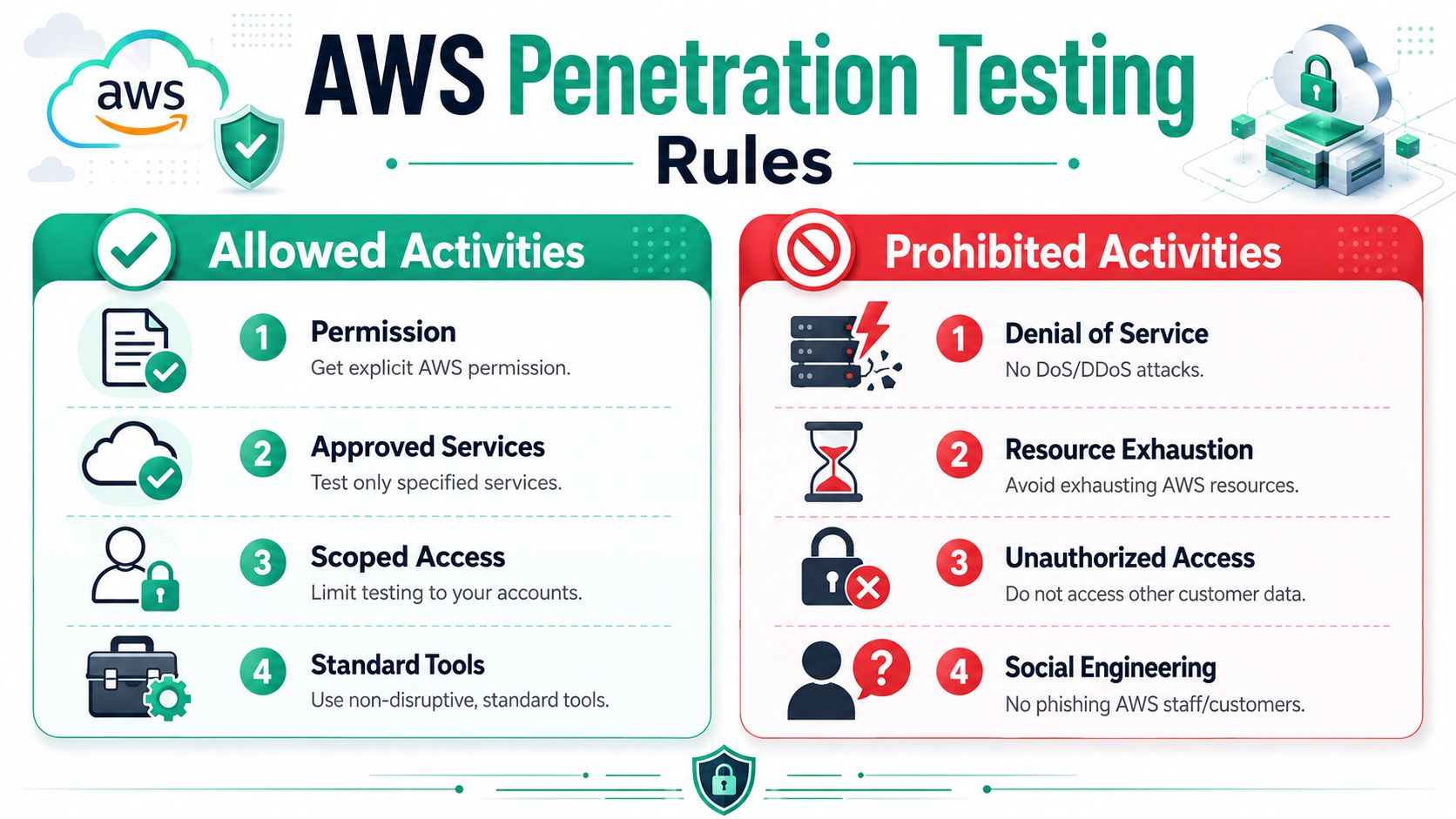
AWS permits a broad set of normal security assessment activity. That includes port scanning, vulnerability scanning, web application scanning, exploitation, code injection, fuzzing, and even crashing running processes for local exploitation in the right context.
In plain terms, if you're testing your own systems carefully and staying inside scope, normal penetration testing work is allowed.
Here's the safe checklist I recommend before any AWS pen testing starts:
- Write the scope down: List the accounts, apps, domains, APIs, and cloud resources being tested.
- Get owner approval: Written authorization from the system owner isn't paperwork fluff. It's basic legal hygiene.
- Set timing: Pick a schedule so your team knows what traffic and alerts to expect.
- Verify identity: If testers have AWS credentials, confirm who they are with the AWS identity check command noted in AWS pentest guidance.
- Validate domain control: If the target includes an application domain, prove you own or control it before testing.
AWS Security Agent guidance also requires domain ownership validation, typically by adding a verification method tied to the target domain, as described in the AWS Security Agent availability post.
What AWS forbids
This part is simple. AWS explicitly prohibits customers from performing DoS or DDoS simulations against its resources without specific pre-approved exceptions, as stated on the AWS penetration testing policy page.
That means no traffic floods, no resource exhaustion games, and no clever attempt to call it "load validation" when you're really trying to knock something over.
Think of AWS like a rented building. You can inspect your office. You can't smash the power system to see what fails.
The common line teams cross
Most mistakes happen when teams confuse aggressive testing with smart testing. Banner grabbing, standard scanning, and controlled exploitation are one thing. Traffic patterns that degrade availability are another.
Use this quick split:
- Allowed in scope: Port scans, vuln scans, app testing, auth checks, controlled exploit attempts
- Not allowed without special approval: DoS, DDoS, resource exhaustion, anything that risks collateral impact
If your team needs a baseline understanding of AWS security concepts before a test, expert-curated AWS Security exam materials can help non-specialists understand core identity, logging, and network ideas without drowning in docs.
For internet-facing assets that connect back into your cloud environment, this is also where a focused approach to affordable external pentesting makes sense. Start from the exposed edge, then move inward.
Keep it boring and legal
The best AWS pentest isn't dramatic. It's authorized, scoped, controlled, and useful.
If your provider talks more about "simulating chaos" than staying inside AWS rules, walk away.
How to Scope Your AWS Pen Test
Scope decides cost. Scope decides speed. Scope decides whether your penetration test finds the stuff that matters or burns time on low-risk junk.
Overscoping often occurs due to nervousness. This leads to higher costs, longer waits, and reports filled with filler.

Start with what can hurt you
Don't begin with every service in every account. Begin with the path an attacker would care about.
That usually means these targets first:
- Your public app layer: Load balancers, web apps, APIs, login flows
- The compute layer: EC2 instances, containers, serverless functions handling sensitive logic
- Storage and data: S3 buckets, RDS databases, backups, snapshots
- Access control: IAM users, roles, policies, and trust relationships
- Network controls: VPC paths, security groups, internet exposure, internal reachability
If you're a SaaS company, think in terms of customer impact. The shortest route to material risk is usually app to compute to credentials to data.
Scope each service in plain English
Here's the simple version of what a pentester looks for.
| Service | What the tester asks |
|---|---|
| EC2 | Can someone get in, steal creds, or move to another system? |
| S3 | Did anyone leave files public or writable? |
| IAM | Does any user or role have more access than it needs? |
| RDS | Can an attacker reach the database or steal access details? |
| Lambda | Can function permissions be abused to access other services? |
| Security groups | Are there open paths that shouldn't exist? |
An S3 bucket is just a file cabinet. IAM is your key ring. Security groups are doors. Good AWS penetration testing checks whether any of those are open when they shouldn't be.
Scope for attack paths, not for service counts.
Cut the waste from the engagement
You don't need every internal microservice tested the first time. You need the assets that affect compliance, customer data, and privilege boundaries.
A good scoping call should answer these questions fast:
- What handles sensitive data?
- What is exposed to the internet?
- What grants access to other AWS resources?
- What would an attacker pivot through first?
That approach keeps the project affordable and gets better findings.
If you want a useful outside perspective on where app testing and security assessment differ, this write-up with cybersecurity insights for North Texas explains that gap in practical terms.
Good scope for startups
For many startups, the sweet spot is a focused cloud and app engagement. Test the public app, the AWS resources behind it, and the identity paths that could expose customer data.
If your product is multi-tenant, billing-heavy, or handles regulated records, pair cloud review with a SaaS security checkup. That's usually a better use of budget than asking for an oversized, enterprise-style exercise.
A Practical AWS Pen Testing Workflow
A real AWS pen test isn't magic. It's a disciplined workflow. Good testers follow the same rough path every time because that path works.
The strongest model is a four-phase process: Identification, Mapping, Vulnerability Analysis, and Exploitation. A common miss is failing to check the AWS metadata endpoint from a compromised instance, which can expose credentials for privilege escalation, as noted in this discussion of cloud privilege escalation and metadata abuse.
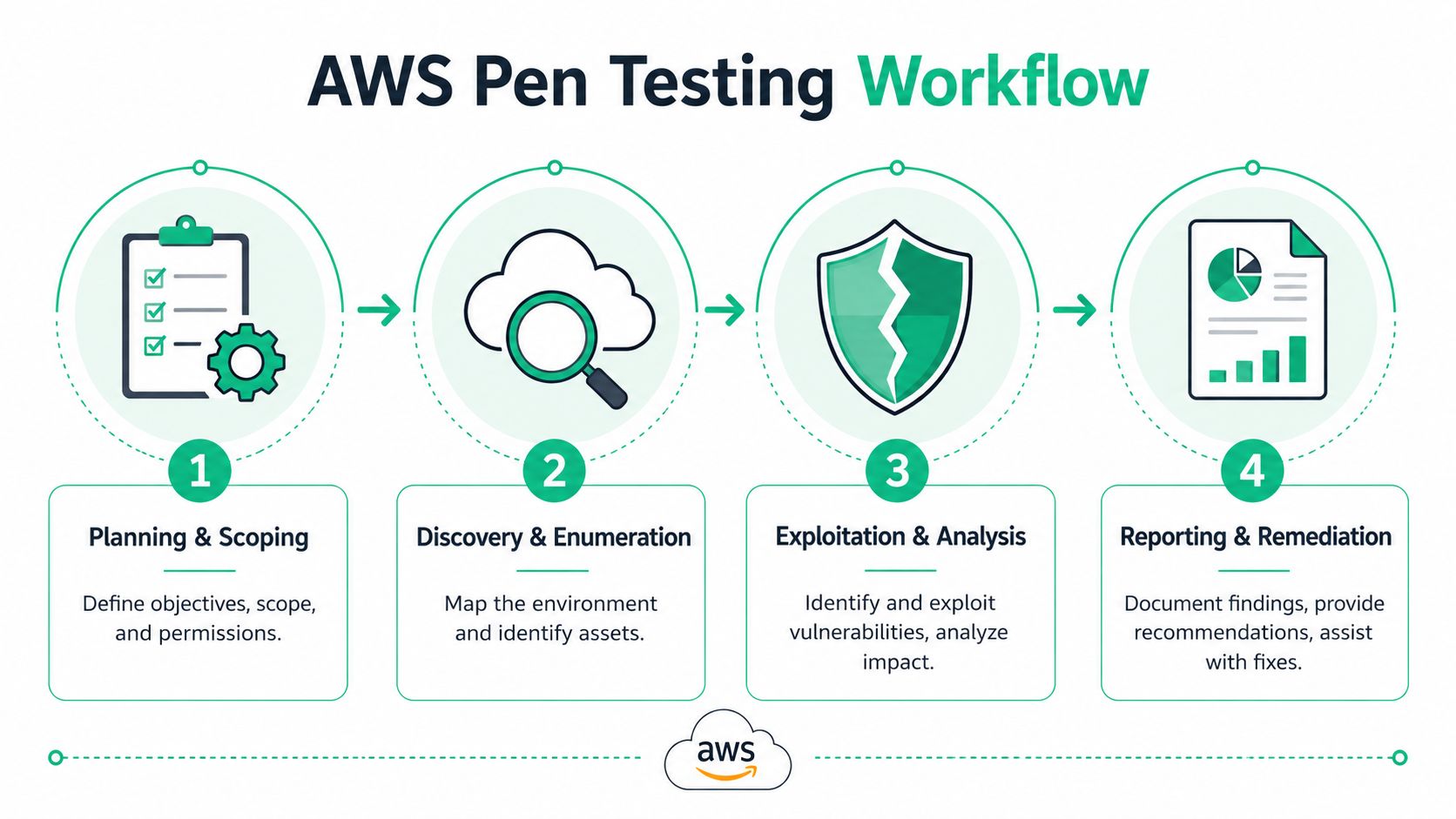
Identification phase
This is the recon stage. The tester figures out what exists and what can be seen from the outside.
In AWS work, that can include looking for the target organization in the AWS Marketplace and identifying whether account details or service patterns leak useful information. It can also include checking the AWS sign-in pattern to validate whether the environment exposes clues about account structure.
At this stage, the tester is building a target map, not smashing buttons.
Mapping phase
Now the tester enumerates the environment. That means identifying EC2 instances, S3 buckets, IAM roles, RDS databases, Lambda functions, and VPC setups, then understanding how they connect.
Ineffective testing ceases as real penetration testing begins. Cloud risk isn't just one bad setting. It's often a chain.
For example:
- One exposed EC2 instance can reveal local files or app secrets
- One weak IAM role can open access to more services
- One permissive security group can make internal systems reachable
- One public bucket can leak data or deployment artifacts
Vulnerability analysis phase
This phase mixes tools and human judgment. Tools are fast at finding common AWS mistakes. Humans are better at context.
The core open-source stack usually includes:
- ScoutSuite: Good for broad AWS configuration review
- Prowler: Strong for checking security posture against known best practices
- CloudFox: Helpful for seeing access paths and attack surface in plain terms
These tools help spot issues like open ports, unencrypted storage, broad permissions, and service relationships. Then the tester validates which ones matter and which ones are just noise.
A scanner can tell you a door exists. A pentester tells you whether it opens into anything important.
If the app sits behind WAF controls, testers may also study how filtering behaves before manual testing. For developers trying to understand that area better, this developer guide on AWS WAF bypassing is a useful technical reference.
Exploitation phase
This is the proof stage. The tester safely checks whether a weakness can be exploited.
In AWS, that often means trying to:
- Escalate privileges from one identity to another
- Pivot from one service to connected resources
- Pull credentials from places developers forget to lock down
- Reach data that should be blocked
A classic example is landing on an EC2 instance, checking local files and app directories for credentials, then validating whether the instance metadata service exposes temporary access keys. Another is moving from a compromised app server toward an RDS database because the internal security group trusts that path too much.
Why white-box beats blind testing
The fastest, highest-value AWS engagement usually combines black-box testing with white-box access. That means the tester attacks like an outsider, but also reviews source code, API specs, and architecture notes where needed.
That mix matters because cloud environments hide risk in implementation details. Automated tools won't always understand the weird trust relationship, the forgotten backup bucket, or the hardcoded secret in an app file.
If a provider only runs scanners and calls it a pentest, you're not getting a true penetration test.
Affordable Tooling for AWS Security Testing
You don't need an expensive software stack to run solid AWS penetration testing. You need a tester who knows which tools answer which question.
That's good news for startups because the best cloud security toolkit is often built from open-source tools and standard utilities, not enterprise licenses.
The smart budget stack
ScoutSuite is a fast way to review AWS configuration issues across many services. It helps surface obvious mistakes without making you click through the console for hours.
Prowler is strong for posture checks. It gives teams a structured view of weak settings and missing controls in AWS.
CloudFox is useful when you need to understand access paths. It helps testers see where privileges, reachable assets, and trust relationships might create an attack route.
Pacu is different. It's an exploitation framework for AWS. In the hands of a skilled tester, it helps simulate what an attacker could do after getting a foothold.
Why tools don't replace a pentester
Many startups and SMBs struggle to define AWS test scopes correctly, and 75% of startups lack dedicated security staff, which makes affordable, self-directed guidance important, according to HackerOne's practical guide to penetration testing on AWS.
That's why tools alone don't solve the problem. Someone still has to decide:
- whether a finding matters
- whether it can be exploited
- how it maps to your app and your compliance scope
- what to fix first
Where to spend and where not to
Spend money on people with OSCP, CEH, and CREST experience who can validate findings manually. Don't waste budget on a giant platform just to get a prettier dashboard.
If your AWS environment backs a customer-facing product, pair cloud review with affordable web app security testing. That's usually where the most meaningful attack paths show up.
Cheap tooling plus experienced testers beats expensive tooling plus checkbox operators.
Reporting and Remediation for Compliance
Most pentest reports are bad. They're too long, too technical, and too lazy about what the findings mean for an audit.
A compliance-ready report should translate technical flaws into business risk and control impact. That's the whole game.
What an auditor actually needs
Auditors don't need a dramatic hacker story. They need evidence that you tested the environment, identified risk, assigned remediation, and tracked the fix.
That is why the key to a compliance-ready pentest is building a contextual narrative that links a technical issue to a specific compliance requirement, and why poor documentation of risk remediation causes 80% of compliance failures, according to the NIST Cybersecurity Framework resource.
Turn findings into compliance language
A finding should never stop at "public S3 bucket" or "overly broad IAM role."
It should explain:
| Technical finding | Business meaning | Compliance angle |
|---|---|---|
| Public S3 bucket | Unauthorized people may access stored data | Supports access control and data protection discussions |
| Weak IAM permissions | Users or services may gain more access than intended | Supports least privilege and logical access reviews |
| Exposed RDS path | Sensitive database may be reachable from unsafe locations | Supports network protection and restricted access reviews |
| Risky security group rule | An attacker may pivot between systems too easily | Supports segmentation and change-control evidence |
That style of reporting helps a SOC 2, HIPAA, or PCI auditor understand why the issue matters.
The finding is only half the job. The rest is proving you understood it and fixed it.
What a useful report includes
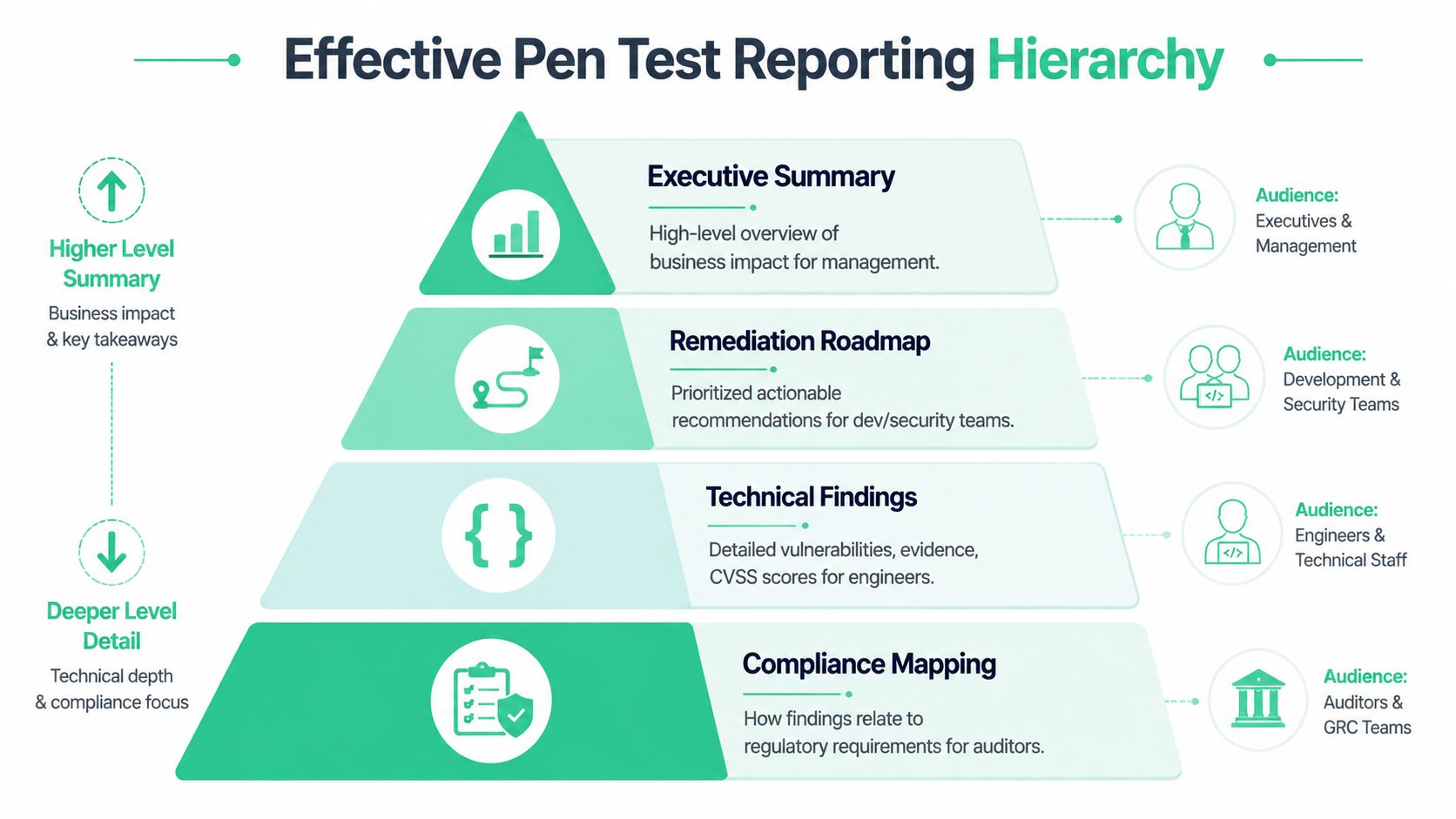
A report your team can use should have four layers:
- Executive summary: A short business view for leadership
- Remediation roadmap: A prioritized fix list for engineering
- Technical findings: Evidence, reproduction notes, and risk detail
- Compliance mapping: Clear tie-in to the controls your auditor cares about
Many firms often falter. They dump technical output on you and call it complete.
Fix order matters
Start with issues that expose data, grant broad access, or enable pivoting across services. Then clean up lower-risk weaknesses after the dangerous paths are closed.
If your team receives a report within a week and knows exactly what to fix first, the pentest did its job. If the report arrives late and nobody can act on it, it didn't.
Affordable Pentesting helps startups, SMBs, and compliance-focused teams get manual pentests without the usual drag. If you need a fast AWS penetration test, a clear report, and certified pentesters with OSCP, CEH, and CREST experience, use the Affordable Pentesting contact form to start the conversation.