.svg)

Breach Notification Requirements Guide
Friday afternoon. Your alerts light up. Someone on your team says a login pattern looks wrong, a bucket might have been exposed, or a customer is asking why their account just changed without them touching it.
That's the moment most companies realize their breach policy is just a PDF sitting in a folder.
If you're a founder, CISO, or IT manager, you don't need more legal fog. You need a plan that works under pressure. Auditors and regulators care less about your polished policy and more about whether your team can detect, escalate, investigate, and document fast enough to meet breach notification requirements. That's why smart teams treat a pen test, pentest, or full penetration testing engagement as practice for an incident, not just a compliance checkbox.
Your Breach Response Clock Is Already Ticking
The worst mistake is waiting for certainty.
When a possible breach shows up, your internal timer starts long before your team feels ready. Security, legal, ops, and leadership all need to move at once. If one person sits on the alert, or if your Slack channel turns into a debate club, you lose time you don't get back.
A lot of startups think breach readiness means having an incident response document. That's not enough. A document doesn't prove your team can recognize a reportable event, route it to the right people, and collect the facts you'll need for regulators and customers.
What matters in the first hour
Start with a simple sequence:
- Contain first: Stop more data from leaving.
- Escalate fast: Pull in security, legal, and whoever owns customer communications.
- Preserve evidence: Don't wipe logs, rotate everything blindly, or let people “clean up” systems.
- Write down the timeline: Who found it, when they found it, what systems are involved, and what you know right now.
If you don't have this muscle memory, your team will improvise. Improvised breach response gets messy fast.
Practical rule: Your first report doesn't need to be perfect. Your first actions do need to be organized.
A tested response plan is what separates “we had a bad day” from “we made the bad day much worse.” If you need a plain-English reference for organizing responsibilities, escalation, and communications, this guide to IT Cloud Global for breach planning is useful because it focuses on what teams have to do when the pressure is on.
Auditors want proof, not promises
SOC 2 and HIPAA reviews often expose the same gap. Leadership says there's a plan. The team can't show evidence that anyone has tested it.
That's where a penetration test helps. A manual pentest gives you a controlled way to test detection, escalation, and reporting behavior. A good pen testing report doesn't just list technical flaws. It gives you evidence that your incident response process was exercised under realistic conditions.
What Breach Notification Requirements Actually Mean
Breach notification requirements are just rules for who you must tell, how fast you must tell them, and what information has to be included.
Consider a fire alarm system: If smoke appears, you don't wait until you've mapped every inch of the fire before calling for help. You alert the right people, give the best information you have, and keep updating as facts come in.
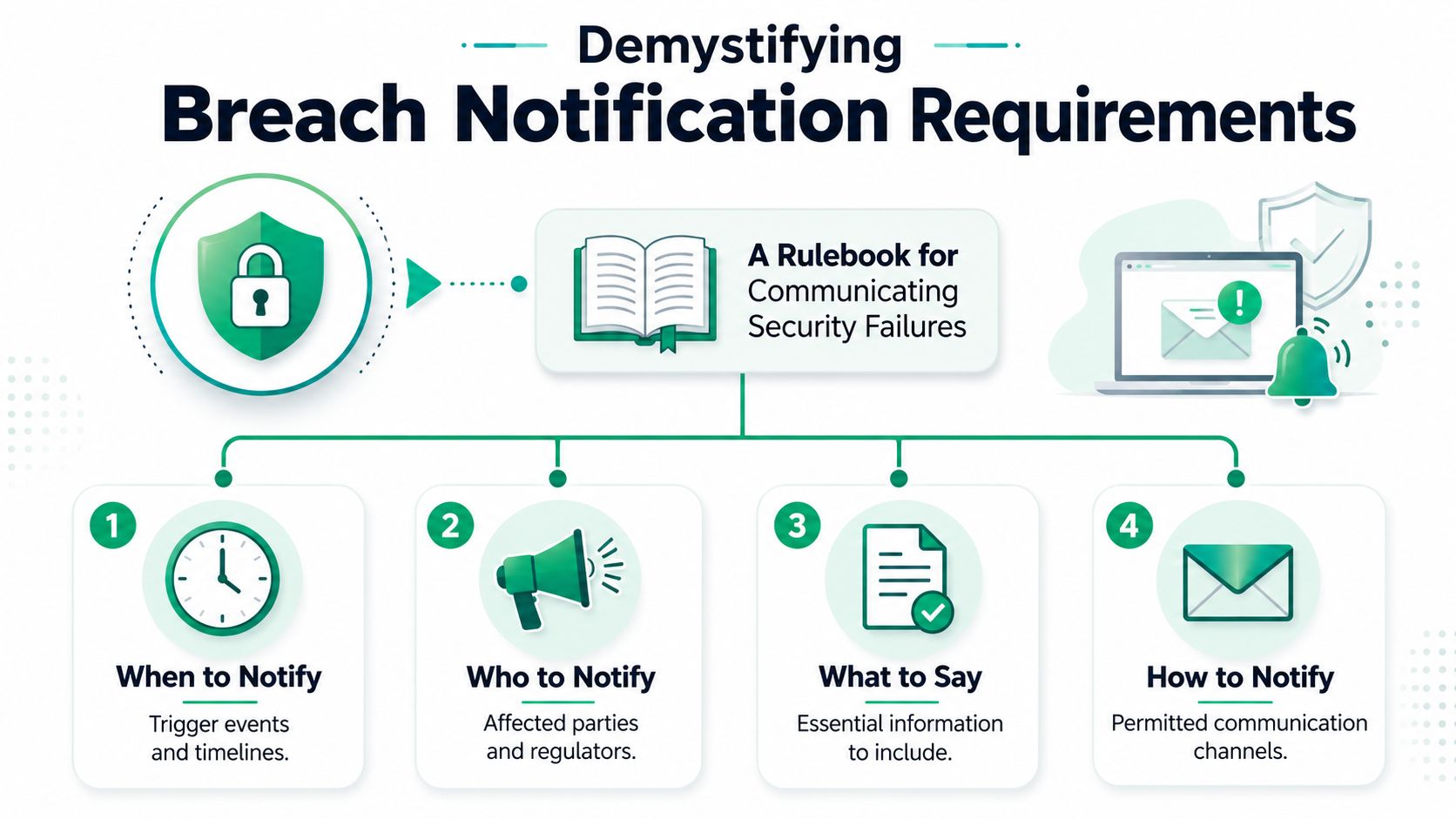
The four questions you must answer
Most breach notification requirements boil down to four things:
- When to notify: What event starts the clock
- Who to notify: Regulators, customers, patients, partners, or media
- What to say: The facts you know, the risks, and what you're doing next
- How to notify: Email, letter, website notice, media notice, regulator portal, or a mix
That's it. The hard part isn't the concept. The hard part is doing it fast when your team is stressed and your facts are incomplete.
Under GDPR, the timeline is brutally short. GDPR Article 33 mandates that organizations notify the relevant supervisory authority within 72 hours of becoming aware of a personal data breach that risks individuals' rights and freedoms; this 72-hour window begins when the organization has sufficient awareness that a breach likely occurred, not when full technical details are known according to this explanation of GDPR breach notification requirements.
Why founders get tripped up
Founders often hear “notification law” and assume it's a lawyer problem. It isn't. It's an operations problem with legal consequences.
Your security team has to know when an incident crosses the line from suspicious activity to likely breach. Your engineers have to preserve enough evidence to support a decision. Your legal and compliance people have to translate technical facts into a notice that's accurate without being reckless. If you need a broader plain-English primer on navigating complex compliance rules, that resource can help frame why these obligations cut across the whole company.
If your team needs complete technical certainty before escalation, your process is too slow.
That's why manual pentesting matters here. A real penetration test shows whether your team can separate noise from a genuine incident and whether your escalation path works before a regulator tests it for you.
A Simple Breakdown of Major Notification Rules
You find suspicious access in a production system on Tuesday morning. By lunch, your team is arguing about whether it counts as a reportable breach. That argument burns time you do not have.
The rules are different, but the operational lesson is the same. You need to know which law applies, who must hear from you, and which deadline is shortest. If you wait to sort that out during an incident, you built the wrong response process.
Breach notification requirements at a glance
| Regulation | Notification Timeline to Authorities | Individual Notification Required? | Reporting Threshold |
|---|---|---|---|
| GDPR | Notify the relevant supervisory authority within 72 hours of awareness when the breach is likely to risk individuals' rights and freedoms | Yes, when the breach is likely to result in a high risk to individuals | Risk to rights and freedoms drives the reporting decision |
| HIPAA | The HIPAA Breach Notification Rule requires covered entities to notify affected individuals without unreasonable delay and no later than 60 days after discovery. The HHS breach notification rule page explains that breaches affecting 500 or more people must also be reported to HHS without unreasonable delay and no later than 60 days, while smaller breaches may be logged and reported annually | Yes | 500 or more triggers faster HHS reporting. Fewer than 500 may be reported annually |
| State law overlays | Many state laws set their own notice deadlines, attorney general reporting triggers, and content requirements. The National Conference of State Legislatures breach notification overview tracks these state-by-state differences | Often yes | Thresholds and deadlines vary by state |
The table matters because your process has to survive overlap. A healthcare startup with EU users can face HIPAA, state breach laws, and GDPR analysis at the same time. The shortest realistic deadline should control your internal escalation.
What founders should do with this
Build one decision tree, not three separate policy binders nobody will read. Your incident lead should be able to answer four questions fast.
What data was exposed. Which people were affected. Where they are. Which regulator or agency gets notice first.
That is why testing matters. If your team cannot trace sensitive data, validate access paths, and confirm scope quickly, your legal deadline is already slipping. pentesting for HIPAA compliance helps you map protected data, find weak access controls, and prove your response team can move from detection to evidence to notification without chaos.
Healthcare teams also miss a messy source of exposure. Staff posts, replies, screenshots, and marketing content can create separate HIPAA headaches outside the core app or EHR. Review how AI prevents social media HIPAA breaches if your support, marketing, or community teams touch patient information.
Do not ask, “How long do we have?” Ask, “What is the fastest deadline that could hit us, and can we prove we are ready for it?” That is the question a good pentest helps you answer before an actual breach does.
What Your Breach Notification Report Must Contain
A breach notice is not a place for vague corporate language. People need useful information. Regulators need enough detail to see that you understand the event and are acting on it.
If your report reads like PR copy, you're doing it wrong.
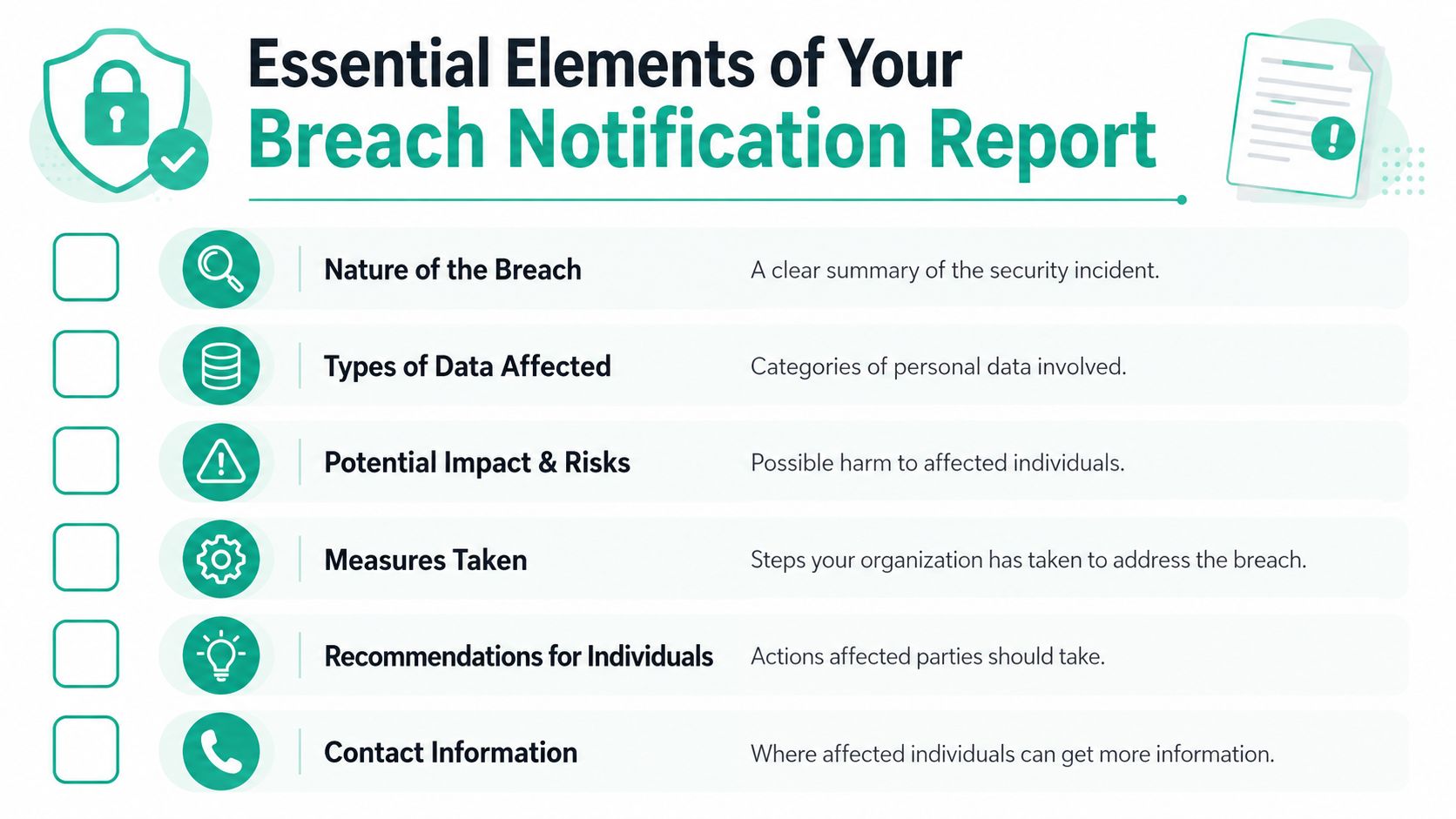
The six parts that matter
Use this checklist when building your response template:
- Nature of the breach: Say what happened in plain English. Was it unauthorized access, data exposure, account takeover, or loss of a system containing sensitive information?
- Types of data affected: Name the categories involved. Keep it factual and specific.
- Potential impact: Explain the likely risks to affected people without exaggerating.
- Measures taken: List containment and remediation steps already completed or underway.
- Recommendations for individuals: Tell people what they should do next, such as watching accounts, changing credentials, or contacting support.
- Contact path: Give a clear route for follow-up, usually through a support or contact form and your formal incident communication channel.
Write for clarity under pressure
Don't dump every forensic detail into the first notice. Include what people need to act.
That means your internal reporting template should be simple enough for legal, security, and leadership to update together. If your current template needs a committee meeting to complete, it will fail when time matters.
A strong notification report is a crisis tool first and a paperwork artifact second.
This is one reason auditors often ask for supporting evidence around controls and response processes. Teams using industry-focused SOC 2 pentesting usually get a clearer picture of where data can be reached, which systems matter most, and what facts they'll be able to gather quickly if a real incident hits.
How a Pentest Proves Your Response Plan Works
Most breach plans look fine on paper.
Then a real attacker chains together one exposed web app flaw, one weak permission boundary, and one missed alert. Suddenly the team learns that the escalation path is fuzzy, the logs are incomplete, and nobody is sure who approves a notice draft.
That's why I push manual pentests so hard. A real pentest, pen test, or penetration testing engagement doesn't just find vulnerabilities. It pressure-tests the parts of your company that determine whether you can meet breach notification requirements without chaos.
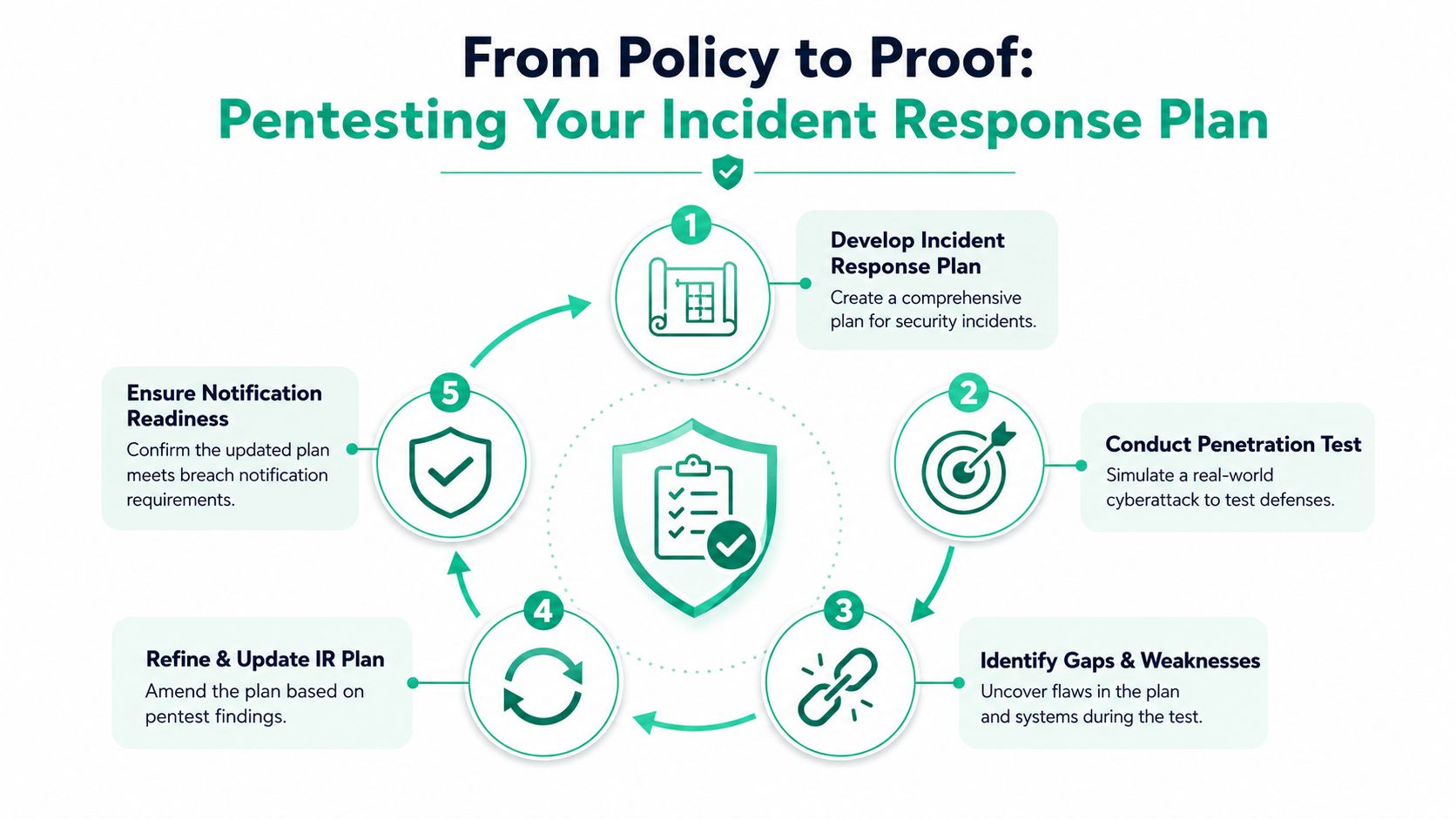
What a good manual pentest uncovers
Automated scanners have their place. They're fast and cheap. They also miss context all the time.
A certified tester with OSCP, CEH, or CREST experience looks at how an attacker would move. That includes chained weaknesses, weak business logic, bad access controls, and reporting gaps your tools won't explain well.
Here's what that gives you for breach readiness:
- Detection gaps: You learn whether suspicious activity creates alerts your team will see
- Escalation weaknesses: You find out if alerts reach the right people quickly enough
- Evidence problems: You discover whether logs and artifacts support a notification decision
- Containment friction: You see where response actions break business workflows or stall approvals
Why speed matters more than polish
You do not need a six-week engagement and a glossy slide deck.
You need a penetration test that surfaces real findings, a report you can act on within a week, and enough clarity to tighten your incident response plan before an auditor or regulator forces the issue. That's especially true for startups and SMBs that can't burn budget on oversized consulting projects that produce very little.
Data indicates that 40% of GDPR regulator fines stem from notification delays rather than the breach itself, which is why submitting what you know now matters so much, as noted in the EDPB guidance on personal data breach notification.
Reality check: If your team can't identify a likely reportable incident during a controlled penetration test, they probably won't do it cleanly during a live breach.
For teams with exposed customer-facing systems, web app penetration testing is often the fastest route to useful evidence because web applications are where authentication flaws, broken access control, and sensitive data exposure tend to surface first.
A good pentest report becomes audit evidence. It shows you tested controls, identified weaknesses, and improved your process. That's a lot more convincing than saying, “We have a policy somewhere.”
Avoid These Common Breach Notification Traps
Most notification failures aren't caused by ignorance. They're caused by bad assumptions.
Teams assume the clock starts after the investigation. They assume federal rules always beat state rules. They assume they need every detail before they say anything. Those assumptions get companies in trouble.

Trap one waiting for perfect information
This is the classic GDPR mistake. A team sees signs of compromise, launches forensics, and delays escalation because they want a complete answer first.
That's backwards. You need a process that supports phased reporting when facts are still developing. If your internal culture treats incomplete early reporting as failure, people will wait too long.
Trap two assuming HIPAA always gives you sixty days
This one bites healthcare organizations and vendors all the time. Content often cites the standard HIPAA 60-day rule without addressing the conflict when a state law, such as New York's 30-day or Florida's 30-day requirement, mandates faster notification. Surveys show that 65% of HIPAA-covered entities mistakenly believe the 60-day federal standard overrides all state laws, according to the AMA discussion of the HIPAA breach notification rule.
If you operate across multiple states, your process has to account for stricter state deadlines. Don't let anyone tell you “HIPAA says sixty days” as if that ends the conversation.
Trap three separating security from compliance
A lot of companies split these functions so hard that neither side sees the whole incident.
Security teams find the problem but don't know the notification triggers. Compliance teams know the rules but don't have enough technical context to make the call quickly. Run drills together. Review pen test findings together. Build one shared incident timeline, not three disconnected versions.
The teams that respond well aren't smarter. They've just practiced the handoff before the real incident happens.
Frequently Asked Questions About Breach Response
A founder gets a late-night Slack alert, sees “critical vulnerability,” and immediately asks the wrong question: “Do we have to notify anyone?” Start one step earlier. Figure out whether you have a security weakness, an actual incident, or a confirmed breach involving regulated data. That distinction decides your next move, and a good pentest helps you make it fast.
Does a pentest finding count as a real breach
A pentest finding is evidence of exposure, not proof that an attacker got in. It shows where your systems can fail and where your response process will break under pressure.
Treat those findings seriously anyway. If your pentest shows customer data could be reached through a simple chain of flaws, fix it, document it, and test your escalation path right then. That is the cheap version of breach response practice.
How fast do we need to act under GDPR
You need a team that can make an initial call within hours, not days. GDPR's 72-hour timer starts when you become aware of a personal data breach, not when your investigation feels complete.
If that sounds tight, good. It is. Your security lead, legal contact, and operations owner should already know who decides whether a suspected breach crosses the reporting threshold.
What if we don't know the full scope yet
Report based on what you know, then update as facts come in. Waiting for perfect certainty is how startups miss deadlines and create a second problem on top of the first.
Your incident log should show when you detected the issue, who reviewed it, what systems were affected, what data may be involved, and what you still do not know. If you cannot assemble that timeline quickly, your process is weak.
What kind of penetration testing helps most
Pick the tests that match your actual exposure. For many startups, that means a web application pentest, an external attack surface review, and testing around cloud assets or APIs that touch customer or regulated data.
Do not buy a giant scope to impress an auditor. Buy the scope that shows whether an attacker can reach the systems that would force you into breach notification.
My auditor wants a report quickly. What should I ask for
Ask for a manual pentest, named tester qualifications, clear proof of findings, severity ratings you can act on, and a report delivered within a week.
Speed matters here. You are not buying a PDF. You are buying usable evidence that your team can find, verify, triage, and fix security issues before a real incident forces disclosure.
If you need a fast, affordable way to validate your incident response process and support breach notification readiness, Affordable Pentesting is a practical place to start. Their certified pentesters, including OSCP, CEH, and CREST professionals, focus on affordable manual pentests, useful findings, and reports within a week so your team can fix issues and walk into audits with real evidence instead of wishful thinking.