.svg)
Dynamic application security testing (DAST) is an automated way to test a running application by throwing malicious-looking inputs at it and watching how it responds. It's fast, it's language-agnostic, and it's genuinely useful for catching a certain class of bugs. It also misses the ones most likely to get you breached. At Affordable Pentesting, we use DAST tooling as part of the job, then a certified human goes hunting for what the scanner walked right past. Manual pentests start at $2,000 and land in about five business days.
Here's the trap. A clean DAST report feels like safety.
It isn't.
DAST is a smoke detector. Useful, worth having, and completely blind to the burglar who walks in the front door with a key. If you're relying on a scanner alone to tell you whether your app is secure, you're going to get a nasty surprise. Usually from an attacker, sometimes from an auditor.
Let's break down what DAST actually does, where it earns its keep, and where it quietly leaves you exposed.
In this guide:
- What dynamic application security testing (DAST) is
- How DAST works
- DAST vs SAST vs penetration testing
- What DAST catches well
- Where DAST falls short
- How to get real value from DAST
- DAST and compliance
- DAST or a penetration test?
- FAQ
What dynamic application security testing (DAST) is
Dynamic application security testing is black-box testing of a live application. The tool doesn't see your source code. It interacts with your app the way an outside attacker would, sending crafted requests and reading the responses for signs of a vulnerability.
Because it works from the outside, DAST doesn't care what language you wrote the app in. Node, Python, Go, a fifteen-year-old Java monolith, it's all the same to the scanner. It just needs a running target and a URL.
Common DAST tools include OWASP ZAP and commercial scanners built on the same idea. They crawl your app, map its pages and endpoints, and then fire off test payloads to see what breaks.
That's the whole model. Attack the running app, watch the responses, flag anything that looks wrong. No code access, no assumptions about how the app was built.
How DAST works
Under the hood, a DAST scan runs in a predictable loop.
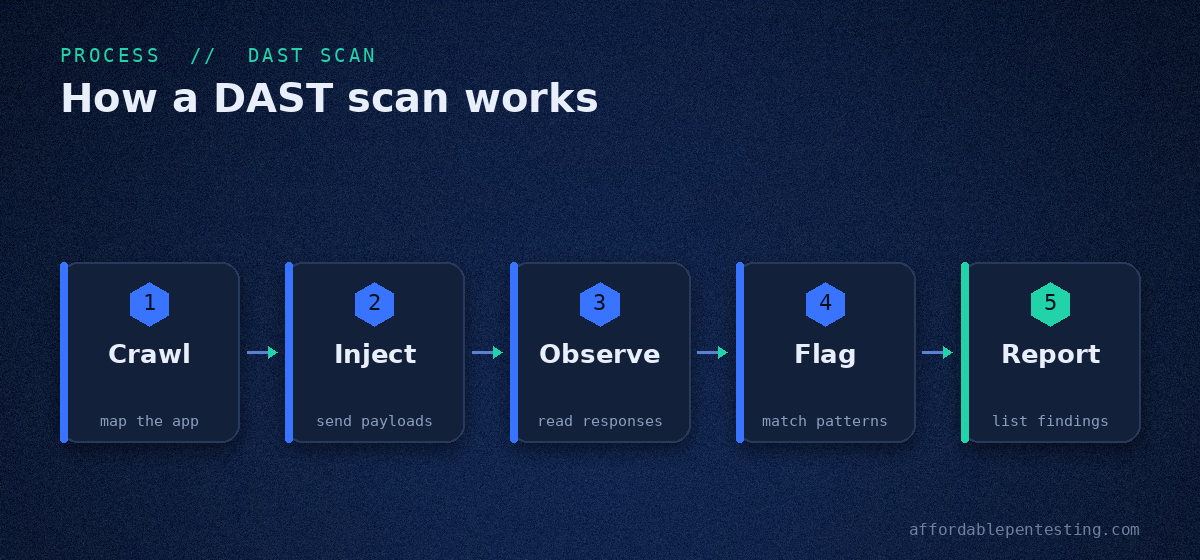
- Crawl. The scanner spiders your application, following links and forms to build a map of pages, parameters, and endpoints.
- Inject. It sends malicious-looking inputs to each of those parameters: script tags, SQL fragments, path traversal strings, oversized values.
- Observe. It reads the responses. An error message, a reflected payload, an unexpected redirect, or a timing delay can each signal a flaw.
- Flag. When a response matches a known vulnerability pattern, the tool records a finding with a severity rating.
- Report. You get a list of findings to review, confirm, and fix.
Notice what's missing from that loop. Judgment. The scanner matches patterns. It doesn't understand your business, your users, or what your app is supposed to protect.
DAST vs SAST vs penetration testing
DAST gets lumped in with two other things it isn't. Static application security testing (SAST) reads your source code. A penetration test is a human trying to break in. They solve different problems.
| DAST | SAST | Penetration test | |
|---|---|---|---|
| What it tests | Running app, from outside | Source code, from inside | The whole system, like a real attacker |
| Who runs it | Automated tool | Automated tool | A certified human |
| Language-aware | No | Yes | Whatever it takes |
| Finds business logic flaws | Rarely | No | Yes |
| False positives | Moderate | High | Low, findings are verified |
| Best used for | Fast, repeatable regression checks | Catching bugs early in the code | Proving real-world risk and passing audits |
These aren't competitors. A mature program uses SAST and DAST in the pipeline for coverage, then a penetration test to find what automation can't. The mistake is treating any one of them as the finish line.
What DAST catches well
Give DAST credit where it's due. For a whole category of technical flaws, it's fast and effective.
- Reflected cross-site scripting (XSS). Payloads that bounce back unescaped are exactly the pattern DAST is built to spot.
- Obvious injection points. Some SQL injection and command injection flaws surface through error messages and timing, which a scanner reads well.
- Security misconfigurations. Missing security headers, verbose error pages, exposed admin panels, and default files show up quickly.
- Known-vulnerable components. Outdated server software and libraries that announce their version get flagged.
- Regression checks. Run it every release and it'll tell you if an old bug came back.
That last one is the real value. DAST scales. You can run it on every build, cheaply, forever. It's a solid layer in a web application security program. Just don't confuse a layer with a roof.
Where DAST falls short
This is the part vendors gloss over. The vulnerabilities most likely to actually hurt you are the ones DAST is worst at.
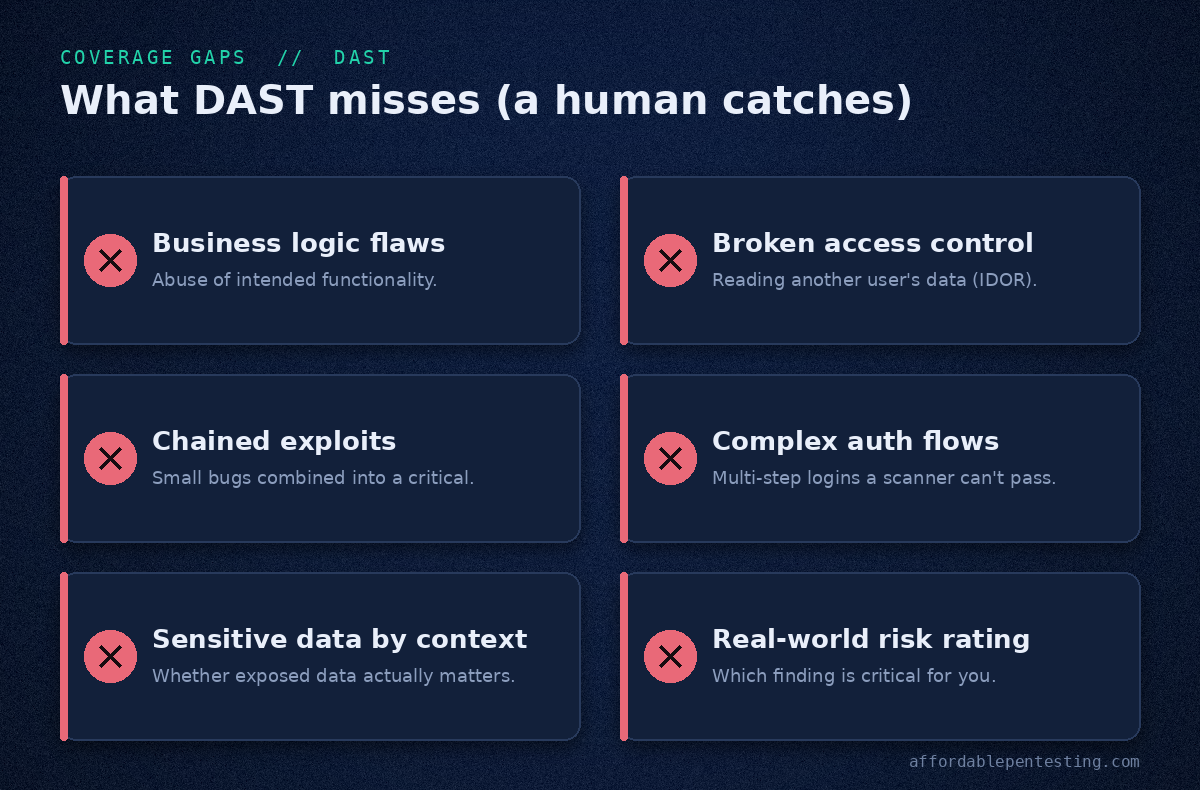
Business logic flaws. A scanner doesn't know that your checkout lets a user set the quantity to negative one and get a refund. It doesn't understand intent, so it can't spot an abuse of intended functionality. This is where a lot of real money gets lost.
Broken access control. Broken access control sits at the top of the OWASP Top 10 for a reason. Can user A read user B's invoices by changing an ID in the URL? A human tester logs in as two users and checks. A scanner usually can't tell the difference between an intended page and a stolen one.
Chained exploits. Real attacks stack small issues. An information leak feeds a weak password reset, which feeds an account takeover. DAST reports those three findings as unrelated "lows," if it finds them at all. A tester connects them into one critical.
Authentication and multi-step flows. Scanners struggle to navigate complex login, multi-factor, and stateful workflows. Whole sections of your app can go untested because the tool couldn't get past the front door.
Anything needing context. Is that exposed data actually sensitive? Is that "low" finding critical in your environment? The scanner shrugs. A human decides.
None of this means DAST is useless. It means a clean DAST report answers one narrow question, and buyers keep mistaking it for a different, bigger one.
Want it concrete? Picture an online store. Your DAST scan runs clean: no XSS, no injection, headers all present. Meanwhile a user changes the quantity field to a negative number at checkout and the total goes negative, so your system issues a refund on a purchase. That's a business logic flaw. The scanner saw a valid form submission and a normal response, so it said nothing. A human tester tries the weird input on purpose, because breaking the intended flow is the entire job. Same app, same day, one finds a critical and the other finds nothing.
How to get real value from DAST
DAST is worth running. Just run it like a tool, not an oracle.
- Scan authenticated. An unauthenticated scan only sees your login page. Give the tool valid credentials so it can reach the parts of the app that actually hold risk.
- Tune the noise. Triage the findings and suppress the confirmed false positives, or your team learns to ignore the report entirely.
- Use it for regression. Its best job is catching a known bug that sneaks back in. Wire it into your release pipeline and let it run on every build.
- Pair it with a human. Let the scanner handle breadth so your tester spends their hours on logic, access control, and chained attacks. That's the combination that actually covers you.
DAST and compliance
If you're running DAST to satisfy an auditor, read this part twice.
DAST can support your vulnerability management story. It shows you test regularly and act on findings. But most frameworks that matter to SMBs expect a penetration test, and a scan is not a pentest.
- PCI DSS. Requirement 11.4 specifically calls for penetration testing, internal and external, performed by a qualified tester. Automated vulnerability scanning lives under a separate requirement. A DAST scan alone doesn't cover 11.4.
- SOC 2. The Trust Services Criteria don't name a tool, but auditors routinely expect a penetration test as evidence for monitoring and change-management controls. A scan report usually won't carry that weight on its own. See our guide to automated testing for SOC 2.
- ISO 27001. Annex A controls around technical vulnerability management and secure development are best evidenced by testing that includes human validation, not just tool output.
The pattern is consistent. Scanners help you stay clean between tests. The test that auditors and customers actually ask for is a human-led penetration test. We build ours to hand straight to the auditor. Get a SOC 2 pentest if that's your deadline.
One more thing: no tool and no tester can promise you'll pass an audit or that you're unhackable. Anyone who does is selling. What good testing does is show you exactly where you stand and how to fix it.
DAST or a penetration test? How to decide
You don't have to pick one forever. But for a given need, the choice is usually clear.
Reach for DAST when you want cheap, repeatable coverage on every release, a fast regression check, or an early warning on obvious misconfigurations. Build it into your pipeline and let it run.
Reach for a penetration test when you need to prove real-world risk, when a customer or auditor is asking, when your app handles money or sensitive data, or when you have complex logic and access rules that a tool can't reason about. That covers most APIs, too, which is why API penetration testing leans so heavily on human testers.
The smart move for most SMBs: automated scanning for breadth, a manual pentest for depth. If you only have budget for one and something real is on the line, the human wins every time. For more on the limits of tooling, see our breakdown of web application scanning.
Frequently asked questions
What is dynamic application security testing (DAST)?
DAST is an automated method that tests a running application from the outside. It sends malicious-looking inputs to the app and analyzes the responses to find vulnerabilities, without any access to the source code.
How does DAST work?
A DAST tool crawls your application to map its pages and parameters, injects test payloads into those inputs, observes how the app responds, and flags responses that match known vulnerability patterns. Then a person reviews and confirms the findings.
What is the difference between DAST and SAST?
SAST analyzes your source code from the inside and is language-specific. DAST tests the running application from the outside and is language-agnostic. SAST catches issues earlier in development; DAST catches issues that only appear at runtime. Neither replaces a penetration test.
Is DAST the same as a penetration test?
No. DAST is an automated scan that matches known patterns. A penetration test is a human simulating a real attacker, chaining flaws and testing business logic and access control. DAST is a useful input to a pentest, not a substitute for one.
What are the limitations of DAST?
DAST struggles with business logic flaws, broken access control, chained exploits, and complex authenticated workflows. It also lacks context, so it can't judge which findings actually matter in your environment. Those gaps are exactly where human testing earns its keep.
Does DAST satisfy SOC 2 or PCI DSS?
Not on its own. PCI DSS Requirement 11.4 calls for penetration testing, and SOC 2 auditors typically expect a pentest as evidence. DAST supports your vulnerability management program, but the audit usually asks for human-led testing.
The bottom line
Dynamic application security testing is a good tool doing a narrow job. It finds the shallow, patternable bugs fast and cheap, and it's worth running on every release.
Just don't mistake it for the whole picture. The flaws that empty accounts and leak customer data, the logic abuse and the access-control holes, are the ones a scanner walks right past. That's what a human tester is for.
Want to know what your scanner is missing? Get a quote in about 60 seconds, or book a call and we'll tell you straight.