.svg)
Ethical Hacking Basics for Fast Pentests
You're probably here for one reason. A customer, auditor, or board member wants proof that your security works, and they want it soon.
That usually means a pentest, a pen test, or a full penetration test. Then the frustration starts. Traditional firms quote five figures, drag timelines out, and hand back reports that either miss obvious business risk or arrive too late to help.
Ethical hacking basics matter because this isn't an academic topic for your team. It's a buying decision tied to compliance, customer trust, budget, and deadlines.
What Is Ethical Hacking and Why You Need It
A customer security review lands in your inbox on Tuesday. They want proof your app has been tested by Friday. Your engineers are shipping, your budget is tight, and nobody has time for a month-long security project. Ethical hacking is the fast way to find out whether an attacker can get in, before a prospect, auditor, or criminal forces the issue.
Ethical hacking means hiring a qualified tester to attack your systems legally, with written authorization and a defined scope, so you can fix real weaknesses before they cost you a deal or trigger an incident. The line between legal testing and criminal activity is simple. Permission, scope, and a requirement to report findings back to you.
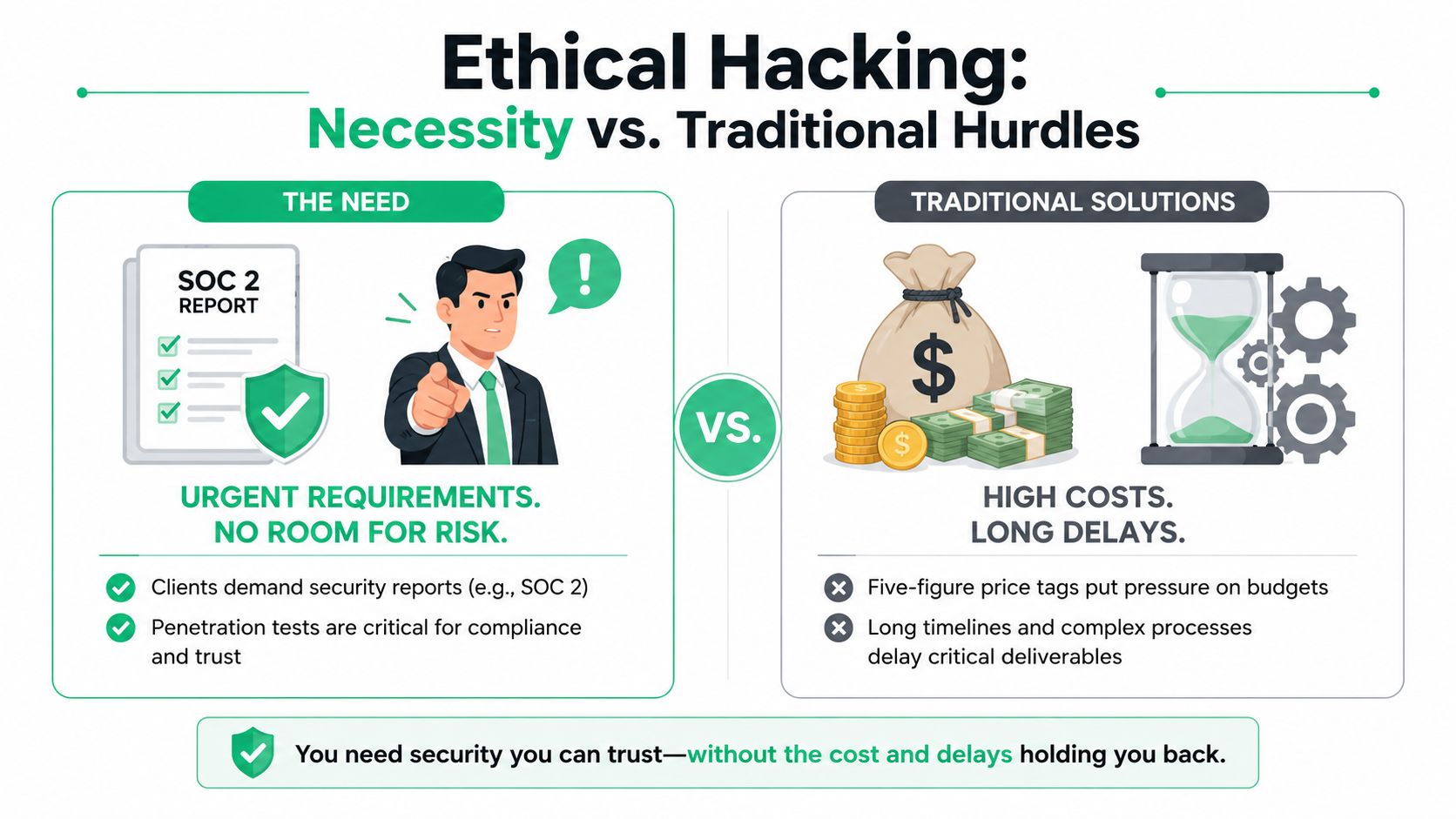
What this means for a business leader
If you run a startup, lead IT, or own security, you are not buying ethical hacking to learn attacker tricks. You are buying an answer to a business question.
Can someone break into the systems that matter to revenue, customer trust, or compliance?
A good pentest answers that quickly. It shows which weaknesses are exploitable, which ones deserve engineering time first, and what evidence you can hand to customers or auditors. That is why ethical hacking matters. It cuts through noise and gives you a short list your team can act on now.
Why you should care
Penetration testing earns its keep when it helps you move faster without taking blind risk. The payoff is practical:
- Sales moves faster: Enterprise buyers want proof that your controls hold up under real testing.
- Compliance work stops stalling: Auditors often expect independent validation, not internal claims.
- Engineering stays focused: Your team gets confirmed issues, not a bloated spreadsheet of scanner output.
- Delays get expensive fast: Missed security evidence can slow procurement, renewals, and launch dates.
Practical rule: If the engagement does not end with clear findings, business impact, and remediation guidance your team can use right away, do not buy it.
You will also hear the terms white hat and black hat. Keep it simple. White hats are the authorized testers you hire. Black hats are criminals. The techniques can overlap. The business outcome does not. One gives you documented findings, priorities, and proof for stakeholders. The other gives you downtime, cleanup costs, and uncomfortable board updates.
If your environment includes overseas operations or region-specific infrastructure concerns, review broader network security best practices for China so your pentest supports a security plan that fits how your business runs.
Understanding the Penetration Testing Lifecycle
You hire a pentest because a customer deadline is close, the auditor wants evidence, and your engineers do not have time to chase vague security noise. That means the lifecycle matters. A good test follows a disciplined path, stays inside scope, and ends with a report your team can use fast.
A standard engagement usually moves through six stages: reconnaissance, scanning, gaining access, maintaining access, analysis, and reporting. You do not need to memorize the labels. You need to know what happens in each step, how long it should take, and what you should get back for the money.
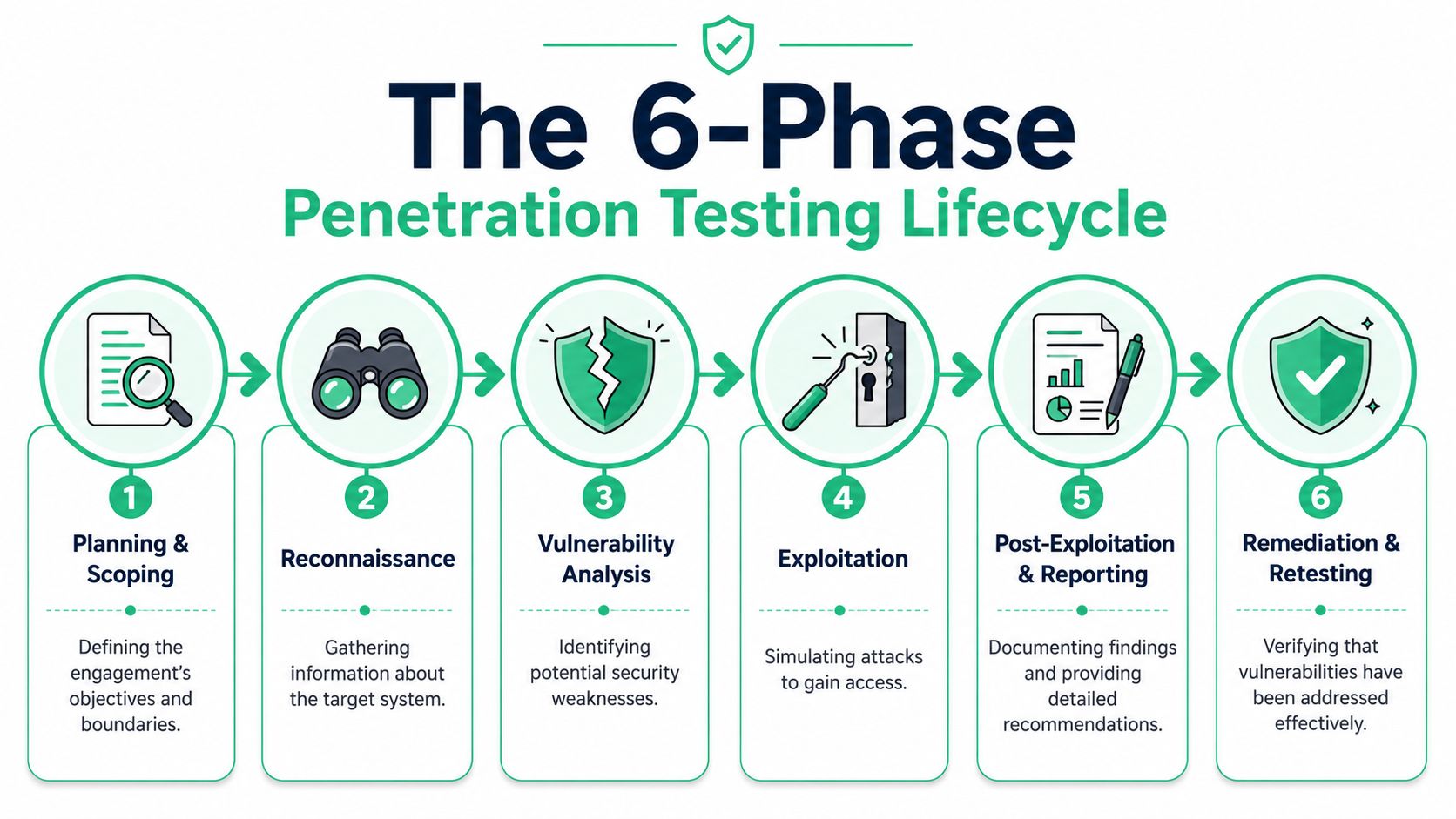
What your pentester does
Here's the lifecycle in plain English:
Reconnaissance
The tester collects information about your internet-facing systems, application paths, login flows, and exposed infrastructure. This shows where an attacker would start and helps keep the rest of the test focused.Scanning
Tools like Nmap and Nessus identify open ports, running services, and obvious weaknesses. This phase is fast, but it is only the map, not the answer.Gaining access
The tester tries to turn weaknesses into proof. That can mean exploiting poor authentication, injection flaws, insecure configurations, or exposed admin functions. For a business buyer, this is the stage that separates a checkbox exercise from a test that proves risk.Maintaining access
If the tester gets in, the next question is impact. Can they escalate privileges, move sideways, pull sensitive data, or persist long enough to matter? That tells you whether the issue is minor or worth fixing this week.Analysis
Findings are verified, duplicates are removed, and risk is prioritized. At this point, good firms save your engineers time. You want confirmed issues with evidence, not a recycled scanner dump.Reporting
The engagement ends with a document your security lead, developers, customers, and auditor can all understand. If the report is unclear, the test failed, even if the tester found real issues.
Why the Report is the Most Valuable Deliverable
Founders often focus on the attack phase because it sounds like the hard part. It is not. The report decides whether the engagement helps your business or creates more work.
A strong report gives your team three things immediately: what was found, how serious it is, and what to fix first. It should include scope, affected assets, evidence, business impact, and clear remediation guidance. That is what helps you close tickets, answer customer questionnaires, and hand auditors something usable without weeks of follow-up.
If you are buying this test for compliance, ask to see a sample report before you sign. If the vendor cannot show a clean, readable deliverable, keep looking. Teams buying for SOC 2 should review Affordable Pentesting's SOC 2 offerings because speed and audit-ready reporting matter more than flashy methodology slides.
You may also need to test signup and account recovery flows tied to SMS verification, temporary identities, or abuse-prone onboarding paths. In those cases, resources on how teams manage accounts without real numbers can help you define realistic abuse scenarios around registration, fraud controls, and verification logic.
Connecting Pentesting to Your Compliance Needs
A pentest isn't just security hygiene. For many companies, it's a sales and compliance document.
If you're dealing with SOC 2, HIPAA, PCI DSS, or ISO 27001, someone will ask for evidence that your controls were tested in operational environments. That evidence usually comes in the form of a penetration testing report with clear findings, scope, methodology, and remediation guidance.
Auditors want proof, not confidence
You can tell an auditor your app is secure. That won't carry much weight.
What helps is an independent penetration test showing what was tested, what was found, and how your team handled it. The same goes for enterprise procurement teams. They don't want a marketing answer from your sales rep. They want a document they can pass to their own security reviewers.
That's why a pentest often speeds up more than compliance. It can unblock procurement, shorten customer security reviews, and reduce the back-and-forth that stalls deals.
Use the report to move deals forward
A strong pen test report helps three groups at once:
- Auditors: They get evidence that controls weren't just designed, but challenged.
- Customers: They get confidence that you take risk seriously.
- Internal teams: They get a prioritized fix list instead of vague concern.
If SOC 2 is your immediate pressure point, review Affordable Pentesting's SOC 2 offerings to understand how a pentest fits into that specific compliance path.
A pentest report should help you pass review, close gaps, and answer customer questions without dragging engineers into every call.
Risk work also gets easier when you tie findings back to operational controls. If you need a non-technical primer on governance and remediation planning, this guide to strategies for risk assessment and control is useful context for turning findings into a plan your leadership team will approve.
The Difference Between Scans and Manual Pentests
A cheap scan is not the same thing as a manual pentest. Vendors blur this line all the time because “penetration testing” sells better than “automated scan.”
Don't fall for it. If you need a report that stands up to audit scrutiny or customer review, you need human-led testing.
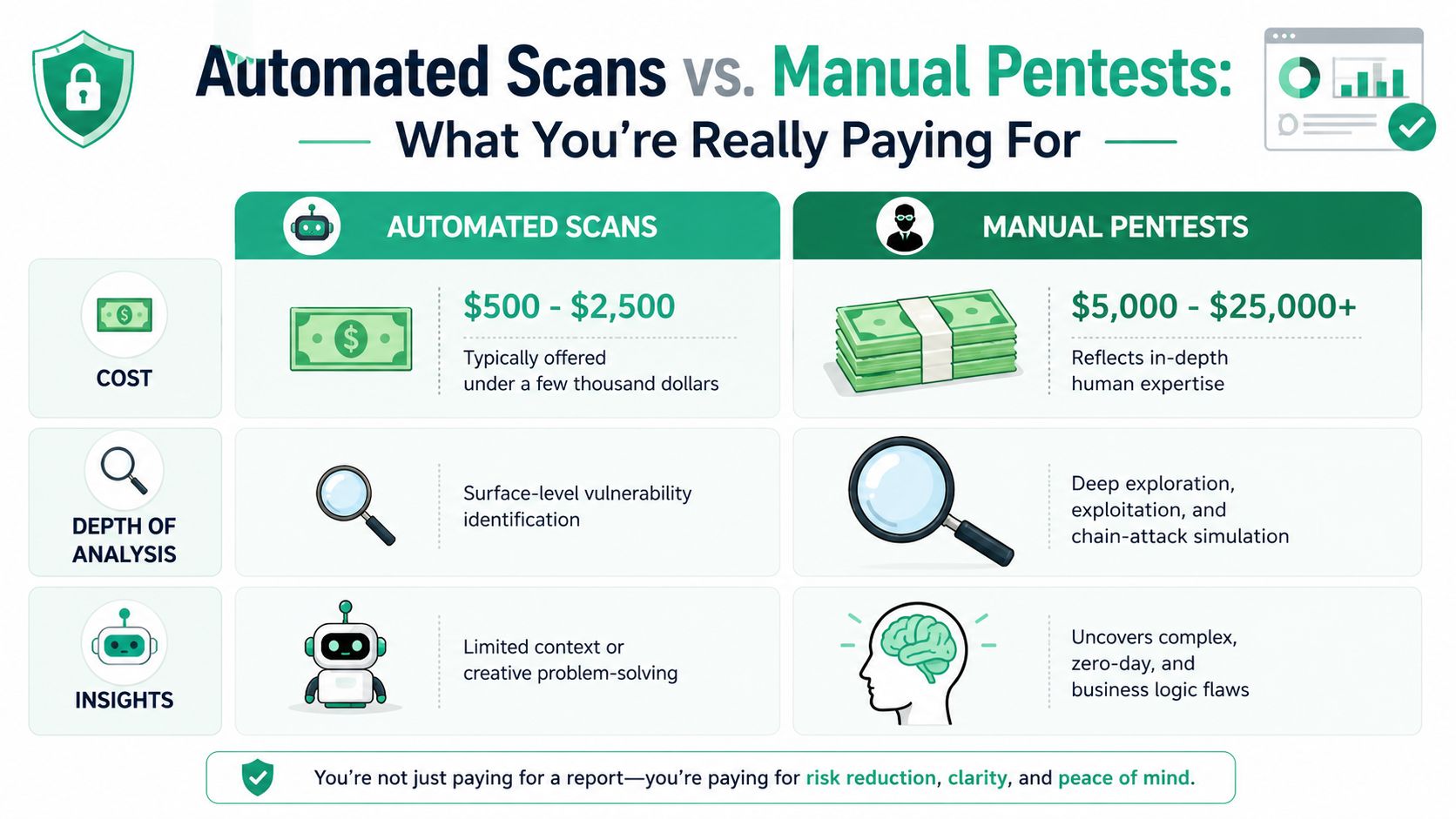
What the pricing usually tells you
The market gives this away. Professional-grade manual penetration testing generally falls in the $10,000 to $35,000 range, while offerings under $4,000 are usually automated scans with little or no manual validation. A manual web application pentest typically starts around $5,000, according to DeepStrike's penetration testing cost guide.
That doesn't mean every expensive test is good. It does mean ultra-cheap “pen testing” is usually just software running checks and exporting a report.
Side-by-side comparison
| Service type | What you actually get | Where it falls short |
|---|---|---|
| Automated scan | Fast surface-level checks for known issues | Misses context, chaining, and business logic flaws |
| Manual pentest | Human validation, exploitation, prioritization, clearer reporting | Costs more and requires scheduling |
| Hybrid approach | Scanner support plus human testing | Quality depends heavily on how much manual work is included |
A scanner can tell you a door might be open. A pentester checks whether that door leads to payroll, customer data, or an empty closet.
That distinction matters for web apps in particular. Login flows, role changes, password resets, checkout steps, and API permissions often break in ways scanners don't understand. If that's your main risk area, look closely at penetration testing for web apps rather than generic network-only testing.
Cheap scans produce long lists. Good manual penetration testing produces decisions.
How to Choose a High-Quality Pentesting Partner
Not all testers are equal. Some can run tools. Fewer can think like attackers, explain risk clearly, and write a report your engineers and executives can both use.
When you're buying a pentest, credentials matter because they're one of the fastest ways to filter out weak providers.
Certifications are a quality shortcut
To become a certified ethical hacker, professionals need deep knowledge in networking, programming, and tools like Kali Linux, and certifications such as CEH and OSCP are essential for establishing credibility according to CCI Training's overview of ethical hacking skills.
For buyers, that means something practical:
- OSCP: Usually signals hands-on offensive skill and real exploitation experience.
- CEH: Shows formal grounding in ethical hacking concepts and standard methods.
- CREST: Adds another layer of recognized professional assurance in many commercial environments.
None of these badges make someone perfect. But they're a useful filter when your shortlist is full of firms making the same promises.
What to ask before you sign
Don't ask vague questions like “Are your testers experienced?” Ask questions that force a real answer.
- Who performs the work: Ask whether certified senior testers do the engagement, or whether junior staff run tools and escalate only if needed.
- What's included: Confirm whether the service is manual penetration testing or mostly automated scanning with analyst review.
- How findings are validated: You want confirmed issues, not inflated noise.
- What the report looks like: Ask for a redacted sample so you can see whether it works for both engineers and leadership.
- How communication works: You need a clear point of contact during scheduling, testing, and report review.
The partner should fit your pace
A high-quality provider doesn't just find issues. They help you move fast without creating chaos.
That means tight scoping, clear rules of engagement, straightforward scheduling, and a report that doesn't require a translator. If the firm talks in circles before the project starts, expect the report to read the same way.
Your Checklist for Commissioning a Pentest
Your auditor asks for a pentest report. Your largest prospect asks for one too. Now the clock is running, and the actual risk is not the test. It is the prep work that stalls approval, scheduling, and delivery.
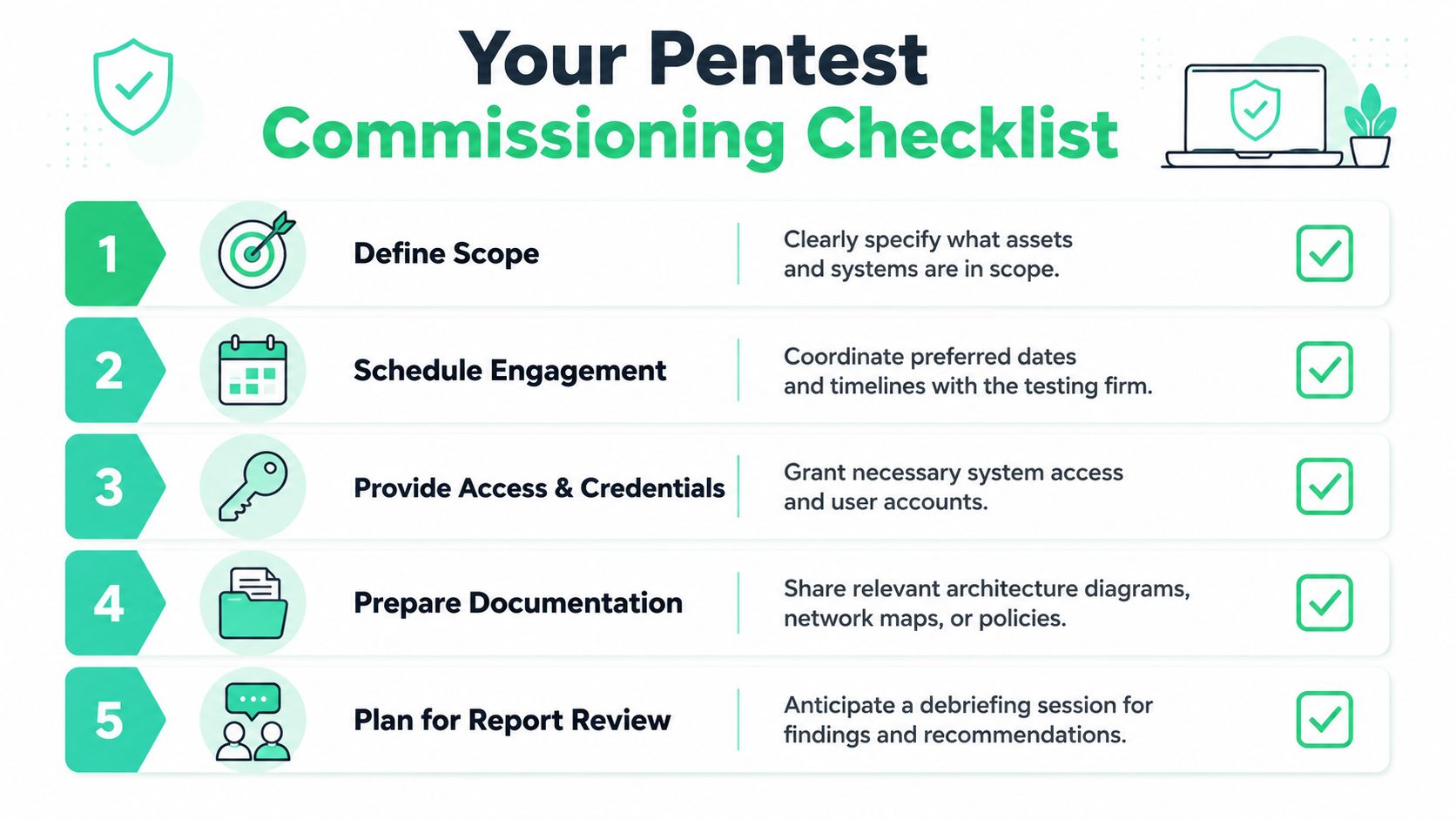
If you want a fast, affordable pentest, get your inputs straight before you contact vendors. That cuts wasted calls, keeps the quote accurate, and shortens time to report.
The checklist that saves a week
Use this before you book the engagement:
- Define the assets: List the exact web apps, APIs, IPs, cloud systems, and environments in scope. If an asset is missing from the list, expect it to be excluded.
- Choose the business goal: Be clear about why you are buying the test. Compliance evidence, customer due diligence, release readiness, or risk reduction. This drives scope and reporting.
- Pick the test type: Decide whether you need external, internal, web application, authenticated testing, or a small targeted retest after fixes.
- Set the rules in writing: Confirm testing dates, production limits, rate-limit concerns, no-touch systems, and emergency contacts.
- Prepare access early: If the provider needs logins, VPN access, allowlisting, or MFA support, sort that out before the start date.
- Send the right context: Architecture diagrams, user roles, workflows, and known edge cases help testers find real issues faster.
- Define the report audience: Tell the provider whether the report needs to satisfy auditors, security questionnaires, engineers, leadership, or all of them.
Tight prep saves money.
A lot of startup teams waste budget by buying a scope that is too broad for the deadline in front of them. If your immediate need is SOC 2, HIPAA, ISO 27001, or a customer security review, start with the systems that store sensitive data, support login, process payments, or face the internet. You can expand later. That approach gets you a usable report faster and leaves your engineering team with a fix list they can complete.
If you are still comparing vendors, start with a provider built for a fast and affordable pentest, not a long pre-sales cycle.
Keep approval and authorization simple
Do not treat permission details as paperwork. Treat them as project control.
Put the scope, test window, points of contact, and written authorization in one place. That prevents internal confusion, avoids accidental alerts to your ops team, and protects your business if someone asks why offensive testing hit a production system on Tuesday at 2 p.m.
The best pentest starts with a clean scope and a short email thread, not a month of back-and-forth.
Get Your Audit-Ready Report in One Week
You don't need a drawn-out process to get a serious pentest. You need a clear scope, certified testers, and a report your team can use right away.
That quality piece matters. Certified practitioners identify 35% more critical vulnerabilities than non-certified ones in SOC2 and HIPAA compliance audits, which directly affects the usefulness of the final report, according to Hack The Box's ethical hacking career guide.
For a busy founder, CISO, or IT manager, the right outcome is straightforward:
- Fast scheduling
- Manual testing by certified professionals
- Clear findings
- An audit-ready report within a week
That's the standard you should expect. Not six weeks of waiting, not vague pricing, and not a bloated report packed with scanner noise.
If you're comparing options, start with a provider built for speed and practical compliance outcomes, not endless pre-sales calls. A fast and affordable pentest should help you meet the deadline, fix the actual issues, and move on.
If you need a pentest, pen test, or full penetration testing engagement without the usual delays and inflated pricing, contact Affordable Pentesting through the contact form. Their team focuses on affordable manual testing for startups and growing companies that need clear findings, certified testers, and an audit-ready report fast.