.svg)
Your team is ready to turn on a new vendor. The tool looks useful, the price works, and implementation can happen this week. Then someone asks the question that matters. Will this vendor touch protected health information, and if so, do we have a signed BAA before anything moves?
A Business Associate Agreement, or BAA, is the contract that lets you share PHI with a vendor and puts real HIPAA duties on that vendor. Treat it like a security document, not just legal paperwork. A weak BAA creates the same problem as a weak firewall rule. You approved risk without defining the control.
HHS OCR continues to enforce HIPAA through investigations, settlements, and civil monetary penalties, and the penalty tiers can reach $1,919,173 per violation in the highest category, as listed on the HHS page for HIPAA violation categories and penalties. That should settle the debate. If a vendor creates, receives, maintains, or transmits PHI for you, get the BAA signed before procurement turns into exposure.
This matters most to the people who usually get pulled in too late. IT leads. Security managers. Founders. Compliance owners at small healthcare companies trying to move fast without buying enterprise bloat. If you are reviewing a cloud app, billing platform, support provider, or pentest firm, the BAA tells you what to verify before access is approved.
That is the practical angle many articles miss.
A solid BAA gives your security and IT teams a working checklist. What systems can the vendor access? What safeguards are they expected to run? How fast do they need to report an incident? Can they use subcontractors? What happens to PHI in logs, backups, test environments, and exported files when the work ends? Those answers shape vendor reviews, pentest scoping, evidence requests, and remediation timelines.
If you need the broader roadmap beyond the contract itself, start with how to achieve HIPAA compliance.
What Is a HIPAA Business Associate Agreement
A HIPAA Business Associate Agreement is the contract that turns a vendor from "some outside company helping us" into a party with enforceable HIPAA duties. If your clinic, startup, or SaaS platform uses a third party to handle PHI, this is the document that makes that relationship lawful.

HHS says covered entities must obtain written assurances before disclosing PHI to a business associate, and the BAA must be in writing, with limited exceptions such as certain treatment disclosures, some organized health care arrangements, and some payment-related situations, as explained in HHS guidance on business associates. Plain English version: no signed BAA, no PHI sharing.
What it means in real life
Say you're a small healthcare startup. You use a scheduling platform, a cloud storage provider, and an outsourced support team. If any of them handles PHI on your behalf, you need more than a vague confidentiality clause in a master services agreement.
A BAA is the legal key to that vendor relationship. It says what the vendor can do with PHI, what they can't do, what safeguards they must implement, and what they owe you if something goes wrong.
Practical rule: An NDA protects secrets. A BAA governs PHI handling under HIPAA. They are not interchangeable.
Why security teams should care
Here, legal text and technical work must align. A vendor can promise to protect PHI, but promises are cheap. Security teams need proof that those promises line up with reality.
That proof usually comes from actual validation work. Risk reviews, control walkthroughs, and a pentest or penetration test all help you confirm whether the vendor's environment is as secure as their paperwork claims. If you're mapping your broader compliance program, this guide on how to achieve HIPAA compliance helps connect the contract side to the operational side.
Here's the blunt version. A BAA without verification is trust. A BAA plus testing is evidence.
Required Elements for Your BAA Checklist
Most BAAs are too vague. That's a problem because vague contracts create vague accountability. If you're reviewing a template from a vendor, use a checklist and reject anything fuzzy.
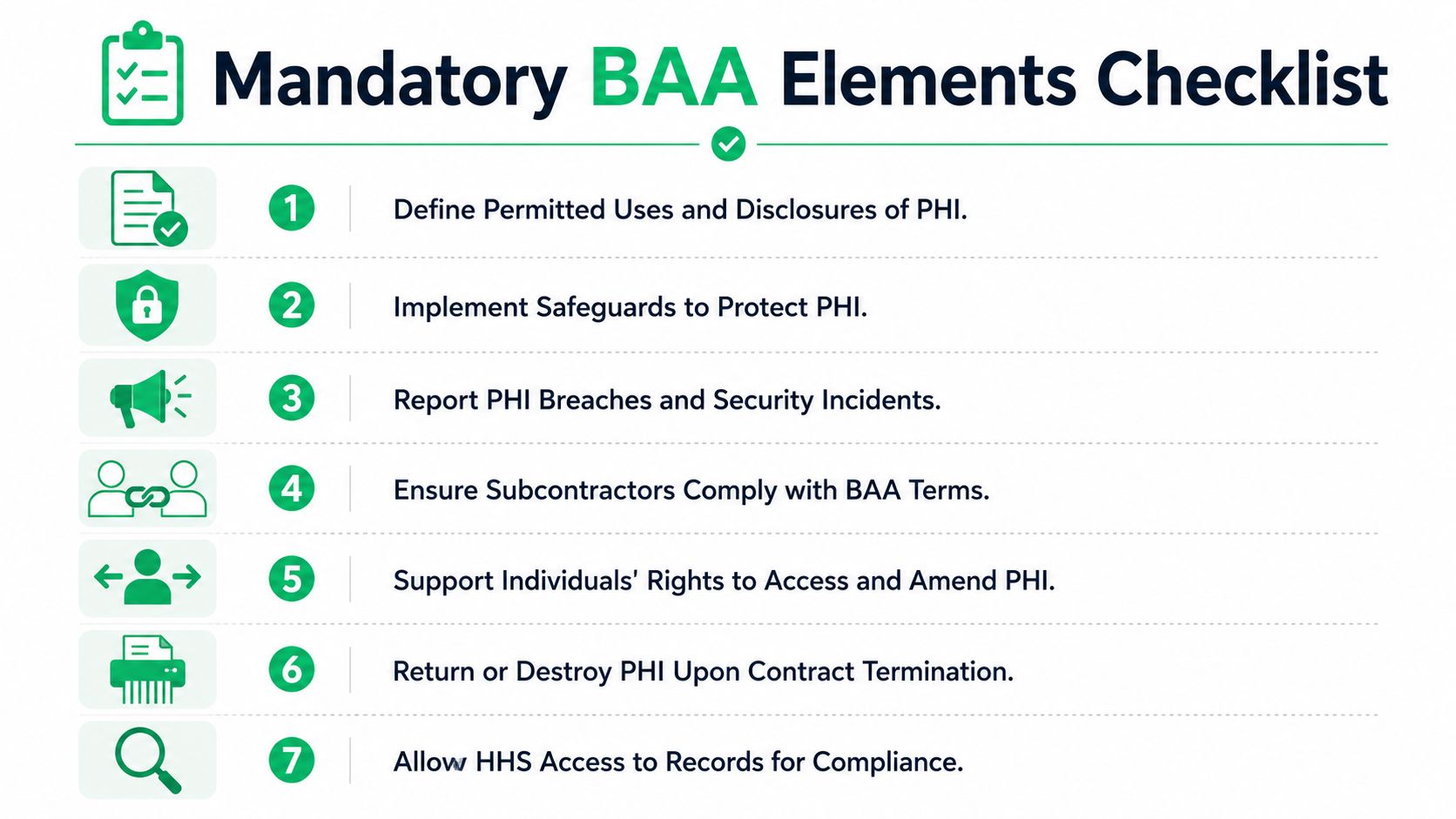
What your BAA must cover
- Permitted uses and disclosures
The agreement should spell out exactly how the vendor may use PHI. If the language says they can use data however they think is necessary, push back. - Safeguards for PHI
The vendor must be required to protect PHI with administrative, physical, and technical safeguards. In plain terms, they need real security controls, not nice words. - Breach and incident reporting
The BAA should require the vendor to report unauthorized uses, disclosures, and breaches. If the contract is vague about reporting, you're buying delay when you need speed. - Subcontractor compliance
If the vendor uses another company that touches PHI, that downstream party must be bound too. Cloud hosting, support firms, and backup providers are often examples of such downstream parties. - Support for individual rights
The vendor must help you support access, amendment, and related HIPAA obligations when needed. If they can't help you respond to requests tied to PHI, your operations will stall. - Return or destruction at termination
The contract needs a clean rule for what happens when the relationship ends. Data should be returned or destroyed unless that's not feasible, and protections must continue if it can't be fully removed. - HHS access to records
The BAA should allow records related to PHI handling to be made available as required for compliance review. If that language is missing, the contract is incomplete.
What to reject fast
You don't need to over-lawyer this. You do need to reject weak terms fast.
Red flagWhy it matters"Use PHI as necessary" languageToo broad. It doesn't limit vendor behavior.No security control languageLeaves safeguards implied instead of enforceable.Soft incident languageGives the vendor room to delay or minimize reporting.No end-of-contract data clauseCreates cleanup risk when you offboard the vendor.
If a vendor says, "Our standard terms cover privacy already," assume they don't understand HIPAA well enough yet.
Speed matters, but laziness is expensive
Plenty of teams now use AI tools for legal document creation to draft or redline first-pass contract language. That's fine for speed. It isn't fine as a substitute for checking whether the final BAA effectively restricts PHI use, requires safeguards, and covers breach reporting, subcontractors, and data disposal in plain terms.
The test is simple. Can your legal team, security lead, and operations lead all read the BAA and explain what the vendor must do on day one, during an incident, and at offboarding? If not, the draft isn't done.
How Your BAA Drives Security Requirements
A BAA isn't just a privacy contract. It's a security mandate dressed up as legal text.
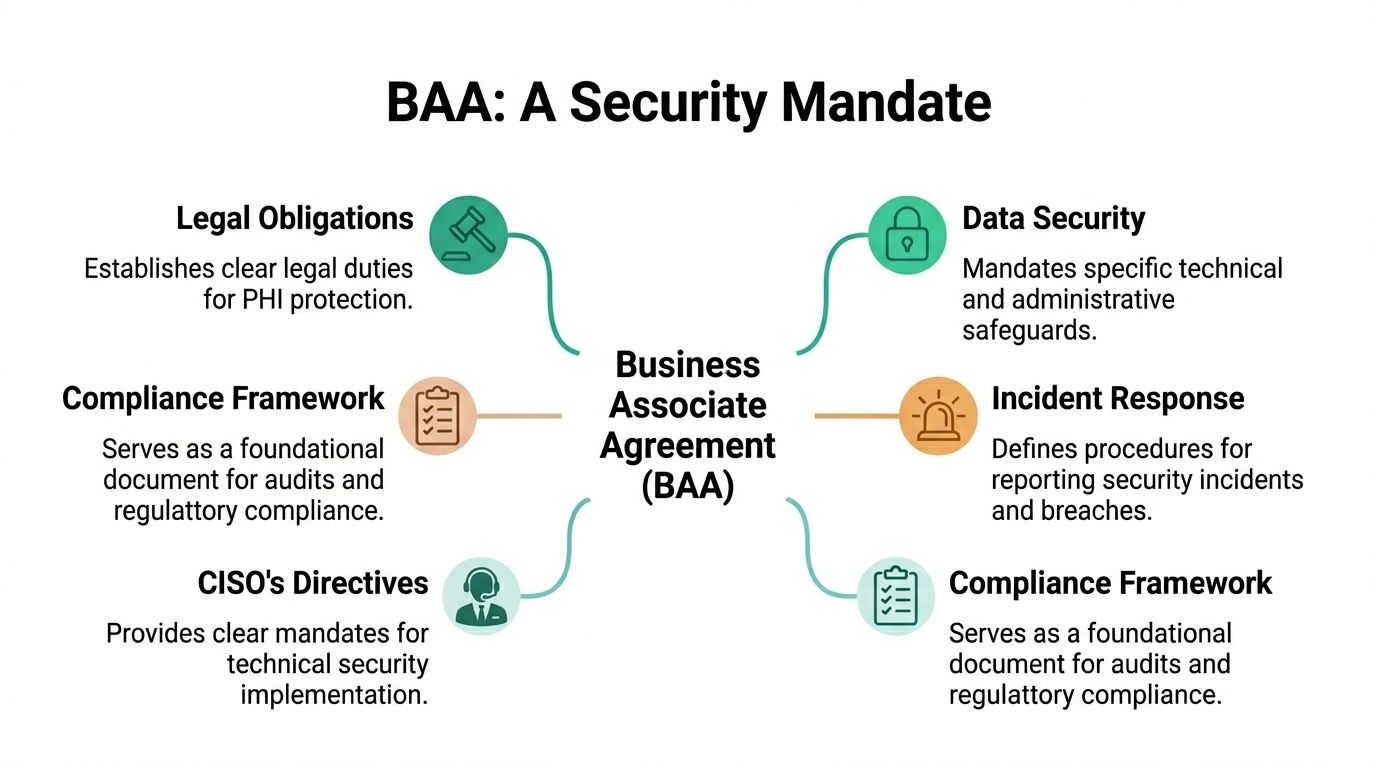
HHS makes this clear in its sample business associate agreement provisions. A BAA extends the HIPAA Security Rule to vendors handling electronic PHI by requiring administrative, physical, and technical safeguards, and by requiring reporting of unauthorized uses or disclosures, including breaches of unsecured PHI. HHS also states covered entities may be fined for not having a BAA or for having an incomplete one, even where no downstream HIPAA violation has yet occurred.
Translate legal clauses into technical tasks
Security leaders should read a BAA like a control sheet. Every clause should map to a real operational task.
- Access control means you verify who can reach PHI systems and whether privilege is too broad.
- Integrity protection means you check whether data can be changed without detection.
- Transmission security means you validate how PHI moves between apps, APIs, and users.
- Incident reporting means you confirm the vendor has logging, escalation, and clear notification paths.
- Return or destruction duties means you review offboarding, data retention, and backup handling.
That's why contract review can't sit only with legal. Your GRC lead, security engineer, and vendor owner should all be in the loop.
Where pentesting fits
A pen test, pentest, or penetration testing engagement doesn't replace a BAA. It proves whether the controls named in the BAA hold up under pressure.
If a vendor says they restrict access to PHI, a penetration test can show whether weak authentication, broken authorization, or exposed admin paths undermine that claim. If they say incidents will be detected quickly, logging gaps and blind spots often show up when testers push on the environment.
A BAA tells you what must be true. A pentest checks whether it actually is.
For teams working in environments like healthcare contact centers, HIPAA and PCI compliance for contact centers is a useful reference because it shows how compliance language quickly turns into practical security requirements across systems, agents, and workflows.
If you want a cleaner technical baseline before you review vendor language, start with the core HIPAA Security Rule requirements. Then map the BAA to the controls you can test.
Managing BAAs for Subcontractors and Pentesters
The easiest way to break HIPAA contract coverage is to ignore the next vendor in line. That's often where the problems arise.
The subcontractor problem
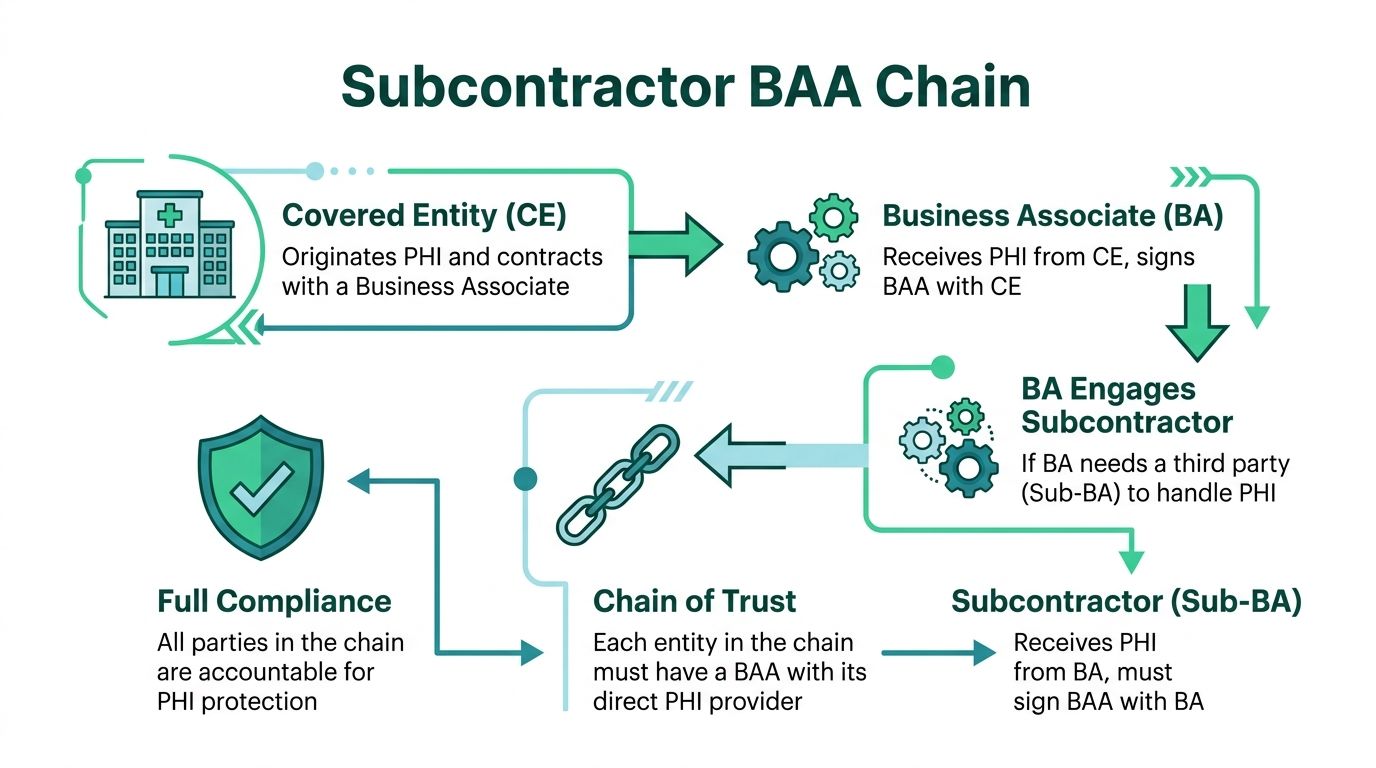
Let's keep it simple. Your company hires a SaaS vendor. That vendor uses a cloud host, a backup service, and a managed support provider. If those downstream services create, receive, maintain, or transmit PHI, the chain doesn't stop with your first contract.
As explained in this breakdown of downstream BAA obligations, HIPAA requires a business associate to get a downstream BAA with any subcontractor that handles PHI, and that obligation applies recursively. In plain English, every PHI-handling handoff in the chain needs its own written agreement.
Why chain of custody matters
This isn't theory. It affects how incidents unfold.
If a subcontractor mishandles PHI and the upstream vendor never locked down the relationship with a proper BAA, you've now got two problems. First, compliance exposure. Second, confusion about who had what duties, who should have reported what, and what restrictions applied to the data.
Here's a simple way to understand it:
PartyWhat you need to confirmCovered entityHas a signed BAA with each direct business associateBusiness associateHas signed downstream BAAs with PHI-handling subcontractorsSubcontractorIs bound to equivalent PHI use, security, and reporting limits
One weak vendor can break the whole compliance chain, even if your own team did its part.
Where pentesters fit in
Now to the question security teams ask all the time. Does a pentest vendor need a BAA?
If the pentest, pen test, or penetration testing engagement involves systems with live PHI, stored PHI, accessible PHI, or test activities that create or maintain access to PHI on your behalf, treat the security firm like any other vendor touching sensitive health data. Get the BAA in place before testing starts.
That doesn't mean every external scanner automatically becomes a business associate. Scope matters. But if your pentesters can access real application data, authenticated workflows, production databases, support portals, ticket attachments, or cloud storage containing PHI, don't dance around it.
What to ask your testing vendor
Ask direct questions and expect direct answers.
- Will you access live systems with PHI
If yes, the contract path should be obvious. - Can you work with sanitized data if needed
A mature firm can help reduce PHI exposure during testing. - Do you understand HIPAA scoping
If they fumble basic terminology, legal review will drag and the project will slow down. - Can you move quickly
A slow vendor creates two risks. Delayed security validation and delayed compliance evidence.
For teams that need a tester already familiar with this environment, Affordable Pentesting HIPAA solutions show what HIPAA-focused scoping looks like for web apps, APIs, networks, and supporting systems.
Negotiating a BAA Without Wasting Time
Your pentest is scoped, the vendor is ready, and legal turns a two-page BAA review into a two-week slowdown. That is usually self-inflicted. Teams waste time polishing boilerplate instead of fixing the clauses that change security work, incident response, and vendor accountability.
Treat the BAA like an operating document. If a clause affects PHI access, logging, breach notice, subcontractors, data return, or test restrictions, review it closely. If it does not change how the vendor handles your data or how your team proves compliance, stop arguing about it.
Terms worth fighting for
Focus on the terms that change real risk and real workload.
- Permitted uses of PHI
Cut vague language such as product improvement, analytics, or internal research unless you explicitly want it. If the vendor needs PHI to deliver the service, say that. Nothing broader. - Security control obligations
Do not settle for "reasonable safeguards" with no detail. Tie the language to specific expectations such as access control, encryption where appropriate, audit logging, secure disposal, and workforce training. For security vendors, add guardrails around test data handling, evidence retention, and who can access findings that may expose PHI. - Incident reporting deadlines
"Without unreasonable delay" is too soft for operational response. Set a defined notice window and require enough detail for triage. Your security team needs to know what happened, what data was involved, what systems were affected, and what containment steps started. - Subcontractor controls
If the vendor uses cloud providers, offshore support, scanning platforms, or freelance testers, the BAA should require the same protections downstream. Ask for a current subprocessor list if the service model depends on them. - Return or destruction of data
Make offboarding specific. Spell out what gets deleted, what can be retained for legal reasons, how backups are handled, and what proof you will receive.
One sentence can save a week later. If the agreement says the vendor may keep security artifacts indefinitely, your pentest screenshots, database extracts, or support logs can sit around far longer than your team expects.
Terms that usually waste time
Do not burn legal and security hours on edits that look smart but change nothing.
Low-value argumentBetter use of timeRewriting settled HIPAA definitionsRestrict PHI use and retentionTweaking style in indemnity boilerplateSet firm incident notice requirementsDebating abstract intent languageConfirm who can access PHI and test evidence
If a vendor resists specificity on PHI use, security duties, or subcontractors, assume the contract matches a weak process behind the scenes.
Use the BAA to speed security review
A good negotiation shortens vendor review because it forces operational clarity early. Your security team can map each disputed clause to a practical question.
- Can the vendor work with de-identified or synthetic data instead of live PHI?
- Will pentesters touch production, or can they test a scrubbed staging environment?
- Who receives exported evidence, logs, packet captures, and screenshots?
- How fast will the vendor notify your team if testing exposes PHI or triggers an incident?
- Which subprocessors store reports, tickets, or raw test data?
That turns contract review into a checklist. It also keeps legal from arguing in the abstract while security is waiting on answers that should have been gathered on day one.
For teams building a cleaner approval workflow, CISO's guide to HIPAA compliance is useful for organizing vendor review, policy evidence, and ongoing monitoring in one place.
A faster path to signature
Use a simple sequence and keep it moving.
- Get the vendor's current BAA before procurement starts.
- Mark only the clauses tied to PHI handling, security controls, incidents, subcontractors, and offboarding.
- Have security review those terms with the actual service scope in front of them.
- Escalate only unresolved risk items.
- Block PHI access until the signed version matches the work being performed.
That is how you cut cycle time without accepting avoidable risk. A BAA should help your team move faster, scope pentests correctly, and keep vendor security review grounded in facts instead of contract theater.
How to Audit and Verify BAA Compliance
Signing a BAA is the start. Audit is where you find out whether your program is real or just organized paper.
Begin with a vendor inventory. Not a vague list in someone's inbox. A usable record of every vendor that creates, receives, maintains, or transmits PHI, who owns the relationship, whether a BAA exists, and whether the current services still match the signed terms.
A practical review cycle
Use a simple pass-fail review.
- Check coverage
Every PHI-handling vendor should have an executed BAA on file. - Check alignment
The services in the BAA should match what the vendor does today. - Check downstream handling
If the vendor uses subprocessors, confirm those relationships are governed too. - Check evidence
Ask what security validation supports the promises in the agreement.
A lot of teams automate parts of that workflow. If you're building a broader leadership process around this, CISO's guide to HIPAA compliance is a useful reference for organizing policy, monitoring, and review tasks in one place.
Don't confuse signatures with proof
A signed BAA tells you what the vendor agreed to. It doesn't prove access control works, logging works, or exposed attack paths are closed.
That's where independent validation matters. Security questionnaires help, but they are still self-reported. A real pentest, penetration test, or pen testing engagement gives you evidence from actual technical review. It shows whether the environment reflects the contract.
Compliance documents say what should happen. Security testing shows what would happen if someone attacked the system today.
What verification should look like
For high-risk vendors, verify more than policy language. Review architecture, confirm where PHI lives, and test the attack surface that could expose it. For your own environment, make sure the systems tied to BAA obligations are in scope for regular assessment.
If you need proof quickly, manual pentesting is usually the most practical path. It's faster than bloated enterprise engagements, more useful than checkbox scans, and easier to line up with audit needs when the report contains findings people can act on.
If you need to prove your HIPAA controls instead of just talking about them, Affordable Pentesting can help with fast, affordable manual pentests for healthcare apps, APIs, cloud systems, and internal environments. Their certified pentesters, including OSCP, CEH, and CREST professionals, deliver clear reports within a week so your team can validate BAA-related security obligations without getting buried in slow enterprise process. Use the contact form to get a quote.