.svg)
HIPAA compliance BAA advice online usually gets one big thing wrong. It treats the Business Associate Agreement like the finish line. It isn't. It's the starting line.
I've seen plenty of teams breathe a sigh of relief once the BAA is signed, then ignore the hard part. That's backwards. The BAA creates obligations. If your vendor touches PHI and your controls are weak, a signed contract won't save you. Real protection comes from actual safeguards, evidence, and regular pen test, pentest, and penetration testing work that proves your systems hold up.
For IT managers, CISOs, compliance leads, and founders, the practical question isn't "Do we have a BAA?" The better question is "Can we prove the systems behind that BAA are secure enough to trust?"
What Is a BAA and Why It Is Not Just Paperwork
The most dangerous myth in HIPAA compliance BAA work is simple. People think the signature solves the problem.
It doesn't. A signed BAA is only a legal foundation. One source notes a widespread misconception here, stating that 78% of SMBs in healthcare assume legal contracts replace technical safeguards, while OCR can still penalize entities for operating without a BAA even if no breach occurs, with fines ranging from $141 to over $71,000 per violation according to this discussion of why a BAA alone is not enough.
That should change how you think about the document. The BAA isn't a compliance shield. It's a contract that says both sides now have serious duties around PHI.
What the agreement really does
A BAA tells a vendor what it can do with patient data and what it must do to protect that data. If the agreement is weak, your control over the vendor is weak. That's the part too many teams miss.
A generic vendor paper with light HIPAA language is not good enough. If the vendor stores, processes, or moves PHI, the contract needs to match the technical reality of that work.
Practical rule: If the BAA doesn't connect legal promises to real security controls, you've bought paper comfort, not risk reduction.
Why startups and lean teams get this wrong
Most small teams aren't careless. They're overloaded. The founder is handling procurement, the IT manager is juggling support and security, and compliance gets pushed into contract cleanup at the end.
That approach creates a mess. By the time legal asks for the BAA, the vendor may already have PHI in logs, backups, support tickets, or test systems. At that point, you're not organizing paperwork. You're trying to catch up to exposure that already exists.
Here's the blunt version. If your budget is tight, spend less time polishing policies and more time validating controls. A basic, well-scoped penetration test or pen testing engagement that finds real issues is worth more than a glossy compliance packet with no evidence behind it.
Who Actually Needs to Sign a Business Associate Agreement
The rule is simpler than commonly perceived. If a covered entity shares PHI with a vendor that creates, receives, maintains, or transmits that PHI on its behalf, a BAA is required. Missing that contract can lead to annual penalties of up to $1.5 million according to this overview of HIPAA Business Associate Agreement requirements.
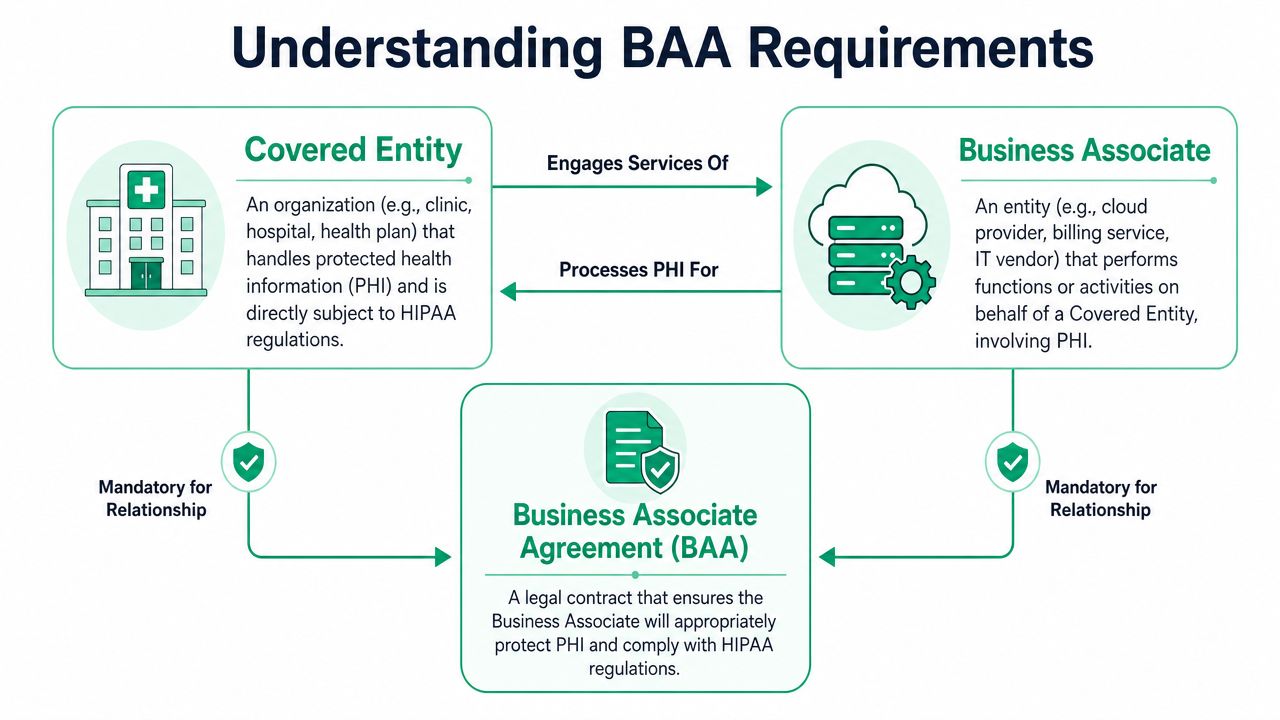
Think about it like this. If you hire someone to fix a sink in your office, they don't need access to patient records. No BAA. If you hire a cloud vendor, billing service, IT support shop, or scheduling platform that handles PHI for you, they likely do.
Common vendors that usually need a BAA
You don't need legal gymnastics for the obvious cases. These are the vendors that usually belong in your BAA review queue:
- Cloud hosting providers: If your app, backups, or files containing PHI sit on their systems, they're in scope.
- Managed IT and MSPs: Admin access to endpoints, email, or servers often means potential access to PHI.
- Billing and revenue cycle vendors: They usually process claims, patient identifiers, and payment-related records.
- EHR and scheduling platforms: If they run the software patients and staff use, they handle PHI by design.
- Data analytics providers: If they analyze patient-level data, the BAA question isn't optional.
- Document storage or shredding services: Physical records still count when they contain protected information.
The easy test to apply
Ask one question. Can this vendor touch PHI while doing work for us?
If the answer is yes, stop arguing over labels and get the contract path sorted out. If the answer is no, document why and move on. The mistake isn't being cautious. The mistake is pretending a vendor is "just infrastructure" when its staff can access systems full of patient data.
Covered entities hire business associates to do a job. Once that job involves PHI, the BAA becomes part of the relationship, not an optional add-on.
There's one more point teams skip. Business associates also need to control their own vendors. If they use subcontractors that handle the same PHI, those downstream relationships need the same seriousness. Otherwise, you've got a decent contract at the top and a blind spot underneath it.
The Six Must-Have Clauses in Every BAA Contract
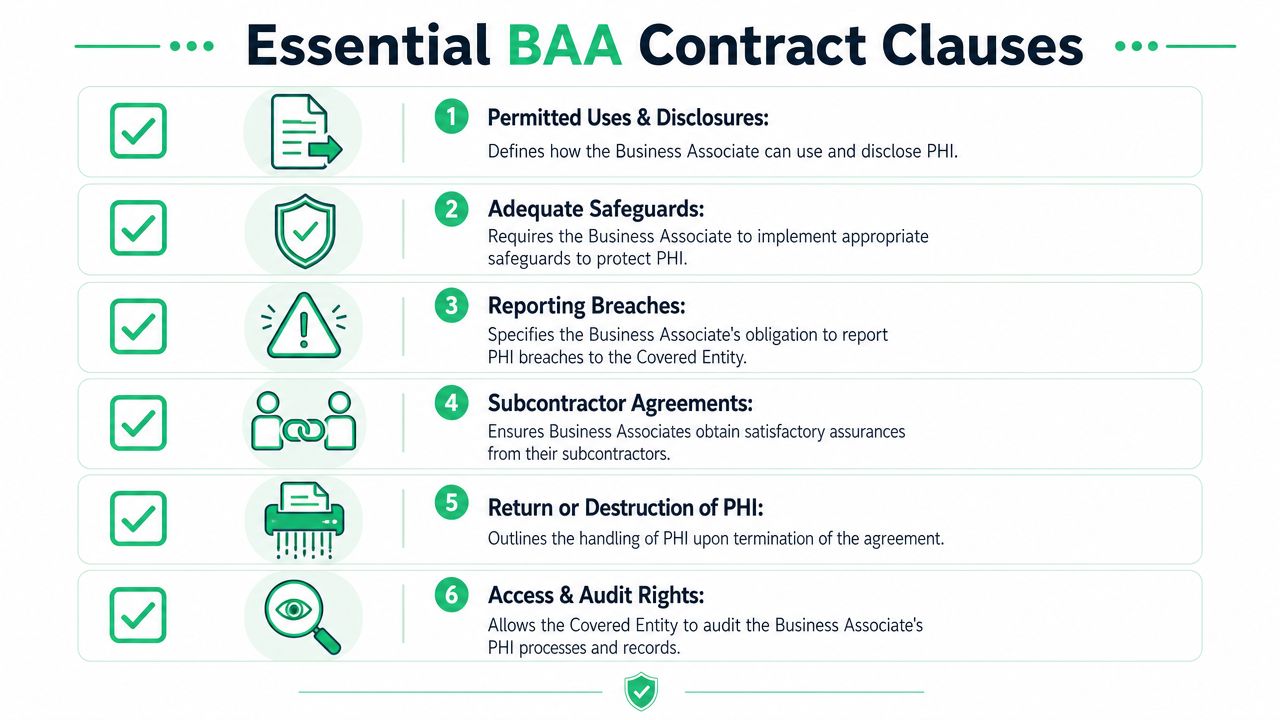
A real BAA isn't vague. It has to include specific elements. A compliant HIPAA BAA must include six mandatory elements: permitted uses of PHI, administrative, physical, and technical safeguards, breach reporting timelines, subcontractor obligations, termination conditions, and covered entity audit rights according to this breakdown of required BAA contract clauses.
What each clause means in plain English
| Clause | What it means for your team |
|---|---|
| Permitted uses | The vendor can use PHI only for defined tasks, not for whatever is convenient |
| Safeguards | The vendor must protect PHI with real admin, physical, and technical controls |
| Breach reporting | You need a clear timeline and process for reporting incidents |
| Subcontractor obligations | The vendor can't pass PHI to others without equivalent protections |
| Termination conditions | There has to be a path to end the relationship and address data handling after exit |
| Audit rights | You need the right to review evidence and verify the vendor isn't freelancing with your risk |
Permitted uses matter because they limit scope creep. A vendor that starts with support access shouldn't turn that into broad data processing.
Safeguards matter as they bridge legal language with reality. If the contract doesn't clearly require protections, you'll struggle to force action when the vendor drags its feet.
Weak BAAs are easy to spot
Watch for contracts that sound polished but say almost nothing. If the BAA doesn't spell out obligations around breaches, subcontractors, and termination, you have a problem. If there are no practical audit rights, you have very little influence once the relationship starts going bad.
A lot of teams also ignore general contract language around fights, liability, and process. That's a mistake. If you need a quick primer on how online contract language can affect enforcement, review these dispute resolution terms before you sign a vendor deal that touches PHI.
A good BAA doesn't just describe a relationship. It gives you leverage when the vendor fails to protect data.
One more item deserves attention. According to HIPAA Journal's discussion of 2026 HIPAA updates, a BAA must stipulate workforce HIPAA training for business associates under the Privacy Rule and security awareness training under the Security Rule. That's not busywork. A vendor with untrained staff is one careless click away from turning your contract into an incident report.
Your Practical Step-by-Step Vendor Vetting Checklist
Don't start with the BAA. Start with the vendor's actual access, actual need, and actual proof.
Under this explanation of why Business Associate Agreements matter, a BAA must define permitted uses and require appropriate safeguards. If the contract doesn't bind the vendor to technical safeguards, the covered entity loses a practical enforcement tool and may need to cure a material breach or terminate the relationship. That's why vetting comes first. You need to know what you're asking the vendor to promise.
Start with data access, not paperwork
Use this sequence before any PHI moves:
- Map the data first: Identify where PHI will enter, move, sit, and leave. Include backups, support tools, logs, and file exports.
- Challenge the need: Ask whether the vendor really needs PHI, or whether de-identified or limited data would do the job.
- Confirm role and scope: Decide whether the vendor is a business associate based on what it does, not what sales calls it.
If your team skips this, you end up signing BAAs for the wrong tools and missing the ones that matter.
Ask for evidence, not reassurance
A vendor saying "we take security seriously" means nothing. Ask them to show work.
- Security questionnaire: Keep it short and practical. Focus on access control, encryption, logging, incident handling, and subcontractors.
- Independent proof: Ask for a recent SOC 2 report if they have one, or evidence from a recent penetration test or pen test.
- System boundaries: Make them identify which products, environments, and support teams are covered by their controls.
- Remediation history: Ask what they fixed after the last test. A report with no findings can be less comforting than one with findings that got closed fast.
For teams building a repeatable process, this guide to managing third party risks is a useful operational reference.
If a vendor can't produce basic evidence, don't let them touch PHI while they "get back to you."
Read the BAA against the real environment
Now compare the contract to the technical facts. If the BAA says the vendor has safeguards, verify what those safeguards are. If the vendor uses subcontractors, name them. If breach reporting is required, ask who sends the alert, who receives it, and how quickly the workflow runs.
This isn't expensive lawyering. It's disciplined buying. Organizations can often do a strong first-pass review with IT, security, and procurement in one working session.
The Required Technical Safeguards You Must Implement
A BAA without technical safeguards is a shell. The contract only matters if the systems behind it can resist mistakes and attacks.
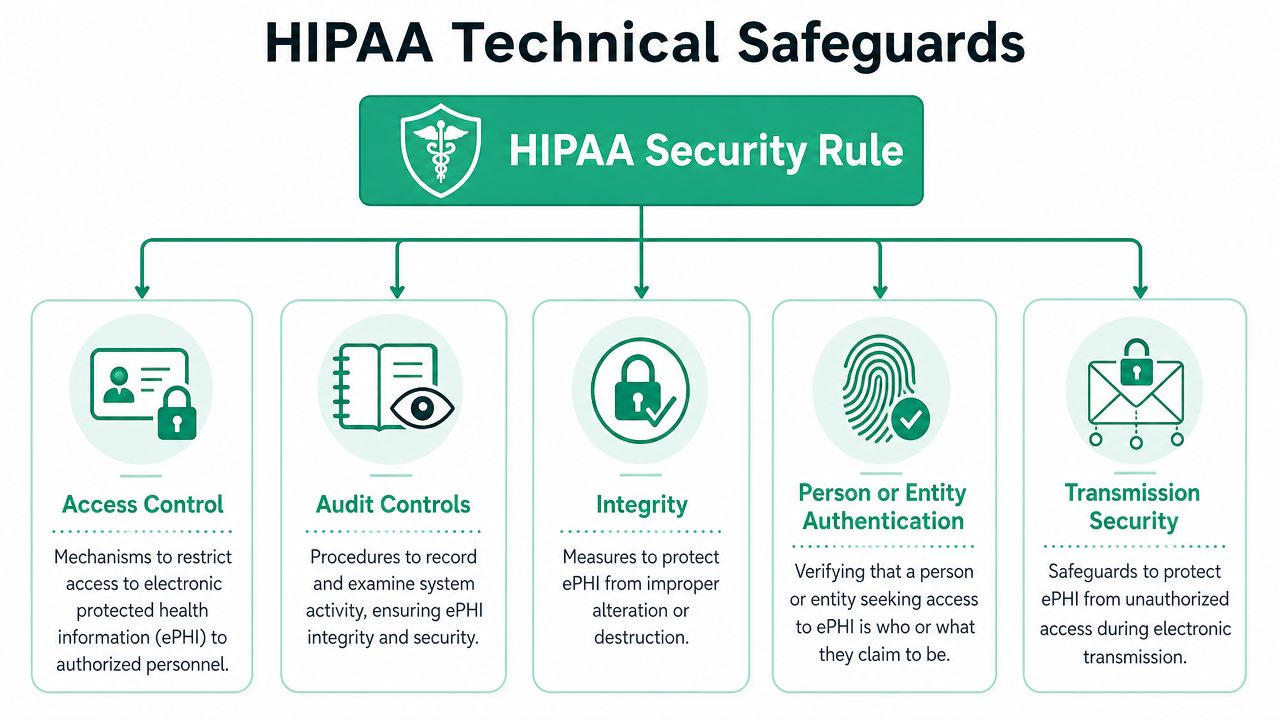
Operating without a required BAA is a HIPAA violation, but business associates are also directly liable for Security Rule failures, including missing risk assessments or failing to implement required technical safeguards, as noted in this review of the importance of HIPAA BAAs. That liability point matters. It means nobody gets to hide behind the paper if the controls are missing.
The controls that actually matter
You don't need a pile of jargon. You need basic, defensible safeguards that work.
| Safeguard | Plain-English meaning |
|---|---|
| Access control | Only the right people get into systems with ePHI |
| Audit controls | Systems record activity so you can investigate who did what |
| Integrity | Data shouldn't be changed or destroyed improperly |
| Authentication | Users and systems must prove they are who they claim to be |
| Transmission security | ePHI must be protected when it moves electronically |
These aren't abstract ideas. Access control means role-based permissions, strong account handling, and quick removal of old access. Audit controls mean logs that exist, are retained, and are reviewed when something looks off. Transmission security means protected channels for moving sensitive data, not loose exports and risky handoffs.
How you prove safeguards are real
Many compliance programs often fail because they describe controls but never test them.
A proper penetration test, pen test, or pentest gives you evidence. It shows whether an attacker can abuse weak authentication, poor access boundaries, insecure web apps, exposed admin paths, or unsafe data flows. For smaller healthcare companies and SaaS teams, a manual penetration test is often the best value because a skilled tester can chain issues together the way a real attacker would.
If you're evaluating vendors at scale, a structured framework for risk scoring for secure vendor decisions can help you prioritize where to dig deeper.
Why affordable manual pentesting matters
Traditional firms often frustrate smaller teams for three reasons. They charge too much, take too long, and sometimes deliver reports with shallow findings because they leaned too hard on scanners.
A focused manual pentest doesn't need to be bloated to be useful. You want certified testers with credentials like OSCP, CEH, and CREST who can move fast, validate exploitability, and explain findings in plain language. You also want the report back within a week so the security work doesn't stall procurement, releases, or audits.
For application-heavy teams, practical guidance on securing web applications for SMBs fits directly into this control validation process.
The cheapest test is the one that finds real weaknesses quickly enough for your team to fix them before they turn into an incident.
Maintain Compliance with Affordable and Fast Pen Testing
HIPAA compliance BAA work doesn't stay finished. Systems change. Vendors add features. Staff roles shift. A clean environment in January can be messy by spring.
That is why ongoing penetration testing matters. Not because auditors like the phrase, but because your attack surface keeps moving. A new web portal, a rushed integration, or an overlooked admin account can undo months of careful contract and policy work.

What a sane testing rhythm looks like
Most organizations don't need endless consulting theater. They need a repeatable cadence.
- Test on a schedule: Run a penetration test at least annually and after major application, infrastructure, or authentication changes.
- Test what changed: If you launched a patient portal, changed hosting, added SSO, or switched vendors, don't rely on last year's report.
- Fix and verify: Good pen testing isn't just a PDF. It should lead to remediation and targeted validation of important fixes.
Speed matters more than people admit
A slow report creates dead time. Security issues sit open. Release teams guess what to do. Compliance owners can't close evidence requests.
That's why fast delivery matters. Getting findings within a week is practical, especially for startups and lean IT teams that can't afford months of back-and-forth. The faster you get a usable report, the faster you can assign fixes, retest key issues, and move on.
If you're working in healthcare, this page on medical industry security pentesting shows how targeted testing supports HIPAA-focused environments without turning into an oversized consulting project.
Affordable penetration testing also tends to be better aligned with reality for SMBs. You don't need a giant firm with a giant invoice to identify exposed admin functions, weak session handling, poor tenant separation, or broken access control. You need capable humans who know where attackers look and who can explain the results clearly enough that engineers will follow through and fix them.
Move From Paper Compliance to Real World Security
The right mindset is simple. The BAA is the legal base layer. Security is the structure you build on top of it.
If you're still treating HIPAA compliance BAA work like a contract filing exercise, you're behind. The teams that do this well map PHI flows, challenge unnecessary vendor access, verify technical safeguards, and use penetration test evidence to show that controls aren't just promised, they're working.
This mindset should also shape how you build software and processes. If your team wants a broader view of building requirements into delivery instead of stapling them on later, this article on integrating compliance into SDLC is worth your time.
Paper compliance feels safe right up until a vendor incident forces you to prove what you actually checked.
Keep it practical. Use contracts to set obligations. Use reviews to verify scope. Use pen test, pentest, and penetration testing work to validate the controls that matter most. That's how you protect PHI without wasting money or slowing your team to a crawl.
If you need a fast, affordable way to validate HIPAA-related security controls, Affordable Pentesting offers manual penetration testing and compliance support for startups, SMBs, and regulated teams. Their certified pentesters, including professionals with OSCP, CEH, and CREST credentials, focus on clear findings, practical remediation, and reports delivered within a week. Use the contact form to discuss your environment and get a scoped engagement that fits your budget.