.svg)
Infrastructure penetration testing is now part of a market projected at USD 2.72 billion in 2026 and USD 5.54 billion by 2031, which tells you exactly where things are headed. If your audit deadline is close, you don't need a bloated project. You need a fast, affordable pen test and a report in hand within a week.
That's the situation a lot of teams are in right now. SOC 2 is coming up, PCI DSS evidence is due, or a customer security questionnaire just landed, and the quotes from traditional firms look absurd. Long timelines, vague scoping, thin findings, and a price tag that feels built for enterprise giants instead of startups and SMBs.
A good infrastructure penetration test shouldn't wreck your budget or your schedule. It should tell you what's exposed, show how an attacker could use it, and give you an audit-ready report quickly enough to matter.
Stop Overpaying for Slow Penetration Testing
Your auditor wants a pentest report in hand next week. A customer is asking for proof that your external systems were tested. Then a traditional firm sends over a bloated proposal, asks for three more scoping calls, and quotes a price that makes sense only if you run a large enterprise.
That is the problem.
Startups and SMBs do not need a slow, ceremonial engagement dressed up as high-end security work. They need a manual infrastructure pentest that starts fast, stays focused, and produces a report an auditor will accept without draining the security budget.
Why the old model fails
Large firms often sell process instead of results. You get layers of account management, vague scope language, and a timeline built around their internal handoffs rather than your deadline. By the time testing starts, the business problem is already getting worse.
The frustration is not the cost alone. It is paying premium rates for avoidable delay.
- Slow kickoff: Meetings stack up before anyone tests a single target.
- Unclear scope: You still cannot tell which assets, access paths, or environments are included.
- Thin findings: The report looks polished but reads like recycled scanner output.
- Late delivery: The final report shows up after the audit request, customer review, or renewal discussion.
Practical rule: If a firm cannot explain scope, testing method, and report timing in plain English, do not hire them.
You can screen providers fast. Ask how they handle internet-facing assets, internal testing, cloud scope, retesting, and reporting timelines. If they struggle to answer basic questions, expect scope creep and slow delivery. If you need a quick way to verify exposed services before the engagement, use Server Scheduler's guide to open ports to check what is visible from the outside.
What a sane pentest should look like
A good infrastructure pentest is simple to buy. You define the targets, rules of engagement, and test depth. The testers start quickly, validate real weaknesses manually, and deliver a report while there is still time to fix anything that matters.
That is why many startups and smaller security teams choose Affordable Pentesting services. The value is not fancy branding. The value is fast scheduling, direct scoping, manual testing, and an audit-ready report without the six-figure invoice.
Buy on outcomes. Manual testing depth. Speed. Report quality. If a provider cannot give you those three things, keep looking.
What an Infrastructure Pentest Actually Is
An infrastructure pentest is a controlled attack on the systems your company runs on, much like hiring certified professionals to check every door, window, lock, and hallway in your digital office. That includes servers, employee devices, firewalls, routers, VPN access, cloud hosts, and the connections between them.
It's different from a web app pen test. A web app test focuses on the website or application itself. Infrastructure penetration testing checks the underlying systems and network that keep the business running.

What falls inside scope
This kind of penetration testing usually covers both on-prem and cloud systems. If your company uses AWS, Azure, or GCP, those environments often sit right beside office networks, remote access tools, and internal admin systems. Attackers don't care how you divide the diagram. They care about what they can reach.
Typical scope can include:
- External assets: Internet-facing systems like VPN gateways, firewalls, remote access portals, and exposed services
- Internal assets: Workstations, file shares, domain controls, flat networks, and weak segmentation
- Cloud infrastructure: Permissions, exposed management interfaces, public storage mistakes, and insecure access paths
- Supporting devices: Routers, switches, printers, and anything else nobody remembered to harden
If you're trying to understand one small but important part of exposure, Server Scheduler's guide to open ports is a useful plain-English read. Open ports are one of the first things testers review because they tell you which doors are open to the outside.
What certified testers actually do
A real pentester doesn't just run a tool and call it done. Certified professionals with credentials like OSCP, CEH, and CREST look at how systems connect, where trust is misplaced, and how one small weakness can turn into a bigger compromise.
Good infrastructure penetration testing is less like checking boxes and more like tracing how an intruder would move once they get one foot in the door.
That matters because scanners often miss context. A scanner might flag a service. A human tester asks whether that service can be abused to move deeper, pull sensitive data, or gain admin access.
If your biggest concern is what strangers can hit from the internet, the first step is to secure your external perimeter. That's where many infrastructure breaches begin.
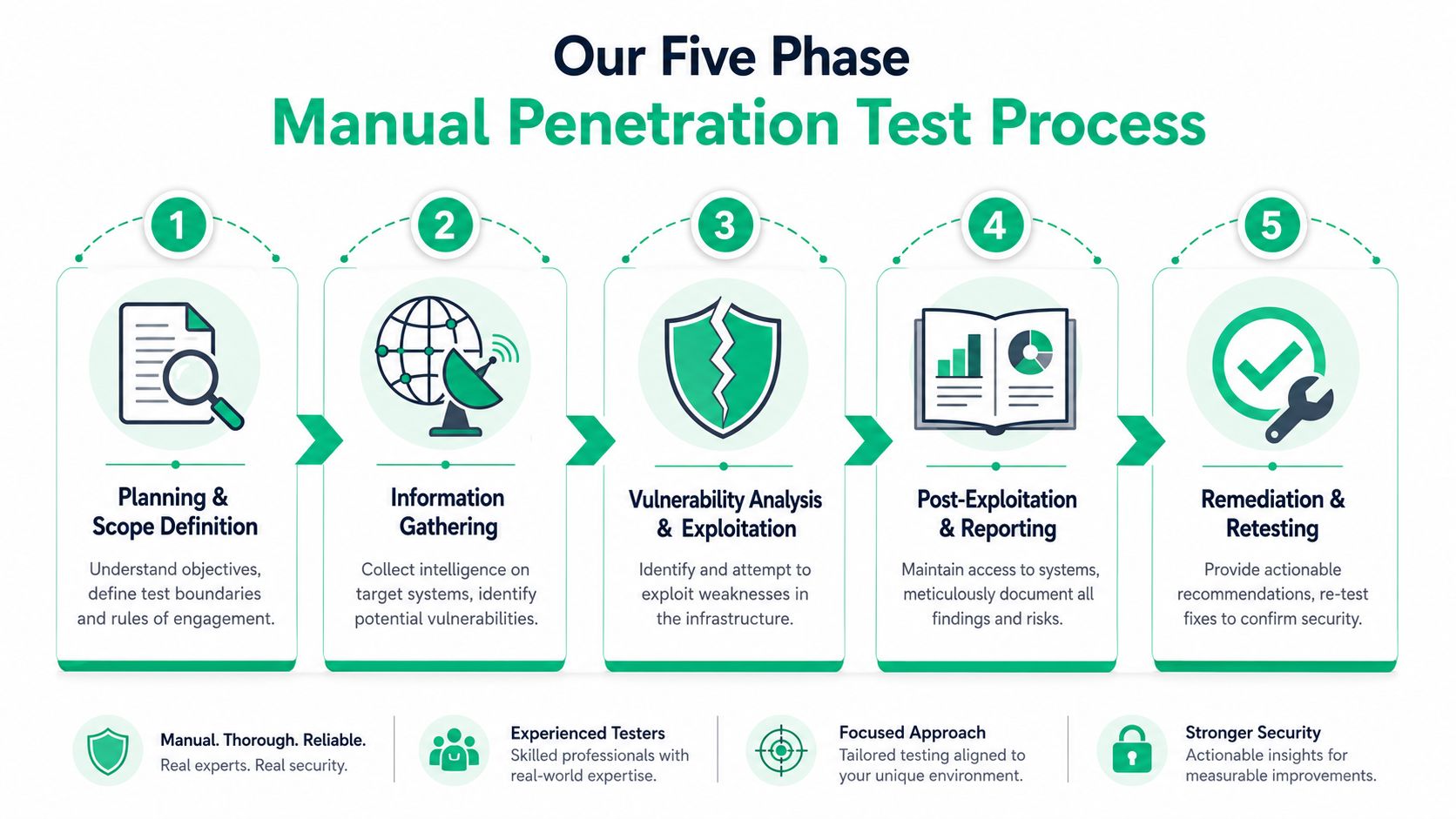
Our Five Phase Manual Penetration Test Process
Fast doesn't mean sloppy. It means the work follows a disciplined process and the testers know what they're doing. The best manual penetration testing engagements are structured, repeatable, and focused on proving risk, not producing noise.
The backbone for this kind of work is a formal methodology. NIST SP 800-115 defines a six-phase approach that starts with scoping and planning, moves through reconnaissance and exploitation, and ends with prioritized reporting and retesting, as explained in DigitalXRAID's overview of the NIST-based process. In practice, many teams package that work into five operating phases because remediation and retesting often happen as a closing cycle.
Phase one starts before any attack
Planning and reconnaissance come first. Here, scope gets nailed down, rules are set, and the tester starts mapping what exists. That can include public records, exposed services, login portals, forgotten subdomains, cloud endpoints, and network pathways.
This phase matters because blind testing wastes time. A good tester learns the terrain first.
The middle phases prove real risk
The next part combines vulnerability discovery and exploitation. Testers use manual checks and selected tools to find weak credentials, old systems, bad segmentation, exposed management access, or risky trust relationships. Then they try to exploit those weaknesses safely.
A real penetration test distinguishes itself from a basic scan.
- Discovery finds the crack: A service is exposed, a policy is weak, or a system is outdated.
- Exploitation tests the impact: Can that issue be used to gain access or move laterally?
- Post-exploitation answers the business question: If someone got in, what could they reach next?
Tools like Nmap help with discovery, and frameworks like Metasploit can help demonstrate impact in a controlled way. But ultimate value comes from human judgment. A skilled tester knows when a finding is noisy and when it's the first step in a real attack path.
A report full of unverified scanner output is not penetration testing. It's expensive clutter.
Reporting is where the value shows
The final phase is reporting, followed by retesting after fixes go in. The report should explain what was found, how it was validated, why it matters, and what to fix first. If the remediation advice is vague, the pentest failed.
A good report usually includes:
- Executive summary: Clear language for leadership and auditors
- Technical findings: Evidence, affected systems, and attack paths
- Fix guidance: Specific steps the IT team can act on
- Retest results: Confirmation that the issue has been closed
That structure is how you get speed without sacrificing quality. The process is organized, the scope is controlled, and the output is useful.
Common Vulnerabilities We Find and Fix Fast
Most infrastructure problems aren't exotic. They're the same avoidable mistakes showing up in slightly different forms. The danger is that teams get used to them. Attackers don't.
A typical infrastructure penetration testing engagement often uncovers issues that look small in isolation but become serious when combined. One weak password, one exposed admin panel, one server missing patches, and suddenly an attacker has a path.
The usual suspects
Here are the problems that show up again and again:
- Default or weak passwords: This is the digital version of leaving the key under the mat. Shared admin passwords, reused credentials, and easy guesses still open doors.
- Missing security patches: An unpatched system is like an open window nobody checks. The software works, but known weaknesses stay exposed.
- Poor network segmentation: If every system can talk to every other system, one compromise spreads fast.
- Exposed remote access: Admin interfaces, VPN portals, and remote desktop tools often end up reachable when they shouldn't.
- Cloud misconfigurations: Public storage, broad permissions, and forgotten test systems create easy wins for attackers.
The point of a manual pen test is to show whether those issues are just ugly or exploitable. That's a huge difference.
What scanners usually miss
Automated tools are fine for basic coverage. They are not enough on their own. A scanner might identify a vulnerable service and move on. A human tester asks whether that service connects to a domain account, whether that account has broad access, and whether the path leads to payroll data, customer records, or production systems.
That's also why infrastructure testing often overlaps with application risk. A weak server config can expose the app, and a weak app can expose the server. If that side of your stack is in scope too, it helps to review affordable web application security for SMBs as part of the bigger security picture.
The fastest fixes usually come from the clearest findings. If the tester can prove the issue and explain it simply, your team can patch it fast.
Why this matters more than teams think
These aren't edge cases. They're everyday failures that busy teams miss because they're shipping products, onboarding users, or keeping systems alive. Infrastructure penetration testing forces those weak points into the open and ranks them by actual risk.
That's what makes the work practical. You're not buying a list of theoretical problems. You're buying a short path to the issues most likely to hurt you first.
Meeting Compliance Needs with a Pentest Report
A pentest isn't just for security teams. It's often the evidence your auditor wants to see. If you're dealing with SOC 2, PCI DSS, HIPAA, or ISO 27001, the question isn't whether security matters. The question is whether you can show that you tested your environment, documented the findings, and acted on them.
That's where many companies get caught flat-footed. 1 in 5 companies do not test their software for security vulnerabilities, which leaves infrastructure exposed and fails to satisfy the kind of security assessment expectations found in frameworks such as SOC 2 and PCI DSS, according to Astra's penetration testing statistics summary.
What auditors actually care about
Auditors usually don't need dramatic stories. They want evidence that the test was legitimate, the scope made sense, the findings were documented, and remediation was tracked. A clean penetration testing report helps answer all four.
Here's the simple version. A report should show:
- What was tested
- How it was tested
- What was found
- What you did next
If your report can't answer those basics, it won't help much in an audit.
Pentest activity to compliance mapping
| Penetration Testing Activity | SOC 2 | PCI DSS | HIPAA | ISO 27001 |
|---|---|---|---|---|
| Scoping systems and defining rules of engagement | Supports documented security controls and assessment boundaries | Helps define internal and external testing scope | Supports risk analysis and safeguard planning | Supports formal control and assessment planning |
| Reconnaissance and vulnerability discovery | Supports control testing around exposure and monitoring | Helps identify weaknesses relevant to cardholder data environments | Helps identify technical weaknesses affecting protected health information | Supports vulnerability identification and treatment |
| Manual exploitation of confirmed weaknesses | Demonstrates whether controls actually prevent unauthorized access | Aligns with required penetration testing of reachable systems | Helps validate real security impact on sensitive systems | Supports evidence-backed control effectiveness review |
| Reporting with remediation guidance | Supports audit evidence and management review | Supports documented remediation for identified issues | Supports security documentation and corrective action | Supports treatment plans and continuous improvement |
| Retesting after fixes | Shows that remediation was verified | Helps demonstrate closure of discovered weaknesses | Supports follow-up validation of security fixes | Supports verification of corrective actions |
Compliance is not the same as security
That table matters, but don't stop there. Too many companies treat a penetration test like a receipt for the auditor. They buy the cheapest scope that looks good on paper, then act surprised when a real attacker finds the system the report ignored.
Compliance should be a floor, not the goal.
A strong infrastructure pentest helps with audits because it produces real evidence. But its bigger job is to give your team a clear list of what needs fixing before someone else finds it first.
How We Scope Your Pen Test Affordably
Pricing gets weird fast in this industry. One firm charges by the week. Another charges by tester seniority. Another wraps a simple penetration test in consulting language until nobody can tell what they're buying. That confusion is why companies overpay.
The useful benchmark is simple. The average cost of a professional penetration test in 2026 ranges from $5,000 to $30,000, and large enterprise engagements can go much higher, according to DeepStrike's penetration testing cost guide. Startups and SMBs should not assume they need the biggest package on the menu.
What should determine price
For infrastructure penetration testing, the fairest scopes usually map to the size and complexity of the environment. That often means the number of systems, exposed assets, network segments, cloud components, or user roles that matter to the test.
Good scoping questions include:
- What's in scope: Internet-facing assets, internal systems, cloud workloads, or all three
- How much access is provided: Black-box, gray-box, or authenticated testing
- What matters most: Compliance evidence, attack path validation, or broad risk discovery
- What changes the effort: Complex segmentation, hybrid environments, sensitive production constraints
How to avoid paying for fluff
You don't need a giant statement of work full of padded language. You need a quote tied to assets and objectives. Before you request pricing, collect a basic inventory of the systems you want tested, note which ones are public-facing, and decide whether you need internal testing, external testing, or both.
If compliance is driving the engagement, it also helps to understand the broader control picture. This guide to IT compliance gives a useful non-technical overview of how security assessments fit into business obligations.
A few buying rules save money fast:
- Ask what is manual: If most of the work is automated, the price should reflect that.
- Ask what the report includes: Evidence, remediation guidance, and retesting matter.
- Ask what affects timeline: Delays often come from poor scoping, not hard testing.
- Ask what is excluded: That's where surprise costs hide.
The best affordable pen test is not the cheapest quote. It's the one that gives you enough real coverage to fix meaningful issues without paying enterprise overhead you don't need.
Your Report and Next Steps After the Test
Your pentest report decides whether you got real value or paid for paperwork. Startups and SMBs do not need a bloated PDF full of recycled scanner output. They need a report leadership can read in minutes, engineers can use the same day, and auditors can accept without a long follow-up thread.
A good report arrives fast. For a focused engagement, you should have it within a week of kickoff. Speed matters because environments change quickly, especially in smaller teams shipping updates every week. If the report lands months later, part of it is already stale.
What your report should contain
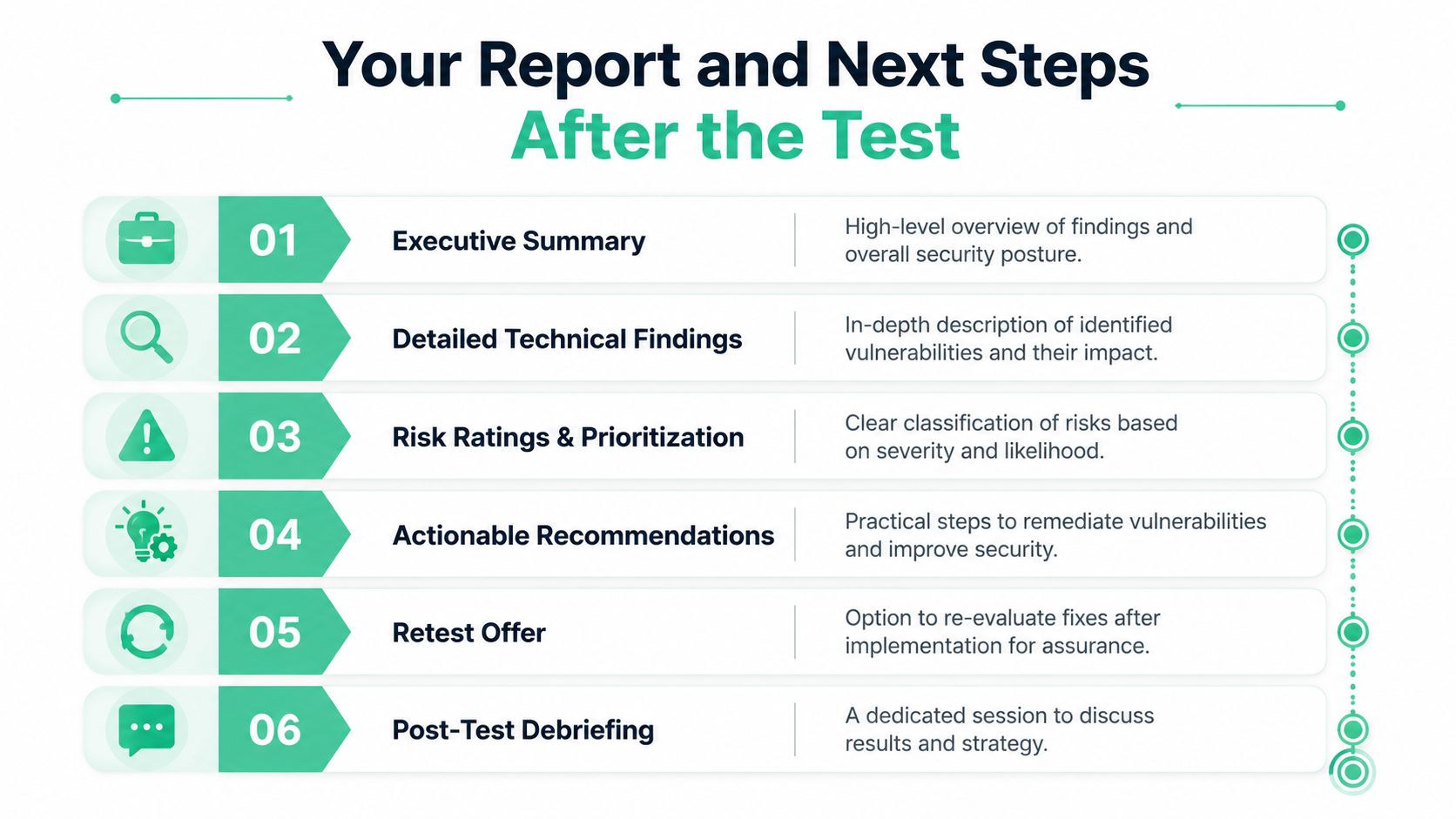
Expect these five parts:
- Executive summary: A plain-English summary of scope, business impact, and the highest-priority risks.
- Technical findings: Proof of access, affected assets, attack path details, and enough evidence for your team to reproduce and fix the issue.
- Risk ratings and priority: Clear ranking so your team knows what to fix first instead of treating every finding the same.
- Remediation guidance: Specific fixes tied to your environment. Generic advice wastes time.
- Retest results: Confirmation that the issue was fixed, not just marked done in a ticket.
What happens after delivery
Do three things immediately. Assign an owner to each finding, set deadlines for the high-risk items, and book retesting before the report goes stale.
A short debrief call helps. Your engineers should be able to ask direct questions, confirm exploit conditions, and leave with a clear remediation plan. If the testing firm cannot explain the finding clearly, the report is not strong enough.
The report should create action by Monday morning. If it does not, the engagement missed the point.
This is also where cheaper-looking pentests often fail. They hand over a generic report, skip remediation context, and leave your team to sort out priority on its own. That is how small companies burn time and budget twice. First on the test, then on cleanup and clarification.
If you need an infrastructure pentest, pen test, or full penetration testing engagement that is fast, practical, and priced for reality, request a same-day quote through the contact form and keep the process moving.