.svg)

Build an Effective IT Security Management System
You're probably not shopping for an IT security management system because it sounds fun. You're here because a customer asked for SOC 2, an auditor wants evidence, or a partner sent over a security questionnaire and exposed the fact that your security process lives in Slack, a few Google Docs, and one stressed-out IT lead's head.
That's normal. It's also fixable.
Most small and midsize teams make the same mistake. They assume an ISMS has to be a giant enterprise project with endless policy documents, expensive consultants, and months of meetings. It doesn't. A practical IT security management system is just a disciplined way to decide what matters, protect it, check that protection works, and keep improving without wasting money.
Why You Need An IT Security Management System
If your company handles customer data, employee data, financial records, product code, or internal systems, you already have security risk. The only real question is whether you're managing it deliberately or winging it.
That's why an IT security management system matters. It turns security from random one-off fixes into a repeatable operating system for the business. Instead of reacting every time someone asks for a policy or proof of controls, you build a structure that answers those questions before they become a fire drill.

Audit pressure is not the real issue
The audit isn't the problem. The audit just reveals whether your company has clear rules, assigned ownership, and evidence that security work happens.
A lot of founders treat compliance like theater. They buy templates, hold one risk meeting, and hope nobody looks too closely. That falls apart fast when an auditor, enterprise buyer, or investor asks who owns access reviews, how incidents are handled, or how you know controls work in practice.
Practical rule: If you can't explain your security process in plain English, you don't have a system. You have scattered activity.
The business case is already settled
The financial risk is big enough that this stops being an IT preference and becomes a management issue. IBM's reporting cited an average data breach cost of $4.24 million in 2021 and 2022, which is why ISMS adoption is better treated as a business control than a technical side project, as noted by SearchInform's overview of ISMS and breach cost context.
That number matters for one reason. Even a modest security program is usually cheaper than the damage from a serious incident, especially when your system includes technical, administrative, and physical controls instead of only software tools.
Here's what an ISMS gives you that ad hoc security never will:
- Clear ownership so people know who approves access, who reviews logs, and who handles incidents
- Repeatable decisions so risk treatment doesn't depend on who happens to be available that day
- Audit evidence so you can show policies, reviews, testing, and follow-up without scrambling
- Stronger customer trust because you can prove security is managed systematically
You don't need a giant security department to get this right. You need a simple system that matches the size of your company and the value of the data you hold.
What Exactly Is An IT Security Management System
An IT security management system is not a tool you buy. It's the set of rules, responsibilities, processes, and checks your company uses to protect important information.
Imagine building a house. The firewall is not the house. Multi-factor authentication is not the house. A policy alone is not the house. Those are parts. The ISMS is the blueprint, the construction plan, the inspection process, and the maintenance schedule.
It covers people, process, and technology
That last part matters more than most companies realize. Security breaks because a person gets too much access, a process gets skipped, or a system is misconfigured. A real ISMS accounts for all three.
ISO/IEC 27001, first published in 2005, became the best-known ISMS standard because it changed security from a pile of technical controls into a management system covering people, process, and technology that can be audited and certified, as explained in this overview of ISO 27001 and the rise of the ISMS model.
That shift was huge. It meant companies could stop treating security like a side effect of buying tools and start treating it like a business function with scope, controls, documentation, audits, and improvement.
What it looks like in a real company
A useful ISMS answers very basic questions:
- What are we protecting
- Who owns it
- What could go wrong
- What controls are in place
- How do we know those controls still work
- What happens when something fails
If you can answer those consistently, you're already moving in the right direction.
Security is mature when the company can explain how it manages risk without hiding behind jargon.
For a startup or SMB, this does not mean writing a binder nobody reads. It means documenting the few things that drive security behavior. Who gets access. How devices are managed. What data is sensitive. How vendors are reviewed. How incidents are reported. How changes are approved.
It's a business system, not a paperwork project
The big misconception is that an ISMS exists to satisfy auditors. Wrong. Auditors only check whether the system exists and works. Its purpose is to help your company make better security decisions before you have a breach, a failed customer review, or a contract blocked by procurement.
That's why a lean ISMS beats a bloated one. If your team can follow it, update it, and show evidence, it works. If it lives in a folder and nobody uses it, it's dead weight.
The Five Core Components Of Your ISMS
It's common to overcomplicate this. Your ISMS doesn't need to start with a giant control library. It needs a handful of connected parts that keep risk visible and force follow-through.
An effective ISMS runs on a continuous Plan-Do-Check-Act cycle. You define scope, implement controls, measure whether they work through audits and testing, then improve because controls degrade as threats and configurations change, according to this explanation of the Plan-Do-Check-Act cycle in an ISMS.
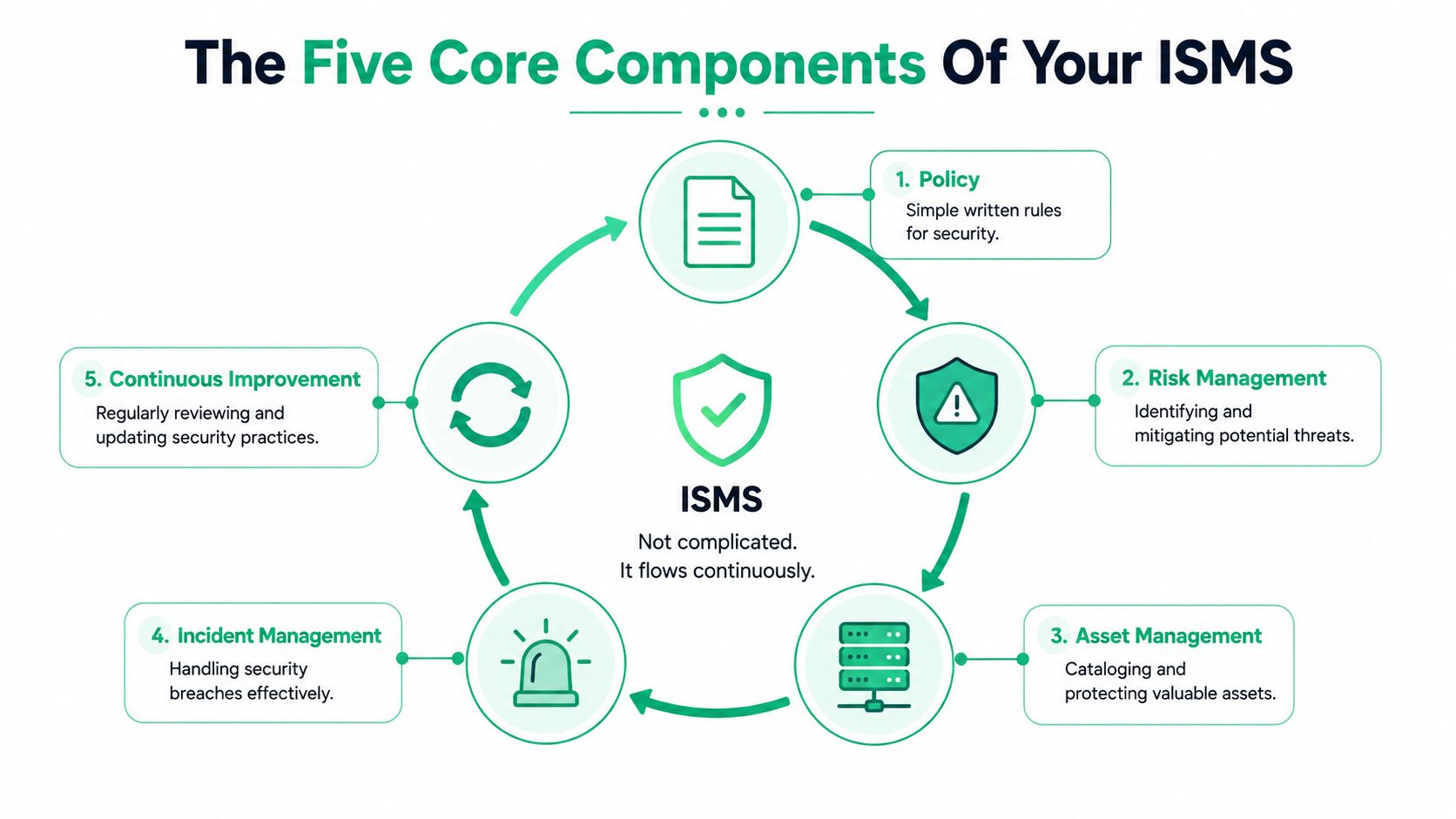
Policy sets the rules
Policies are the written rules people follow. They don't need to be long. They need to be clear.
Start with the basics. Acceptable use. Access control. Passwords and authentication. Incident reporting. Vendor handling if you rely on third parties. If a policy can't be understood by a non-lawyer in a few minutes, rewrite it.
Risk management drives priorities
Risk management involves deciding what could hurt the business and what deserves attention first. Consequently, founders often waste money by trying to protect everything equally.
Don't do that. Rank systems and data by business impact. Customer records, payment flows, source code, admin accounts, and production infrastructure usually matter more than the marketing site or a low-risk internal wiki.
A short risk register is enough to start if it lists the asset, threat, weakness, existing controls, owner, and next action.
Asset management tells you what exists
You can't secure what you haven't identified. Asset management means making a usable inventory of devices, applications, cloud services, data stores, and critical accounts.
For smaller teams, a spreadsheet is often enough at the start. The point isn't perfection. The point is knowing what you run, who owns it, and whether it holds sensitive data.
This is also where data classification becomes practical, not theoretical.
Controls should follow data sensitivity
The smartest ISMS programs use data classification as the engine for choosing controls. You inventory assets, classify data by sensitivity, and then apply stronger protection to the most sensitive classes, as outlined in Syracuse's discussion of data classification and security control selection.
That means your strongest safeguards go where they matter most:
- Encryption for sensitive data so exposed storage doesn't immediately become exposed content
- Role-based access control so people only reach what they need for their job
- Multi-factor authentication for high-risk accounts and important systems
- Micro-segmentation to reduce lateral movement if one system gets compromised
- Monitoring for odd behavior such as failed logins, unusual transfers, or unexpected geolocations
If all data gets the same treatment, you'll either overspend or underprotect. Usually both.
Monitoring and incident management close the loop
Monitoring checks whether controls are still doing their job. Incident management tells your team what to do when they aren't.
These don't need to be enterprise-grade programs on day one. You need log review for important systems, visibility into suspicious activity, and a basic incident process that names who investigates, who communicates, and who approves response decisions.
Here's the five-part model in plain terms:
| Component | What it does | Why it matters |
|---|---|---|
| Policy | Defines expected behavior | Removes guesswork |
| Risk Management | Identifies what can hurt you | Focuses resources |
| Asset Management | Lists systems and data | Prevents blind spots |
| Controls | Applies protection | Reduces likelihood and impact |
| Monitoring and Incident Management | Verifies and responds | Keeps the system alive |
Building Your ISMS A Practical Roadmap
Big firms love turning this into a long consulting engagement. They'll drown you in workshops, policy decks, and maturity models before you've even identified your critical systems. That approach burns budget and delays actual risk reduction.
For SMBs, sequencing is a key challenge. The goal is to support business risk, not build compliance theater, and a common obstacle is failing to identify the most critical data first, as discussed in Keystone's piece on practical ISMS structure for smaller organizations.
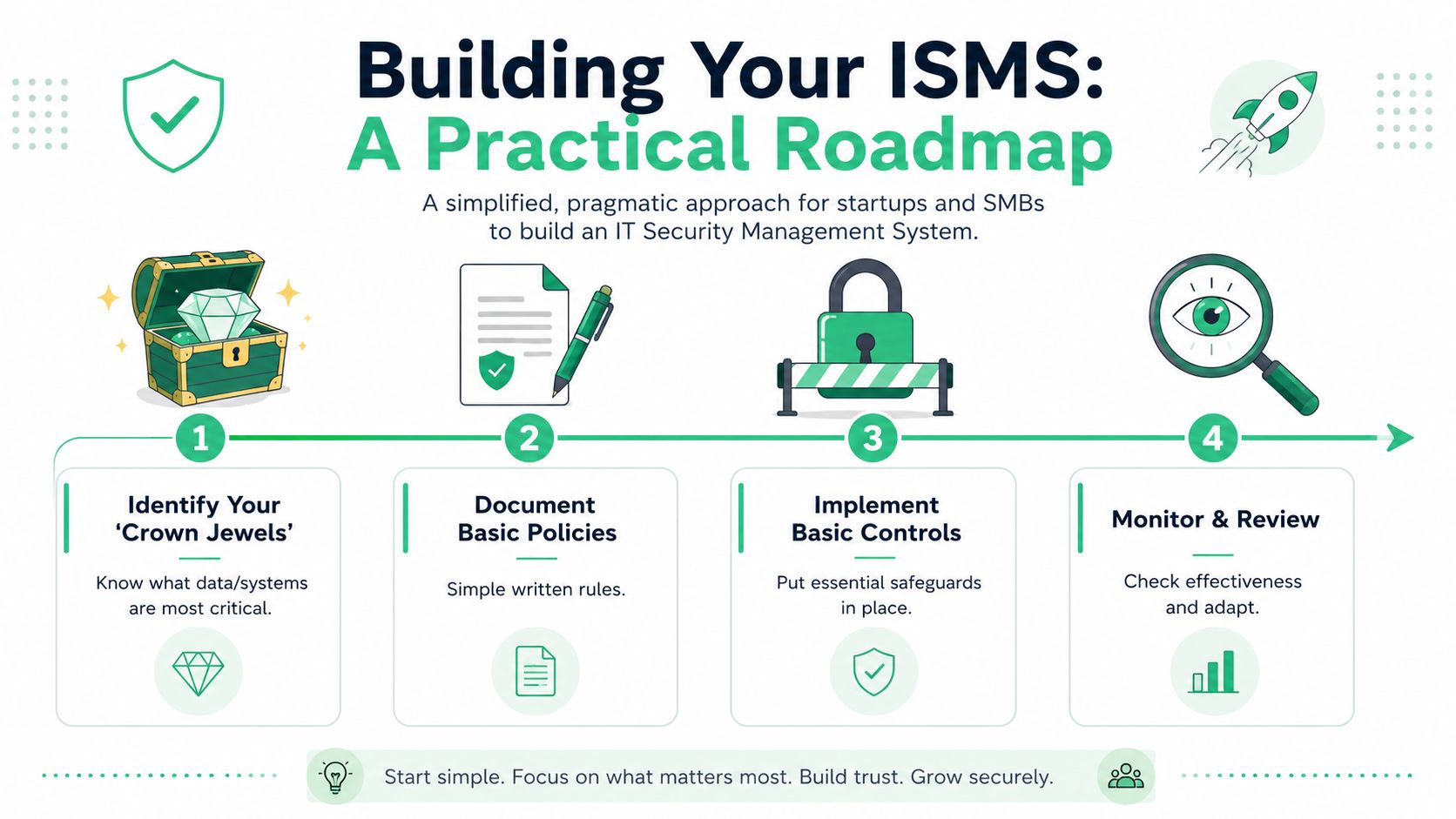
Start with the crown jewels
Your first job is not writing policies. It's identifying what would seriously hurt the business if exposed, altered, or unavailable.
That usually includes customer data, identity systems, finance systems, source code repositories, production apps, cloud admin consoles, and sensitive internal records. If you need a grounded way to frame business risk before writing controls, a resource on Accelerate IT Services security can help teams think through threats in operational terms.
Build only the documents you need now
Don't write twenty policies because a template pack told you to. Start with the few that control behavior right away.
A lean first pass usually includes:
- Access control policy that defines who gets access, how approval works, and when access is removed
- Acceptable use policy that tells staff what's allowed on company systems
- Incident reporting rule so employees know how to escalate suspicious activity
- Simple risk register to track real issues and decisions
Templates can help, but only if you adapt them to your environment. This guide on turning templates into real defense is useful because the hard part isn't collecting documents. It's making them match how your company operates.
Add controls in layers
Once scope and policies exist, put basic controls in place around the assets that matter most. Focus on access restrictions, stronger authentication, backup discipline, logging, and secure configuration review.
Then validate the controls. Don't wait until the end of a compliance project to check whether they hold up under pressure. Test as you go, fix gaps, and document the result.
A small company wins by building a narrow system that people actually use, then expanding it. Not by copying an enterprise binder on day one.
Proving Your System Works With Penetration Testing
An ISMS on paper means very little. Policies can say the right things while your web app still exposes sensitive functions, your admin panel still lacks proper access control, or your cloud setup still has easy paths for abuse.
That's why penetration testing matters. A pentest, pen test, or penetration test gives you evidence that your controls work in practice, not just in a spreadsheet.
Documents are not proof
Auditors and customers increasingly want more than policy files. They want signs that the company validates its safeguards. A manual penetration testing engagement does exactly that. It checks whether authentication, authorization, session handling, exposed services, and other controls can withstand attack attempts.
If you're still learning the basics of ethical hacking for businesses, it helps to view it as a basic process. A certified tester acts like an attacker, finds weak points, shows impact, and gives your team a fix list.
Traditional pentesting is often too slow
Smaller companies often become frustrated. Traditional firms often move like law offices. Long scoping calls, long waits, expensive statements of work, and a final report that shows up after your audit timeline is already slipping.
That model might fit a large enterprise. It's a bad fit for a startup that needs answers quickly.
Here's the practical comparison:
| Metric | Traditional Firms | Affordable Pentesting |
|---|---|---|
| Scoping speed | Often slow and meeting-heavy | Same-day quote |
| Start time | Often delayed by scheduling | Start within 48 hours |
| Report timeline | Commonly stretched out | Clear report within one week |
| Team fit | Better for large procurement cycles | Better for lean teams and fast audits |
| Tester credentials | Varies by firm | OSCP, CEH, and CREST certified pentesters |
That speed changes the value of a penetration test. Instead of treating it as a painful finish-line task, you can use penetration testing during the build. Test early controls, fix what breaks, and show evidence while the compliance project is still moving.
Use pentests to validate milestones
A good rhythm looks like this:
- After core controls are live run a pen test to see whether basic protections hold
- Before an audit or customer review run targeted penetration testing for high-risk systems
- After major changes validate new code, new infrastructure, or new exposed functionality
- When findings are fixed retest so the evidence is current
One practical option for affordable web app security for startups is Affordable Pentesting, which provides web application penetration testing and compliance-focused reporting for organizations that need faster validation without the usual enterprise process drag.
If your ISMS has never been tested by humans trying to break it, you're relying on assumptions.
Aligning Your ISMS With Compliance Frameworks
The smartest reason to build an ISMS is that you stop rebuilding security from scratch for every framework. Once your system is organized, you can map it to different compliance requirements instead of starting over each time a customer names a new standard.
That matters because most frameworks ask for the same basic behaviors. They want documented rules, risk assessment, access control, incident handling, review, and evidence.
Build once and map outward
SOC 2, ISO 27001, HIPAA, and PCI DSS all come with their own language. Underneath that language, they keep circling the same questions. Who owns security. What data matters. How access is controlled. How issues are detected. What happens when something goes wrong.
A working ISMS becomes your central source of truth. Policies live there. Risk decisions live there. Reviews, control checks, and test results live there. That cuts duplicated effort and makes audits less chaotic.
For teams aiming at certification, it helps to understand how to build a security system for ISO 27001 first, then map those practices to other frameworks as needed.
Compliance should support breach prevention
A lot of companies make the mistake of treating frameworks like separate paperwork stacks. That's expensive and dumb. Compliance should support actual protection, not distract from it.
If you're trying to connect governance work to practical risk, guidance around protecting your online presence from breaches can help teams think through what happens when prevention fails and response obligations kick in.
The better model is simple:
- One risk process
- One control set
- One evidence trail
- Many mappings
That's how you keep the work manageable. Build the system once. Reuse it everywhere.
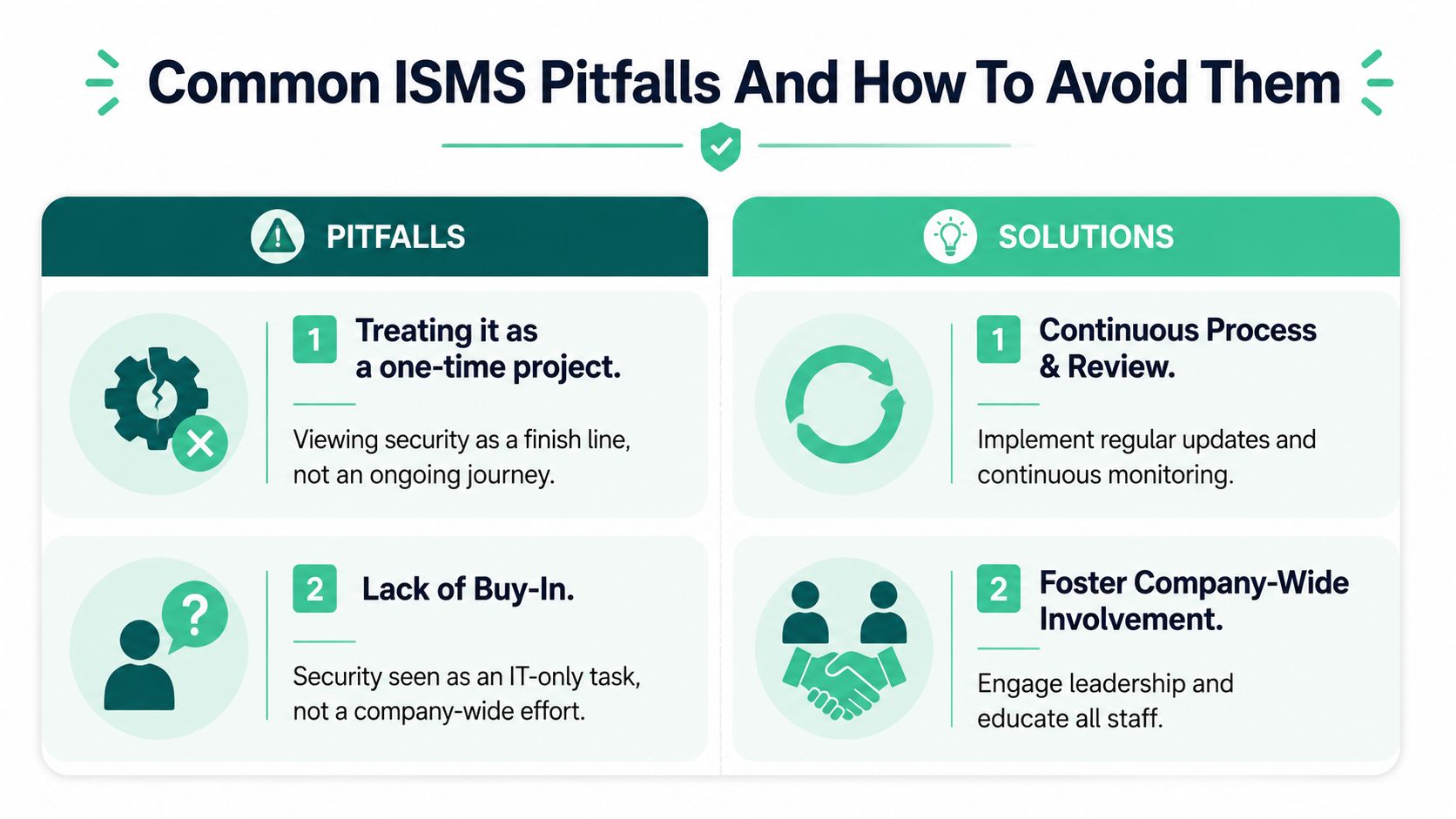
Common ISMS Pitfalls And How To Avoid Them
Most ISMS failures are predictable. The company either builds too much, too little, or nothing that gets tested. None of these are hard problems if you stay honest about how your team operates.
The paper system trap
The most common mistake is treating the ISMS like a one-time project. Teams write policies, save them in a folder, and assume the job is done. Then the environment changes, staff changes, tools change, and the controls drift out of date.
Fix it by scheduling regular review points. Review policies, risks, major assets, and evidence on a routine basis. If no one owns the review cycle, the system will decay.
Overengineering the whole thing
The second mistake is copying a big-company model into a small company that doesn't have the headcount to run it. Fifty policies, endless approval layers, and control language nobody understands won't make you safer.
Use short, enforceable documents and keep scope tight. Protect the high-value systems first. Expand only when the first layer is operating cleanly.
The best ISMS is the one your company can maintain without faking it.
Ignoring classification and scope
Another expensive error is applying the same level of control to every asset. That usually leads to wasted effort on low-value systems while critical systems still have gaps.
Define sensitive data classes and tie stronger controls to them. This gives you a rational way to choose where to spend time and money.
Skipping real-world testing
The last failure is the biggest one. Teams assume controls work because they bought tools and wrote policies. That's not validation.
Use a pen test, targeted penetration testing, or retesting cycle to challenge your assumptions. If you don't test your system, you don't know your system.
If you need a practical way to validate your controls without the usual long timelines and bloated consulting process, Affordable Pentesting is a straightforward place to start. Use the contact form, outline your environment, and get a clear path to penetration testing that supports compliance work without blowing up your budget or your schedule.