.svg)

You bought a small plant, inherited a warehouse with conveyors and sensors, or added a production line after an acquisition. Now the same team that protects laptops, cloud apps, and Microsoft 365 also owns programmable logic controllers, HMIs, and systems that can stop physical operations if they fail.
That's where many smart IT managers get blindsided. Operational technology security isn't just “IT security in a factory.” It's security for systems that move motors, control pressure, open valves, and keep production running. If you treat it like a normal server environment, you can create outages while trying to prevent them.
What Is Operational Technology Security?
Operational technology, or OT, is the hardware and software that controls physical processes. Think SCADA servers, PLCs, industrial control systems, sensors, relays, and operator workstations. If IT protects emails and files, OT protects the machines and processes that make products, move materials, and keep utilities flowing.
A lot of teams first meet OT by accident. An IT manager gets handed a site expansion, a startup deploys automation in a new facility, or a company acquires a business with older industrial systems. Suddenly the job changes from protecting data to protecting uptime and safety.
That shift is why OT security is now a serious business category, not a niche engineering topic. One market estimate valued the OT security market at USD 22.3392 billion in 2025, with projected growth at a 15.9% CAGR from 2026 to 2034 according to Polaris Market Research on the OT security market.
What makes OT different
OT systems often run for years with limited changes. They may use older protocols, fragile vendor software, and equipment that operators are reluctant to reboot for obvious reasons. In many sites, a “small change” can interrupt production or create safety concerns.
Practical rule: If a device controls a physical process, treat every security action like it could affect operations.
That's also why the line between OT and connected device risk is getting blurry. Sensors, gateways, and embedded devices often sit in the middle. If that sounds familiar, Affordable Pentesting's IoT insights are worth reading because the operational reality overlaps more than is commonly anticipated.
Key Differences Between OT and IT Security
IT and OT share tools, networks, and people more than they used to. They do not share the same risk model. In IT, a bad day usually means lost data, account compromise, or business downtime. In OT, a bad day can mean halted production, damaged equipment, or unsafe conditions.
A simple healthcare analogy makes this clear. IT security protects the hospital records system. OT security protects the device that keeps a patient stable. Both matter. One is much less forgiving of disruption.
IT and OT priorities differ
IT teams usually rank confidentiality high. OT teams usually rank availability and safety first. That changes how you handle scanning, patching, remote access, and change control.
Here's the side-by-side view.
| Aspect | IT (Information Technology) | OT (Operational Technology) |
|---|---|---|
| Primary goal | Protect data and business systems | Protect physical operations and safety |
| Downtime tolerance | Often manageable with maintenance windows | Often limited because production must keep running |
| Common assets | Laptops, servers, cloud apps, user accounts | PLCs, HMIs, SCADA, sensors, relays, controllers |
| Patch approach | Frequent updates are common | Updates may be delayed or tightly controlled |
| Traffic patterns | Dynamic and user-driven | Predictable and process-driven |
| Security testing | Broad scanning is common | Testing must be careful and non-disruptive |
| Main concern | Data loss, fraud, account compromise | Process interruption, unsafe commands, equipment impact |
The mistake I see most often is forcing an IT playbook into an OT environment. That usually means aggressive scanning, rushed agent deployment, or access changes with no operations review. Those moves can create the incident you were trying to avoid.
The environment is less forgiving
OT devices often live longer than normal IT hardware. They may depend on vendor support, proprietary software, or protocols your IT team barely sees anywhere else. A Windows server in accounting can usually survive a rough maintenance cycle. A controller tied to a process line may not.
That's why network behavior matters so much. OT traffic is often repetitive and expected. When you understand that pattern, anomalies stand out faster. When you don't, you miss dangerous access paths.
If your leadership team still thinks cyber risk is mostly an office problem, a regional threat overview like this Atlanta cybersecurity threats guide can help frame the broader business reality. The lesson carries into OT. Attackers don't care whether disruption starts in finance, a VPN, or a plant network.
OT security succeeds when IT, engineering, and operations agree on one thing first. What cannot break.
Top Threats Facing Your Operational Technology
The biggest OT threats are boring in one sense. They usually start with common weaknesses. Poor remote access. Flat networks. Weak visibility. Shared credentials. Old systems nobody wants to touch.
Then they turn into expensive operational problems.

Repeated intrusions are now normal
According to Fortinet's 2024 State of Operational Technology and Cybersecurity Report, nearly one-third (31%) of industrial organizations experienced 6 or more intrusions, up from 11% the previous year. That should reset expectations. OT attacks aren't rare, cinematic events. Many teams are dealing with repeated intrusion activity.
The practical takeaway is simple. If your OT security plan assumes “we're too small” or “we're not a target,” your plan is already broken.
The common ways attackers get in
Most OT compromise paths aren't mysterious. They tend to involve a short list of failures:
- Remote access abuse where an attacker gets into a trusted connection and moves inward
- IT to OT pivoting after compromise of a workstation, server, or identity in the business network
- Ransomware spillover that reaches industrial operations and interrupts production
- Weak segmentation that allows lateral movement into control systems
- Default settings and poor credential hygiene on devices or vendor tools
Ransomware deserves special attention because it doesn't need to understand your process to hurt it. If it locks supporting systems, operators lose visibility and control. For leaders who want a grounded example of how ransomware pressure looks in live environments, this overview on understanding ransomware threats for businesses is useful context.
Why pen testing matters here
A normal vulnerability scan won't show you the full attack path. It may find software issues, but it won't tell you whether an attacker can jump from an exposed service to an engineering workstation and then toward a controller network.
That's where a pentest, pen test, or penetration test earns its keep. Good penetration testing maps what an attacker can do with the trust relationships, routes, and access already in your environment. In OT, that's the difference between a checklist and a real risk picture.
If you can't explain how an attacker would move from IT into OT at your site, assume someone eventually will.
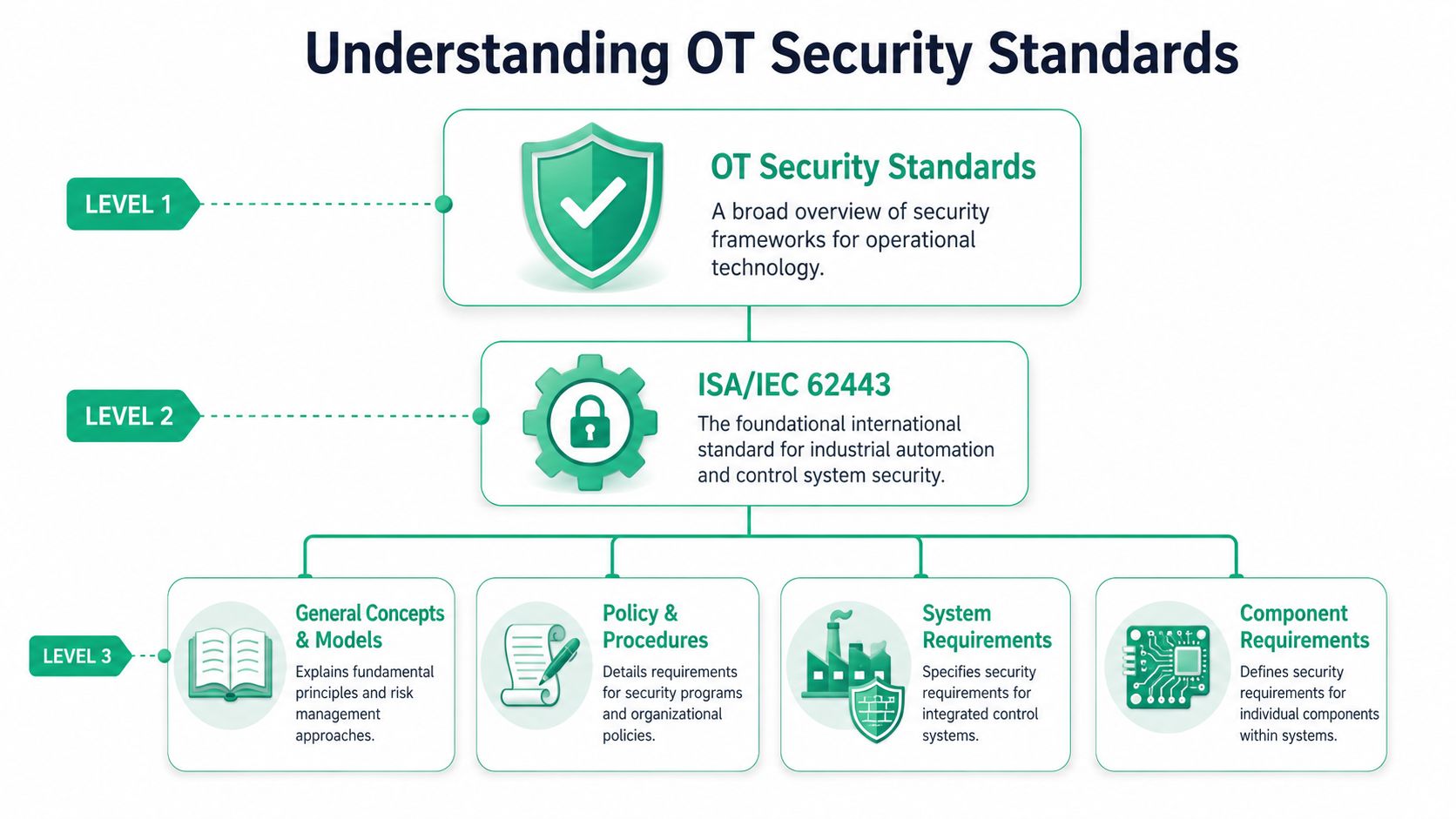
Navigating OT Security Standards Like IEC 62443
Many in the field hear “IEC 62443” and tune out because standards language is dense. Don't make that mistake. The value of this framework is practical. It gives you a clean way to organize industrial security without pretending every plant is the same.
The core idea is easy to understand. Break your environment into zones based on function and risk, then control how traffic moves between them through conduits. This is comparable to securing a building with controlled checkpoints instead of leaving every internal door open.
Zones and conduits in plain English
CISA's OT asset inventory guidance explicitly recommends building inventory from engineering drawings, SCADA and control schematics, relay configuration files, vendor model and firmware data, and network documentation, then grouping assets into zones and conduits aligned to ISA/IEC 62443 in CISA guidance on OT asset inventory. That's not paperwork for auditors. It's how you stop guessing.
Here's what that looks like in practice:
- Production zone for controllers and HMIs that directly support process operations
- Engineering zone for workstations that configure or maintain control systems
- Business zone for standard IT users and enterprise apps
- Controlled conduits for the few approved connections between those areas
Why standards help smaller teams
SMBs often think standards are for giant utilities and global manufacturers. Wrong. Smaller teams need structure more because they usually have fewer people and less room for error.
A simple zone-based design helps you answer the questions auditors, insurers, and customers always ask. What's critical. Who can access it. How is that access controlled. What happens if something goes wrong.
If your security work also supports broader governance programs, Affordable Pentesting risk insights provide a useful bridge between practical controls and overall risk management.
Standards matter most when they force clear boundaries. In OT, clear boundaries reduce both attack paths and operational confusion.
Building a Defensible OT Security Architecture
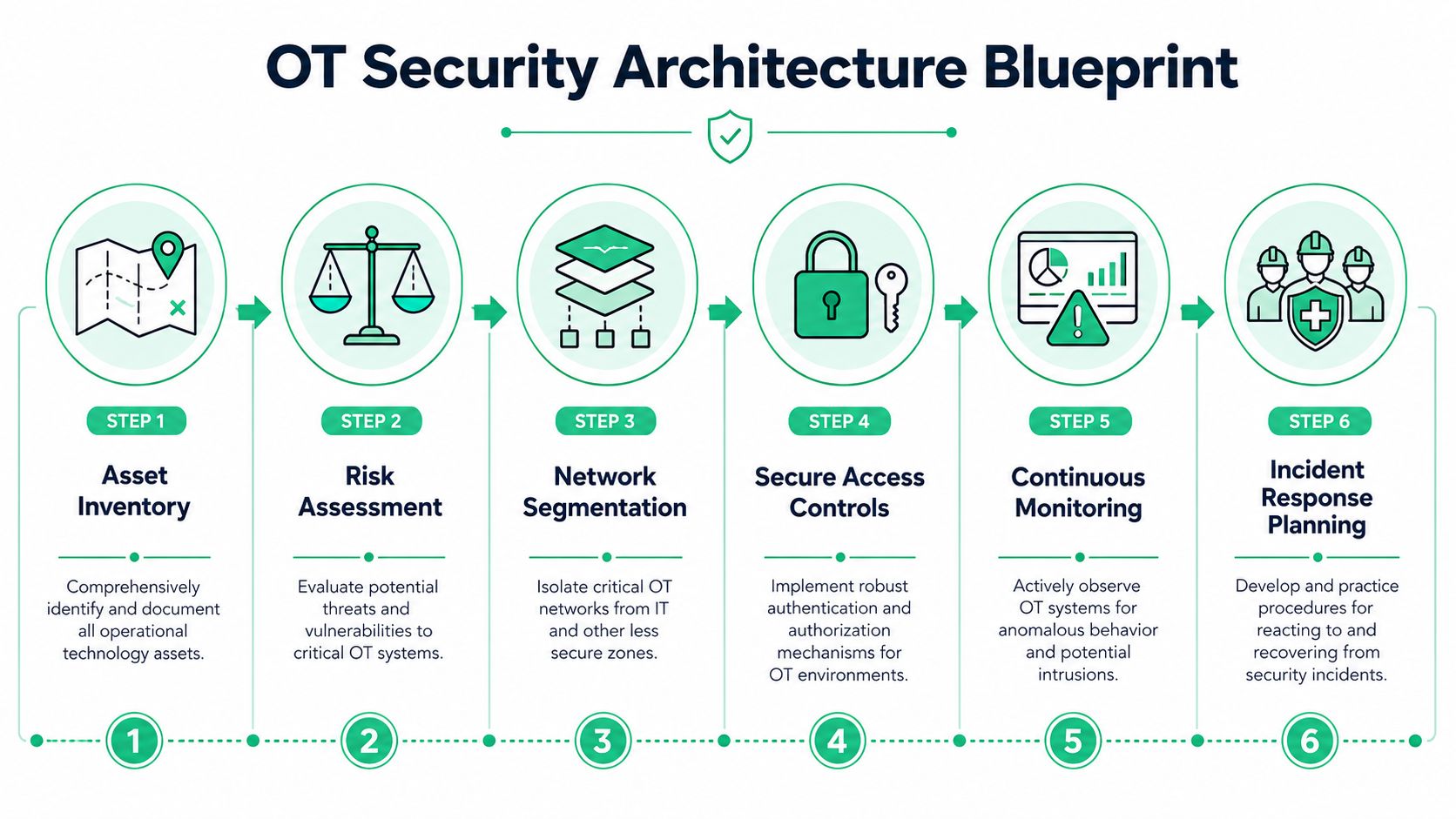
Most OT environments don't need a dramatic rebuild. They need discipline. Start with visibility, separate what should never be flat, and stop buying systems that are painful to defend.
Start with asset inventory
If you don't know what assets exist, every other control is weaker. CISA's inventory guidance pushes teams to pull engineering drawings, control schematics, firmware details, and network documentation because OT blind spots are where bad assumptions live. Unknown devices, forgotten remote access paths, and legacy controllers don't become safer because nobody documented them.
Build inventory by function, not just IP list or host name. You need to know what the thing does, who depends on it, and what would happen if it stopped.
Segment hard and control access
IBM recommends separating OT from IT and the internet with firewalls and unidirectional gateways in its IBM overview of OT security. That advice is right. If I had to choose one architecture move that reduces OT risk fastest, it's segmentation.
Focus on these moves first:
- Separate IT from OT with explicit barriers, not informal trust
- Restrict remote access to approved paths, approved users, and approved times
- Limit lateral movement so a compromise in one area doesn't become a plant-wide problem
- Review engineering access because maintenance tools often become attacker shortcuts
Don't overcomplicate this. A smaller, well-defined path is easier to monitor, easier to test, and easier to shut down safely if needed.
Fix procurement before it fixes you
This is the OT security topic too many buyers ignore. You can't patch your way out of a bad purchasing decision. The NSA, CISA, and partners recently published guidance warning that many OT products still ship with weak authentication, default settings, default credentials, limited logging, and weak upgrade tooling in NSA and partners guidance for secure OT product selection.
When you evaluate OT products, ask direct questions:
- Authentication can it support strong authentication cleanly
- Logging can your team see what happened
- Secure communications can it protect management and operational traffic
- Updates can you upgrade and recover without chaos
- Vulnerability handling does the vendor have a real process
Good architecture is part network design, part purchasing discipline.
Affordable OT Penetration Testing for SMBs
You can document controls all day. You still won't know whether they hold up until someone tests them like an attacker.
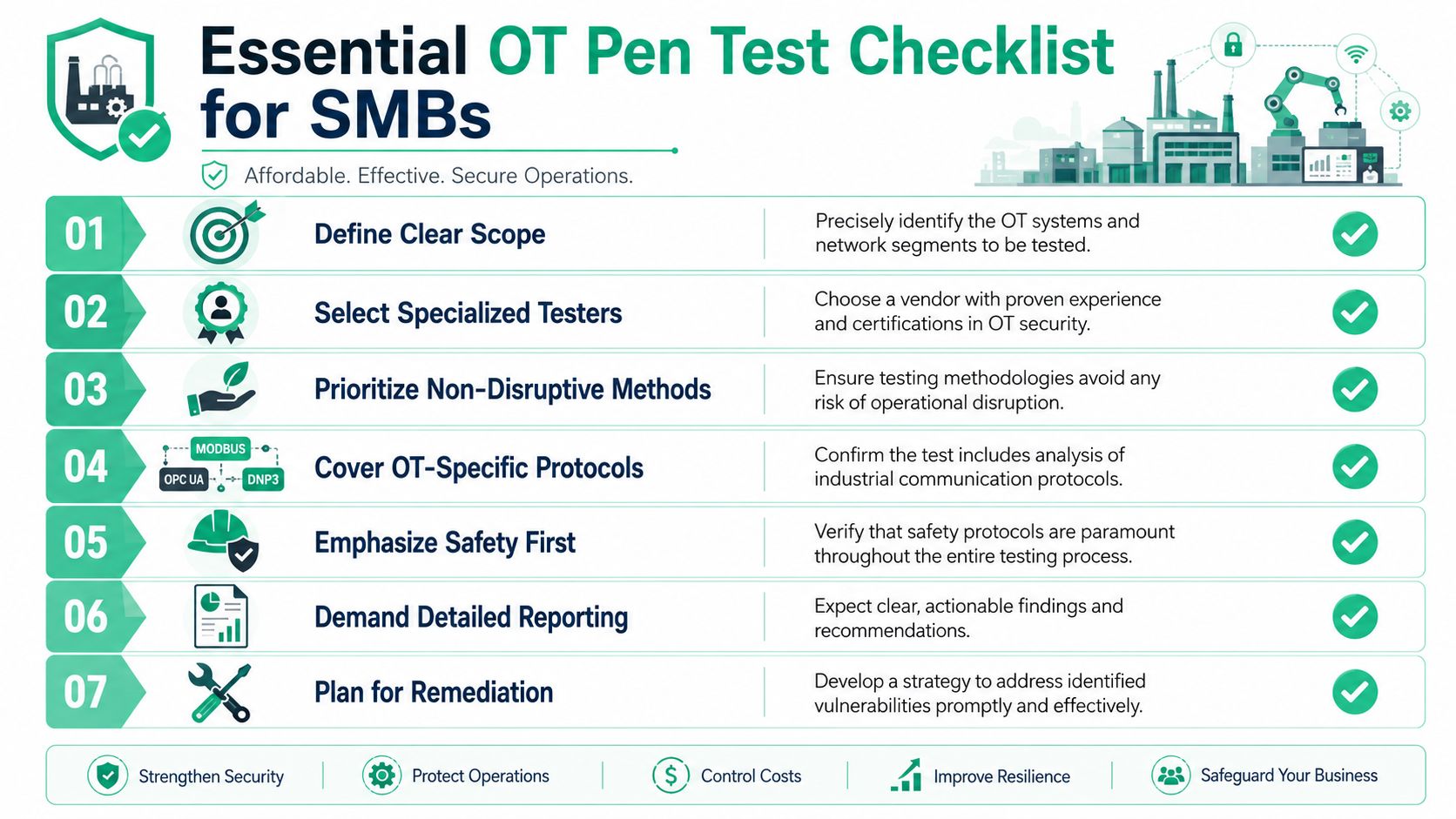
That's why OT-specific pentesting, pen testing, and penetration testing matter. A standard IT penetration test can be useful around the edges, especially for remote access, perimeter systems, and jump hosts. But a real OT pentest has to account for fragile devices, process impact, maintenance windows, and safety constraints.
What a good OT pen test looks like
A solid OT pen test doesn't mean reckless exploitation inside a live process environment. It means controlled, manual testing with clear scope, operations coordination, and a tester who knows when to stop. In this kind of work, judgment matters as much as tooling.
Look for teams that can explain:
- How they prevent disruption before testing begins
- How they handle industrial protocols instead of treating OT like generic Ethernet
- How they validate attack paths manually rather than flooding you with scanner noise
- How quickly they report so you can fix issues while the test is still fresh
Speed and affordability matter
Traditional firms often make SMBs miserable. Long scoping cycles. Expensive statements of work. Generic findings. Reports that show up long after your internal momentum is gone.
A better model is straightforward. Use experienced testers with certifications like OSCP, CEH, and CREST. Keep the work manual enough to uncover real paths, but disciplined enough to stay safe. Deliver the report within a week so leadership can act while the context is still current.
For internet-facing exposure that often serves as the first step toward larger compromise paths, it also helps to understand pentesting for external environments. External weaknesses are often where OT problems begin, even if the final target sits deeper in the network.
Fast reporting isn't a luxury. If a penetration test takes too long to turn into fixes, the value drops fast.
Frequently Asked Questions About OT Security
Is OT security just industrial IT security
No. The overlap is real, but the priorities are different. IT can often tolerate more aggressive change and testing. OT usually can't, because uptime and safety carry more weight.
Do small manufacturers and startups really need OT security
Yes. Size does not protect you. If your business depends on physical processes, connected machinery, industrial control systems, or automated production, operational technology security is part of business continuity.
Can we just run a normal vulnerability scan
Not as your main answer. Some OT assets can't tolerate the same approach you use in office IT. You need a controlled method, clear scope, and people who understand where active testing is safe and where review should stay passive.
What should we fix first
Start with three things. Build a real asset inventory. Segment IT from OT. Lock down remote access. Those steps remove a lot of avoidable risk and make the environment much easier to assess.
How is an OT pentest different from a normal penetration test
An OT penetration test is planned around operational impact. The tester needs to understand industrial devices, fragile communications, vendor dependencies, and safety constraints. Good penetration testing here is careful, manual, and realistic.
What should we expect in a report
You should get clear findings, attack paths, business impact, and practical remediation guidance. If a report is mostly screenshots and scanner output, that's not enough. You need something your IT team, operations staff, and leadership can all use.
How fast should results come back
Fast. If a vendor drags the process out, your team loses momentum and open issues sit longer. The best pen test programs keep scope tight, communicate clearly, and return actionable results quickly.
What if we're also dealing with compliance
That's common. OT environments often tie into larger obligations around audits, insurance, customer security reviews, and governance programs. A well-run pentest helps because it gives you evidence of real testing, not just policy language.
If you need a fast, practical read on your industrial exposure, Affordable Pentesting offers affordable manual pentests, pen tests, and penetration testing designed for teams that don't want bloated timelines or low-value reports. Their certified pentesters, including OSCP, CEH, and CREST professionals, focus on actionable findings and can deliver reports within a week. Use the contact form to start a straightforward conversation about your OT environment.