.svg)
Your acquirer emails you. A customer asks for your Attestation of Compliance. A partner's security questionnaire suddenly turns into a PCI problem. Now you're stuck trying to figure out whether you need an audit, a scan, a pen test, or all three.
Many organizations experience significant difficulties in this area. Traditional firms drag the work out, flood you with vague checklists, and charge like they're rebuilding your whole security program from scratch. Meanwhile, your deadline doesn't move.
PCI DSS audit services don't have to work like that. If you handle card data in any way, you need a practical path to get clean scope, gather real evidence, fix the obvious gaps, and achieve regulatory compliance without wasting weeks on theater.
Your Fast Track to PCI DSS Compliance
The worst PCI projects start with confusion. One person thinks the payment processor handles everything. Another thinks the annual scan is the audit. Someone else is pretty sure the firewall spreadsheet from last year is still fine.
Then the demanding work begins. You need to prove what's in scope, show controls are operating, and produce evidence an assessor can follow without guessing. That's the part slow firms love to stretch into a long engagement.
A smarter approach is simple. Shrink scope first. Validate what systems touch card data. Run the required testing early. Fix what's broken before an assessor has to write it up.
Practical rule: If your PCI effort starts with policy templates instead of scoping, you're already wasting money.
You do not need more jargon. You need a fast read on what applies, what evidence is missing, and which technical tests have to happen now so you don't miss the window.
What Are PCI DSS Audit Services Really
PCI DSS audit services are a structured way to prove your cardholder data environment is secure enough to meet the standard. Imagine it as a home inspection, except the house is every system, process, and vendor that touches payment data. If you can't show what exists, how it's protected, and whether the controls work, you don't have an audit-ready environment.
The standard isn't local or optional for one niche market. PCI DSS applies globally to any entity that stores, processes, or transmits cardholder data, and the framework is organized into 12 requirements across areas like secure networks, cardholder-data protection, access control, monitoring, and information security policy, according to the PCI DSS Quick Reference Guide.
What auditors actually look for
A real PCI audit service doesn't stop at documents. Auditors want to connect your written rules to actual systems and actual proof. If your policy says access is restricted, they'll expect to see account settings, logs, and owner accountability.
That's why strong PCI DSS audit services usually center on a few plain questions:
What touches card data
Systems, applications, networks, people, and vendors all matter if they store, process, or transmit cardholder data.How is that data protected
Auditors look for technical and operational controls, not just broad statements.Can you prove the control works
A control without evidence is just a claim.
The 12 requirements without the fluff
You don't need to memorize all 12 requirements to understand the job. Group them by purpose and the picture gets clearer.
| Control area | What it means in plain English |
|---|---|
| Secure systems and networks | Lock down the environment so only approved traffic and configurations are allowed |
| Protect account data | Keep card data from being exposed in storage or transit |
| Control access | Make sure only the right people get in, and only as much as they need |
| Monitor and test | Log activity, review it, scan for weaknesses, and verify defenses hold up |
| Governance and policy | Set rules people can follow and maintain over time |
A PCI audit is less about answering “Do you have a policy?” and more about answering “Can you prove the environment matches the policy?”
That difference matters. Cheap paper-only consulting creates false confidence. Then the assessor asks for firewall configs, MFA settings, access logs, scan outputs, or segmentation evidence, and the whole thing stalls.
Choosing Your Type of PCI DSS Assessment
Most companies don't have a PCI problem. They have a classification problem. They don't know which assessment path they're on, so they overspend, underspend, or prepare for the wrong thing entirely.
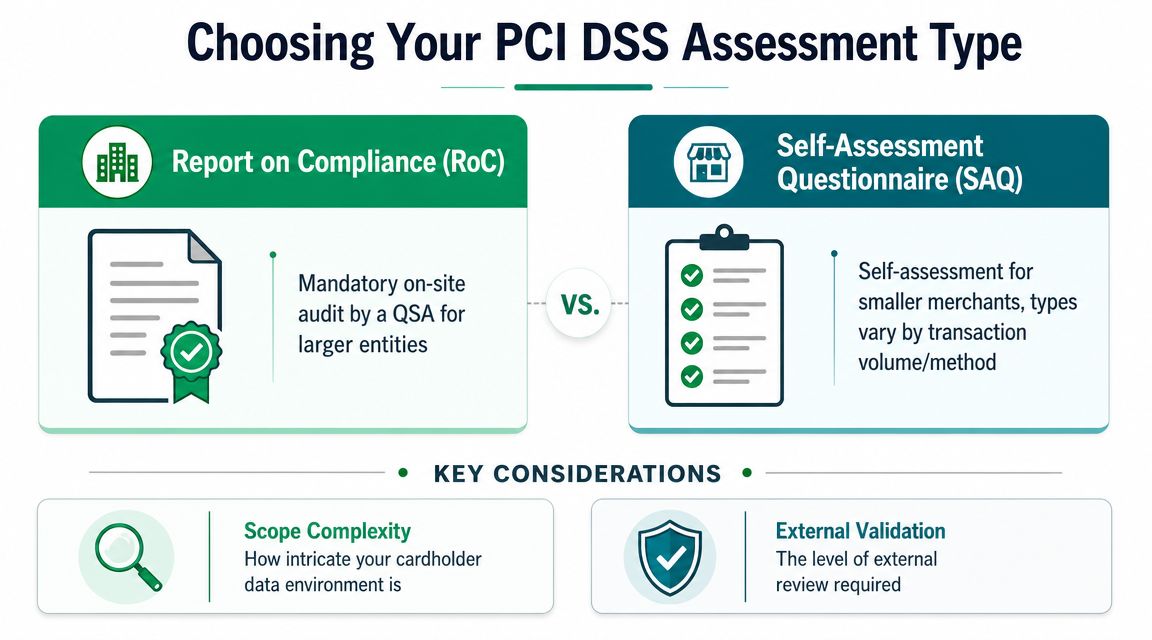
RoC versus SAQ
At a high level, organizations commonly end up dealing with one of two validation tracks.
| Assessment type | Best fit | What it usually means |
|---|---|---|
| Report on Compliance or RoC | Larger entities with heavier external validation needs | Formal third-party assessment and deeper evidence review |
| Self-Assessment Questionnaire or SAQ | Smaller merchants with eligible environments | Internal validation against the applicable questionnaire type |
For large merchants, the line gets clearer. Industry guidance commonly treats Level 1 merchants as those processing over 6 million transactions annually, and they're generally expected to undergo annual third-party verification rather than rely only on self-attestation, as summarized in this PCI DSS audit overview.
That doesn't mean everyone else gets off easy. SAQ environments still need to be properly scoped, correctly classified, and supported by the required technical testing.
Don't guess your way into scope
Here's where teams waste money. They assume using Stripe, Square, or another processor automatically means tiny scope. Sometimes that's true. Sometimes the website, support workflow, cloud environment, or connected application involves more systems than initially obvious.
Use these questions before you pick your path:
Who handles the card data directly
If your systems touch it at all, expect more scrutiny.How complex is the environment
A simple hosted checkout is very different from a custom payment flow.What does your acquirer require
Your bank or payment partner often decides how validation needs to happen.
Gap assessments still matter
A gap assessment isn't the formal validation itself. It's the sanity check before the pressure starts. It tells you what your environment looks like today, where your evidence is thin, and what will blow up later if you ignore it.
That's usually the smartest first spend. Not because it sounds impressive, but because rework is what makes PCI expensive.
The PCI DSS Audit Process and Timeline
Most PCI delays are self-inflicted. Not because teams are lazy, but because they start collecting evidence before they know what's in scope. That's backwards.
A PCI audit should move in a straight line. First define the environment. Then gather evidence for the systems that are relevant. Then run the testing, document the results, and fix the issues that would block validation.

Scope first or pay later
Scoping is the lever that controls effort, cost, and pain. PCI DSS audit services are built around a scope-validation problem. The assessor has to identify every system, process, and third-party service provider that stores, processes, or transmits cardholder data, because audit effort grows with the Cardholder Data Environment. PCI DSS 4.0 also requires service providers to document and confirm scope every six months, as explained in this PCI DSS 4.0 requirements guide.
If your network diagram is stale, your asset inventory is incomplete, or your cloud data flows are based on assumptions, your audit gets bigger fast.
What the workflow should look like
A clean PCI workflow usually looks like this:
Define the CDE
Identify payment flows, connected systems, admins, integrations, and service providers.Collect evidence
Pull configs, screenshots, policies, logs, access records, and architecture diagrams.Test controls
Run scans, pen tests, segmentation checks, and validate technical safeguards.Review findings
Separate real blockers from noise and assign fixes to actual owners.Remediate and finalize
Close the gaps and package the evidence so the assessor can verify it quickly.
If your assessor has to discover your environment for you, the timeline is already off the rails.
Where the timeline usually breaks
Audit projects slow down when teams rely on tribal knowledge. One engineer knows how the payment subnet works. One compliance person has the last approved policy set. One vendor contact knows which managed service can affect the CDE. That's fragile and expensive.
The fastest teams centralize evidence early. They tie every control to a system owner, a proof artifact, and a remediation path. That's how you turn a messy multi-month scramble into something tighter and far more manageable.
Integrating Penetration Testing Into Your Audit
This is the part too many firms soft-pedal. A PCI audit is not a paperwork contest. If your testing story is weak, your compliance story is weak.

PCI guidance makes that pretty clear. Requirement 11 is about evidence-backed testing of security systems and processes. Organizations must perform quarterly internal and external vulnerability scans and annual penetration testing, with extra testing after significant network changes, as outlined in this explanation of the twelve PCI DSS requirements.
What a pentest actually does
A pentest is a controlled attack by an ethical hacker. The tester tries to find the same weaknesses an attacker would use, then documents what was exposed, how it could be abused, and what you need to fix.
A good penetration test is not a scanner dump with a fancy cover page. It should tell you:
What was tested
Applications, external attack surface, internal paths, or segmented environmentsWhat was found
Real exploitable weaknesses, not just theoretical issuesWhat matters for PCI
Findings tied to the systems and controls that support your audit
Why speed matters here
Traditional penetration testing firms love long queues. You wait, they schedule, they test, they disappear, and the report lands after your compliance deadline is already on fire.
That model is broken. For PCI work, speed matters because the penetration test is not the end of the process. You still need time to review the findings, remediate what matters, retest if needed, and hand the final report to the assessor.
A fast manual pen test with a report delivered within a week is not a luxury. It's what keeps the whole project moving.
Field advice: The best time to book penetration testing is before your assessor asks for the report, not after.
Manual testing beats checkbox testing
Automated scanning has its place. It helps teams streamline SOC and DevSecOps security, especially when they need faster visibility across changing environments. But automation alone won't replace a real pentest for PCI evidence.
A certified human tester finds logic flaws, access control mistakes, broken workflows, and chained attack paths that scanners often miss. For audit readiness, that matters more than glossy dashboards.
If you're new to the requirement, start with understanding PCI DSS pentests. It's the fastest way to separate required testing from vendor upsell.
What to demand from a pen testing provider
Don't accept vague promises. Ask direct questions.
Who is doing the work
You want certified pentesters, not a sales team outsourcing the hard part. Look for credentials like OSCP, CEH, and CREST.How fast is reporting
PCI timelines get wrecked by slow report delivery, not just slow testing.Will the report be audit-ready
If the findings aren't clear, scoped, and mapped to the environment, your assessor will push back.Is it manual or mostly automated
If the answer sounds slippery, assume you're buying a scan dressed up as penetration testing.
How to Actually Prepare for Your Audit
Preparation is where you either save money or light it on fire. PCI DSS 4.0 pushes harder on continuous monitoring and stronger documentation, while many providers still act like a point-in-time exercise is enough. That mismatch shows up fast in complex environments where diagrams, segmentation, and policies drift over time, as discussed in this PCI audit preparation overview.
Your pre-audit checklist
Start with the items that reduce confusion and shrink the chance of ugly surprises.
Map the payment flow
Document where card data enters, moves, and exits. If the answer is “we think it goes through this app,” you are not ready.Validate the asset inventory
Make sure every server, workstation, cloud workload, and admin path tied to the CDE is accounted for.Review segmentation
If you claim systems are out of scope, be ready to prove they are separated in practice.Gather evidence by control owner
Policies alone won't save you. Pair each control with a person, a system, and a piece of evidence.Run your testing early
Leave room for remediation. The report is not useful if it arrives after your deadline.
Stop treating compliance like a one-time event
Teams often do a frantic cleanup right before validation, then let the environment drift. That's why the next audit feels like starting over.
Use a simple operating rhythm instead. Update diagrams when systems change. Review inventories on schedule. Track findings in the same ticketing flow you already use for engineering work. Keep evidence where more than one person can find it.
If you need a starting point, use this 2025 PCI DSS compliance guide as a practical checklist, not as shelfware.
Clean documentation doesn't make you secure. But messy documentation makes it much harder to prove you are.
Choosing an Affordable and Qualified Provider
The wrong provider costs more, even if the quote looks cheap. They miss scope issues, deliver weak reports, bury you in generic findings, or take so long that your team pays in delay and rework.
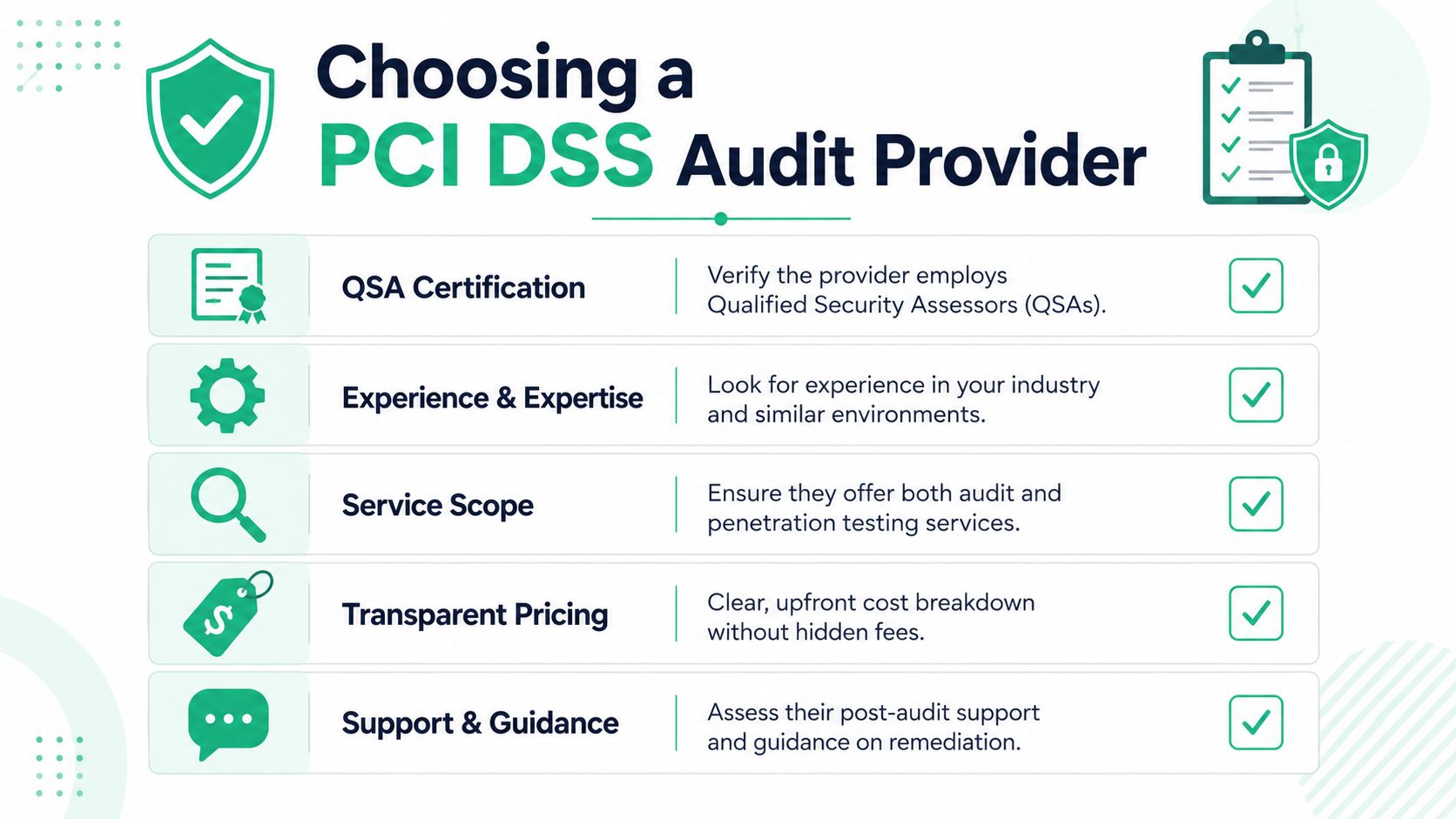
What to ask before you sign
Use this list and don't apologize for being blunt.
Who will assess or test us
Ask whether work is done in-house and what qualifications the team holds.What is included in scope
If they can't clearly explain what environments, applications, and retesting are covered, expect change orders later.How fast do reports arrive
Slow reporting kills PCI projects.How do you handle remediation questions
You need direct answers once findings land, not a handoff to an account manager who wasn't in the test.
Cheap is not the same as affordable
Cheap providers cut the parts that matter. They automate too much, test too shallowly, or rush through scoping so they can keep margin. Then your internal team spends the next stretch untangling vague evidence requests and unclear findings.
Affordable is different. Affordable means the work is scoped correctly, delivered quickly, and useful the first time. It respects your budget by not creating avoidable rework.
The best value is boring in the right way
A qualified provider should make the process feel predictable. Clear kickoff. Clear scope. Clear deadlines. Clear findings. Clear report.
That's what you want when the audit clock is running. Not a giant consulting circus. Not a “platform” that still needs a human to explain everything. Just competent people doing focused work at a fair price.
If you need PCI-ready penetration testing without the usual delays and bloated pricing, Affordable Pentesting is the practical next step. Their team delivers affordable manual pentests, pen tests, and penetration testing for compliance-driven teams, with certified pentesters holding OSCP, CEH, and CREST credentials. If you're on a deadline and want an audit-ready report fast, use the contact form and get a quote that fits your timeline and budget.