.svg)
Confused about security testing? A vulnerability assessment is an automated scan that finds potential weak spots, like a checklist. A penetration test is a manual attack by a certified expert who tries to break in, showing you what a real hacker could do. We provide fast, affordable manual pentests so you can find and fix real risks without the high price tag.
Stop Wasting Money on the Wrong Security Test
You need security testing for compliance or to protect your business, but choosing wrong is expensive. Old-school pentesting firms are slow and overpriced, while cheap automated scans just give you a noisy list of false alarms. This wastes your team's time and leaves you vulnerable.
You need to know what's actually exploitable, not just what a scanner thinks might be a problem. A real manual pentest shows you exactly how an attacker could get in and what damage they could do. It's the difference between a guess and proof.
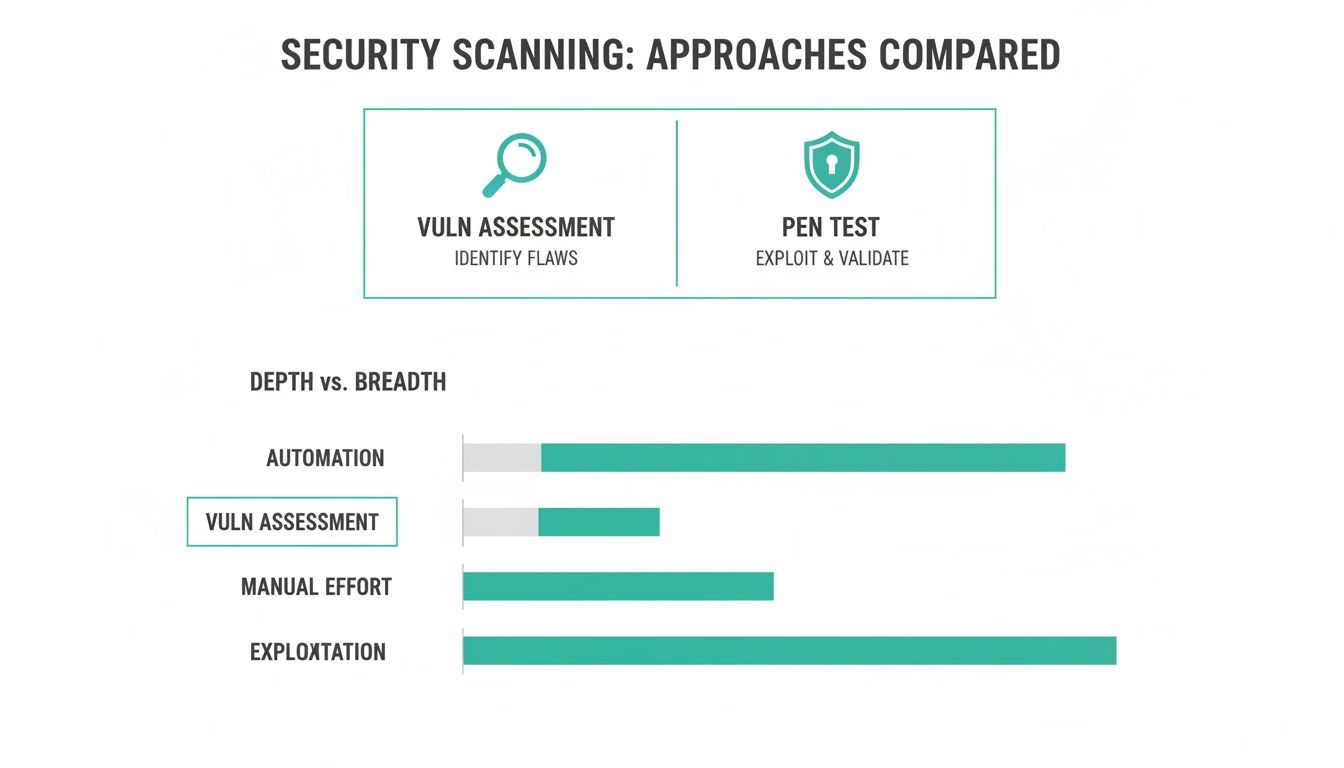
A pentest gives you the real-world validation that an automated scan can never provide. It moves beyond theory and into practical, actionable proof of risk.
What a Vulnerability Assessment Actually Is
Think of a vulnerability assessment as a quick, automated check-up. A tool scans your systems and spits out a long list of potential security issues. It’s like a spellchecker for security.
Its job is to be broad and fast. It looks for known problems like outdated software or common misconfigurations. The goal is to give you a big picture of all possible weak spots.
But here’s the problem: the report is just a list of possibilities. It often includes false positives and doesn't tell you if a hacker could actually use any of these findings to break in. It's a starting point, not the whole story.
For more details, you can read our guide on what is a vulnerability assessment.
Why a Manual Penetration Test is Different
A penetration test, or pentest, is a simulated real-world attack. We answer one simple question: "Can a hacker actually get in and cause damage?" It's not a scan; it’s a mission.
Our certified ethical hackers manually try to break into your systems. Our experts hold top certifications like OSCP, CEH, and CREST. They don't just find flaws—they exploit them to see how far they can get. It's the difference between knowing a window is unlocked and climbing through it.
This manual approach is key. It finds complex issues that automated tools always miss. Your final report is a clear story showing exactly how we breached your defenses, proving the real business risk you face. To learn more, here are 5 reasons your business can benefit from penetration testing.
How This Choice Affects Your Budget and Team
Knowing the difference between these tests helps you spend your money wisely. A vulnerability assessment is automated and cheap, but it gives you a noisy list of potential issues. A manual pentest gives you a focused report on exploitable flaws.
This is where it hits your productivity. An assessment report can overwhelm your engineers with a long list of false positives. It creates a ton of work chasing ghosts.
A good pentest delivers a short, actionable report on what was actually exploited. Your team can fix the real, critical issues first. That's why teams using pentests see remediation rates jump to 60-75%. Focus makes all the difference.
If you are trying to budget for this, our guide on the cost of penetration testing can help.
Choosing the Right Test for Compliance Audits
For compliance frameworks like SOC 2, PCI DSS, or HIPAA, security testing is not optional. Just running a vulnerability scan is not enough to pass an audit. Auditors need to see your security can stop a real attacker.
While automated scans are a good first step, auditors want more. They want proof. This is where a manual penetration test is essential. It shows you invested in validating your defenses against a human expert.
The data shows why this matters. One study found 68% of companies failed SOC 2 audits when they only used vulnerability scans. In contrast, 92% that invested in a pentest and fixed the findings passed. For more details, check out these vulnerability management findings.
Get Your Pentest Report Fast and Affordably
Let's be direct. Traditional penetration testing is slow and expensive. We exist because startups and SMBs need a better option. You need real findings, fast, without the enterprise price tag.
We deliver 100% manual penetration tests from certified OSCP, CEH, and CREST experts. The best part? You get a full, actionable report in about a week. No more waiting months for a report or paying for a fancy office you'll never visit.
We give you the real-world insights you need to secure your app, protect data, and pass audits. It's real security that fits your budget and timeline. Ready to see how affordable a real pentest can be? Get in touch through our contact form.
Frequently Asked Questions About Pentesting
People often ask us which test to get and how often. For compliance frameworks like SOC 2 or PCI DSS, you typically need a manual penetration test at least once a year. Vulnerability scans are usually done more often, like quarterly or monthly, for ongoing monitoring.
A vulnerability scan is automated and cheaper. It's good for getting a wide list of potential problems. But that list is full of "maybes" that your team has to spend time investigating.
A manual penetration test costs more because a certified human expert is doing the work. That's where the value is. We don't just find a flaw; we confirm if it's exploitable and show you the real-world risk. Our model makes this affordable, with reports delivered in about a week.
Ready for a security test that gives you real findings without the high price and long waits? Affordable Pentesting provides fast, manual pentests from certified experts. Get in touch through our contact form to get started.