.svg)
Penetration testing as a service (PTaaS) is a subscription or on-demand way to get real, human-led penetration tests without the enterprise price tag or the six-week wait. Instead of chasing a big firm for a custom quote every time you need a test, you get scoping, testing, a report, and a retest through one repeatable service. At Affordable Pentesting, that means an OSCP-certified tester on your systems, an auditor-ready report in about five business days, and a free retest once you fix what we find. Manual pentests start at $2,000.
You already know the old way. You need a pentest for SOC 2 or a customer security review, so you email three firms, and two of them ghost you until their sales quarter closes.
Then the quote lands. Enterprise pricing. A statement of work thick enough to prop open a door. A start date next month.
PTaaS exists because that model doesn't fit how fast your business actually moves.
In this guide:
- What penetration testing as a service really is
- How PTaaS works, step by step
- What you can test through PTaaS
- PTaaS vs traditional penetration testing
- What PTaaS costs
- Is PTaaS right for your business?
- How to choose a PTaaS provider
- FAQ
What penetration testing as a service (PTaaS) really is
PTaaS packages penetration testing into a service you can start on demand, usually through a platform or a short intake instead of a drawn-out sales cycle. You scope the work, a tester attacks your systems by hand, and you get findings you can act on. Some providers run it as a subscription for continuous coverage. Others sell it per engagement. Either way, the point is speed and repeatability.
Here's the part that matters. PTaaS is not a scanner with a nice dashboard.
Real PTaaS still puts a human in the loop. A tool can flag a missing patch. It can't chain three "low" findings into a full account takeover the way an attacker does. The OWASP Web Security Testing Guide and the Penetration Testing Execution Standard exist because good testing is a thought process, not a button. PTaaS just wraps that process in a faster delivery model.
If a provider sells you "PTaaS" and it turns out to be an automated vulnerability scan, walk. That's a scan wearing a costume.
How PTaaS works, step by step
The delivery is simple on purpose. Five steps, start to finish.
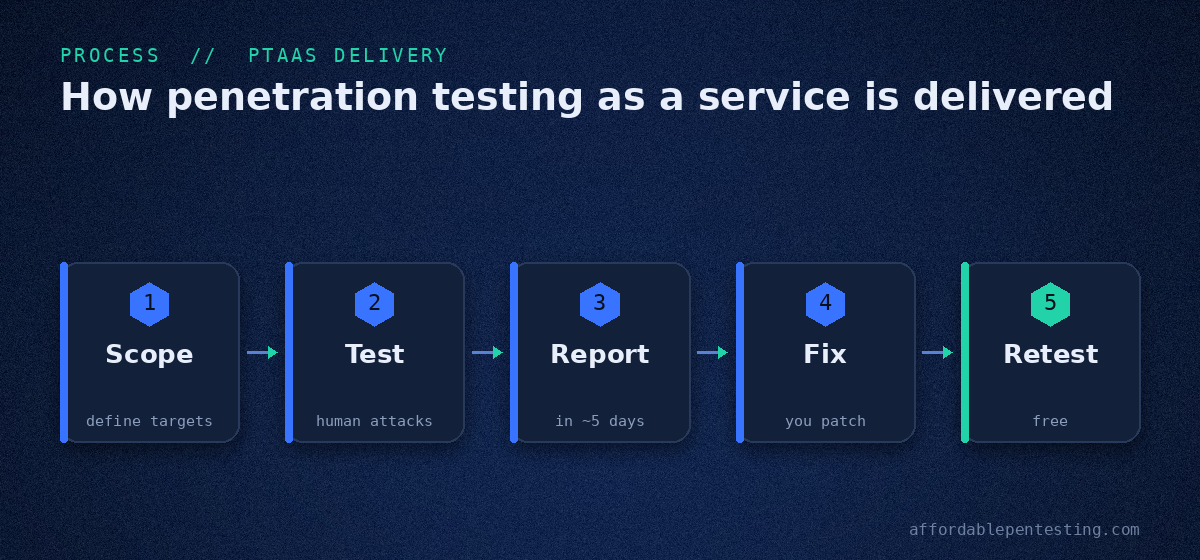
- Scope. You share what you want tested: a web app, an external network, an API, a cloud environment. You set the goal, whether that's SOC 2 evidence or just finding out where you're exposed.
- Test. A certified tester attacks the target by hand, using the same techniques a real intruder would. Automated tooling handles the noisy coverage. The human hunts the logic flaws and privilege paths that scanners skip.
- Report. You get a written report with findings ranked by severity, proof for each one, and clear remediation steps. Ours land in about five business days, built to hand straight to an auditor.
- Fix. Your team patches the issues. A good report tells you exactly how, not just that something is "high."
- Retest. The tester verifies your fixes actually worked. We include the retest free, because a finding you can't confirm is closed isn't really closed.
What you can test through PTaaS
"Penetration testing" isn't one thing, and neither is PTaaS. The service model covers the same range of targets a traditional engagement would. You pick what matters to your business and your compliance scope.
- Web applications. Your customer-facing app, the one holding logins and data. Usually the first thing an auditor or customer asks about.
- External networks. Everything an attacker can see from the internet: your perimeter, exposed services, and misconfigurations. Start with network penetration testing.
- APIs. The endpoints powering your app and integrations, where broken authorization and data exposure love to hide. See API penetration testing.
- Cloud environments. Your AWS, Azure, or GCP setup, checked for the misconfigurations that cause most cloud breaches.
- Mobile apps. iOS and Android clients and the way they talk to your backend.
Most SMBs start with whatever their auditor or biggest customer is asking about, then widen coverage from there.
PTaaS vs traditional penetration testing
Traditional pentesting isn't bad. It's just built for a different buyer: the giant enterprise with a dedicated security team and a budget that doesn't flinch at $50,000.
You're probably not that buyer. Here's how the two stack up.
| Factor | PTaaS | Traditional pentest |
|---|---|---|
| Time to start | Days | Weeks of sales calls and scoping |
| Turnaround | About 5 business days | 3 to 6 weeks |
| Pricing | Transparent, from $2,000 | Custom, often $15,000 to $50,000+ |
| Human-led testing | Yes | Yes |
| Retest | Included | Usually billed extra |
| Best fit | SMBs, startups, fast compliance | Large enterprises, bespoke scopes |
The honest take: if your scope is genuinely massive and strange, a big bespoke engagement can make sense. For the other 90% of SMB testing, PTaaS gets you the same manual rigor faster and cheaper.
What PTaaS costs
Pricing is the whole reason PTaaS exists, so let's be blunt about it.
Traditional engagements for small and mid-sized companies often run $10,000 to $50,000 once you add project management layers and padded scope. PTaaS strips that overhead out. Manual penetration tests at Affordable Pentesting start at $2,000, with the exact number set by scope: how many apps, how big the network, whether you need API or cloud coverage.
What moves the price:
- Scope size. One small web app costs less than a sprawling network with fifty live hosts.
- Test type. External network, web app, API, and cloud each take different effort.
- Depth. A focused compliance test is lighter than a full adversary simulation.
- Retesting. Some firms charge for it. We don't.
Want a real number instead of a range? Get a quote and you'll have one in about a minute. For a deeper breakdown, read our guide to penetration testing cost.
Is PTaaS right for your business?
PTaaS fits you if any of this sounds familiar.
- You need a pentest report for SOC 2, PCI DSS, HIPAA, or ISO 27001, and the deadline is real.
- A customer sent you a security questionnaire and wants proof of testing.
- Your cyber insurance renewal asks whether you run regular pentests.
- You ship code often and want testing that keeps pace instead of once a year.
- You got quoted enterprise money for an SMB-sized job.
It's a weaker fit if you're a Fortune 500 with a red team on staff and a scope that needs a fully custom, months-long engagement. Different tool for a different job.
If you want testing that runs on a cadence rather than once and done, look at continuous security testing too.
How to choose a PTaaS provider
Not all "PTaaS" is created equal. Some of it is a scanner with a subscription button. Run through this checklist before you sign anything.
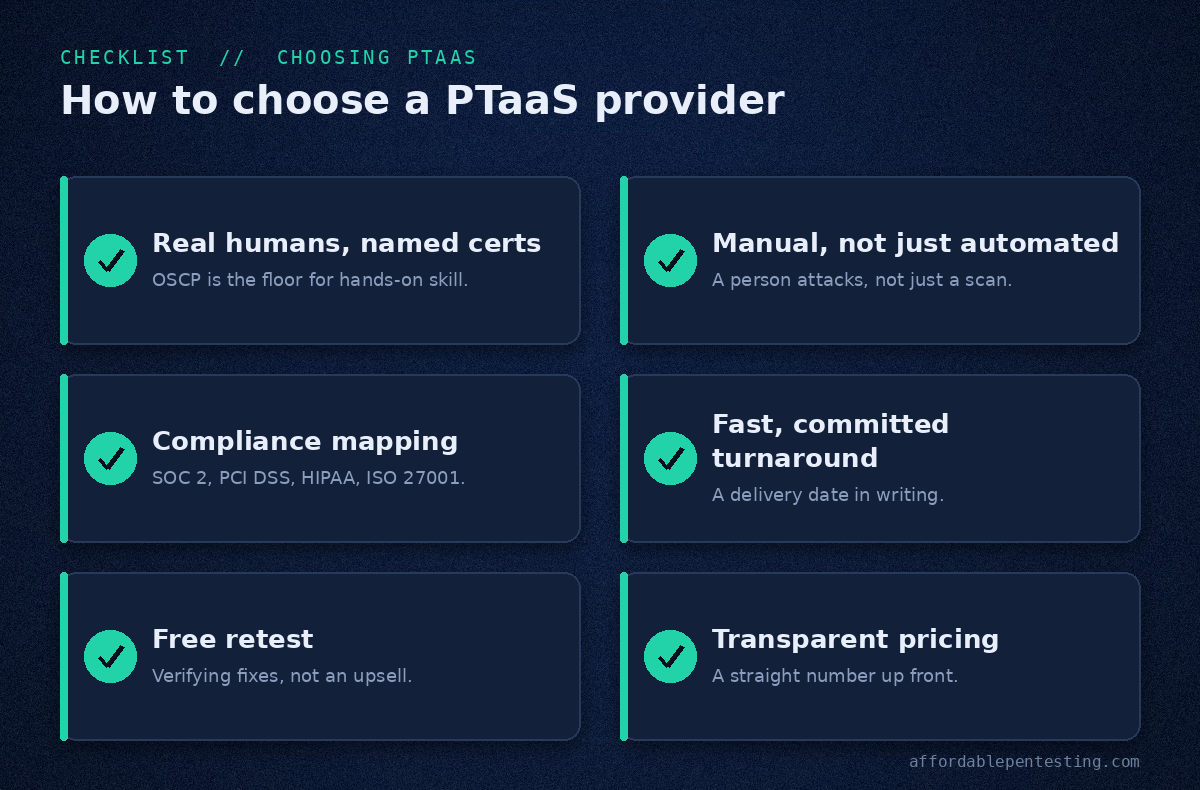
- Real humans, named certs. Ask who tests and what they hold. OSCP is the floor for hands-on skill.
- Manual, not just automated. Confirm a person is actually attacking your systems, not just running a scan and forwarding the output.
- Compliance mapping. Your report should map to the framework you care about: SOC 2 Trust Services Criteria, PCI DSS, HIPAA, or ISO 27001.
- Fast, committed turnaround. Get the delivery window in writing, not "soon."
- Free retest. Verifying fixes should be part of the deal, not an upsell.
- Transparent pricing. If you can't get a straight number up front, expect a not-straight invoice later.
Frequently asked questions
What is penetration testing as a service (PTaaS)?
PTaaS is penetration testing delivered as an on-demand or subscription service. You scope a test, a certified human attacks your systems, and you get a report and a retest, all through a repeatable process instead of a custom, months-long engagement.
How does PTaaS work?
Five steps: scope the target, a tester attacks it by hand, you get a severity-ranked report with proof and fixes, your team patches, and the tester retests to confirm the fixes held.
Is PTaaS as thorough as a traditional pentest?
When it's genuinely human-led, yes. The same manual techniques apply. What changes is the delivery: less sales overhead, faster turnaround, lower cost. The one caveat is scope. Enormous, highly custom environments can still call for a traditional bespoke engagement.
How much does PTaaS cost?
At Affordable Pentesting, manual pentests start at $2,000, with the final price set by scope and test type. That's well below the $15,000 to $50,000 range typical of traditional SMB engagements, mostly because PTaaS cuts the enterprise overhead.
Does PTaaS work for SOC 2 and other compliance?
Yes. A proper PTaaS report maps findings to the framework you need, whether that's SOC 2 Trust Services Criteria, PCI DSS, HIPAA, or ISO 27001, and is built to hand to your auditor as evidence.
Is PTaaS just an automated scan?
It shouldn't be. Automated tools are part of the coverage, but real PTaaS puts a certified tester in the loop to find business logic flaws and privilege escalation paths that scanners miss. If a "PTaaS" offer is scan-only, it isn't a penetration test.
The bottom line
PTaaS isn't a watered-down pentest. It's the same manual testing, delivered without the enterprise tax and the enterprise wait. For most SMBs, that's simply the better deal.
You get a certified human on your systems, an auditor-ready report in about five business days, and a free retest to prove the fixes held. Starting at $2,000.
Ready to see where you stand? Get a quote in about 60 seconds, or book a call with a tester who'll actually pick up.