.svg)

Are your security teams stuck in silos? Your attackers (Red Team) find holes, and your defenders (Blue Team) try to patch them. Reports go back and forth, but the process is slow, expensive, and frustrating. Real improvements get lost in the shuffle.
Purple teaming changes that. It's not a new team, but a smarter way to work. It’s a hands-on collaboration where your attackers and defenders team up to find and fix security gaps in real time.
Understand Purple Teaming In Cyber Security

Think of purple teaming as a live practice with an open playbook. Instead of a surprise attack, the Red Team announces its moves. For example, "We're trying to steal credentials using this specific technique." The Blue Team immediately checks its security tools to see if they caught it.
If they didn't see the attack, they fix the rule right there on the spot. This instant feedback is what makes purple teaming so powerful. You get to see exactly how an attack works and prove your defenses can stop it, without waiting weeks for a report.
Compare Red, Blue, and Purple Teams
To get what purple teaming does, it helps to see how it differs from traditional security teams. The Red Team is your offense, acting like real-world hackers. They perform penetration tests to find ways into your systems.
The Blue Team is your defense. They monitor systems, respond to alerts, and protect your company's data. A purple team isn't a third group but a function where red and blue teams work together, sharing information to improve security immediately.
Know The Goals and Benefits
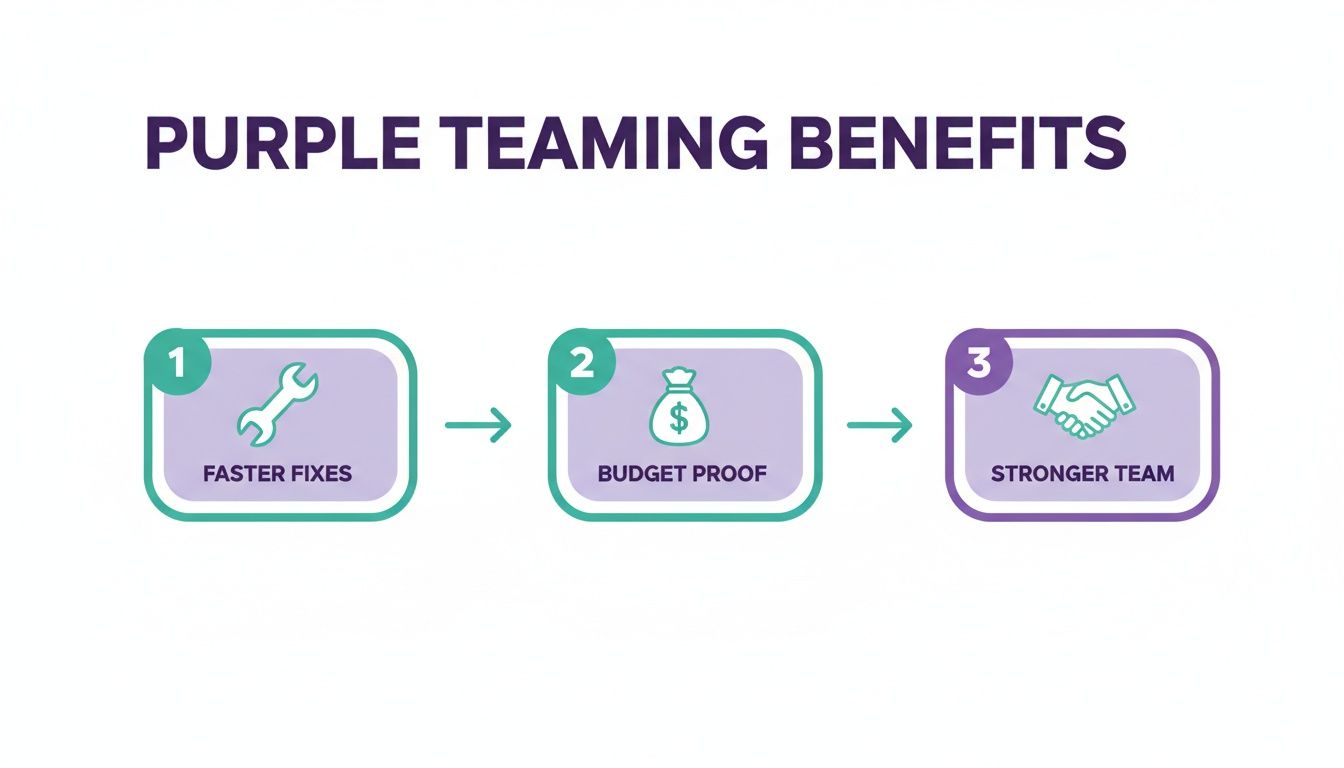
The whole point of a purple team is to get stronger, faster. Forget waiting weeks for a traditional penetration testing report. A purple team exercise gives your team real-time feedback they can act on right away.
This collaboration means defenders can fix vulnerabilities and fine-tune monitoring on the spot. It’s a live, hands-on audit of your security tools, proving their value and exposing gaps before a real attacker finds them. This process builds a stronger, more collaborative security culture.
Strengthen Your Security Defenses Now
Traditional penetration testing often leaves your defense team in the dark. A report might show up weeks later, but it doesn't explain how the attack happened. Purple teaming fixes this by focusing on immediate, hands-on improvement.
When an attacker shows a technique, your defenders see it happen live. This lets them ask the right questions and create new detection rules on the spot. This direct knowledge transfer from our OSCP, CEH, and CREST certified pentesters is far more valuable than any static report.
Maximize Your Security Budget
Companies spend a fortune on security tools that are often misconfigured or unused. Purple teaming ensures your defenses, like Security Incident and Event Management Systems (SIEMs), are tuned to stop real threats. It proves whether your security spending is actually working.
This process gives you hard data on what works and what doesn’t. This helps you justify your security budget and focus on tools that deliver real results. You stop guessing and start knowing.
Get Measurable Security Improvements
Purple teaming gives you solid data that proves your security is getting better. After an exercise, you can see clear metrics showing improved detection and response capabilities. It's not just a feeling; it's a measurable fact.
For managers, this data is gold. You can show leadership exactly how your security posture has improved, turning security from a cost center into a business advantage. This is how you prove your team's efforts are reducing risk.
The Purple Teaming Security Lifecycle
A purple team exercise is a continuous improvement cycle. Think of it like a workout for your security program. You repeat the process to build real strength and endurance against cyber attacks.
The cycle is structured and all about getting measurable results. It moves away from the classic "gotcha" style of a traditional penetration test and into a loop of testing and improving. For IT managers who need to prove controls work for compliance like SOC 2, this process delivers clear proof.
Plan And Scope The Engagement
Every great purple team engagement starts with a clear plan. The offensive "red team" and defensive "blue team" sit down together to agree on what to test. This usually means picking specific tactics from a framework like MITRE ATT&CK.
This ensures the exercise focuses on your organization's real risks. For a startup founder or compliance officer, this means you can align the test with a specific goal, like validating controls for a PCI DSS audit. A focused plan makes the entire process affordable and effective.
Execute The Collaborative Attack Simulation
This is where the action happens. The red team executes a planned attack, and the blue team works to detect it in real time. It’s an open-book test with constant, clear communication.
The red team announces their move, like "we are attempting a pass-the-hash attack." The blue team immediately checks their tools. If nothing was detected, they dig in together to figure out why and fix the gap on the spot.
Improve And Document All Findings
After an attack is simulated, the cycle moves straight to improvement. If a detection failed, the blue team uses the red team's insights to build a new detection rule. That new defense is then re-tested immediately to make sure it works.
This "attack, detect, fix" loop repeats for every technique, making your defenses measurably stronger. At the end of the exercise, you get a report in about a week that shows exactly what was tested, what failed, and how it was fixed. This gives you tangible proof of security improvement.
Run An Affordable Purple Team Program

You don't need a huge budget to get value from a purple team program. The key is to start small. Don't try to test everything at once; pick one thing that matters, like your main web application or a specific compliance goal.
You already have a "blue team"—it's your internal IT staff. Pair them with an affordable penetration testing service to act as your expert "red team." You get a winning combination without the high cost of hiring full-time security staff.
Find An Affordable Pentest Partner
The most important step is finding the right partner. You need a firm that understands the frustrations of old-school penetration testing: high prices, slow timelines, and weak reports. Look for a service built around speed, affordability, and practical results.
Make sure your partner provides certified pentesters with credentials like OSCP, CEH, and CREST. These certifications guarantee a high level of technical skill. They ensure your "red team" can simulate real threats and provide genuine value to your internal team.
Focus On Valuable Knowledge Transfer
The real goal of an affordable purple team program is making your team smarter. The magic is in the knowledge transfer. The external red team should explain the "how" and "why" of an attack to your blue team every step of the way.
This turns a simple penetration test into a live training exercise. Your team learns how real attackers think and operate. This hands-on experience is worth far more than any PDF report and builds your team's skills long after the engagement is over.
Common Purple Teaming Mistakes
A lot of companies get purple teaming wrong by falling into common traps. Many treat it like just another pen test, which misses the point. The focus has to stay on getting better at detection and response, not just ticking a box.
Another classic error is diving in without a clear plan. If you don't agree on what you're testing, the exercise becomes a chaotic mess. The whole point is structured collaboration, not a surprise attack.
Avoid The Traditional Pen Test Mindset
The biggest mistake is running a purple team exercise with a "red team versus blue team" mentality. This is not a competition. If the red team gets in without the blue team knowing, you’ve just paid for a slow, old-school pen test and lost the chance to learn.
The goal is collaboration. A purple team engagement should feel like a workshop, not a surprise exam. This is why finding an affordable penetration testing partner who understands this collaborative approach is so important.
Set Clear Goals And Communicate
A purple team exercise without clear goals is like driving without a map. Before you start, both teams must agree on what success looks like. This usually means picking specific attacker techniques to simulate that matter to your business and compliance needs.
Bad communication during the exercise is just as deadly. The teams need to be in constant contact, sharing screens and talking through every step. This live feedback loop is what makes purple teaming so powerful.
Act On The Findings Immediately
The last and most critical mistake is doing nothing with the results. If the exercise ends with a report that collects dust, you've wasted everyone's time and money. The entire purpose is to drive real security improvements.
Every finding needs to lead to a concrete action, like an updated detection rule or a better security incident response plan. This gives you clear proof of security uplift to show auditors and leadership. To see how our fast and affordable penetration testing can help, get in touch via our contact form.
Frequently Asked Questions About Purple Teaming
When it comes to purple teaming, the same questions pop up again and again. If you're an IT manager, CISO, or founder wondering if this approach fits your business, you're in the right place. We've got direct answers to the most common questions we hear.
What Is The Main Difference Between Red And Purple Teaming?
The biggest difference is collaboration. A traditional red team test is a surprise attack. The goal is to see if your defenders can stop it, which often ends with a "gotcha" moment. The red team acts like a real adversary, staying hidden and trying to break in without anyone noticing.
A purple team exercise is the complete opposite. It's an open-book, collaborative session where attackers and defenders work together. The red team announces its moves, and the blue team tries to detect and block them in real-time. This turns a simple test into a live training exercise, letting you make immediate improvements to your security controls.
How Does Purple Teaming Help With SOC2 Or PCI DSS Compliance?
Purple teaming gives you hard evidence that you're actively testing and improving your security controls, which is exactly what auditors want to see. Compliance standards like SOC2 and PCI DSS demand proof that your controls are effective, not just that you have them written down.
A purple team exercise simulates real attacks against your specific environment. The final report doesn't just list failures; it documents which controls worked, which didn't, and precisely how you fixed them. This gives auditors concrete proof that you're on top of your security posture, helping you meet compliance requirements faster and more affordably.
Do I Need A Large Internal Security Team For This?
Not at all. This is a common myth that holds smaller companies back. You can get all the benefits of purple teaming by partnering with a pentesting service that brings the "red team" expertise.
Your own IT staff, who already know your network inside and out, act as the "blue team." The goal is knowledge transfer. Our certified experts (OSCP, CEH, CREST) guide your team, showing them how attackers think and how to get more out of the security tools you already own. It’s a powerful way to train your team and harden your defenses at the same time.
How Often Should We Conduct A Purple Team Exercise?
The right schedule depends on your goals, but most companies see great results with quarterly or bi-annual exercises. A good rule is to run one after any major change to your environment, like deploying a new critical application or migrating services to the cloud.
This steady, focused approach provides far more value than a single, massive penetration test every few years. It ensures your defenses evolve with your business and keep pace with the ever-changing threat landscape.
Ready to see how a collaborative and affordable pen test can strengthen your security and speed up compliance? At Affordable Pentesting, we deliver fast reports, certified experts, and real results. Get in touch with us through our contact form to learn more.