.svg)
A client asked for a report of compliance. An auditor wants proof. A bigger partner won't sign until they see security evidence. So now your team is digging through Google Drive, Slack, old tickets, and half-finished policies, trying to turn a mess into something official.
That scramble is normal. It's also expensive when you handle it badly. The average cost of non-compliance can lead to a revenue loss of over $4 million, and organizations that miss regulatory requirements also deal with fines, disruption, and reputational damage, according to Hyperproof's compliance data roundup. That's why a report of compliance matters. It protects deals, timelines, and budget.
Most companies don't fail because compliance is impossible. They fail because they wait too long to gather evidence, and the pentest, pen test, penetration test, or penetration testing report becomes the bottleneck. That's the part that usually costs too much, takes too long, and shows up late.
Why You Suddenly Need a Compliance Report
A deal is close, then procurement asks for proof. Your team has controls in place, but nobody can produce a clean packet that shows what exists, who owns it, and whether it was tested. That delay kills momentum fast. Buyers stall, auditors keep asking, and your staff burns hours chasing screenshots, tickets, and policy versions instead of doing real work.
That is why a report of compliance shows up "suddenly." The requirement was always there. You just didn't feel it until revenue, contract renewal, cyber insurance, or vendor approval depended on evidence.
For startups and SMBs, the primary cost is usually speed. A messy compliance response slows sales cycles, drags security reviews into legal review, and forces expensive last-minute help. The worst part is predictable. The penetration test is often the missing piece, and it takes longer than everything else around it.
If you sell into larger companies, this pressure often shows up during customer reviews tied to web application SOC 2 security. Buyers are screening risk. They want a report they can hand to their internal team and move on.
PCI work creates the same problem. If your product handles payment data, the Global businesses PCI DSS guide is a useful reminder that compliance is about proving controls, not claiming you care about security.
Why this gets expensive fast
Companies waste money when they treat compliance like a document project instead of an evidence project. Policies are usually easy. Collecting proof is slower. Getting a usable pentest report is slower still.
That bottleneck is where budgets get wrecked.
A slow consulting firm can turn a simple need into weeks of scheduling, scoping calls, and report revisions. Meanwhile, the customer is waiting, the auditor is waiting, and your team is paying for delay twice. Once in vendor fees, and again in lost time. The smart move is to get the missing evidence quickly, especially the pentest, because that is the item outsiders trust most and internal teams are least prepared to produce on short notice.
What to do first
Start with three decisions:
- Name the trigger: customer request, audit, board pressure, insurer, or partner review
- Name the framework: SOC 2, PCI DSS, HIPAA, ISO 27001, or a contract requirement
- Name the missing proof: policies, logs, training records, risk reviews, or a penetration test report
Do that first, and the job gets smaller. You stop guessing, stop overbuying, and stop paying consultants to "assess readiness" while the actual blocker sits untouched.
What a Report of Compliance Actually Is
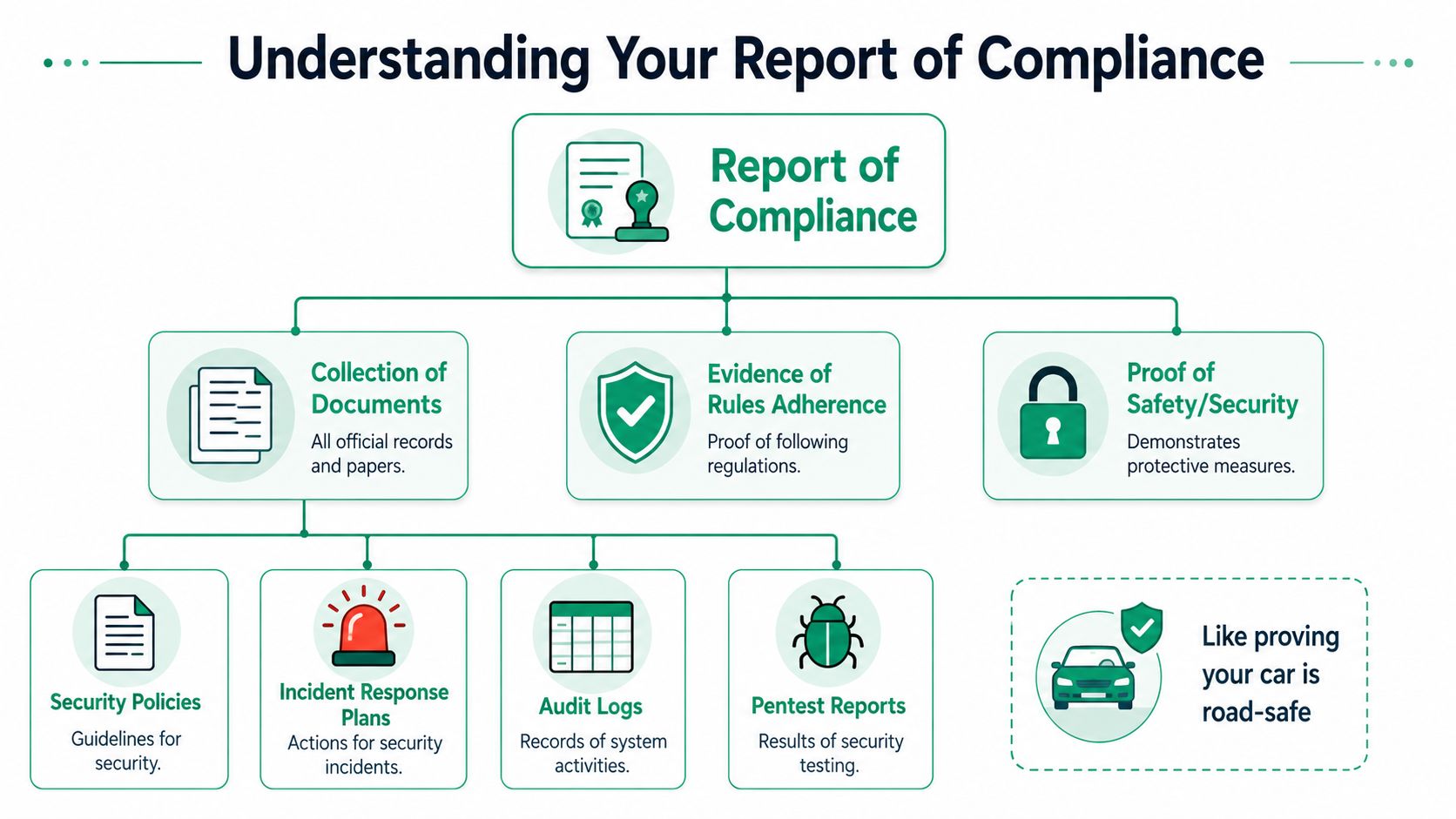
A report of compliance isn't one magical document. It's a folder of proof. Picture proving your car is road-safe. You don't just say “trust me, the brakes work.” You show the inspection record, maintenance history, and safety checks.
Compliance works the same way. You're collecting documents that show your company follows a specific set of rules and can prove it under scrutiny.
What usually sits inside the folder
Most reports of compliance include some mix of these items:
- Security policies: Password rules, access control, vendor management, data handling
- Response procedures: What your team does when something breaks or gets compromised
- System records: Logs, tickets, change history, and evidence that controls run as described
- Testing evidence: Results from reviews, audits, and a real penetration test
- Training records: Proof that staff were trained on the right policies
If your company takes card payments, a practical starting point is this Global businesses PCI DSS guide, which explains the core purpose of PCI DSS in plain language. It's useful because PCI DSS is one of the fastest ways a small company gets dragged into formal evidence gathering.
The framework changes the details
The folder changes depending on what rules you need to satisfy.
| Framework | What it mainly cares about |
|---|---|
| SOC 2 | Whether you protect customer data through security controls |
| HIPAA | Whether protected health information is handled safely |
| PCI DSS | Whether payment card data is stored, processed, and transmitted securely |
| ISO 27001 | Whether your security program is managed in a structured, repeatable way |
A contract can also create its own compliance burden. A compliance with specifications clause means your deliverables must match the agreed technical and quality standards. If they don't, that can become a breach issue under the contract terms described by Law Insider's clause reference.
A report of compliance is proof that your company does what it says, not a marketing deck with nicer formatting.
That's the mindset shift. Once you stop treating it like mystical audit paperwork, it becomes manageable.
Key Contents and The All-Important Pentest
Here's where many organizations get tripped up. They gather policies, screenshots, employee acknowledgments, and ticket exports. Then the auditor asks for the one thing they don't have ready. The penetration test report.
That's why the pentest is often the slowest piece of the whole package.

What auditors expect to see
A solid report of compliance usually includes evidence from several buckets:
- Governance documents: Policies, standards, and assigned responsibilities
- Operational proof: User access reviews, change approvals, backup checks, log retention
- Risk records: Risk assessments, treatment plans, exceptions, and approvals
- Human evidence: Security training, onboarding and offboarding records
- Technical validation: Vulnerability management and a manual pentest report
For many regulations in the EU, technical documentation must include a verified risk assessment and a list of critical components affecting compliance, and that documentation acts as the primary legal evidence that requirements were met, according to the EU guidance on preparing technical documentation. In plain English, regulators don't care what you meant to do. They care what you can prove.
Why a manual penetration test matters
A scanner is useful. It is not the same as a manual penetration test.
A real pentester checks how an attacker would move through your app, API, cloud setup, auth flow, or admin panel. They chain small weaknesses together. They test business logic. They look for the weird stuff scanners miss. That's why auditors, customers, and security-savvy buyers keep asking for a human-led pen test report.
If you're sorting through findings and trying to understand what a good report looks like, this guide on analyzing your security audit report helps decode the parts that matter.
What auditors want: proof that a qualified human tried to break your environment, documented what they found, and gave you a path to fix it.
Why this becomes the bottleneck
Traditional firms often treat penetration testing like enterprise theater. Long sales cycle. Slow scheduling. Junior tester. Thin findings. Then the report shows up after your deadline.
That's backwards. The pen test should be the evidence engine for your report of compliance, not the thing that stalls the whole process.
Your Simple Plan to Prepare for a Report
You don't need a giant committee to get this done. Treat it like a short project with a clear owner, a checklist, and a hard deadline. That alone saves time and cuts the usual chaos.
Start with the framework and scope
First, define the target. If you don't know whether the request is for SOC 2, HIPAA, PCI DSS, ISO 27001, or a contract requirement, you'll waste days collecting the wrong evidence.
Then define scope. Which product, app, cloud environment, office, team, or business unit is in play? A report of compliance falls apart when your evidence covers one system but your customer assumes it covers five.
Use a fast prep checklist
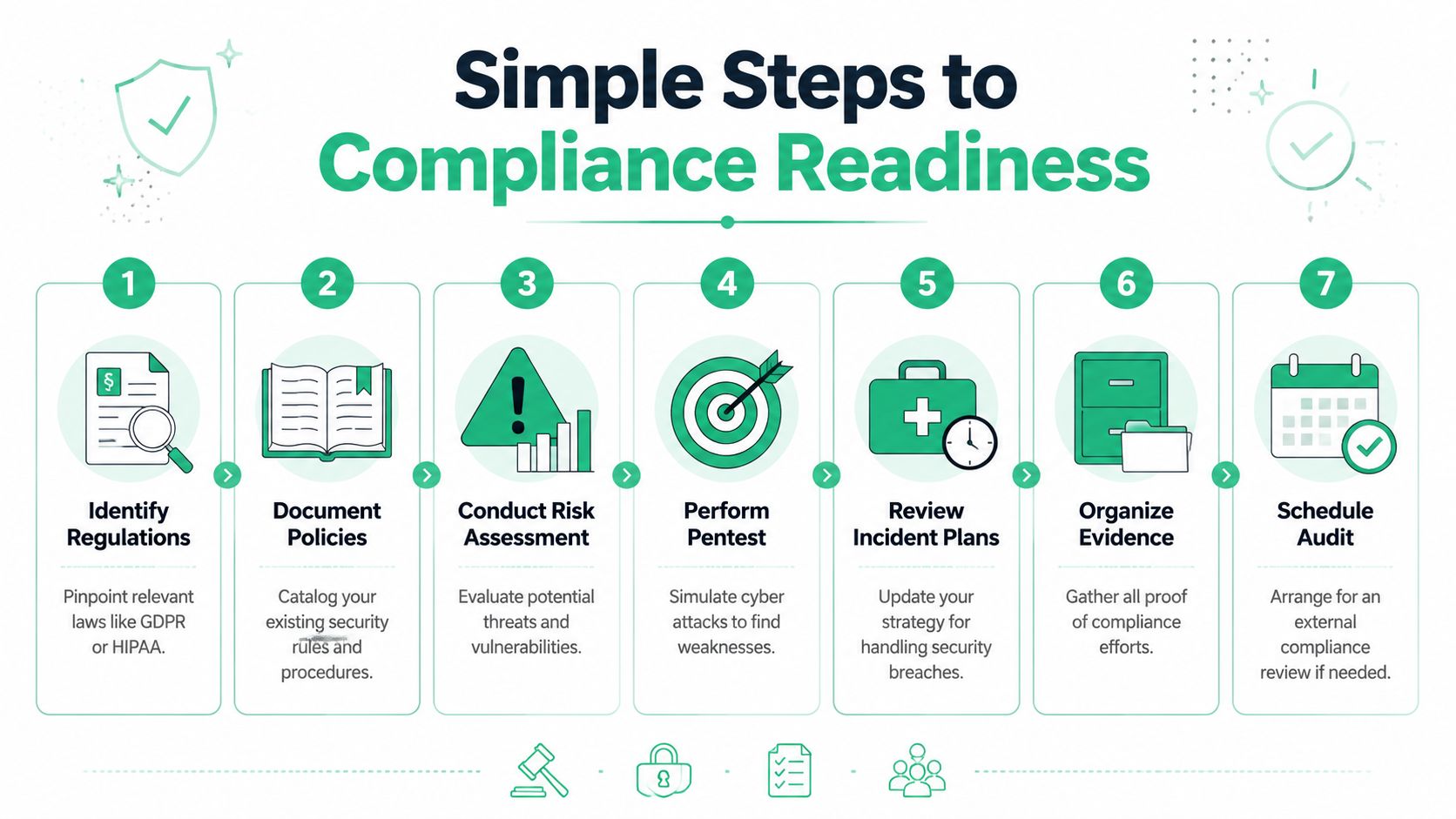
This is the simplest sequence that works:
Name the standard
Write down the exact requirement and who requested it.Pick an internal owner
One person needs to chase documents and make decisions. Committees slow everything down.Collect what already exists
Pull policies, ticket evidence, training records, diagrams, prior audit artifacts, and access review notes.Run a gap check
Look for missing approvals, outdated policies, weak incident procedures, and missing test evidence.Schedule the pentest early
This is the most common delay. Book the pen test before you think you need it.Organize evidence by control
Don't dump files into one folder. Match each item to the exact requirement it supports.
For a broader finance-side prep view, this comprehensive financial audit checklist is useful because the discipline is similar. Clean owners, clean records, clean timing.
Don't wait on penetration testing
This is the part people get wrong every week. They save penetration testing for the end, as if it's a checkbox you can knock out in a day. It isn't.
A manual pentest takes coordination, testing time, remediation review, and reporting. If the tester finds real issues, you need room to fix them and show retesting. Booking the penetration test early gives you options. Booking it late gives you excuses.
If your deadline is tied to a customer deal, the pentest should be one of the first calendar items, not the last.
Common Compliance Pitfalls to Avoid
Most compliance pain is self-inflicted. Not because the team is lazy. Because they treat the report like a school assignment instead of a business control.
The first mistake is treating compliance as a one-time event. You rush, collect evidence, pass the review, and then let everything rot until next year. That creates stale policies, outdated screenshots, and a security story that falls apart the second someone asks a follow-up question.
The expensive mistakes
A few traps show up over and over:
- Buying a checkbox pentest: You pay a premium, wait too long, and get a report so shallow it barely helps with compliance or security.
- Hiding local gaps inside a central report: One office, one app team, or one cloud project is weak, but the rollup report makes everything look fine.
- Collecting files without a narrative: You have documents, but nobody can explain how people, policy, and testing fit together.
- Ignoring remediation evidence: Finding issues is only half the job. Auditors want to see what changed after the findings.
The multi-site problem is bigger than typically acknowledged. Centralized reporting can hide weak spots if you don't compare sites or teams directly. The discussion in The hidden risk in multi-site healthcare is worth reading because the same pattern hits distributed startups and SMBs too.
Use the report to manage risk
Many teams struggle to turn compliance reports from historical records into active risk tools. The better approach is to combine people data and policy data into one story so leadership can see where the next gap is forming, as discussed in Absorb LMS on compliance reporting challenges.
That means your report of compliance shouldn't just say, “training completed” or “policy approved.” It should help you spot things like overdue training in finance, weak ownership in one business unit, or a security control that exists on paper but isn't being followed.
Better question: Don't ask “Did we finish the report?” Ask “What does this report warn us about next?”
That shift saves money because it catches problems before they turn into audit failures, customer escalations, or emergency consulting bills.
Get Your Pentest Report in Days Not Months
The biggest delay in a report of compliance is usually the penetration test. Not the policy review. Not the screenshot gathering. The pentest.
That's why the old model is so frustrating. You wait while a sales team qualifies you, then wait again for scheduling, then wait for a tester, then wait for the report. By the time you get the document, your deal timeline is already under pressure.
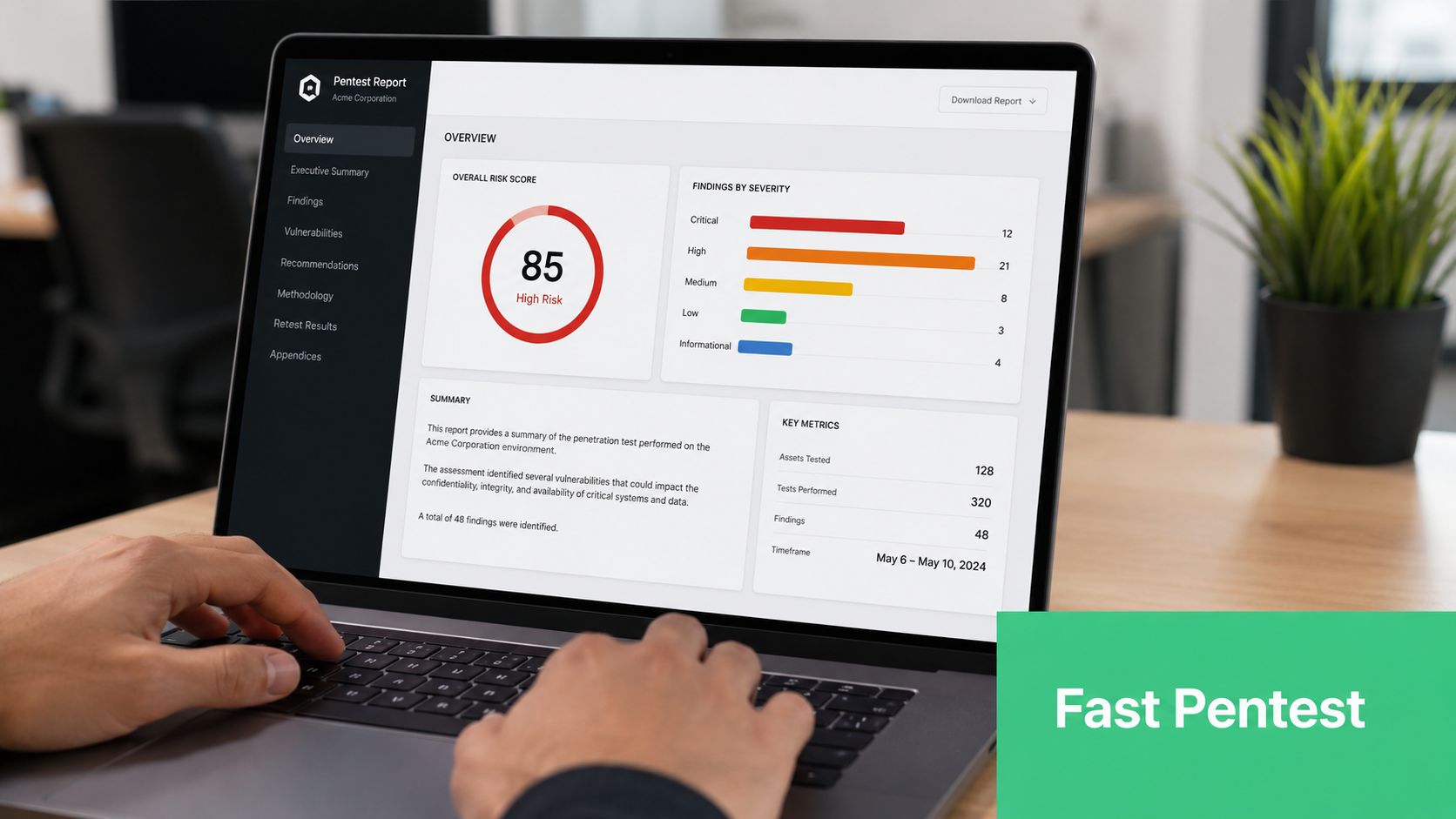
A better model is simple. Start fast. Use senior testers. Deliver the report within a week. Keep the price reasonable enough that a startup or SMB can act without asking finance for permission three times.
What good buyers should demand
If you need a pentest, pen test, penetration test, or penetration testing report for compliance, don't get distracted by shiny sales language. Ask practical questions:
- Who is doing the test: A senior tester or a junior reading from a script
- What certifications they hold: OSCP, CEH, and CREST matter because they show baseline professional discipline
- How quickly they can start: Delays kill deals
- When the report arrives: Fast reporting matters almost as much as the test itself
- Whether the findings are usable: Clear remediation guidance saves engineering time
The right provider should help you meet the deadline without wasting your budget. If you're comparing options, start with an affordable pentest approach that prioritizes manual testing, quick turnaround, and experienced certified pentesters instead of bloated overhead.
Why speed matters to compliance
Fast reporting isn't just convenient. It changes the whole project. When the report lands in days instead of months, your team can fix issues faster, send evidence sooner, and stop compliance work from taking over the quarter.
For startups and SMBs, that matters a lot. Security work has to support growth, not choke it.
If you need a report of compliance and don't want the penetration test to become the expensive, slow part that blocks everything else, talk to Affordable Pentesting through the contact form. You can get a same-day quote, work with certified pentesters with OSCP, CEH, and CREST credentials, and get a detailed manual pentest report within a week. That saves time, protects budget, and gets you the evidence you need.