.svg)
SOC 2 compliance cost usually lands between $30,000 and $150,000, and startups often spend $20,000 to $60,000. The part that trips people up is simple. The audit quote is rarely the actual cost because remediation, tooling, internal labor, and slow security vendors usually eat the budget.
If you're pricing SOC 2 right now, you're probably staring at an auditor proposal and hoping that's the hard part. It isn't. The traditional model hides the expensive stuff in prep work, evidence collection, back-and-forth with vendors, and delays that pull engineers away from product work.
That's why smart teams stop thinking about SOC 2 as a single invoice. They treat it like a controlled project with a few cost levers they can manage. One of the biggest is how they handle penetration testing, pen testing, and pentest reporting, because that's one of the fastest ways to either keep the process moving or let it turn into a slow, overpriced mess.
Understanding Your Total SOC 2 Budget
Most companies start with the wrong question. They ask, “What does the audit cost?” when they should ask, “What will the whole SOC 2 program cost us?”
Public 2026 market estimates consistently put total SOC 2 spend in the mid-five-figure to low-six-figure range, with many teams landing between $30,000 and $150,000, and startups often in the $20,000 to $60,000 range, according to Sprinto's SOC 2 cost breakdown. That total includes preparation, tooling, and remediation, which is why the all-in number is usually much higher than the audit fee.
A lot of founders and IT leaders get burned because they budget for the CPA firm and ignore everything else. Then the surprise costs show up. Someone has to clean up policies, tune access controls, gather evidence, coordinate with legal, and deal with findings from a pentest or penetration test.
Practical rule: If you're budgeting only for the auditor, you're underbudgeting for SOC 2.
Think of SOC 2 like renovating a house before the inspector shows up. The inspection matters, but most of the money goes into fixing what's behind the walls. That's why buyers looking for Affordable Pentesting SOC 2 services should care less about flashy audit sales talk and more about whether each vendor helps reduce remediation drag and report delays.
Here's the budget frame that works:
- Audit fee: What the auditor charges for Type I or Type II work
- Security work: Control implementation, evidence collection, and remediation
- Tooling: Compliance software, logging, identity, endpoint, and related systems
- Support costs: Legal review, training, and internal project ownership
- Testing costs: Your pen test, pentest retest, and reporting timeline
If you control those buckets early, SOC 2 stays manageable. If you don't, the “cheap” audit becomes the most expensive line on the project because everything around it spirals.
The Biggest Drivers of SOC 2 Cost
A startup can buy a cheap-looking SOC 2 package and still end up with an expensive mess. The actual budget gets blown by bad scoping, slow vendors, weak remediation, and testing that lands too late to be useful.
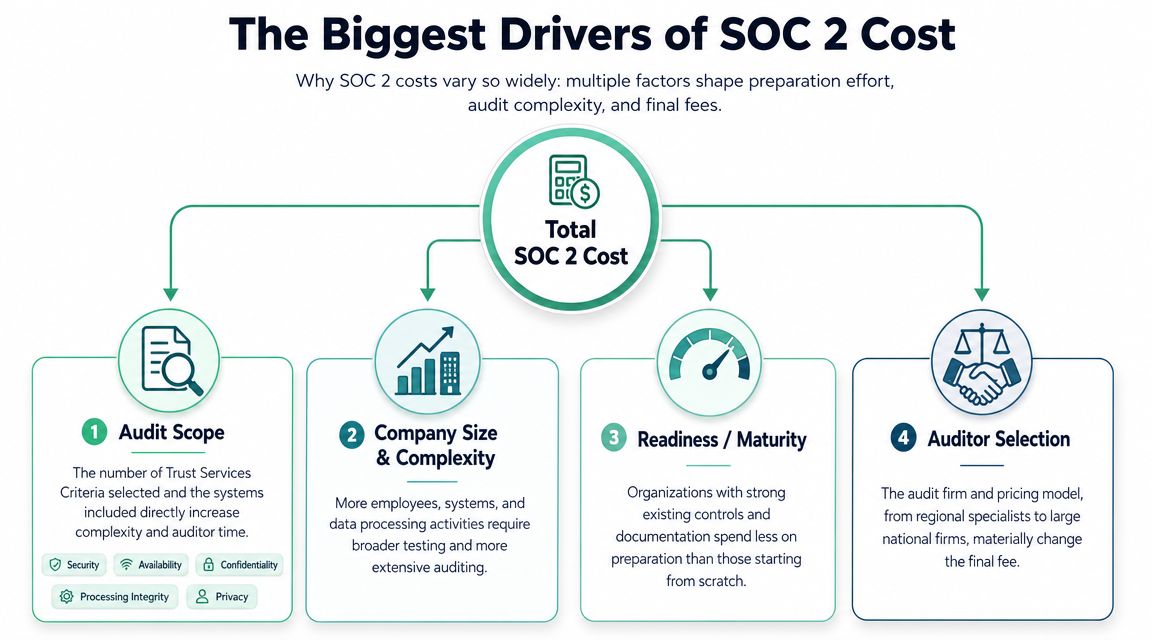
Analysts at Secureframe note in its SOC 2 audit cost guide that first-year SOC 2 spending often stretches far beyond the audit itself, with major costs tied to readiness work, risk assessment, penetration testing, compliance prep, the formal audit, and ongoing maintenance. The lesson is simple. Audit fees get attention, but preparation and cleanup usually drive the total.
Scope is the first budget trap
Scope decides how much evidence your team has to produce, how many controls need to work, and how long the whole project drags on. Teams waste money when they copy enterprise scope without an enterprise environment.
A single-product company on a clean cloud stack should not pay for a bloated control set just because a consultant wants a bigger statement of work. If customer requirements point to the Security criteria, start there. Every extra system, exception, and trust service category increases review time, remediation work, and audit friction.
Cut scope early or pay for it later.
Type II gets expensive when your controls are sloppy
Type I checks control design at a point in time. Type II checks whether those controls operated over a review period. That difference matters because weak execution turns Type II into a drag on both budget and sales timing.
If access reviews are late, logging is inconsistent, or onboarding and offboarding are still half-manual, the auditor is not your first problem. Your own operating discipline is. Fixing that late forces more internal labor, more evidence chasing, and more retesting.
Penetration testing is a cost-control move, not just a checkbox
Founders often treat pentesting like a required line item to buy right before the audit. That is backward. Fast, affordable testing is one of the best ways to control overall SOC 2 cost because it exposes the issues that delay reports and trigger extra remediation cycles.
Good testing gives you clear findings, a usable report, and enough time to fix real problems before they spill into the audit. Bad testing does the opposite. It creates vague writeups, unnecessary noise, slow retests, and report delays that force your team to keep babysitting the project.
Teams working on understanding SOC 2 pentesting should judge vendors on speed, report quality, and retest efficiency first. A lower pentest price means nothing if the result adds weeks of cleanup and pushes your audit back.
Maturity drives effort more than company size
Headcount is a weak predictor of cost. Operational maturity is the primary driver.
A 40-person SaaS company with clean IAM, centralized logging, documented vendor reviews, and a basic evidence process can move faster than a 15-person team with scattered screenshots, shared admin accounts, and policies nobody follows. The second company usually pays more because every control has to be rebuilt while the clock is running.
Vendor choice changes the bill fast
Traditional compliance vendors make money by turning simple work into a long project. They add layers, meetings, and handoffs, then act like delay is normal. It is not normal. It is expensive.
Use a blunt filter when comparing auditors, consultants, and testing firms:
- Scope discipline: They keep scope tight and explain why anything gets added
- Timeline speed: They move work forward without dead weeks between steps
- Report quality: Their deliverables are clear enough for auditors and customers to use
- Remediation support: They help your team fix issues instead of dumping a list and disappearing
- Startup fit: Their process matches a lean team that cannot burn a quarter on compliance theater
The companies that keep SOC 2 affordable do one thing right early. They choose vendors that reduce downstream work. That is why fast, affordable penetration testing matters so much. It is not just cheaper testing. It is one of the smartest ways to keep the entire SOC 2 budget from getting out of control.
One-Time Expenses vs Recurring Annual Costs
Your first SOC 2 budget review usually goes sideways the same way. Finance sees an audit quote, assumes that is the project cost, and misses the setup work, retesting, tool cleanup, and staff time that actually drive the bill.
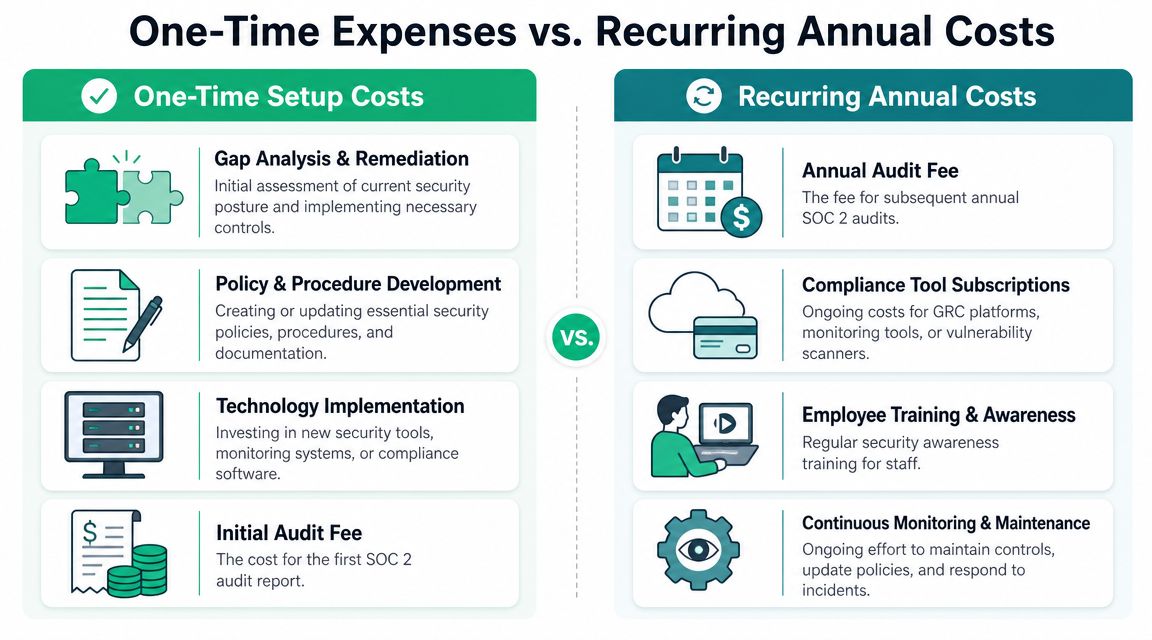
SOC 2 has two cost buckets. Setup costs show up while you build the program. Annual costs show up because you now have to keep that program working. Confuse those two buckets and you will overspend in year one, then get blindsided at renewal.
Year one is expensive because everything collides at once. You are fixing controls, cleaning up access, writing policies, collecting evidence for the first time, and proving your environment can stand up to outside testing. This is also where smart teams control the budget early. They buy penetration testing that is fast, scoped correctly, and audit-ready. Cheap-looking testing that drags out for weeks or produces a weak report creates more remediation churn, more internal labor, and more delay.
The one-time spend usually includes:
- Readiness and remediation: gap work, policy updates, control fixes, and evidence process setup
- Security and compliance tooling: only the tools needed to close actual control gaps
- Initial audit fees: Type I or Type II kickoff costs
- Penetration testing: the first test, retest if required, and auditor-friendly reporting
- Internal labor: engineering, IT, security, HR, and legal time pulled into the project
Startups commonly face financial exploitation. They stack new tools before they know what the auditor will ask for, then pay consultants to sort out the mess later. A tight penetration test early in the process helps prevent that. It exposes actual security issues before you waste money dressing up controls that will not survive review.
Recurring annual costs are different. You are no longer building from zero. You are maintaining evidence, renewing the audit, rerunning training, keeping monitoring in place, and testing changes in the environment. The AICPA makes that cadence clear in its SOC for Service Organizations overview. SOC 2 is an ongoing attestation process, not a certificate you buy once and hang on the wall.
Here is the practical split:
| Cost type | What it looks like |
|---|---|
| One-time setup | Initial remediation, policy buildout, process cleanup, first penetration test, first audit |
| Recurring annual | Re-audits, tool renewals, employee training, control monitoring, ongoing penetration testing, evidence upkeep |
The right budget move is simple. Treat fast, affordable penetration testing as a cost-control strategy, not a checkbox. Good testing shortens remediation, avoids repeat work, gives auditors what they need, and keeps both the first-year bill and the annual renewal cycle from spiraling.
Example SOC 2 Budget Scenarios
Your CFO asks for a real budget. Your team wants a fast answer. The wrong move is copying a generic SOC 2 price range from a vendor blog and pretending it fits your company.
Budgeting gets easier when you model the problem the way it shows up in the business. One small company is trying to move fast with a thin team and limited cash. Another has more people, more systems, and more approvals slowing everything down. The line items may look familiar in both cases. The cost behavior does not.
As noted earlier, public SOC 2 cost breakdowns show the same pattern again and again. The audit fee gets attention, but internal labor, tool sprawl, legal review, and remediation usually do more damage to the budget. That is exactly why penetration testing should be treated as a budget control decision early, not a late-stage add-on.
Two common budget patterns
A lean startup pays for distractions more than complexity. One slow vendor, one bloated tool purchase, or one messy remediation cycle can throw off the entire timeline because the same engineer is also handling production issues, customer requests, and security work.
A mid-market company pays for coordination failure. More systems and more reviewers create friction. Evidence gets stuck in different teams. Fixes wait on approvals. Retesting stretches out because nobody owns the sequence.
Here is the practical comparison:
| Cost Category | Lean Startup 30 Employees | Mid-Market Co 250 Employees |
|---|---|---|
| Readiness and gap work | Usually narrower in scope, but expensive if policies and evidence collection start from zero. | Broader review effort because multiple teams, tools, and workflows need alignment. |
| Compliance tooling | Easy to overspend if the team buys platforms before defining scope. | Costs rise fast when teams stack overlapping tools to handle evidence and monitoring. |
| Audit fee | Lower if the environment is small and the audit scope stays tight. | Higher because the auditor has more systems, users, and exceptions to review. |
| Pen test and remediation | Best place to control cost. A fast, scoped test finds the issues that matter before the team wastes time fixing the wrong things. | Often drifts into expensive retesting and long fix cycles unless the testing partner moves quickly and keeps findings clear. |
| Internal labor | Concentrated on a few people, which makes every delay expensive. | Spread across departments, which creates meeting overhead and slower evidence collection. |
| Legal and policy review | Usually contained if contracts, policies, and ownership are already simple. | Slower and more expensive because approvals and vendor review chains are longer. |
| Annual maintenance | Becomes manageable after year one if controls stay simple and the environment stays clean. | Stays heavier because the environment changes more often and ownership is spread out. |
What these scenarios actually mean
Startups should not chase the cheapest line item. They should cut the costs that trigger more costs. That means tight scope, fast decisions, and penetration testing early enough to catch real issues before they turn into rewrite work, audit delays, and duplicate remediation.
Mid-market teams need discipline, not more vendors. If your pen test provider is slow, vague, or overpriced, the damage spreads into legal review, engineering time, evidence collection, and audit scheduling. A cheap-looking test that creates two extra rounds of remediation is not cheap.
One more budget leak gets ignored too often. Software sprawl. If your environment is full of unused apps, duplicate licenses, and tools nobody can explain to an auditor, you are paying for unnecessary scope and unnecessary review time. This guide to software license compliance is useful because cleaning that up can reduce both compliance overhead and audit friction.
The pattern is simple. Affordable, fast penetration testing is not just a security checkbox. It is one of the smartest ways to keep the entire SOC 2 budget and timeline under control.
Practical Ways to Reduce Your SOC 2 Costs
You don't control every part of SOC 2. You do control some big ones. Scope, readiness, and vendor choice are where most of the wasted money hides.
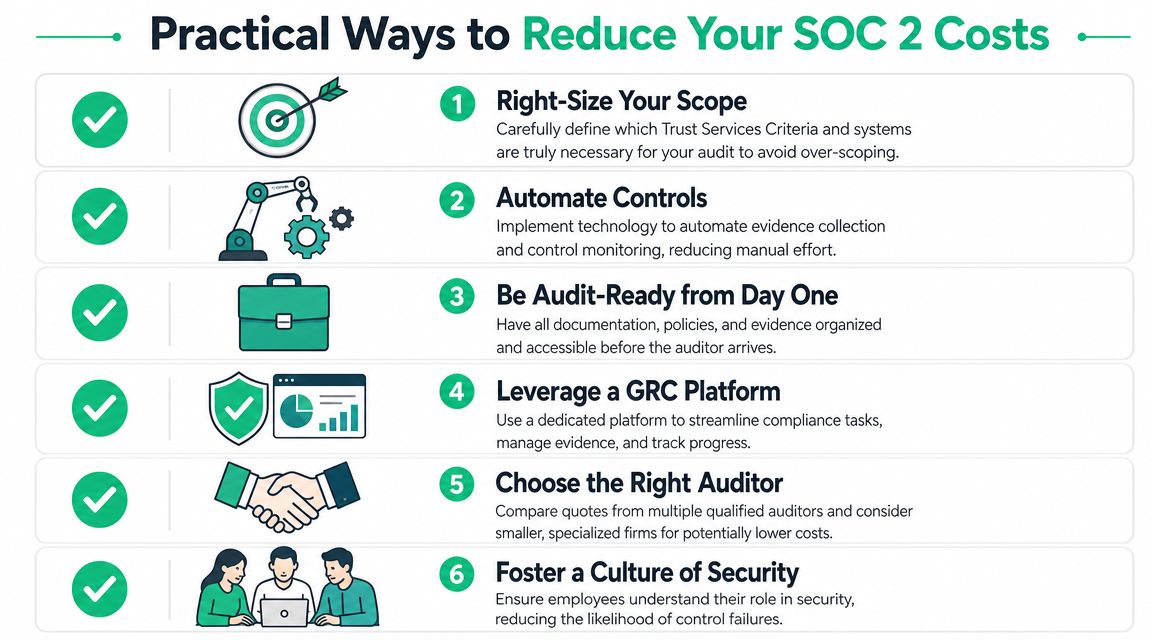
The fastest way to overspend is to let every vendor upsell you. The smartest move is to trim the process down to what your audit and customers require, then pick partners who move fast and produce work your auditor can rely on.
Cut scope before you cut quality
It is often more effective to reduce waste before reducing spend. Those are not the same thing.
Use these filters:
- Audit only what matters: Include systems and controls tied to the services customers care about.
- Avoid compliance theater: Don't buy extra criteria, tools, or documentation packages just because a salesperson says “most enterprises expect it.”
- Fix evidence flow early: If screenshots, tickets, approvals, and logs are scattered, the process gets expensive fast.
A related place where teams lose money is software sprawl. If you're trying to clean up your compliance environment, this guide to software license compliance is worth reading because unused and unmanaged software creates unnecessary cost, access headaches, and audit noise.
Choose testing vendors who help, not stall
Allow me to be blunt. Traditional penetration testing firms often drag out a straightforward engagement, overcharge, and still return a report with thin findings or slow turnaround. That doesn't help a startup under customer pressure. It just burns time.
A good pentest provider for SOC 2 should do a few basic things well:
- Move fast: You should get your report within a week, not wait around while your audit timeline slips
- Test manually: Automated scans have their place, but manual testing finds the issues that matter
- Write usable reports: Auditors need clear findings, scope, severity, and remediation guidance
- Staff certified testers: Look for certifications like OSCP, CEH, and CREST
- Price for SMB reality: You shouldn't pay enterprise consulting overhead for a focused pen test
That applies whether you call it a pentest, pen test, penetration test, or penetration testing engagement. The name doesn't matter. The speed, quality, and usefulness do.
Buyer warning: A cheap report that creates audit questions is more expensive than a fairly priced report your auditor accepts the first time.
Build a process that lowers repeat cost
You don't beat SOC 2 cost by squeezing one invoice. You beat it by reducing rework.
A practical cost-control setup looks like this:
- Narrow the scope early
- Assign one internal owner
- Use tools only where they remove manual evidence work
- Run penetration testing early enough to fix findings without panic
- Pick auditors and testers who answer questions quickly
- Store evidence in one place your team can use
That's the logical path for startups and SMBs. Keep the process lean, use certified people, and eliminate delay. The traditional model counts on you accepting slow timelines as normal. You shouldn't.
The Timeline and Hidden Internal Costs
Your auditor asks for final evidence next Friday. Engineering is still pulling access logs. Legal still has open contract questions. Your pen test report is stuck in review. That is how a "manageable" SOC 2 project turns into an expensive mess.
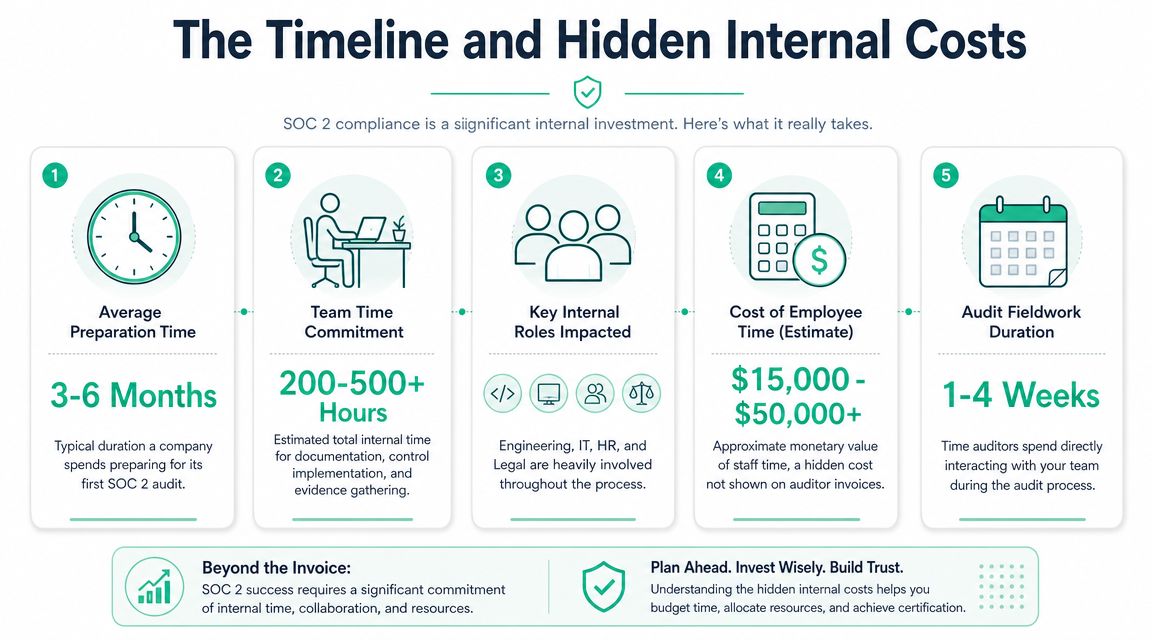
The visible costs are easy to track. Audit fees, software, legal, and testing show up on invoices. Actual budget damage shows up in salary burn, delayed product work, and dragged-out review cycles that keep senior people tied up in compliance admin instead of running the business.
That hidden cost gets worse when companies accept the slow traditional model. Long scoping calls. Delayed fieldwork. Reports that arrive too late to fix anything calmly. Startups and SMBs do not need more process. They need fewer bottlenecks.
Internal time is part of your SOC 2 budget
Count the hours, not just the contracts.
If engineering has to stop roadmap work to collect screenshots, explain architecture, pull tickets, and clean up evidence, you are paying for SOC 2 whether or not that spend appears on a vendor invoice. If IT has to chase device coverage, access reviews, and asset inventory gaps, that time belongs in the budget too.
Penetration testing has an outsized effect here. Run it late, and every finding becomes urgent. Run it early with a fast, auditor-friendly report, and you control both the remediation workload and the audit timeline. That is not a minor purchasing detail. It is one of the clearest ways to keep total SOC 2 cost under control.
Delay creates rework
Slow vendors do not just waste calendar time. They create extra work for your team.
A weak pen test report can trigger follow-up questions from the auditor, force internal staff to explain technical gaps, and add another review cycle you never planned for. A late report can push remediation into the final stretch, where fixes compete with customer commitments and release deadlines.
Use this test before you hire anyone:
- How many internal meetings will this vendor create?
- How long will your team wait for a usable deliverable?
- Will the report answer auditor questions the first time?
- Can you fix findings without turning the last month into a fire drill?
If those answers are unclear, the price is not low.
Fast penetration testing is budget control
A fast, manual pen test with a clear report cuts hidden costs in three ways. Your team spends less time waiting, less time translating bad findings for auditors, and less time fixing issues under deadline pressure.
That is why affordable, fast testing should be treated as a primary cost-control move, not a box to check at the end. If you want a quote built for startup timelines instead of enterprise stall tactics, use the Affordable Pentesting quote request.
In SOC 2, speed with usable deliverables saves more money than a slightly cheaper vendor that slows down the rest of the project.
FAQ About SOC 2 Vendor Selection
Should you hire the biggest auditor you can find
Usually, no. Big names often come with big process overhead and big invoices. For many startups and SMBs, the better choice is a qualified firm that communicates clearly, keeps scope tight, and doesn't treat your team like a giant enterprise account.
What should you ask a penetration testing provider
Keep it simple. Ask how quickly they deliver the final report, whether the work is manual, what certifications their testers hold, whether they support retesting, and whether the report is written for compliance use as well as security remediation.
If they can't answer those questions directly, move on.
Which certifications matter for pentesters
For practical buying decisions, OSCP, CEH, and CREST are useful signals. Certifications aren't everything, but they do tell you whether the provider takes testing seriously enough to invest in qualified people.
How do you spot a bad vendor fit
Watch for these red flags:
- Slow sales process: If they're hard to pin down before the contract, they'll be worse after it
- Vague methodology: If they hide behind jargon, the report usually won't be clear either
- Weak deliverable expectations: If turnaround time and retesting terms aren't explicit, expect delays
- Overbuilt scope: If they push extras you didn't ask for, they're probably padding the project
Is a compliance platform worth it
Sometimes yes, sometimes no. If it reduces evidence chaos and helps your team stay organized, it can save real effort. If you buy it before you've defined scope and ownership, it becomes another subscription sitting on top of a messy process.
Where should you start if you need pricing now
Start with a short vendor list and compare responsiveness, reporting clarity, certifications, and scope discipline. If you need a fast starting point for pen testing or a pentest tied to compliance deadlines, use the Affordable Pentesting quote request to get a clear answer without wasting time.
If you need a fast, affordable pentest for SOC 2, PCI DSS, HIPAA, or ISO 27001, Affordable Pentesting is built for startups and SMBs that can't afford bloated timelines or enterprise consulting prices. Their certified pentesters, including OSCP, CEH, and CREST professionals, deliver manual penetration testing with reports typically returned within a week so you can fix issues, satisfy auditors, and keep your compliance timeline moving.