.svg)
Are your security checks slow, expensive, and finding nothing? A vulnerability scanning service is your first step, but you need a manual pentest to find what scanners miss, delivered fast and at a price that makes sense.
What Is a Vulnerability Scanning Service?
Think of a vulnerability scanning service like a robot that checks all your doors and windows. It’s an automated security sweep that quickly scans your networks and apps for thousands of known weaknesses. It finds the easy targets before a real attacker does.
How Do Vulnerability Scans Work?
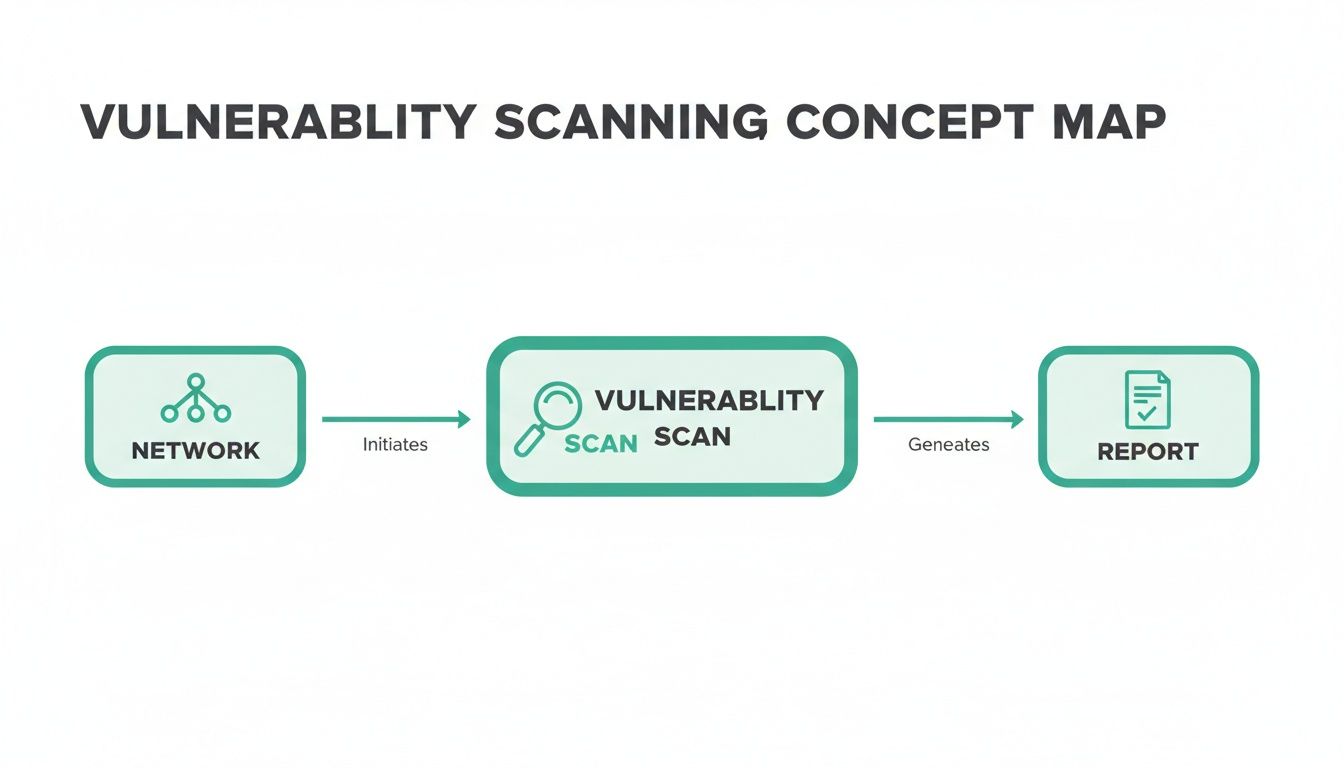
A vulnerability scan answers one question: do I have any common, easy-to-spot security holes? The service uses software that probes your systems and compares what it finds against a huge list of known issues. It's fast, repeatable, and gives you a good starting point.
What Vulnerability Scans Actually Look For
Scans are great at finding common security mistakes. They are not looking for clever attacks, just the straightforward gaps that give hackers an easy way in. This includes things like outdated software, missing security patches, or systems with default passwords still active.
Why Vulnerability Scans Are Important
The report from a vulnerability scan is a simple to-do list for your IT team. It ranks problems by how serious they are so you know what to fix first. This is a must-have for compliance standards like SOC 2, PCI DSS, and HIPAA, but it has limits. It only tells you what might be a problem.
What Are Different Types Of Scans?
Not all security checks are the same, and picking the right vulnerability scanning service means knowing what you need. Scans are broken down by how much access they have and what part of your systems they inspect. This lets you match the right test to the right asset.
Authenticated vs Unauthenticated Vulnerability Scans
An unauthenticated scan is like checking your office building from the outside. It looks for unlocked doors and open windows that any stranger could find. An authenticated scan is like giving an inspector the keys. It gets inside and finds issues an outsider would never see.
What Scans Check On Your Systems
Different scanners are designed for specific parts of your digital infrastructure. Network scans check your servers and firewalls. Web application scans use methods like Dynamic Application Security Testing (DAST) to attack your website like a real hacker. Container scans check Docker and Kubernetes images for built-in security holes.
How to Choose The Right Scan
The scan you need depends on what you are trying to protect and what compliance rules you follow. A simple marketing website has different needs than a fintech startup handling sensitive data. We have a guide explaining our approach to external vulnerability scanning. The demand for these services is huge, with the market expected to grow to USD 9,143 million by 2032.
How Scans Help Meet Compliance Mandates
Meeting standards like SOC 2, PCI DSS, or HIPAA can be confusing. A vulnerability scanning service is your map. It shows you how to satisfy key security rules and prove to auditors that you are taking security seriously. Regular scans give you the proof you need.
Why Scanning Is Important For Compliance
Different rules have different demands, but they all agree on one thing: you must check for vulnerabilities regularly. For example, PCI DSS vulnerability scanning requirements demand at least quarterly scans. SOC 2, HIPAA, and ISO 27001 all have similar expectations for ongoing monitoring.
Why Scan Reports Are Evidence For Auditors
When an auditor asks how you handle security, you need to show them proof. Scan reports create a documented history of your security over time. They show when scans were done, what was found, and what you did to fix it. This paper trail is exactly what regulators need to see.
Why Scanning Alone Is Not Enough
A vulnerability scanning service is a critical first step for compliance, but it is rarely the last. Automated scans are great at finding known issues but can't tell you if they are truly exploitable. To satisfy auditors, you often need a manual penetration test to confirm the real business risk. The global market data from mordorintelligence.com supports this growing need.
Vulnerability Scanning vs Penetration Testing
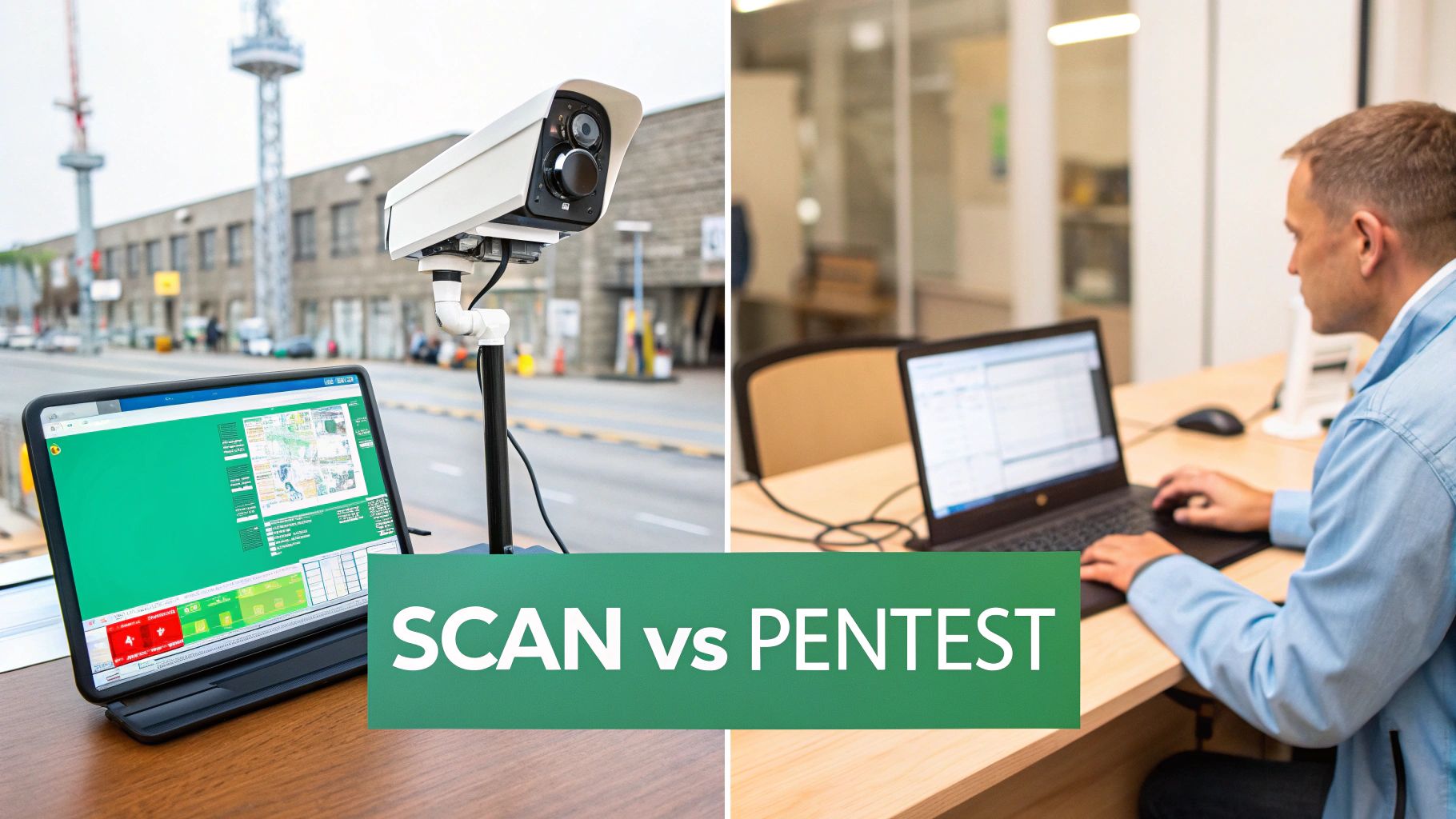
A vulnerability scan is an automated tool, like a security camera. A penetration test is a manual attack by a real person who thinks like a hacker. The scan gives you a list of potential problems. The pentest confirms which of those problems are actual risks.
How Scans Give Breadth Not Depth
A vulnerability scan is a machine. It's a high-speed checklist that compares your systems to a database of known weaknesses. This makes it fast and efficient for covering a lot of ground quickly. It's an essential first step for basic security hygiene.
How Manual Pentesting Finds What Scanners Miss
A pentest is driven by human intelligence. Our pentesters are certified experts with OSCP, CEH, and CREST credentials. They use the same creative thinking as real hackers to find complex flaws that automated scanners are completely blind to. We explain this more in our guide comparing a pen test vs. a vulnerability assessment.
Why You Ultimately Need Both Methods
Vulnerability scanning and penetration testing are partners. Scans give you continuous, broad monitoring for daily security. Pentests provide the deep, focused validation you need to find your most critical risks. While scans are important, professional Penetration Testing Services confirm real threats. We make that step fast and affordable.
How to Choose Your Scanning Service
Picking a vulnerability scanning service is about finding a partner who delivers real value. The right service helps you find and fix what actually matters, fast. It cuts through the noise and saves your team from chasing down alerts that pose no real threat.
How to Evaluate The Quality Of Reports
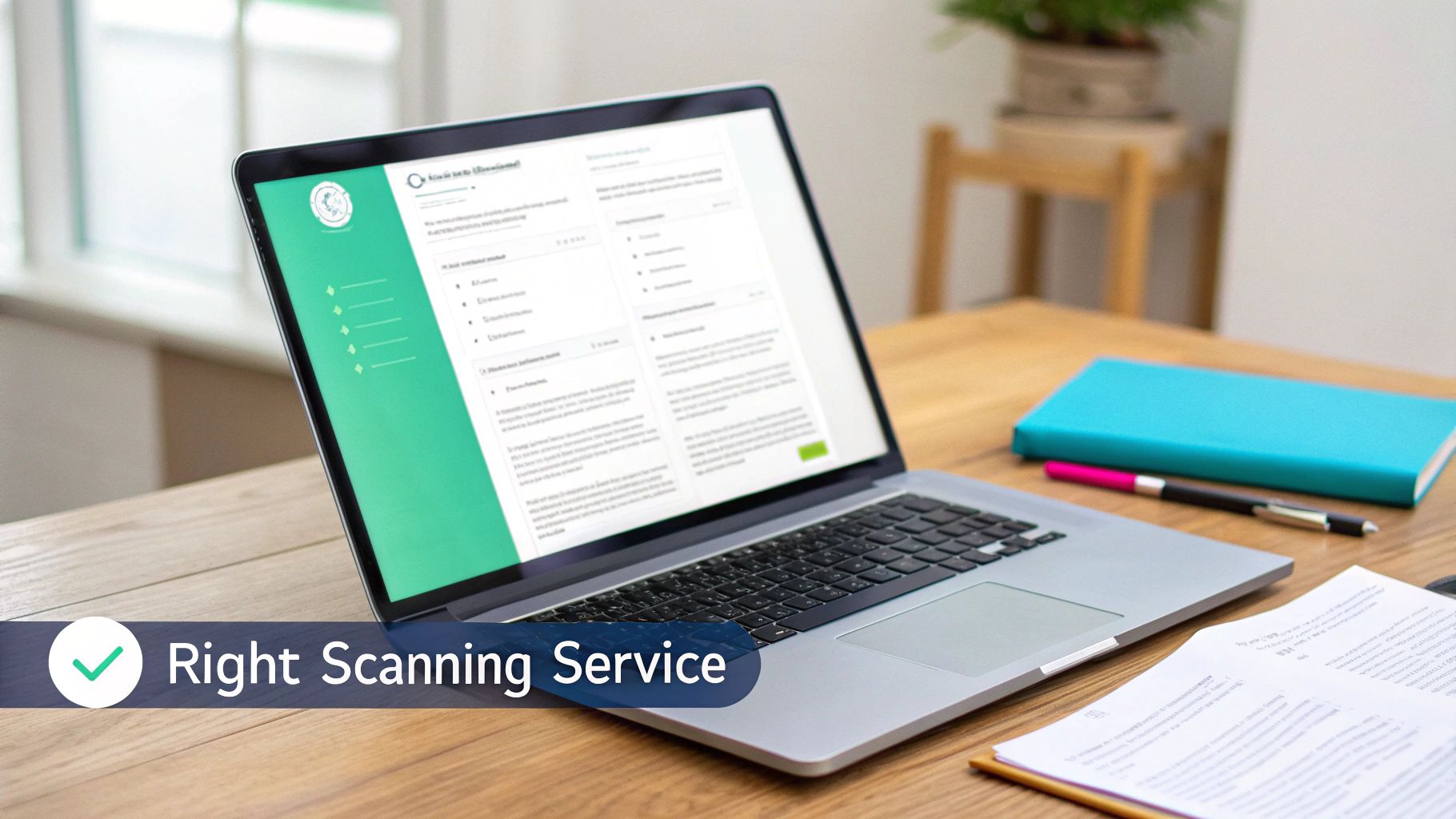
The single most important feature of any scanner is its report. A good report is clear, concise, and prioritized. It should immediately show you the top critical issues you need to fix right now. It must provide actionable guidance and explain the real-world risk, not just list problems.
Why To Ask About Remediation Support
Finding vulnerabilities is only half the battle. Fixing them is what makes you more secure. A good scanning service doesn't just email you a report and vanish. They should be available to help your team understand and address the findings. You are buying access to expertise.
Why To Consider The False Positive Rate
A false positive is when a scanner flags something that isn't really a problem. A high false positive rate wastes your team’s time and leads to alert fatigue. This is where combining automated scans with human oversight from certified experts—like those with OSCP or CREST certifications—makes a massive difference.
Why To Look For Seamless Integrations
Your security tools need to fit into your existing workflow. A modern service should integrate with tools like Jira and Slack. These integrations turn a static report into a dynamic part of your development process, ensuring findings get fixed quickly.
Why a Pentest Is Your Next Step
A vulnerability scan is a great start, but it only shows you half the picture. We know traditional pentesting firms are slow, expensive, and deliver useless reports. This is tough when you're a startup needing a SOC 2 compliance report on a tight budget.
Go Beyond Scanning to Find Real Risk
Our approach is different. We deliver fast, affordable, manual penetration tests that find the critical risks automated tools miss. While a scanner checks a list, our certified experts think like hackers. They find complex business logic flaws and show you how a real breach would happen.
Get Fast Reports You Can Actually Use
Stop waiting months for a pentest report. We deliver our findings in about a week. You get clear, actionable guidance on what to fix first. No confusing jargon, just a straightforward plan to make your business more secure and help you pass your audits. Our team holds top certifications like OSCP, CEH, and CREST.
The Affordable Alternative for Fast Pentesting
You need to know which vulnerabilities truly matter to your business. We bridge the gap between automated scanning and real-world risk. Our service is the affordable alternative designed for businesses that need to move fast. It's time to stop just scanning for problems and let us show you what an attacker would actually exploit. Fill out our contact form for a quick quote.
Frequently Asked Questions About Scanning
Got questions about how a vulnerability scanning service works? Let's get you some straight answers to what we hear most from IT managers and founders.
How Often Should My Business Run Scans?
For most businesses, quarterly scans are a good baseline, especially for compliance like PCI DSS. But if your applications change often, you should be scanning monthly or even weekly. The goal is to find new vulnerabilities as soon as they appear.
Do Vulnerability Scans Find Every Flaw?
No, and it’s important to know why. Scanners are great at spotting known vulnerabilities and common mistakes. They are completely blind to complex business logic flaws, zero-day threats, or creative attacks a human hacker would use. This is why you must pair scanning with a manual pentest.
What's The Difference Between Internal and External Scans?
An external scan is like checking your office building from the outside. It mimics an attacker on the internet probing your public-facing systems. An internal scan is run from inside your network. It's like seeing what a malicious employee or an attacker who already got inside could do. You need both to be secure.
Tired of slow, overpriced security firms that deliver reports with no real findings? At Affordable Pentesting, we provide fast, manual penetration tests from certified experts (OSCP, CEH, CREST) that uncover the critical risks automated scanners miss. Get an actionable report in about a week, not months, at a price that makes sense for your budget.
Ready to find out what a real attacker would see? Fill out our contact form to get a quick quote and secure your business today.