.svg)
Your auditor wants proof. Your security team has screenshots in Slack, policy docs in Google Drive, tickets in Jira, and a spreadsheet that nobody trusts. You're trying to pass SOC 2, HIPAA, PCI DSS, or ISO 27001 without burning a month of engineering time on evidence hunts.
That's the mess audit & compliance software is supposed to fix. And if you buy the right tool, it does. If you buy the wrong one, you just get a prettier dashboard sitting on top of the same manual chaos.
What Is Audit And Compliance Software Anyway
Audit & compliance software is a system for organizing controls, collecting evidence, tracking gaps, and producing audit-ready records. It's not magic, and it's not a substitute for security work. It's the operating system for compliance work that too many startups still run through spreadsheets and shared folders.
If you're staring at an upcoming audit, this software matters because auditors don't care how hard your team worked. They care whether you can show clean evidence, tied to specific controls, with a clear trail of what was tested, when, and by whom.
What it replaces
Most early-stage teams start the same way. They keep policies in one place, cloud settings in another, vendor reviews in email, and remediation tasks in a ticketing system. Then audit season hits and somebody spends days stitching it all together by hand.
A decent platform centralizes that work:
- Control tracking: One place to manage what each framework requires.
- Evidence collection: Pull proof from systems instead of begging people for screenshots.
- Audit history: Keep records of changes, reviews, and remediation steps.
- Collaboration: Let security, IT, engineering, HR, and auditors work from the same source of truth.
Practical rule: If your compliance process depends on one employee remembering where everything lives, you don't have a process. You have a risk.
The shift is already happening across the market. The global audit software market was estimated at USD 3.1 billion in 2024 and is projected to reach USD 9.7 billion by 2034, according to GM Insights coverage of the audit software market. That growth reflects companies moving away from spreadsheets toward tools built for real-time collaboration and fewer errors.
What it still doesn't do
Software can organize your evidence. It cannot prove your controls are effective. If your access reviews are weak, your cloud setup is sloppy, or your app has obvious vulnerabilities, the platform won't save you.
That's also why teams evaluating newer automation should read practical perspectives like Lighthouse Consultants on AI in internal audit. AI can help with review and monitoring, but it doesn't remove the need for real validation.
If your audit scope includes security validation, you also need pentesting for regulatory needs. Software keeps the paperwork straight. Testing proves the controls aren't just paperwork.
Key Compliance Frameworks You Need To Know
Most founders and IT managers don't struggle with compliance because the rules are impossible. They struggle because the same security work gets renamed across multiple frameworks, then tested over and over.
That's why you need to understand the big frameworks in plain English, not auditor language.
What each framework means
SOC 2 matters if you sell software and customers want proof you handle systems and data responsibly. For many SaaS companies, it's the ticket to closing deals.
PCI DSS matters if you store, process, or transmit payment card data. If money moves through your systems, PCI DSS stops being optional.
HIPAA matters if you handle protected health information. If you touch healthcare data, your controls need to stand up to more scrutiny.
ISO 27001 is a broader information security management standard. It's often useful when customers want a structured, internationally recognized security program.
The problem is that these frameworks overlap. You may need access control, logging, vulnerability management, vendor review, and policy documentation in all of them. Startups waste time when they treat those as separate jobs.

Why control mapping matters
The actual cost of compliance is usually duplicate evidence work, not the framework label. As noted in Scytale's discussion of multi-framework compliance software, most buyers need support for multiple frameworks such as SOC 2, ISO 27001, and HIPAA at the same time, and the best software reduces audit burden by mapping overlapping controls.
Here's what good mapping looks like in practice:
- One access review process: Reused across multiple frameworks instead of recreated for each audit.
- One vendor assessment record: Linked to several control requirements.
- One penetration test report: Mapped to relevant technical controls where appropriate.
- One remediation trail: Auditors can follow it without asking for five exports from five systems.
Good audit & compliance software doesn't just track tasks. It lets one control satisfy multiple obligations without forcing your team to re-prove the same thing three times.
If you're chasing attestation now, focused help with SOC 2 compliance services can make this cleaner. The point isn't collecting more evidence. The point is collecting it once and reusing it properly.
Must Have Features In Your Compliance Software
Most compliance tools are sold with long feature lists. Ignore half of them. You're not shopping for a digital trophy. You're buying time back for your team.
The software needs to do a few things very well. If it doesn't, skip it.
Evidence collection that runs without babysitting
The first job is automated evidence collection. Your platform should pull data from the systems you already use, then attach that evidence to controls without someone manually uploading screenshots every week.
That matters because effective compliance software acts as a control-plane for evidence. Comply's guidance on compliance software capabilities highlights multi-framework mapping, automated evidence collection, and vendor risk management as the most valuable capabilities, specifically because they reduce duplicate control testing and lower the risk of gaps caused by manual spreadsheets or disconnected tools.
If a vendor demo relies on phrases like “simple manual upload” for core workflows, that's not automation. That's labor with branding.
Control mapping that actually saves work
A lot of tools claim they support multiple frameworks. That claim is meaningless unless they show you how one control maps across more than one requirement.
Ask the vendor to demonstrate this with a real example. Have them show how a single access review, vulnerability management process, or vendor due diligence record maps to different frameworks without cloning work.
Look for these specifics:
- Reusable control library: Controls should be written once, then linked broadly.
- Traceability: Every test, artifact, and exception should tie back to a control.
- Framework overlays: You should be able to add another framework without rebuilding the program.
- Clean auditor views: Auditors need clear output, not internal clutter.
Vendor risk and remediation tracking
Third-party risk is where a lot of teams fall apart. They can answer questions about their own systems, but they can't show how they review key vendors, document risks, or follow up on issues.
A useful platform should let you track:
| Need | What the software should do |
|---|---|
| Vendor reviews | Store assessments, approvals, and follow-up actions |
| Findings | Turn gaps into tickets with owners and due dates |
| Exceptions | Record why a control failed and what happened next |
| Audit output | Produce reports an auditor can review without extra cleanup |
Buyer filter: If the tool can't turn a finding into a remediation workflow with evidence attached, your team will end up managing the hard part somewhere else.
Reporting that auditors can use
Some products make pretty dashboards for executives and terrible output for auditors. Don't confuse the two.
You want reporting that shows control status, linked evidence, remediation history, and a clear audit trail. If your auditor still has to ask for side spreadsheets, the platform isn't doing its job.
The best audit & compliance software isn't the one with the biggest feature set. It's the one that makes evidence reusable, gaps visible, and remediation obvious.
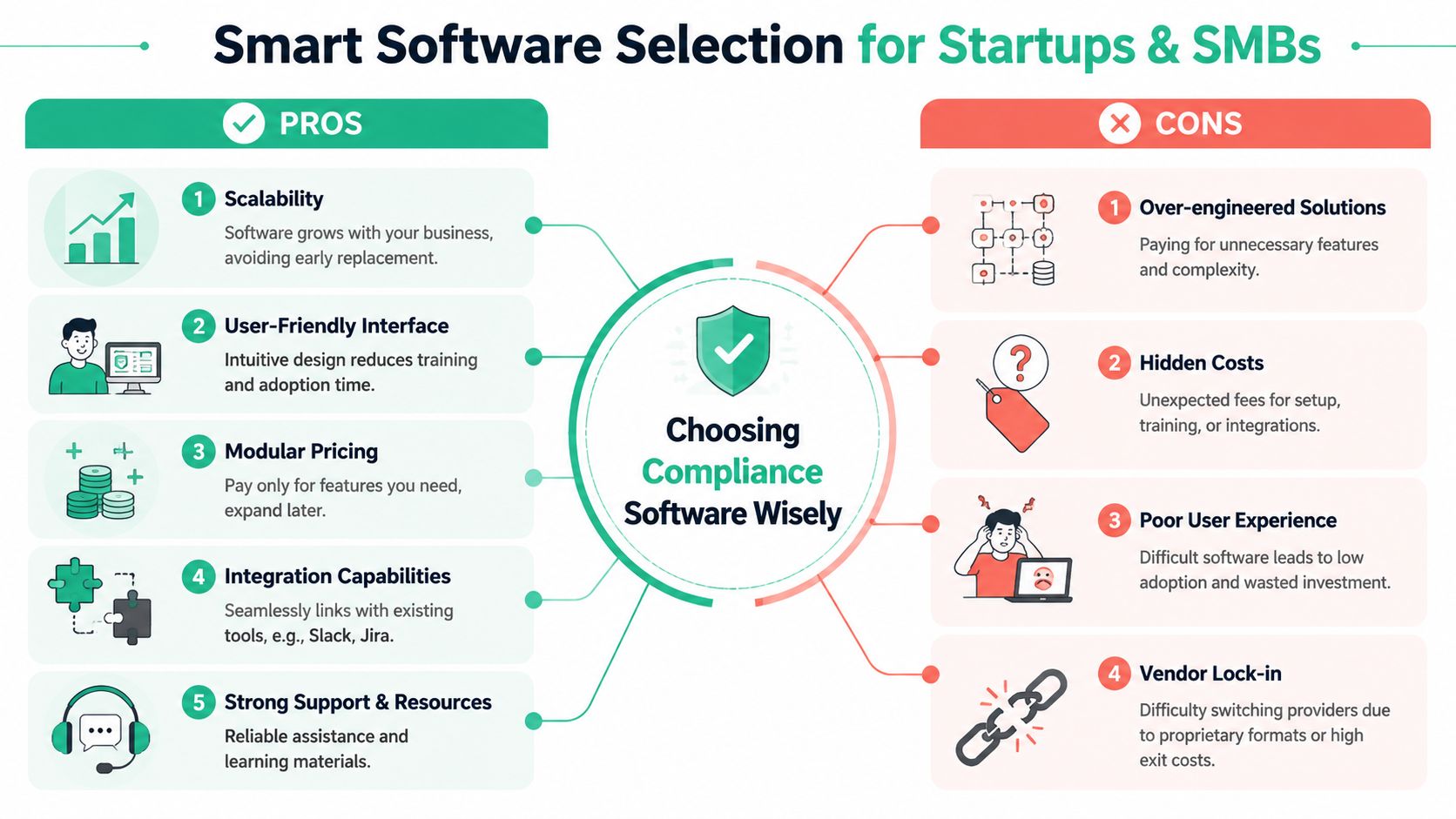
How To Choose Software Without Overpaying
Startups overpay for compliance software for one simple reason. They buy enterprise pain before they have enterprise complexity.
You do not need a giant GRC platform because a salesperson said you'll “grow into it.” That's how you end up funding features your team never touches while still doing manual work on the side.

Buy for your current audit problem
The right question is not “What's the most complete platform?” The right question is “What helps us pass our next audit with the least wasted effort?”
Grand View Research says the global compliance software market reached USD 35.82 billion in 2025 and is projected to rise to USD 78.85 billion by 2033, and also notes that 82% of companies plan to invest more in technology to automate compliance work. In PwC survey findings cited there, teams reported better risk visibility at 64% and faster issue response at 53% when using technology for compliance work, as covered in Grand View Research's compliance software market report. For a startup, that means the target is efficiency and cost savings, not feature bloat.
Questions to ask in every demo
Use the demo to force a vendor out of marketing mode. Ask blunt questions.
- Show live integrations: Don't accept a slide. Ask what evidence is pulled automatically and what still needs manual upload.
- Show multi-framework mapping: Make them prove one control can satisfy multiple requirements.
- Show remediation flow: Ask how a failed control or security finding becomes a tracked fix.
- Show export quality: Ask what an auditor receives.
- Show pricing edges: Ask which features, users, integrations, or support levels cost extra.
A vendor that gets vague during these questions is hiding work you'll still have to do.
What to avoid
Some warning signs are obvious:
- Overbuilt workflows: If setup looks like a six-month internal transformation, walk away.
- Consulting dependency: If you need paid experts every time you change a control, the product is too heavy.
- Locked data: If you can't export your evidence and control history cleanly, you're buying future pain.
- AI-first positioning without control logic: AI can help. It can also create noise if the basics are weak.
If your team also deals with integrity-sensitive systems or transaction records, broader infrastructure planning sometimes matters too. For that angle, resources on blockchain solutions for enterprises can be useful context when you're evaluating how evidence, logging, and trust models fit into regulated operations.
Choose software that makes your next audit cheaper and faster. Don't buy software that turns compliance into another department.
Integrating Your Fast And Affordable Pentest
Friday afternoon. Your biggest prospect asks for the SOC 2 package, your auditor wants proof of remediation, and your compliance platform looks tidy right up until someone asks a simple question. Has anyone tried to break the app?
That gap is where startups waste money. They buy audit software, collect screenshots, map controls, and still end up scrambling for a penetration test at the worst possible time. The fix is simple. Build the pentest into the compliance workflow from the start so findings, tickets, retests, and audit evidence live in one process.

Audit software tracks policies, evidence, owners, and due dates. It does not verify whether an attacker can bypass auth, pivot through a misconfigured cloud asset, or pull customer data through a weak API. Auditors know that. Buyers know that too.
Use a workflow that connects the platform to real testing:
- Map the controls tied to technical risk
- Define the systems inside audit scope
- Run the penetration test
- Turn findings into remediation tickets
- Attach the report and fix evidence to the right controls
- Retest high-risk issues
- Show the auditor the full record from finding to closure
This is the cheaper way to do it. One cycle. One evidence trail. Less rework.
What a practical pentest workflow looks like
A good SMB process is boring in the best way. Scope the assets that matter. Test them with humans, not just scanners. Get a report quickly enough to fix issues before the audit clock runs out. Push findings into the same ticketing flow your team already uses. Then upload remediation proof back into the compliance system so nobody is hunting through email and shared drives later.
The key is timing. Run the test early enough that engineering can fix what matters without derailing the roadmap. Run it late, and you pay twice. Once for the test, again for the delay.
Where startups usually get burned
The common failure modes are predictable:
- Software with no security validation: The controls look complete, but nobody has tested whether they hold up in practice.
- Slow pentest firms: Findings arrive after the audit window tightens, so the report becomes a document dump instead of a tool for fixing risk.
- PDF-only handoff: The report exists, but nothing gets tied back to controls, tickets, or remediation evidence.
- Overscoped testing: The provider tests everything vaguely and proves nothing clearly. You pay more and learn less.
Affordable Pentesting is one example of the service model that fits this workflow. The company focuses on manual penetration testing for teams working toward frameworks such as SOC 2, PCI DSS, HIPAA, and ISO 27001, using certified testers including OSCP, CEH, and CREST. That matters because startups need usable findings and a report they can act on quickly, not a long engagement that burns budget and misses the audit deadline.
What to demand from any provider
Keep the checklist short and strict:
- Manual testing by qualified people: Ask who is doing the work and what certifications they hold.
- Clear scope: Make sure the provider can state exactly what is being tested and why it matters for your audit boundary.
- Fast report delivery: A good report delivered late is still expensive.
- Actionable findings: Engineers should know what to fix. Auditors should see what was tested and what happened.
- Retest support: Closed means verified, not promised.
Done right, audit software and penetration testing support each other. The software keeps the evidence organized. The pentest proves your controls work under pressure. Together, they cut wasted labor, reduce audit friction, and stop you from paying premium prices for last-minute security work.
Calculating Your Return On Investment
Many teams calculate compliance costs badly. They look at the software bill and ignore the labor bill. That's backward.
Your biggest cost usually isn't the platform. It's the hours your engineers, IT staff, security lead, and operations team burn chasing evidence, answering repeat questions, and rebuilding the same audit trail over and over.
Where the return actually comes from
A good return comes from three places:
- Less manual evidence collection: Fewer screenshots, exports, and spreadsheet updates
- Less duplicated testing: One control mapped across multiple frameworks
- Faster remediation handling: Findings move into tickets instead of dying in email
According to InvGate's discussion of software audit workflows, well-integrated audit management software can reduce auditing time by up to 60% while also cutting manual errors and improving reporting quality. For teams preparing for SOC 2 or PCI DSS, that means faster evidence production and fewer wasted hours.
A simple way to think about cost
Don't ask whether software is cheap. Ask whether it's cheaper than the current mess.
If your team spends weeks collecting proof manually, delays fixes because findings aren't tracked well, or repeats the same work for multiple frameworks, then the right audit & compliance software pays for itself through avoided labor. The same applies to penetration testing. A fast, reasonably priced engagement that produces useful findings is worth more than a premium report that arrives after your deadline.
Bottom line: The smart spend is the one that removes repeated work. Not the one that buys the most features.
The strongest ROI usually comes from a paired model. Use right-sized software to manage controls and evidence. Use a fast pen test or penetration test to validate technical controls and feed findings directly into remediation. That combination gives auditors what they need without forcing your team into a long compliance death march.
The Smart Way To Handle Your Next Audit
The old model is broken. Spreadsheets break traceability. Shared folders break accountability. Slow security firms break timelines.
The better model is simple. Use audit & compliance software to centralize controls, evidence, remediation, and reporting. Then back it up with a real pen testing process that validates whether the controls work in practice.
If you're dealing with SOC 2, HIPAA, PCI DSS, or ISO 27001, don't accept duplicate work as normal. Don't buy bloated software that creates more admin. Don't wait weeks for a penetration test report when the audit clock is already running.
Use tools that reduce evidence chaos. Use testing that gives you findings you can act on quickly. If you need a practical starting point for requirements and evidence expectations, review this SOC2 and PCI DSS checklist.
That's how you keep compliance from turning into a money pit.
If you're done overpaying for slow audits and slower security reviews, talk to Affordable Pentesting through the contact form. A fast, affordable pentest can fit directly into your audit workflow and help you move from checkbox compliance to evidence you can effectively defend.