.svg)
Getting ready for an audit like SOC 2 or HIPAA can be a headache. You're probably stuck dealing with old-school firms that are slow, expensive, and don't find much. This checklist for auditing is different. It’s a simple guide for IT managers, CISOs, and startup founders who need to prove their security without waiting months for a report.
Think of this as your game plan. We'll walk through the exact steps for a smooth, fast, and predictable audit process. A huge part of any audit is the penetration test, but it shouldn't be a painful process.
Our team of certified pentesters (OSCP, CEH, CREST) focuses on affordability and speed. You get a real, actionable report in under a week with findings that matter. This guide shows you how to prepare for the pen testing phase and beyond. Let's start.
Define Your Audit Scope and Plan
Every good audit or penetration test starts with a clear scope. This means setting boundaries on what systems, apps, and data are in play. It's like drawing a map before a road trip. A solid scope stops confusion and makes sure all your important stuff gets checked.
For example, a SOC 2 audit scopes specific systems over a 6-12 month period. PCI DSS needs to include every part of your cardholder data environment. Skipping this step leads to an incomplete audit and a false sense of security.
To get this right, make a detailed list of your systems and how data flows between them. Get everyone to agree in writing on what's in and what's out. This simple step makes sure your penetration testing is focused, fast, and doesn't cause problems.
Create a Complete Asset Inventory Map
Once you know the scope, you need to list everything inside it. This means every server, app, database, and network device. You can't protect what you don't know you have. This list is the foundation for any security audit or pen test.

Almost every compliance rule requires this. ISO 27001 and HIPAA demand a full inventory of systems handling sensitive data. Without it, you can't create the network diagrams needed for PCI DSS. Many audits fail when some forgotten, unpatched system is discovered.
To build a good inventory, use network scanning tools to find assets, then have system owners double-check the list. An accurate inventory isn't just a list, it's a map of your attack surface. It helps our pentesters focus on your most critical assets, giving you a faster, more affordable report.
Run a Vulnerability Assessment Scan
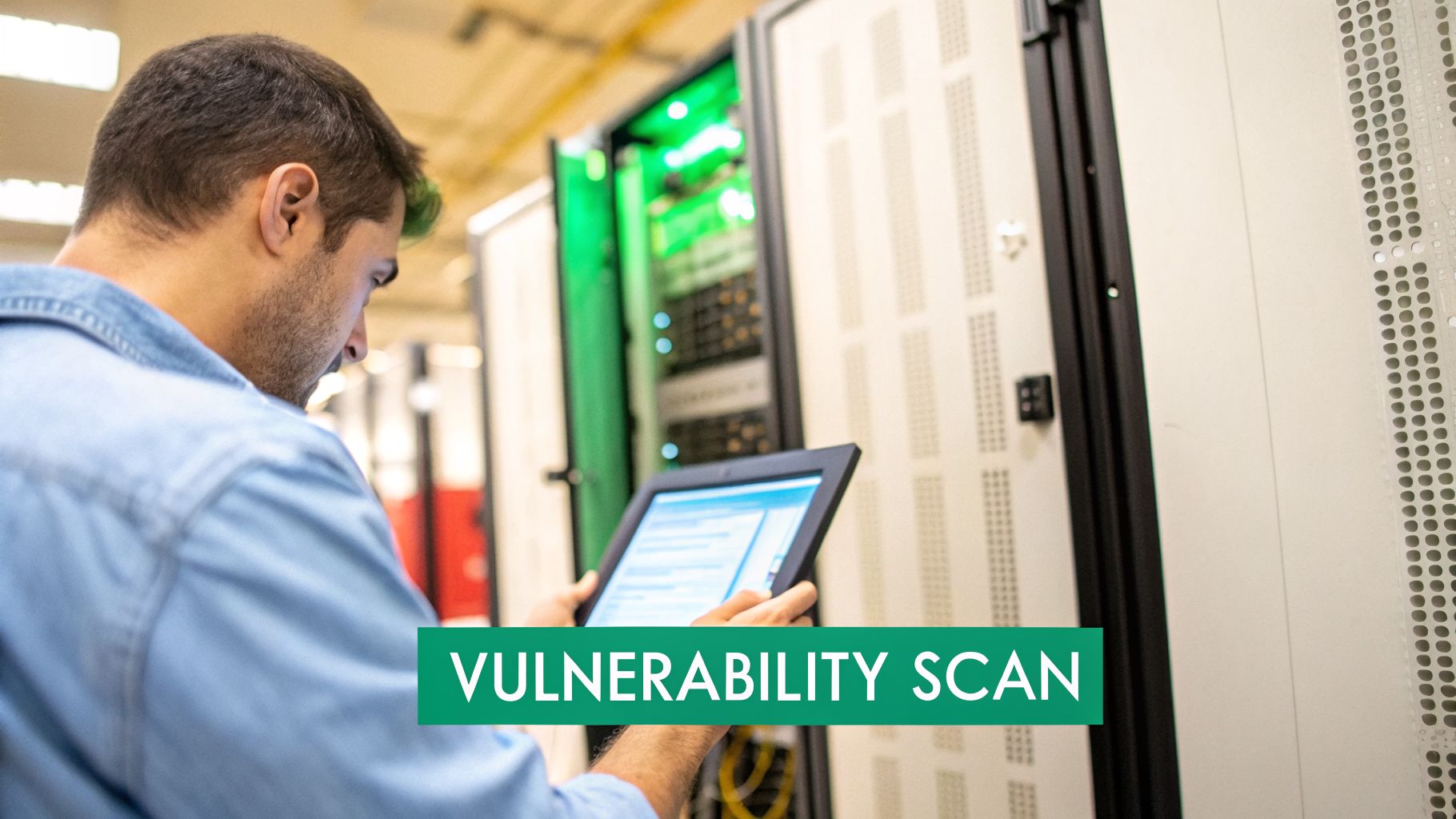
Next, you need to find security weaknesses in your systems. A vulnerability assessment uses tools to find things like missing patches or bad configurations. This scan gives you a map of potential entry points for attackers and prepares you for a focused penetration test.
This step is key for compliance. PCI DSS requires regular scans to protect credit card data. A HIPAA assessment involves scanning for flaws that could expose patient information. Ignoring this is like leaving your doors and windows unlocked.
Scanners are great for finding known problems quickly. But you also need a human expert to check the findings and remove the noise. We recommend running scans that check systems both with and without login credentials to get a full picture. This approach ensures your pen test is efficient and focused on real risks.
Test Your Access and Authentication
Access control is like the bouncer for your data. This part of the audit checks that only the right people can access the right information. It makes sure your identity checks are strong and that users only have the minimum permissions they need to do their jobs.
This is a big deal for almost every security rule. For HIPAA, it means proving only doctors can see patient files. A company with a SOC 2 report must show strong controls that keep one customer's data from being seen by another. Weak access controls are a common reason for audit failures.
Strong login security is your first line of defense. Our penetration testing should confirm multi-factor authentication (MFA) is used everywhere it's needed. Pentesters look for easy-to-guess passwords and check that permissions are removed when an employee leaves. For details on setting this up, read about access control policies. You can also find additional authentication insights from industry experts.
Validate Your Data Encryption Methods
Having security controls isn't enough; you must prove your sensitive data is encrypted. This step checks that your important info is scrambled both when it's stored and when it's moving across the network. Encryption makes data useless to an attacker even if they manage to steal it.
This is a must-have for compliance. PCI DSS requires strong encryption for all stored credit card data. HIPAA demands that patient information is encrypted everywhere it lives or travels. A SOC 2 audit directly checks how you protect data with encryption, so you can't skip this.
An audit has to check the whole encryption process. This includes the strength of the encryption, how you protect the keys, and making sure it's used everywhere. This part of your checklist for auditing proves your data protection plan is a reality, not just a policy on paper.
Review Your Logging and Monitoring
An audit isn't just about finding problems, it's about showing you can spot them as they happen. Good logging and monitoring is how you do that. This step dives into how you record and analyze security events from all your important systems. Without good logs, you're flying blind during an attack.
This is a core part of most compliance rules. HIPAA requires you to log all access to patient data. PCI DSS demands logging for everything in the credit card environment. A SOC 2 audit focuses heavily on your ability to monitor systems for weird activity.
If something isn't logged, it's like it never happened. To prepare, make sure all critical systems send their logs to one secure place. Check that these logs are protected and can't be changed. Test your alerts by triggering a fake security event to see if the right people get notified.
Track Your Patch Management Process
A good patch management process is basic security hygiene. This step in your audit checks that you are finding and fixing known software problems on a regular schedule. It's like changing the oil in your car; skipping it leads to bigger problems down the road.
This is a key control for all security frameworks. PCI DSS requires that critical security patches are applied within a month. HIPAA requires you to protect patient data from known threats, which means patching your systems. Without a formal process, you are guaranteed to fail an audit.
Auditors need to see proof that you are patching systems. Set deadlines for fixing issues based on how serious they are, like 14 days for critical flaws. Always test patches in a safe environment first. This shows you have a mature security program, not just a reactive one.
Assess Your Third-Party Vendor Risks
Your security is only as strong as your weakest link, and that's often a vendor. This audit step looks at the security of your service providers and partners. You're outsourcing a service, not the risk that comes with it. Ignoring this can create a backdoor for attackers into your network.
This is a mandatory part of any modern security program. A healthcare company must have agreements with vendors that handle patient data. A tech company getting a SOC 2 report must prove its cloud provider is also secure. Understanding Third Party Risk Management is key here.
Your vendors are part of your security perimeter. Start by making a standard security questionnaire and requiring proof of security, like a SOC 2 report. Put security rules right into your contracts. This helps you find hidden dangers before they become a real problem.
Test Your Incident Response Plan
A plan on a shelf is useless. You need to test your incident response and disaster recovery plans to make sure they actually work. This part of an audit proves your team can handle a real security incident, from finding a breach to getting services back online.
This is a required check for most compliance rules. HIPAA demands a plan for data backup and disaster recovery. PCI DSS requires that you test your incident response plan at least once a year. Failing to test your plans gives you a false sense of safety that disappears in a real emergency.
The best way to prepare is to run a practice drill at least once a year. This "tabletop exercise" walks your team through a fake attack like ransomware. It tests how you communicate and make decisions under pressure. Documenting every step gives auditors the proof they need.
Finalize Reports and Get Sign-Off
An audit or penetration test is only as good as its final report. This last step turns technical findings into a clear business document. A good report doesn't just list problems; it gives you a roadmap for fixing them, with clear priorities and owners.

This is the end goal of any security assessment. A HIPAA report must prioritize issues based on risk to patient data. Without a clear report, important fixes get lost. That's why our pen testing services focus on delivering clear, simple reports in under a week.
We recommend creating two reports: a short summary for leaders and a detailed technical report for IT teams. Use a simple risk rating system like Critical, High, Medium, and Low. Most importantly, explain how to fix each problem. This ensures your pen test delivers real security improvements.
10-Point Audit Checklist Comparison
| Item | Implementation Complexity 🔄 | Resource Requirements ⚡ | Expected Outcomes ⭐📊 | Ideal Use Cases 💡 | Key Advantages ⭐ |
|---|---|---|---|---|---|
| Scope Definition and Planning | Moderate — stakeholder coordination & documentation 🔄 | Low–Medium — time from stakeholders, planning tools ⚡ | Clear boundaries; reduced scope creep; focused testing ⭐⭐⭐ 📊 | Pre-audit planning; SOC2/PCI/HIPAA scoping 💡 | Prevents scope creep; aligns testing with business goals ⭐ |
| Asset Inventory and Mapping | High — discovery, mapping, and dependency analysis 🔄 | High — discovery tools, cross-team effort, CMDB ⚡ | Comprehensive attack-surface visibility; prioritization ⭐⭐⭐ 📊 | Large/complex infra; compliance requiring diagrams (PCI/HIPAA) 💡 | Enables risk-based testing; finds shadow IT ⭐ |
| Vulnerability Assessment and Discovery | Moderate — automated scans + manual verification 🔄 | Moderate — scanners, skilled analysts, scan windows ⚡ | Identifies known CVEs and misconfigurations; baseline metrics ⭐⭐⭐ 📊 | Regular scanning cadence; pre-penetration test checks 💡 | Fast identification of known issues; remediation guidance ⭐ |
| Access Control and Authentication Testing | High — deep auth logic and privilege testing 🔄 | Medium–High — identity test accounts, skilled testers ⚡ | Detects broken auth and privilege escalation; high-impact findings ⭐⭐⭐ 📊 | Protecting sensitive data; SOC2/HIPAA/PCI control validation 💡 | Prevents unauthorized access; validates least-privilege ⭐ |
| Data Protection and Encryption Validation | Moderate — crypto review and key-management checks 🔄 | Medium — crypto expertise, tools, access to key stores ⚡ | Validates encryption in transit/at-rest; lowers breach impact ⭐⭐⭐ 📊 | Data confidentiality controls; PCI/HIPAA encryption checks 💡 | Meets regulatory encryption requirements; protects data ⭐ |
| Logging, Monitoring, and Event Management Review | High — SIEM tuning, log integrity, correlation work 🔄 | High — SIEM, storage, skilled analysts, retention costs ⚡ | Improved detection and forensics; audit-ready trails ⭐⭐⭐ 📊 | Incident detection, compliance audits, threat hunting 💡 | Faster detection/response; forensic readiness ⭐ |
| Patch Management and Vulnerability Remediation Tracking | Moderate — process, testing, rollback planning 🔄 | Medium — patch tooling, staging, test resources ⚡ | Reduced exposure to known vulnerabilities; compliance metrics ⭐⭐📊 | Ongoing security hygiene; regulatory patch SLAs (PCI) 💡 | Proactive risk reduction; measurable compliance reporting ⭐ |
| Third-Party and Supply Chain Risk Assessment | Moderate — questionnaires, attestations, continuous monitoring 🔄 | Medium — legal/contracts, vendor assessments, tools ⚡ | Identifies vendor risks; reduces supply-chain exposure ⭐⭐ 📊 | Vendor onboarding; cloud provider selection; contract renewals 💡 | Limits third-party liability; enforces contractual controls ⭐ |
| Incident Response and Business Continuity Testing | High — tabletop & live DR tests; cross-functional coordination 🔄 | High — test environments, staff time, simulation resources ⚡ | Faster detection/response; validated RTO/RPO; resilience ⭐⭐⭐ 📊 | Ransomware preparedness; regulatory incident readiness 💡 | Minimizes downtime; improves recovery confidence ⭐ |
| Report Development, Remediation Prioritization, and Management Sign-Off | Moderate — report synthesis and stakeholder review 🔄 | Low–Medium — analysts, executive time, reporting tools ⚡ | Actionable remediation roadmap; executive buy-in; accountability ⭐⭐⭐ 📊 | Post-assessment reporting; board/executive briefings 💡 | Drives remediation; aligns IT and leadership; measurable tracking ⭐ |
Ready for a Faster, Smarter Pentest?
This checklist for auditing gives you a clear roadmap to prepare for any major compliance audit. It helps you get organized, find gaps before an auditor does, and build a stronger security posture. But a checklist is just a guide. You need to prove your controls really work.
That's where penetration testing comes in. A pen test provides the hard evidence that your defenses can stop a real-world attack. It turns your security plan from theory into a proven fact. Auditors want to see proof that your security controls are effective, and a quality pen test report is the best way to give it to them.
The problem is finding a penetration test that's fast and affordable. Old-school firms are expensive and slow, which is a big problem when your audit deadline is close. You need a partner who delivers speed, value, and real results.
Mastering this checklist is the first step. The next is to bring in an expert to verify your work. This proactive approach shows auditors you are serious about security. You're not just checking boxes; you are building a security program that actually works.
Ready to prove your controls and breeze through your next audit? Affordable Pentesting provides fast, manual penetration testing performed by certified experts (OSCP, CEH, CREST), with a full report delivered in under a week. Get the audit evidence you need without the enterprise price tag by visiting Affordable Pentesting and requesting a quote today.