.svg)
Your audit is coming. Your team is already busy. Nobody wants to burn weeks building pretty spreadsheets just to discover the auditor cares about three basic things. What's in scope, who owns the controls, and where the proof lives.
That's why a good audit readiness assessment should be run like a lean project, not a paperwork exercise. If you treat it like a compliance side quest, you'll waste engineering time, miss obvious gaps, and pay for cleanup right before the audit.
The smarter move is simple. Narrow the scope, map the controls, collect proof early, fix the gaps that matter, and finish with a fast pentest, pen test, or penetration test that shows your controls hold up in practice.
Defining Scope and Mapping Your Controls
A founder approves an audit readiness push, the team pulls every system into scope, and three weeks later engineering is arguing about an old internal tool nobody uses for customer data. That is how startups waste money before the auditor even shows up.
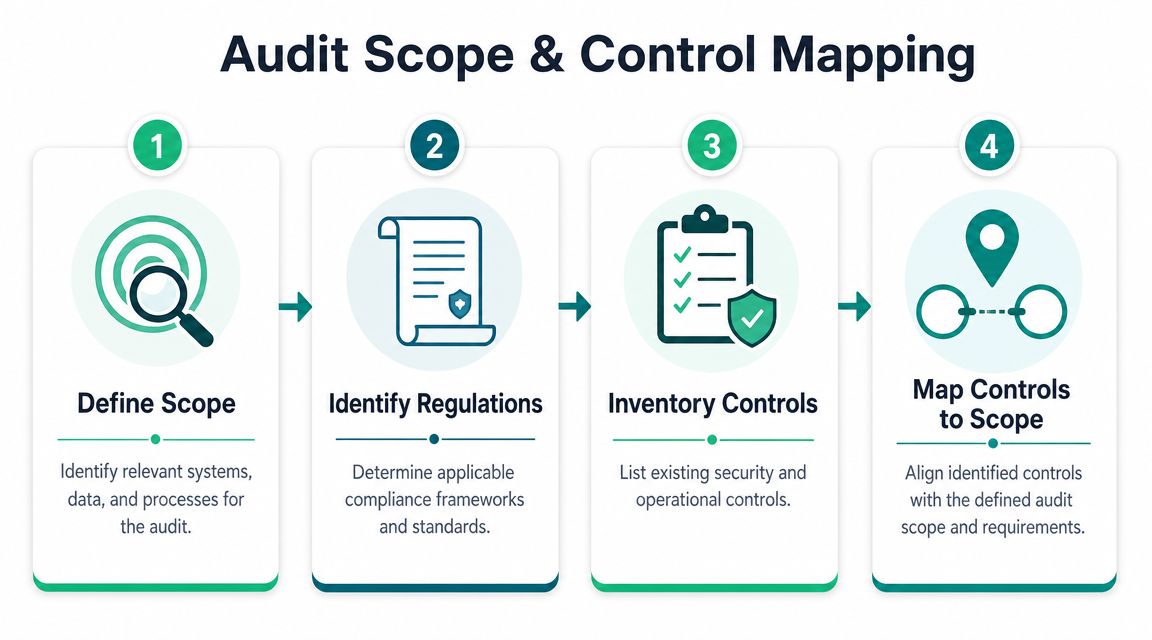
Start narrower. Scope only the systems, people, and workflows tied to the product, data, and services the framework covers. If it does not affect the audited service, leave it out until someone can show why it belongs.
Start with what actually matters
List the environment that supports the audited product. In plain terms, that usually includes your production app, cloud accounts, identity provider, code repository, ticketing workflow, employee access process, backups, and the data stores that hold customer or regulated data.
Then set boundaries in writing. Exclude sandbox environments that do not connect to production. Exclude internal tools that never touch sensitive data. Exclude legacy systems unless the framework or your data flow pulls them into scope. A tight scope saves audit hours, cuts remediation costs, and makes the final penetration test faster and cheaper.
Map controls to the framework
Once scope is fixed, map each requirement to a control that already exists in your operation. Keep the language simple and specific. If the framework requires restricted access, map it to role-based access in Okta, Google Workspace, or AWS IAM. If it requires change management, map it to pull request reviews, branch protections, and deployment approvals in GitHub or GitLab.
Skip the giant spreadsheet unless your environment is complex. A lean control map should answer four questions fast:
- Which requirement applies: SOC 2, ISO 27001, PCI DSS, HIPAA, or another requirement
- What control covers it: MFA, access review, logging, incident response, vendor review, backup testing, or policy approval
- Who owns it: A named person or function such as security, engineering, HR, IT, or legal
- Where the evidence lives: Screenshots, logs, tickets, signed policies, or exported reports
If a control has no owner or no evidence location, mark it as missing now. Do not wait for the audit to expose it.
Teams usually stall here because they treat control mapping like a compliance thesis. It is an operating document. It needs to be traceable, easy to review, and tied to how work happens. That is the standard behind continuous control monitoring and recurring audit prep, and it lines up well with this NIST 800-53 strategic security playbook.
Keep risk attached to scope
A clean scope without risk ranking is still sloppy. Review the obvious problem areas before you lock the map. Access control, incident response, vendor risk, and evidence retention create expensive surprises because they cut across systems, people, and documentation.
Use simple effective risk assessment techniques to rank what needs attention first. That keeps your remediation plan lean and makes the final pentest a validation step, not an expensive way to discover basic scoping mistakes.
Here's the standard I use with founders:
| Focus area | What to define now | What usually goes wrong |
|---|---|---|
| Systems | Production apps, databases, cloud accounts | Low-value systems get pulled in |
| Users | Employees, admins, contractors, vendors | Privileged access is not clearly tracked |
| Data | Customer data, regulated data, secrets | Sensitive data locations are unclear |
| Controls | Security and compliance measures that actually run | Policies exist, but operations do not match |
Get this map right and the rest of the audit becomes a controlled project. Get it wrong and you pay for the same mistake three times. Once in wasted prep, once in remediation, and again when the pentest finds what your scope should have caught.
Gathering Evidence and Finding the Gaps
A founder usually learns the hard way that “we have that control” means nothing once the auditor asks for proof and the team starts digging through Slack, old tickets, and somebody's desktop folder.
Evidence collection is where audit readiness stops being theory. Done right, it saves time, cuts rework, and keeps the later pentest focused on validation instead of exposing basic gaps you should have caught earlier.

Collect proof the way an auditor reviews it
Start from your control map. Pull one clear artifact for each control before you collect anything extra.
The goal is not a giant evidence dump. The goal is a small set of artifacts that prove the control exists, has an owner, and is operational. That usually means screenshots, exported settings, approval logs, signed policies, tickets, training completion records, access review outputs, incident records, vendor reviews, and change history.
Strong evidence is specific, current, and easy to interpret. A screenshot from Okta showing MFA enforcement with a date is useful. A policy PDF with no approval trail is weak. A Jira ticket showing offboarding and access removal is useful. A Slack reply that says “done” is weak.
Use this test for every artifact:
- Can someone outside your team understand it
- Does it show when the control ran, changed, or was reviewed
- Does it match the exact requirement
- Can your team reproduce it next month without hunting for it
If the answer is no, replace it.
Run a gap analysis that stays simple
Gap analysis is a direct comparison between required controls and the proof you have on hand. Nothing more.
If your framework requires quarterly access reviews and you cannot produce records, log a gap. If your incident response policy exists but nobody has tested the process or saved artifacts from an exercise, log a gap. If vendor reviews are part of your program but no one can show an assessment or approval record, log a gap.
Do this early, not right before the audit. Late evidence collection turns easy fixes into expensive fire drills because the team has to rebuild history instead of showing a repeatable process.
Separate proof problems from control problems
This distinction matters because the fix, timeline, and cost are different.
A control problem means the safeguard is missing or unreliable. A proof problem means the safeguard may exist, but nobody documented it in a way an auditor can verify. If you mix those together, you waste time polishing documents while real risk stays open.
| Problem type | What it means | Fix |
|---|---|---|
| Missing control | No real process or technical safeguard exists | Implement it |
| Weak control | Process exists but runs inconsistently | Assign ownership and tighten execution |
| Missing evidence | Control may exist but proof is absent | Capture and store the artifact properly |
| Stale evidence | Proof exists but is outdated | Refresh it and set a review cadence |
One more point. Technical validation belongs in this phase too. Your penetration test report is not just an audit attachment. It is the final proof that your controls hold up under real attack paths. If you want to see what a useful deliverable looks like before you buy one, find actionable pentest report examples. That will help you separate a real assessment from a scanner export with a consultant logo on it.
Building Your Prioritized Remediation Plan
Don't fix the easiest problems first. Fix the ones that can sink the audit or expose the business.
A weak remediation plan usually comes from one bad habit. Teams sort findings by convenience. They knock out minor policy edits, rename folders, and clean up low-impact admin issues while the serious access, logging, and incident-response gaps sit untouched.
Use risk to decide what gets fixed first
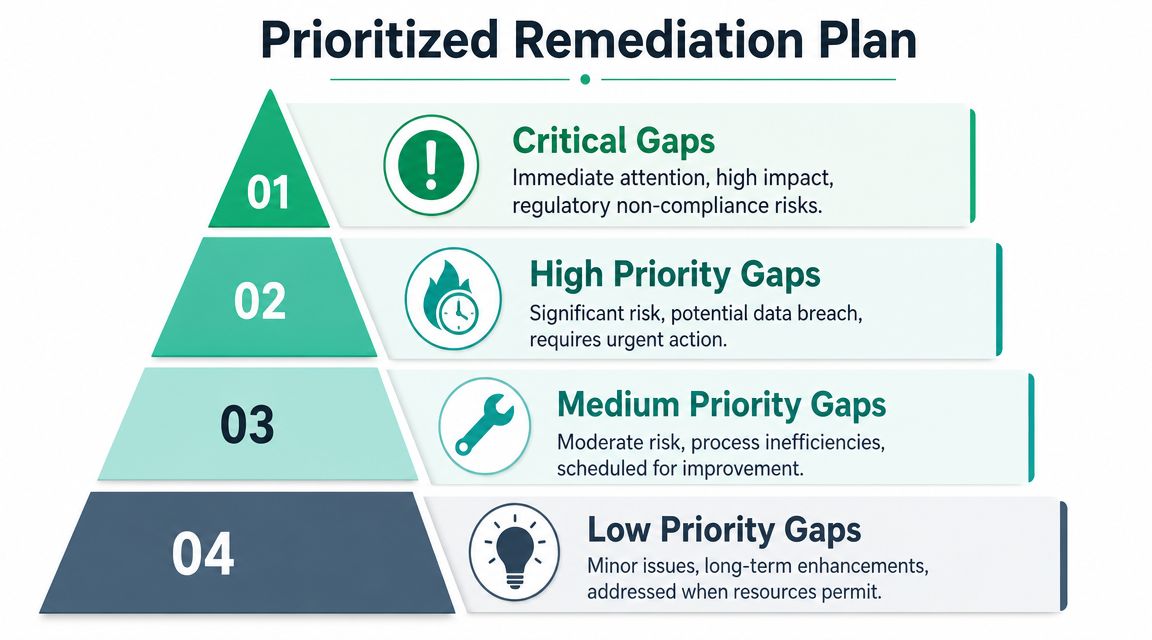
A solid audit readiness assessment should produce a short list of issues that matter most. Start with anything that affects sensitive data, privileged access, core production systems, or a major framework requirement. Those are the gaps auditors notice quickly because they show whether the company controls risk.
Ask these questions for every gap:
- Could this expose customer or regulated data
- Could an attacker exploit this in a realistic way
- Would an auditor see this as a control failure
- Can we show compensating controls if the fix takes time
If the answer is yes to any of the first three, move it up the list.
Don't let low-value work eat your sprint
A startup can lose a lot of momentum trying to polish everything at once. That's not maturity. That's poor prioritization.
I'd rather see a team close a handful of meaningful gaps with clear owners and deadlines than spread effort across a giant compliance backlog. Auditors usually respond better to a known issue with a documented remediation plan than to vague claims that everything is “in progress.”
What auditors want to see: You identified the issue, assigned an owner, tracked the fix, and know when you'll retest it.
A simple remediation tracker should include the gap, business risk, owner, target date, status, and proof of closure. Keep the language direct. “MFA not enforced for all admin accounts” is better than “identity posture enhancement opportunity.”
Push technical controls above cosmetic fixes
Founders and engineering leaders must be ruthless. If you have to choose, put technical safeguards ahead of formatting cleanup. Restrict privileged access before rewriting your policy index. Validate logging before reorganizing your file naming scheme. Test your incident response flow before making your documentation look pretty.
Here's a practical ranking model:
| Priority | Typical issue | Why it goes first |
|---|---|---|
| Critical | Missing admin MFA, broken access control, unprotected sensitive systems | High audit and security impact |
| High | Weak vendor review, incomplete incident handling, missing control ownership | Creates broad operational risk |
| Medium | Outdated policy language, inconsistent training records | Matters, but usually not the first fire |
| Low | Cosmetic document cleanup, formatting issues, duplicate notes | Clean up after the real work |
That's the mindset that saves time and money. The goal isn't to look compliant. The goal is to close the gaps an auditor and an attacker would both care about.
Validating Controls with Penetration Testing
Policies don't prove security. A penetration test does.
This is the step too many companies postpone because they assume pen testing is slow, overpriced, or only needed for enterprise buyers. That's outdated thinking. If your audit readiness assessment says your controls are in place, a pentest is how you pressure-test that claim before an auditor or customer does it for you.

Why a manual pentest matters
Automated scanners are useful, but they don't think. They flag known issues. They don't chain weaknesses together, test business logic, or validate whether access controls break under realistic attacker behavior.
That's why I push startups toward a manual pentest led by certified testers. Credentials like OSCP, CEH, and CREST matter because they signal the tester has gone beyond clicking “scan” and knows how real exploitation works. For audit readiness, that means better validation and a more credible report.
A proper penetration testing engagement should answer practical questions:
- Can an attacker reach sensitive data through the app or supporting infrastructure
- Can low-privilege access turn into admin-level impact
- Do the controls you documented block abuse
- Are the findings clear enough to remediate fast
Fast matters more than firms admit
You do not need a bloated engagement with weeks of delay just to get audit evidence.
A focused pen test for a startup web app or scoped environment can be handled quickly if the provider knows how to work lean. The report should arrive in about a week, not after your audit window has already tightened. That speed matters because technical validation only helps if you still have time to fix what it finds.
Readiness checks are commonly recommended within the past 12 months for risk assessments, with ongoing testing scheduled quarterly or monthly to keep controls current, and that cadence matters because auditors expect evidence that controls were tested repeatedly, especially around access reviews and incident response, according to IS Partners' audit readiness checklist.
Affordable doesn't mean weak
A lot of security buyers got burned by expensive firms that delivered a thin scanner report and called it a day. That's why cost alone isn't the right filter. You want depth, speed, and usable findings.
For teams securing SaaS platforms and customer-facing apps, start with thorough web application security reviews that match what auditors and customers will care about. One option is comprehensive web application security, which focuses on scoped testing for compliance-driven environments. What matters most is that the provider offers manual testing, clear remediation guidance, and a report your team can effectively use.
A good pentest report should tell your engineers what broke, how it was exploited, why it matters, and how to fix it without guesswork.
That final point matters more than most buyers realize. Your pentest is not just a security exercise. It is your final validation step before the audit. If the report is weak, late, or full of noise, it creates more work instead of reducing it.
Documenting Artifacts for a Smooth Audit
A messy evidence package wastes everyone's time.
By this point, your audit readiness assessment should have produced control mappings, artifacts, gap findings, remediation records, and a final technical validation record. If those documents are scattered across Slack, shared drives, laptops, and email threads, the audit will drag even if your controls are solid.
Build one clean evidence repository
Use a single location your team can control and search. That can be Google Drive, SharePoint, Notion, Confluence, a GRC platform, or another secure document system. The tool matters less than the structure.
Keep the top-level folders simple:
- Policies and standards
- Control mappings
- Evidence by control
- Gap analysis
- Remediation tracker
- Vendor and third-party records
- Training records
- Pentest and security validation reports
Name files like a serious company. Include the control name, system, and date. “Access_Review_Okta_Q1” is useful. “final-final-new.pdf” is not.
Make it easy for the auditor to follow
An auditor should be able to move from requirement to evidence without asking your team to translate. That means every control entry should point to the owner, related artifact, and the latest review or test record.
A basic evidence index helps a lot. It can be one sheet or one page with columns for control, owner, repository path, evidence date, and status. That's enough to keep requests from spiraling.
If the auditor has to hunt for proof, they'll start questioning whether the control is managed at all.
Package exceptions the right way
No company has a perfect environment. That's normal. What matters is whether you document exceptions clearly.
If a control isn't fully implemented yet, record the gap, temporary safeguard, owner, and remediation timeline. If a vendor is still under review, note the current risk treatment and approval path. If one system is out of step with the standard, show that you know about it and are managing it.
Use this checklist before the audit starts:
- Confirm ownership: Every artifact should have a named owner
- Check freshness: Old screenshots and stale exports create avoidable questions
- Match evidence to control: Don't bury useful proof in unrelated folders
- Include remediation history: Closed issues need proof of closure
- Separate drafts from finals: Auditors shouldn't sort your work product for you
Keep the handoff boring
That's the goal. You want the audit handoff to feel uneventful.
When the auditor asks for access reviews, you send the exact folder. When they ask how a finding was fixed, you provide the remediation record and the validating artifact. When they ask for your latest penetration testing result, you hand over the final report and any closure notes tied to the findings.
Boring wins audits. Chaos creates findings.
Pass Your Audit Without the Headache
Most audit pain is self-inflicted. Teams wait too long, scope too broadly, collect weak evidence, and treat the pentest like an optional add-on instead of the final proof step.
A lean audit readiness assessment fixes that. You define what matters, map controls to real operations, gather proof early, remediate by risk, and validate the result with a fast pen test or penetration test. That turns the audit from a stressful event into a managed project.
Founders and security leads should think about this as time protection. Every vague control, missing artifact, and late remediation task steals time from engineering, customer work, and roadmap delivery. If your team is already buried under release pressure, this resource on tackling engineering compliance deadlines is worth reading because it lines up with the same practical reality. Compliance work has to fit real operating constraints.
The right approach is straightforward:
- Keep scope tight: Only include systems and processes that belong
- Collect proof early: Documentation gathered late is always messier
- Fix high-risk gaps first: Don't let cosmetic work consume the budget
- Use a real pentest: Manual testing gives you stronger validation than scanner noise
- Organize everything: Auditors move faster when your evidence package is clean
If you do those five things, you'll walk into the audit with fewer surprises, fewer scramble meetings, and fewer expensive last-minute fixes. That's the whole point. Pass the audit without turning the process into a second full-time job.
If you need the final validation step handled quickly, Affordable Pentesting offers manual penetration testing for compliance-focused teams that need clear findings, audit-ready reporting, and a fast quote through the contact form.