.svg)
Your auditor wants proof. Your customer wants reassurance. Your team wants this off their plate before it turns into another month of meetings, scanner screenshots, and overpriced PDF reports.
That's why so many founders and IT leaders end up shopping for cyber security assessment services when they're already under pressure. The problem isn't just security. It's time, cost, and figuring out what you need so you can pass the audit without buying a bloated project.
Why Security Assessments Feel So Complicated
You're probably in one of two situations. You've got a SOC 2, PCI DSS, HIPAA, or ISO 27001 requirement staring at you, or a big customer just asked for a pen test report and gave you a deadline that feels insulting. Then the quotes come in, and suddenly a basic assessment looks like a consulting engagement with endless calls, vague scope, and a delivery date that misses your audit window.

Big firms make this sound harder than it is. Yes, security work takes skill. No, that doesn't mean every company needs a giant strategy engagement before someone can test a web app, validate controls, and hand over an audit-ready report.
Why companies buy outside help
A lot of teams don't have the people for this. A 2026 cybersecurity outlook found that 45% of businesses face a shortage of cybersecurity skills and expertise, which helps explain why companies buy external assessment services instead of trying to build everything in-house, according to Wise Guy Reports market research.
That shortage creates a predictable mess for startups and SMBs. The founder assumes the IT lead can handle it. The IT lead assumes the MSP can help. The MSP runs a scan, sends a spreadsheet, and everyone realizes the auditor wanted something more defensible.
Practical rule: If your audit or customer request asks for evidence that controls were tested, a generic scan usually won't be enough.
What these services are really for
Cyber security assessment services aren't just about finding bugs. They help you answer basic business questions fast. What's exposed, what matters most, what must be fixed first, and what report will satisfy an auditor or buyer.
That's the part too many vendors ignore. You don't need a lecture on threat models when your real problem is getting usable evidence, fixing the obvious issues, and moving on.
The good news is that this stuff gets simpler once you separate the types of assessments and match them to the reason you're buying one.
The Four Main Types of Security Assessments
Think of this like inspecting a building. One person checks for broken windows. Another tests whether the front door can be forced open. Another reviews fire risk and emergency plans. Another confirms the paperwork matches the rules. Security assessments work the same way.
The confusion starts when vendors blur all of these together and sell everything as if it's one service. It isn't. Different assessments answer different questions.
Security assessment services at a glance
| Assessment Type | Primary Goal | Method | Best For |
|---|---|---|---|
| Penetration testing | Prove whether an attacker can exploit real weaknesses | A human tester actively tries to break in and chain findings together | SOC 2 evidence, PCI DSS needs, customer security reviews |
| Vulnerability assessment | Find known security issues quickly | Automated tools identify missing patches, weak settings, and exposed services | Ongoing hygiene checks and broad technical visibility |
| Risk assessment | Decide what matters most to the business | Reviews systems, threats, likelihood, and impact in business terms | Leadership planning, HIPAA risk work, prioritization |
| Compliance assessment | Check alignment with a framework | Compares policies, controls, and evidence against standards | SOC 2 readiness, ISO 27001 readiness, internal audit prep |
What each one actually does
A vulnerability assessment is fast and useful, but it mostly tells you what tools can detect. It's good for finding known issues. It's not the same as proving whether those issues can be exploited in your environment.
A penetration test goes further. A real tester pokes at your login flows, APIs, roles, permissions, cloud setup, and business logic to see what an attacker could do. That's why a pen test carries more weight with auditors and customers.
A risk assessment matters when you need business context. It helps you decide whether the weak admin account in an internal system matters more or less than a flaw in your customer portal. If you're dealing with regulated data, this is often part of the story.
A compliance assessment focuses on the rulebook. It asks whether your controls, documentation, and evidence line up with what the framework expects.
A lot of startups buy the wrong thing because the vendor never asks the obvious first question. “What problem are you trying to solve?”
The fastest way to choose
Use this shortcut:
- Need proof for an auditor or enterprise buyer: Start with a penetration test.
- Need a broad technical inventory of issues: Get a vulnerability assessment.
- Need to justify priorities to leadership: Ask for a risk assessment.
- Need to prepare for a framework review: Use a compliance assessment.
If someone tries to sell you all four without tying each one to a business need, slow down. That usually means you're buying their process, not your outcome.
A Deeper Look at Penetration Testing
If you only remember one thing, remember this. A pentest is not just a scanner report with a nicer cover.
A real penetration test means a human is trying to think like an attacker. They test what happens when roles are misapplied, when account recovery flows are weak, when APIs trust the wrong input, or when one low-risk issue can be chained into a serious one. That's why pen testing still matters even when companies run lots of automated tools.
Why manual testing matters
Modern security platforms can watch a huge amount of telemetry. Bitsight says it monitors more than 40 million entities and analyzes 540 billion+ cyber events in its data lake, which shows how much cyber security assessment services have shifted toward continuous monitoring at scale, according to the Bitsight glossary on cyber security assessments. That's useful for broad visibility.
But broad visibility isn't the same as audit evidence. For a focused compliance need like SOC 2, a manual penetration test gives auditors what they usually care about most. Clear scope, real testing, documented findings, and direct remediation steps.
What good pen testing finds
Automated tools are good at catching the obvious. Humans find the ugly stuff that causes real damage.
Examples include:
- Broken access control: A regular user can see or modify another customer's data.
- Business logic flaws: A checkout, approval, or reset flow works exactly as coded but still creates a security hole.
- Authentication mistakes: Session handling, password reset paths, and role enforcement break under realistic abuse.
- Chained weaknesses: Several moderate issues combine into a serious breach path.
If your product is customer-facing, focused application work matters most. Teams that want a simple overview of web app security for startups should start there before they waste time on generic infrastructure testing that doesn't address the actual audit question.
Who should perform the test
Credentials matter because they tell you whether a tester has been pushed through difficult practical work. Ask whether the team includes OSCP, CEH, or CREST certified pentesters. Then ask a better question. Will certified humans do the testing, or will junior staff run tools and escalate only if something looks interesting?
That second question saves people a lot of money.
If you want a plain-English explanation of what a practical testing process should include, this guide to protecting business IT is a useful reference. Keep it simple. You want real human testing, clear findings, and a report your auditor can use.
Matching Assessments to Your Compliance Needs
Compliance gets easier when you stop treating every framework like a mystery. Most of the time, the answer is straightforward. You need the assessment that proves the control was checked in a way your auditor or customer will respect.
What to ask for by framework
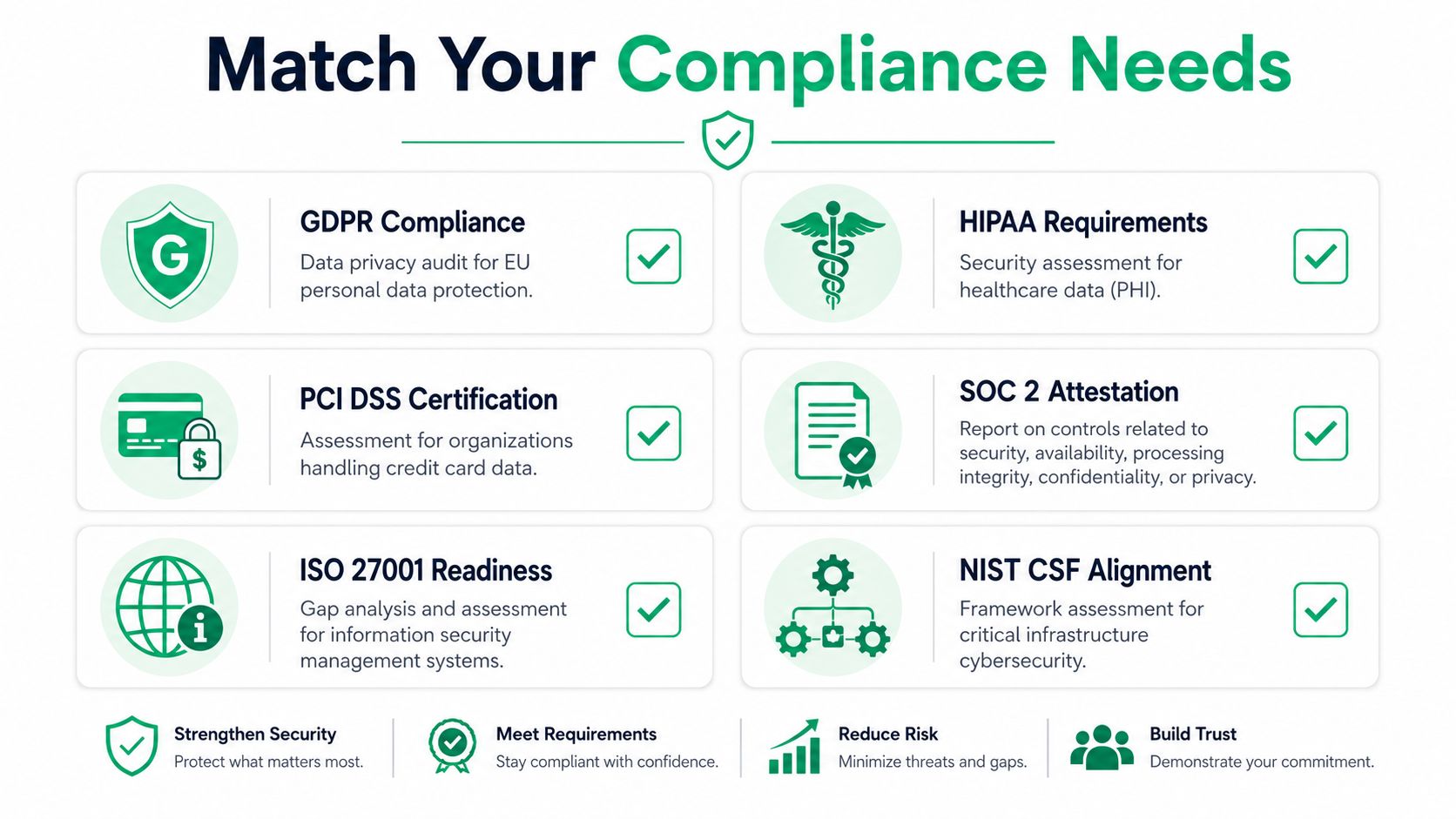
For SOC 2, ask for a manual penetration test and a report that maps findings to systems in scope. Auditors usually want to see that your technical controls were tested by someone other than your internal team. If your environment includes a customer-facing application, make sure that app is explicitly in scope. If you're comparing providers, Affordable Pentesting's SOC 2 offerings show the sort of scoped service companies typically look for.
For PCI DSS, don't overcomplicate it. If cardholder data is involved, penetration testing is a standard expectation. You may also need supporting vulnerability scanning, but don't confuse that with the pen test itself.
For HIPAA, the smart move is usually a mix. Start with a risk assessment so you can show that you evaluated where protected health information is exposed. Then use penetration testing where internet-facing systems, patient portals, APIs, or cloud apps create real attack surface.
The common mistake
A lot of teams ask their MSP for a scan and call it done. That creates a paper trail, but not always the right one. Auditors and enterprise buyers often want evidence that someone validated whether your controls held up under testing.
If the requirement is tied to trust, not just hygiene, default to a penetration test.
Keep the scope tight
You don't need to test every system you own just because you're under audit. You need to test the systems that matter to the framework and the data in scope.
Use these quick filters:
- Customer-facing apps: Usually in scope for SOC 2 and often critical for buyer reviews.
- Payment workflows: Priority for PCI DSS.
- PHI systems and related integrations: Priority for HIPAA.
- Core control environment: Important for ISO 27001 readiness and broader governance reviews.
- Framework alignment work: Useful if you're working against NIST CSF or trying to clean up before a formal audit.
The right assessment is the one your auditor accepts and your team can act on immediately.
What a Good Assessment Report Looks Like
A bad report is long, messy, and written to impress other consultants. A good report helps three people at once. Leadership needs a clear summary, engineers need proof and fix guidance, and auditors need evidence.
If your report can't do all three, it's not done.
The parts that matter
Start with the executive summary. This should explain scope, what was tested, the overall risk picture, and what needs attention first. Your CEO or founder should be able to read it in a few minutes and understand whether the company has a real problem.
Then comes the technical findings, which include screenshots, reproduction steps, affected assets, and risk explanations. Good findings are specific. They show what the tester did, what happened, and why it matters.
The most neglected part is remediation guidance. Your developers shouldn't have to translate consultant language into action. The fix section should tell them what to change, where to look, and what to verify after the patch.
What auditors want: a dated report, defined scope, clear methodology, documented findings, and evidence that fixes were validated when needed.
What makes a report usable
A useful report usually includes these elements:
- Plain-English summary: So leadership can make decisions without decoding jargon.
- Evidence for each issue: Screenshots or concise proof that the finding is real.
- Severity that makes sense: Not every bug is a crisis.
- Fix instructions: Clear enough that engineering can act without a second engagement.
- Retest results: Proof that the issue was resolved after remediation.
This is also where speed matters. If a vendor needs weeks after testing just to write the report, you're paying for their bottleneck. For audit work, you want a process that moves from kickoff to final report fast, ideally within about a week, and includes retesting so you don't have to reopen the whole project just to prove fixes were made.
Red flags in deliverables
Watch for these problems:
- Scanner dump formatting: Hundreds of lines, little context, almost no human analysis.
- No reproduction details: Your engineers can't verify or fix the issue easily.
- No business context: Leadership can't prioritize.
- No retesting path: You fix issues, then scramble to prove it later.
The report is the product. Don't let anyone treat it like paperwork.
Choosing an Affordable Pentesting Partner
You do not need a famous logo on the proposal. You need a provider who can start quickly, test thoroughly, and deliver a report your auditor accepts.
That means looking past polished sales decks and asking operational questions. How fast can they quote. How soon can they start. Who performs the pen test. What does the report include. Will they retest fixes.

What to check before you sign
Use this buyer checklist:
- Scope clarity: They should define exactly what's in scope, including apps, APIs, cloud assets, and authenticated areas.
- Human testers: Ask whether certified testers with OSCP, CEH, or CREST credentials do the manual work.
- Fast scheduling: You shouldn't wait forever just to begin.
- Report turnaround: If they can't explain when you'll get a draft and final report, expect delays.
- Retesting policy: You want a simple way to validate fixes without buying another full engagement.
- Pricing transparency: If pricing is vague until after several calls, expect surprises.
For a practical framework on comparing vendors, review these Vendor Evaluation Criteria before you commit.
Cheap and affordable are not the same
The wrong low-cost provider gives you almost nothing. The wrong enterprise provider gives you too much process and not enough urgency. You want the middle ground. Manual penetration testing with enough depth to find real issues, but without layers of account managers and consultant theater.
That's why transparent pricing matters. A lot of SMBs and startups are specifically looking for clear options, quick kickoff, and reports in about a week. In this market, some providers position around pricing starting from $5,000, fast scheduling, and a defined retest process. That model fits companies that need compliance evidence without wasting budget on overhead.
One example is Affordable Pentesting, which offers manual penetration testing and compliance-focused assessments for organizations dealing with SOC 2, PCI DSS, HIPAA, ISO 27001, and similar requirements.
A good provider respects your deadline. A bad provider explains why their process matters more than your audit date.
The right questions to ask on the first call
Ask these and write down the answers:
- Who does the actual penetration testing?
- Is this a manual pen test, an automated scan, or both?
- What credentials do the testers hold?
- When do we get the draft report?
- Is retesting included?
- Have you handled this compliance use case before?
If the answers are slippery, move on.
Frequently Asked Questions From SMBs
Is a vulnerability scan enough for my audit
Usually not. A scan finds known issues. A penetration test shows whether a person could exploit weaknesses in the systems that matter to your audit or customer review. If the request asks for a pen test report, give them a pen test report.
What if the testers don't find anything
That's fine. Seriously.
A clean result still gives you evidence that the environment was tested, the scope was covered, and no exploitable issues were identified during the engagement. Auditors and customers care about diligence and documentation, not just a dramatic findings list.
How long does a pen test actually take
The testing window depends on scope, but for SMB and startup environments, the process should be built for speed. A focused provider can often kick off quickly and get you a usable report in about a week. That's what most stressed buyers require.
Will manual pen testing disrupt production
A professional team scopes carefully and communicates what they're doing. The goal is to test safely, not take your system offline. You should still ask about test windows, rules of engagement, and whether anything high-risk will be excluded or coordinated in advance.
Do I need a network test or a web app test
Depends on what your auditor or customer cares about. If your product is a SaaS platform or customer portal, the web application is often the priority. If you're worried about internal exposure, segmentation, or external infrastructure, a network-focused assessment may make more sense.
Why are quotes so different between vendors
Because some firms sell process, not just testing. You pay for layers of meetings, project management, brand overhead, and generic deliverables. Others keep the scope tighter and focus on the actual job: perform the pen test, document the findings, support remediation, and help you close the audit gap.
Should I wait until after the audit prep is finished
No. Book the assessment early enough that you have time to fix issues and get retesting if needed. Waiting creates the worst possible timeline. You end up negotiating scope while your auditor is already asking for evidence.
If you need a fast, audit-ready penetration test without the bloated consulting experience, talk to Affordable Pentesting through their contact form. Keep the scope tight, get real manual testing from certified pentesters, and get the report you need while there's still time to fix what matters.