.svg)
Your audit date is close. You need a pentest, a pen test, or full penetration testing done fast, and the quotes coming in look ridiculous. One vendor wants weeks just to start, another sends a glossy proposal with vague language, and a third promises “full coverage” but can't tell you when the report will land.
That's where solid vendor evaluation criteria stop being procurement busywork and start saving you money. If you evaluate pentesting vendors the right way, you avoid the classic mess: slow delivery, inflated pricing, shallow findings, and reports that make auditors happy for five minutes and your engineering team miserable for two weeks.
Why Vendor Evaluation Matters for Security
Your audit date is close, engineering is already stretched, and the pentest quote in front of you looks cheap until you read the fine print. Start date is vague. Retesting costs extra. The report timeline is "after fieldwork." That is how teams end up paying premium rates for a slow engagement that creates more work than it removes.
Vendor evaluation is security work. It decides whether you get a pentest that clears compliance, gives engineers clear fixes, and lands on time, or whether you get a bloated project full of delays, change orders, and recycled scanner output.
For a simple legal refresher on why structured review matters before signing with any provider, this essential guide to due diligence is worth a look. The same standard applies to pentesting. Check the vendor before the contract checks you.
What goes wrong without a process
The problem usually is not "we skipped testing." The problem is "we bought the wrong testing."
- Poor fit: The firm is built for enterprise procurement cycles, not fast-moving teams that need a usable report this month.
- Slow delivery: Scoping drags, kickoff slips, and the final report arrives after your audit window.
- Weak output: Findings are vague, severity is inconsistent, and developers have to translate the report before they can fix anything.
- Hidden cost: The quote excludes retests, extra assets, report revisions, or basic support after delivery.
Practical rule: If a vendor cannot explain scope, timeline, reporting, and retest terms in plain English, do not buy from them.
Traditional procurement models can still help, but only if you keep them tight. A short scorecard forces key questions to the surface. Can this firm start fast? Is the price clear? Will the report help your team act? If you stuff the evaluation with generic procurement criteria, you hide the decision instead of improving it.
If third-party risk is part of your process, this Fast vendor risk assessment breakdown is useful. It frames security review as an operational decision, not a paperwork exercise.
Core Criteria for Selecting Pentesting Vendors
A pentest vendor can look polished on the website, sound sharp on the sales call, and still waste your month. The criteria that matter are the ones that tell you three things fast. Can they start soon, can they price the job clearly, and will the report help your team fix real issues without a translator.
Focus on a small scorecard
Keep the scorecard short enough to force a decision. If you load it up with generic procurement items, weak vendors can hide behind paperwork, references, and polished proposals.
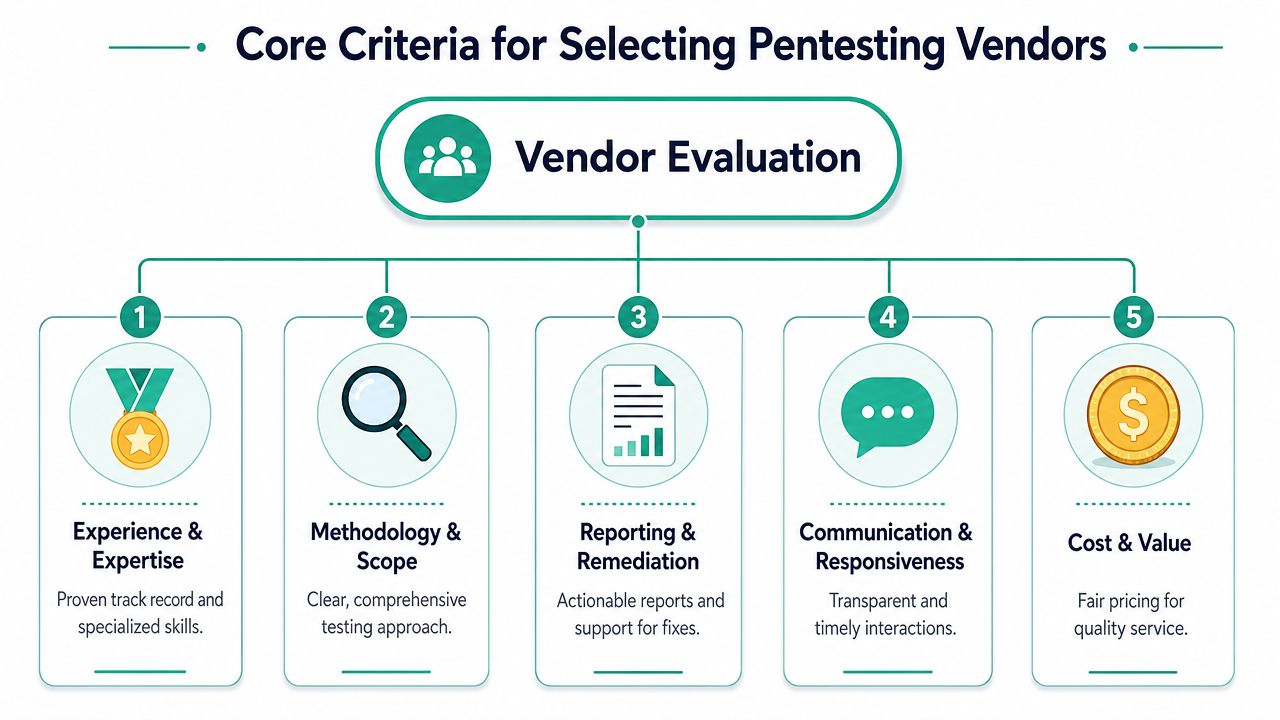
For pentest, pen testing, and penetration testing vendors, score these five areas first:
- Tester credibility: Ask who is doing the work, not just which company won the deal. Named testers, relevant certs such as OSCP, CEH, and CREST, and recent hands-on experience matter.
- Method and scope clarity: The vendor should define what is in scope, what is excluded, how testing will be performed, and what assumptions they are making.
- Report quality: The report should be clear enough for engineers to act on and clean enough for auditors to accept without back-and-forth.
- Delivery speed: Fast scheduling and fast reporting matter if you have an audit window, release deadline, or board commitment.
- Total price: Evaluate the full cost, including retests, rescans, report revisions, support, and any charges tied to asset count or scope changes.
The practical meaning of each criterion
Technical expertise means the testers can find issues that scanners miss and explain why they matter. A firm that refuses to name the testers or explain its testing method is selling a black box. Skip it.
Deliverable quality means the output saves your team time. Good reports include proof of issue, clear severity, affected assets, practical remediation steps, and an executive summary that does not bury the risk in filler.
Speed means more than getting on the calendar. It includes fast scoping, a firm kickoff date, clear communication during the test, and a report that lands while the findings still matter.
One late pentest can break the whole buying decision.
Price means total cost against usable output. Expensive does not mean thorough. Cheap does not mean efficient. The right vendor gives you a clear quote, clear inclusions, and work product that your developers and compliance team can use immediately.
If you're trying to streamline vendor management processes across multiple providers, keep pentesting in its own category. Security testing vendors affect risk decisions, compliance evidence, and remediation workload. They deserve stricter review than ordinary software suppliers.
For a more focused guide to choosing a pentesting partner, compare vendors on turnaround time, reporting quality, and retest terms before you pay for brand name or sales polish.
How to Weight and Score Each Criterion
A vendor scorecard without weights is just organized guessing. If every criterion counts the same, you end up rewarding things that don't move your security program forward.
For pentesting vendors, I don't recommend the old habit of overweighting brand name, office count, or company age. Those factors help the seller justify price. They don't help you get a useful report faster.
Start with priorities, not prestige
Vendor evaluation has expanded beyond price to include security, compliance, and resilience, and some modern RFP models use explicit weights such as technical expertise 25%, capabilities 40%, and data security 10%, as described in this supplier evaluation overview. That matters because pentesting is a risk decision, not just a purchasing decision.
Use that logic, then adapt it to your real need. If you need a compliance pentest quickly, delivery speed and report quality should carry serious weight. If you need a complex application assessment, tester quality and scope depth should dominate.
A scoring model that stays practical
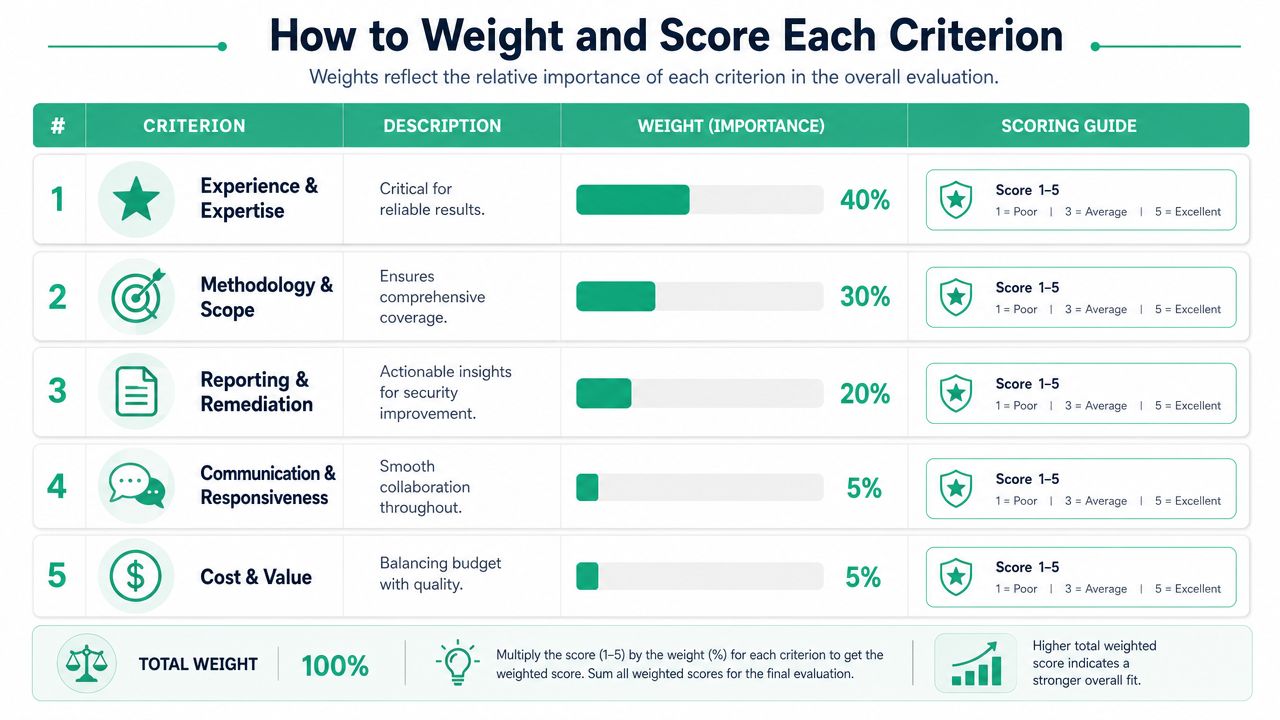
Use a 1 to 5 score for each criterion. Keep the descriptions simple.
| Score | Meaning |
|---|---|
| 1 | Poor fit |
| 2 | Weak |
| 3 | Acceptable |
| 4 | Strong |
| 5 | Excellent |
Then assign weights based on your priorities. Don't copy a generic procurement template. Build one that reflects the job.
Here's a practical model for many compliance-driven buyers:
- Tester skill and certifications: high weight
- Scope and methodology clarity: high weight
- Report quality and remediation support: high weight
- Turnaround speed: high weight
- Total commercial value: medium to high weight
Leave vanity criteria with little or no weight. Fancy branding, oversized sales teams, and polished proposal design don't deserve points.
A vendor that talks well but can't commit to timeline, scope, or retest terms is not a strong vendor. It's a sales process.
How to make the score useful
Score each vendor right after the sales call while details are fresh. Then compare totals, but also look at hard weaknesses. A vendor with the highest total can still be a bad choice if one core area is shaky.
Use weighting to force honesty. If speed matters to your audit deadline, weight speed heavily. If affordability matters to your budget, give price real influence. Don't act like those are secondary if they're driving the purchase.
The point isn't mathematical perfection. The point is to stop choosing pentest providers based on vague confidence and polished marketing.
A Simple Vendor Evaluation Checklist
Most buying teams make one of two mistakes. They either overcomplicate the review or skip structure entirely. Both lead to bad choices.
Use two lanes instead. First, define what must be true before a vendor even qualifies. Then score the vendors that survive. That's the cleanest way to evaluate pentest vendors without letting a smooth demo cover up a deal-breaker.
A rigorous evaluation process should separate pass/fail qualification criteria from scored differentiation criteria, so a vendor with attractive features can't make up for missing a mandatory requirement. That's the core recommendation in this weighted scoring approach.
Pass fail items first
These are your essential requirements. If a vendor fails one, stop there.
- Clear scope exists: The statement of work should define assets, apps, environments, and test type.
- Manual testing is included: If they rely mainly on automation but call it manual pentesting, that's a problem.
- Report format is audit-ready: You should know what the final deliverable includes.
- Retest terms are written down: Don't assume this is included.
- Timeline is committed in writing: Not “estimated.” Committed.
- Budget fits: If the quote already breaks the ceiling, don't spend another week discussing it.
Then score the differentiators
After the hard filters, compare the remaining vendors on what separates good from better.
| Criterion | Pass/Fail? | Weight (1-5) | Vendor A Score (1-5) | Vendor B Score (1-5) | Notes |
|---|---|---|---|---|---|
| Scope clearly defined | Yes | 5 | |||
| Manual testing included | Yes | 5 | |||
| Final report timeline committed | Yes | 5 | |||
| Retest terms included | Yes | 4 | |||
| Budget within range | Yes | 5 | |||
| Tester certifications such as OSCP, CEH, CREST | No | 4 | |||
| Report clarity and remediation quality | No | 5 | |||
| Responsiveness during scoping | No | 3 | |||
| Communication quality | No | 3 | |||
| Overall commercial value | No | 4 |
Keep the notes brutally honest
The notes column is where the truth lives. Write down what they dodged, what they explained well, and what sounded scripted.
Good notes sound like this:
- Strong answer: Named senior tester, clear retest policy, report date provided.
- Weak answer: Sales rep couldn't explain test depth, no sample report, timeline sounded soft.
- Concern: Price looked low until exclusions came up.
If a vendor fails a must-have and you keep them in the running anyway, your scorecard is fake.
This checklist works because it respects how people buy security services. You don't need elegance. You need a short process that blocks bad vendors fast and makes the remaining choice obvious.
Important Interview Questions for Pentest Vendors
The interview matters more than the website. Any vendor can publish claims about expertise, methodology, and responsiveness. The live answers tell you whether they can deliver.
Ask direct questions. Don't ask “tell me about your approach.” That's an invitation for a rehearsed speech. Ask questions that force specifics.

Questions that expose the real vendor
Use these in your first call or proposal review.
Who will perform the pentest?
Good answer: they name the role, seniority, and relevant certifications like OSCP, CEH, or CREST.
Red flag: “Our team is highly qualified” with no specifics.Is the work primarily manual or mainly automated?
Good answer: they explain where automation helps and where human testing performs the core work.
Red flag: lots of tooling talk, little mention of analyst judgment.What exactly is included in scope?
Good answer: apps, APIs, external assets, authenticated testing, exclusions, and assumptions are clearly listed.
Red flag: “We'll finalize that later.”When will we receive the final report?
Good answer: a clear delivery date or a tight written turnaround commitment.
Red flag: “It depends.”
Questions that uncover hidden cost
These questions save more money than negotiation usually does.
- Is a retest included after remediation?
- Are there extra charges for revised reports?
- Do you bill differently if the app has more endpoints than expected?
- Does project management or kickoff time add to the cost?
- Will we pay more if we need an attestation letter for auditors?
A trustworthy vendor answers those cleanly. A slippery vendor says pricing is “flexible” or “case by case” without giving boundaries.
Questions about report usefulness
A pentest report should help your developers fix things and help your auditor verify the control.
Ask these:
- Can you show a redacted sample report?
- How do you prioritize findings?
- Will the report include remediation guidance in plain English?
- Can our team ask follow-up questions after delivery?
A strong vendor doesn't just find issues. They explain them in a way your engineers can use without needing a translator.
Good answers are concrete. They mention evidence, business impact, and remediation notes. Weak answers drift into generalities like “our reporting is complete.”
If the vendor gets vague under pressure, believe that version of them.
Red Flags and Contract Gotchas to Watch For
Most pentest buying mistakes aren't technical. They're contractual. Teams sign a statement of work that sounds fine, then learn too late that the scope is thin, the report date is loose, and the “manual test” was mostly scanner output.
Read the contract like someone who's had to clean up after a bad vendor before. Because eventually, you probably will.
Red flags that deserve a hard no
The biggest danger area is security evidence. Many vendor evaluation guides say to check compliance, but they don't explain how to verify whether a vendor's SOC 2 report, policies, or control evidence fit your risk profile and audit needs. That gap is called out in this vendor evaluation analysis, and it's exactly where sloppy buying creates audit pain later.
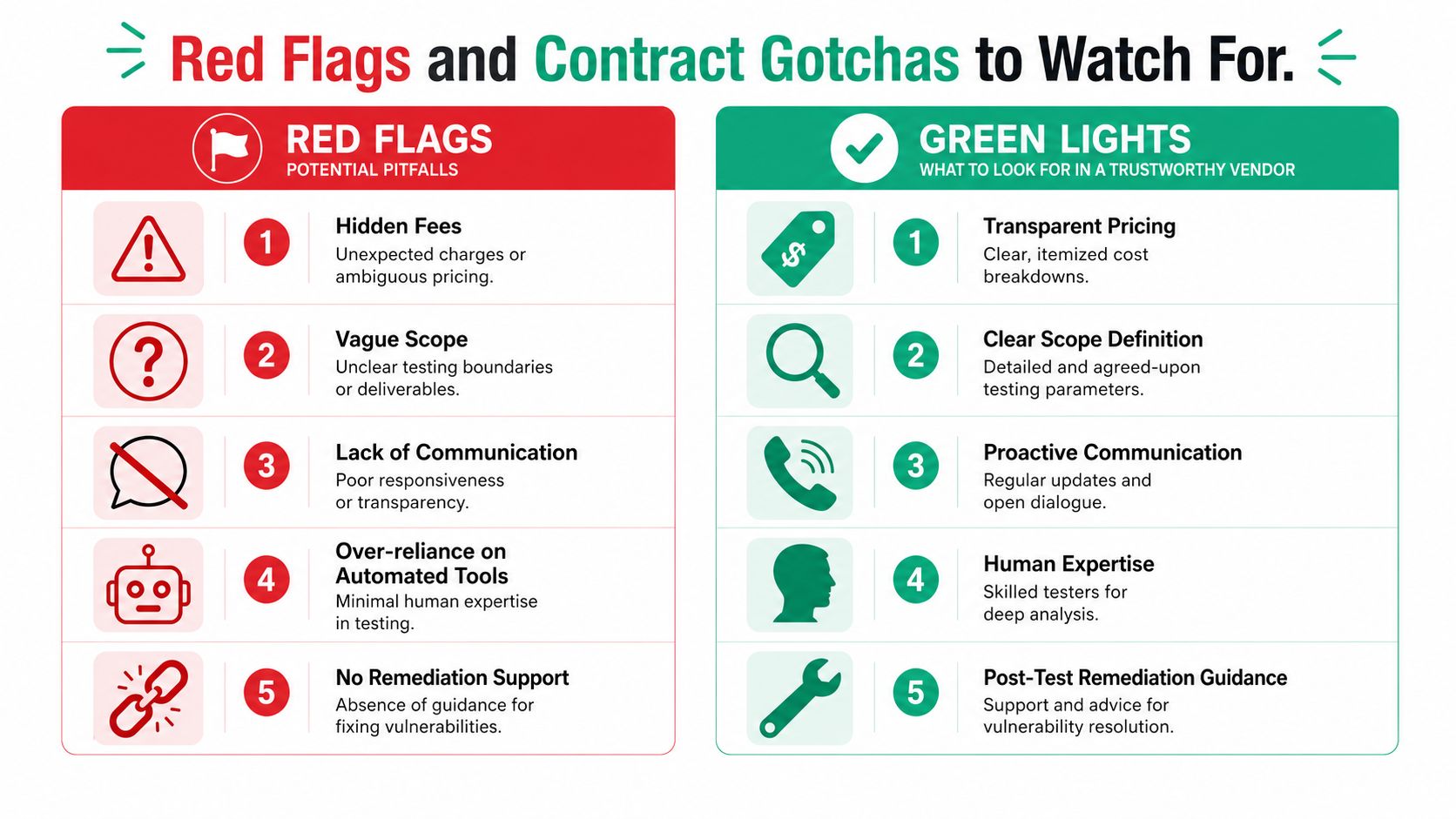
Watch for these contract problems:
- Vague report timing: If the contract doesn't state when the final report arrives, expect drift.
- Hidden retest fees: Some vendors quote the test low, then charge extra after you fix findings.
- Loose scope language: If “reasonable effort” is doing all the work, you don't really know what you're buying.
- Tool-heavy delivery sold as manual testing: Automation is useful. Passing off automation as deep manual penetration testing is not.
- No named support after delivery: If nobody owns post-report questions, your team gets stuck.
Green lights worth paying attention to
Strong vendors don't need mystery language.
Look for:
- Written timeline commitments
- Transparent pricing with inclusions and exclusions
- Clear scope boundaries
- Defined retest terms
- A redacted sample report before signature
- Plain-English explanations of evidence and compliance support
Contracts tell you whether the vendor plans to deliver cleanly or argue later.
One more warning. A long sales cycle can be a red flag by itself. If it takes multiple calls to get a straightforward quote for a straightforward pentest, the delivery phase probably won't get faster. Slow buying often predicts slow execution.
Choose a Pentesting Partner That Moves Fast
Good vendor evaluation criteria do one thing well. They stop you from paying enterprise-firm prices for sluggish work and weak results.
Keep your review simple. Filter vendors on hard requirements first. Score the survivors on tester quality, scope clarity, report usefulness, speed, and total price. If a vendor can't answer direct questions, won't commit to timing, or hides core terms in the contract, move on.
A pentest shouldn't become a quarter-long procurement saga. It should be a focused engagement that gives you useful findings, a clear report, and a path to compliance without wasting budget. If you're buying for a web app, cloud environment, or startup stack, this overview of affordable SaaS pentesting is a practical next step.
Choose the vendor that helps you finish the job, not the one that just sells the best story.
If you need a fast, affordable pentest from certified professionals, Affordable Pentesting is built for exactly that. Their team helps startups and growing companies get penetration testing and compliance support without the bloated timelines and inflated pricing that frustrate so many buyers. Use the contact form to get a quote and move your audit forward.