.svg)
Most advice about external pentesting is wrong.
You don't need a bloated enterprise engagement, a month-long timeline, and a report padded with scanner noise. You need a real external network penetration test that checks what attackers can reach from the internet, proves impact safely, and gives you an audit-ready report fast enough to be useful.
If you're an IT manager, CISO, compliance lead, or founder, the priority is simple. Get a pen test that finds real issues, explains them in plain English, and doesn't torch your budget.
Why Traditional External Pentesting Is Broken
A lot of traditional penetration testing firms still sell external pentests like it's 2014. Long sales cycles. Slow scheduling. Expensive scopes. Reports that arrive after your audit deadline and tell you things your scanner already knew.
That model fails startups and SMBs.
You're usually trying to solve a very practical problem. A customer asked for a penetration test. A SOC 2 auditor wants evidence. A board member wants confidence that your public-facing systems aren't exposed. In those moments, waiting weeks just to start the test is absurd.
Slow process bad outcomes
The biggest firms often carry heavy overhead. You pay for layers of account management, process meetings, internal handoffs, and polished slide decks. What you actually need is a certified pentester doing focused manual work against your internet-facing environment.
That's why so many companies end up frustrated with a pen testing engagement that feels expensive and vague.
- Too much ceremony: Endless kickoff calls don't improve security.
- Too little testing: Some providers lean too hard on automated scans and call it penetration testing.
- Too much delay: If the report lands long after remediation windows or audit milestones, it loses value.
- Too little clarity: A giant PDF stuffed with jargon doesn't help your IT team fix anything.
Practical rule: If a provider can't explain how they manually validate findings, you're probably buying a scan, not a pentest.
Expensive doesn't mean better
High price is not proof of quality. In external network penetration testing, quality comes from scoped manual testing, clear rules of engagement, experienced operators, and a report your team can act on immediately.
That's especially true for companies with a manageable external attack surface. If you have a defined set of public assets, there's no reason the process has to drag. A disciplined team can move quickly without being sloppy.
A good external penetration test should feel focused. You agree on the scope, authorize the work, test the exposed assets, document real findings, and get the report back fast. Then you fix the issues and retest if needed.
That's the standard more buyers should demand. Not prestige pricing. Not theater. Just a solid pentest, done properly, on a timeline that matches how modern companies operate.
Understanding External Network Penetration Tests
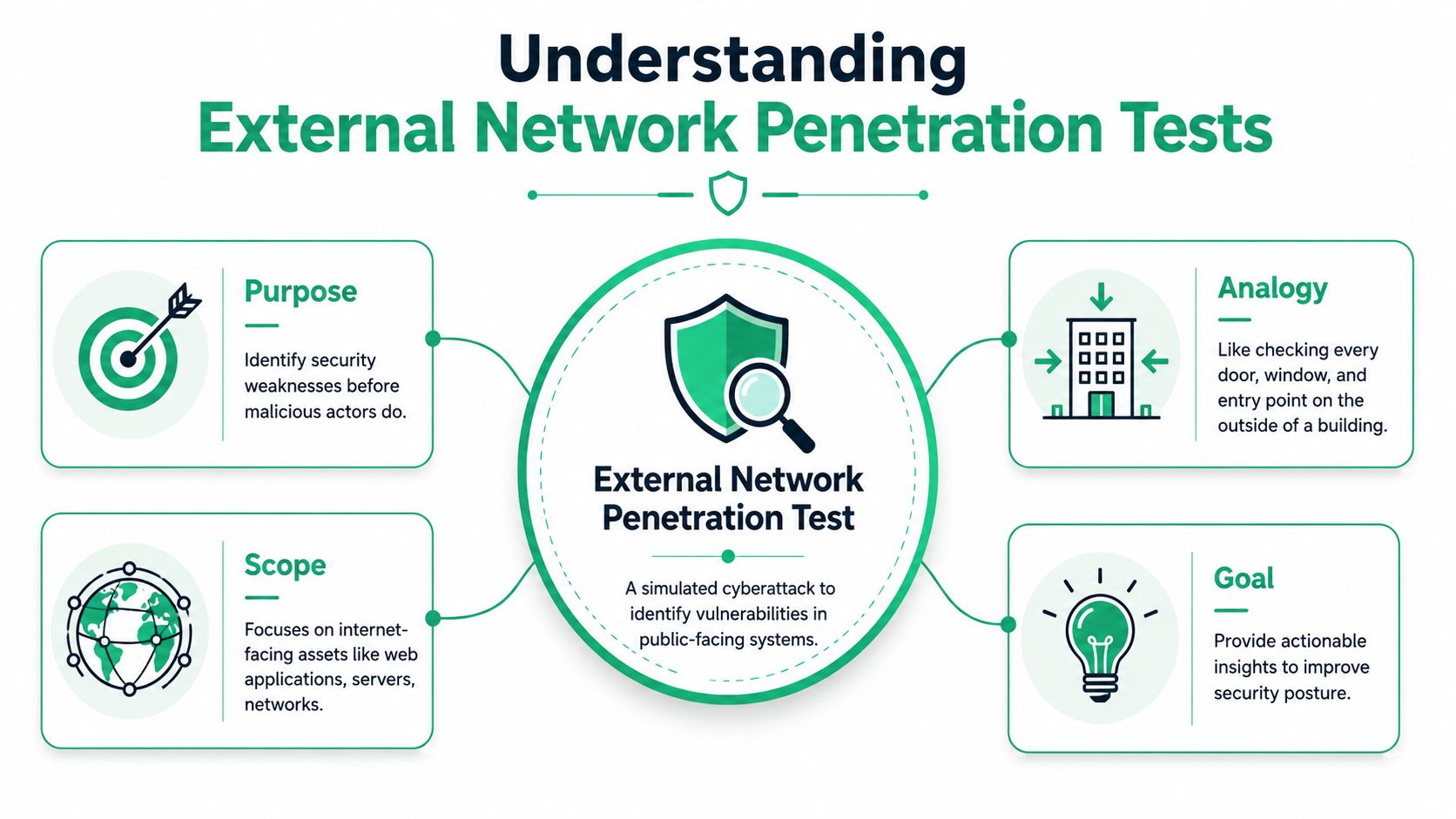
An external network penetration test is simple to understand if you picture a building. The tester walks around the outside and checks every door, window, gate, and loading dock to see what's exposed and what opens when it shouldn't.
That's how black-box external pentesting works. The tester starts with little to no internal knowledge and attacks only what a real outsider could see from the internet. According to Schellman's explanation of external pentesting, this approach measures how well your perimeter controls hold up under realistic attacker conditions.
What sits in scope
This usually includes the systems and services an outsider can reach. Think websites, login portals, firewalls, VPN gateways, email interfaces, public APIs, and other internet-facing hosts.
If your team also manages connectivity and edge infrastructure, solid operational support matters too. For companies that need help keeping the perimeter stable before or after a pen test, Nerds 2 You network services is a useful example of the kind of network support partner that can help clean up the basics.
A proper provider should also make the scope easy to understand. If you want a plain-language view of what gets tested, these external security testing services outline the kind of assets typically reviewed during an outside-in assessment.
What the test is trying to prove
The goal isn't chaos. It's evidence.
A good penetration test answers questions like these:
- Can an outsider discover exposed systems
- Can they identify weak services or bad configurations
- Can they bypass login protections or abuse access controls
- Can they reach sensitive data or gain unauthorized access
Some buyers think a pen test is supposed to “hack everything.” That's not the point. The point is to show whether an attacker has a viable path in, and how serious that path becomes if nobody fixes it.
The best external pentest reports don't just list weaknesses. They show which ones are reachable, usable, and worth fixing first.
That's why manual validation matters. A scanner can flag a possible issue. A skilled tester confirms whether it's real, whether it's exploitable, and whether it creates meaningful business risk.
Defining Your Pentest Scope and Methodology
A good external pen test starts with rules. Not tools.
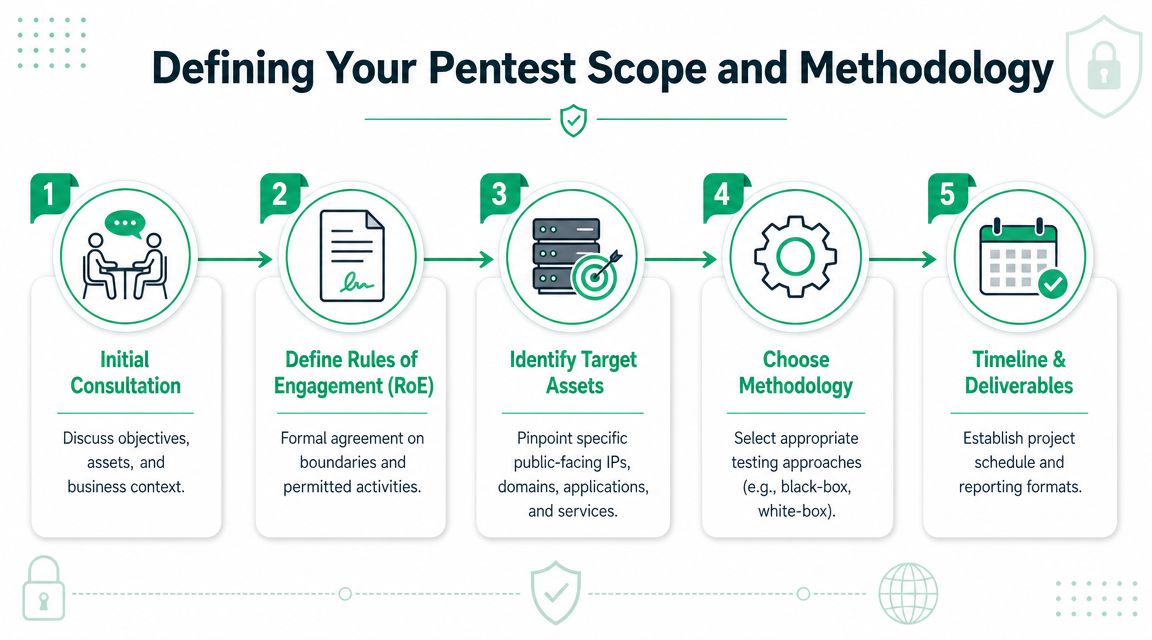
If the scope is fuzzy, the test will be messy, incomplete, or risky. You need a written agreement on exactly what can be touched, when testing happens, and what the tester should do if they hit something serious. That protects your systems and it protects everyone involved.
Start with a tight scope
For external network penetration testing, scope usually means your public-facing assets. That can include domains, subdomains, public applications, remote access portals, cloud-hosted services, and perimeter devices that are reachable from outside your network.
Keep it precise. “Test our website” is weak. “Test these approved external assets under these conditions” is how professionals work.
Here's what a clean scoping conversation should settle:
- Authorized targets: Which public-facing systems are in scope.
- Testing window: When testing can happen and who to contact if something looks unstable.
- Allowed methods: Whether the tester can attempt exploitation, credential attacks, or limited post-access validation.
- Deliverables: What the final report includes and whether retesting is available.
Before a full penetration test, many teams benefit from vulnerability scanning to map obvious exposure and reduce wasted effort. Done properly, that's a crucial first step for cybersecurity, not a replacement for manual testing.
Use a real methodology
Professional pentesters don't wing it. A sound external assessment follows a structured process such as PTES, which includes pre-engagement scoping, reconnaissance, threat modeling, vulnerability analysis, exploitation, post-exploitation, and reporting, as described in EPAM's overview of external network penetration testing.
In plain English, it works like this:
Reconnaissance
The tester gathers information about your external footprint. Domains, exposed services, infrastructure clues, and public attack paths come into focus here.Vulnerability analysis
Likely weaknesses are identified. Unpatched software, exposed admin functions, weak authentication surfaces, and bad configurations often show up at this stage.Exploitation
The tester safely proves whether a weakness can be used. That's the difference between “possible issue” and “real finding.”Post-exploitation
If the perimeter gives way, the tester checks how far that access can go within the approved rules. This proves business impact.Reporting
Every valid finding gets documented with evidence, explanation, and remediation advice.
Field advice: Ask your provider how they move from recon to proof. If they can't explain that chain clearly, their methodology is probably shallow.
Certifications should mean hands-on skill
This is where credentials matter, but only if they're attached to people doing the work. OSCP, CEH, and CREST certifications don't guarantee quality on their own, but they do signal that the pentester has put in serious effort and understands established testing standards.
The right methodology plus experienced operators is what makes a penetration test defensible in front of auditors and useful to technical teams. Anything less is just expensive paperwork.
Common External Attack Scenarios We Find
Most external breaches don't start with genius-level hacking. They start with something exposed, forgotten, or poorly controlled.
That's why manual pentesting matters. A scanner might notice an old service or a strange response header. A human tester asks the better question. Can this be used to get in?
Forgotten systems still bite
One of the most common patterns is the forgotten external asset. A dev box, an old admin portal, a staging app that never got locked down. It sits on the internet because nobody retired it cleanly.
A skilled tester finds that asset during recon, checks how it behaves, and sees whether weak access controls or default settings still exist. That kind of problem is dangerous because it often sits outside normal patching and monitoring.
Small flaws chain together
Attackers rarely need one dramatic flaw. They chain simple problems.
A public login page leaks useful error messages. An old component reveals version details. A secondary endpoint behaves differently than the main app. None of that sounds exciting on its own. In combination, it gives an attacker a path.
Here are common external attack paths that deserve attention:
- Weak authentication surfaces: Internet-facing portals sometimes allow guessing, poor lockout behavior, or sloppy session handling.
- Exposed administrative interfaces: Management panels often get left reachable when they should be restricted.
- Unpatched public services: Older software versions can expose known weaknesses if they're still reachable from outside.
- Broken access control: An outsider may reach data or actions they shouldn't if the app trusts the wrong thing.
Attackers love boring mistakes because boring mistakes are everywhere.
Manual testing finds what scanners miss
Automated tools are useful for coverage, but they don't think. They don't follow a weird redirect chain and ask why it lands somewhere sensitive. They don't notice that one endpoint trusts a user role it shouldn't. They don't test whether a low-friction path can become actual access.
That's why the best penetration testing combines tooling with human judgment. The tools gather signals. The tester validates what matters.
A real external penetration test should produce findings that sound like this: “This service was reachable, this control failed, this access was possible, and here's how to fix it.” It should not read like a dump of generic scanner output with no proof behind it.
What useful scenarios look like
The most valuable findings usually share a few traits:
| Scenario type | Why it matters |
|---|---|
| Reachable exposure | It proves the weakness exists on an internet-facing asset |
| Clear exploit path | It shows how an attacker would use it in practice |
| Business impact | It connects the flaw to access, data exposure, or control failure |
| Fix guidance | It gives your team a direct remediation path |
When a provider can't tell these stories clearly, they probably didn't test sufficiently.
What to Expect in Your Pentest Report
The report is the product. If the report is weak, the penetration test was weak.
A useful report doesn't try to impress you with length. It gives decision-makers a clean summary, gives engineers proof and remediation steps, and gives auditors enough structure to see that the work was real.
Clear summary first
Your executive summary should say what was tested, what level of risk was found, and what needs attention now. A founder or CISO should be able to read that section quickly and understand the situation without translating technical jargon.
Then the technical detail should back it up. Every finding needs evidence, impact, and fix guidance. If your team can't start remediation from the report alone, the provider didn't do their job.
A solid report usually includes:
- Scope and dates: What assets were tested and under what rules
- Methodology: How the testers approached the work
- Validated findings: Real issues, not just suspected ones
- Risk ratings: A practical way to prioritize fixes
- Remediation guidance: Specific next steps for IT, dev, or ops teams
- Retest status: If fixes were verified later
Findings should map to real risk
Many reports frequently fall apart. They list low-value noise and bury the important issues.
That's backwards. One 2026 industry analysis from ZeroThreat reported that approximately 69% of known vulnerabilities are linked to CVEs with a network-based attack vector. The same analysis reported that missing access control accounted for 31.1% of serious findings, while server security misconfiguration made up 28.4% of web and API pentest findings in 2024. That tells you something important. External environments are still getting broken through basic control failures, not just exotic attack chains.
So your report should call out the flaws that expose the business. Missing access control. Bad server configuration. Reachable vulnerable services. Weak internet-facing authentication. Those are the findings that deserve executive attention.
What good looks like: The report should tell your team what an attacker could reach, what they could do with that access, and what to fix first.
Audit-ready beats overbuilt
You do not need a giant report full of filler. You need one that is defensible.
A report is audit-ready when it shows disciplined scope, recognized methodology, evidence-based findings, and remediation guidance written clearly enough that another reviewer can follow the logic. That's what auditors and security-conscious customers care about.
Fast delivery matters too. A report that arrives within a week of test completion is far more useful than one that appears after internal priorities have shifted. Security work loses value when it drifts too far from the moment you discovered the issue.
How Penetration Testing Satisfies Compliance Audits
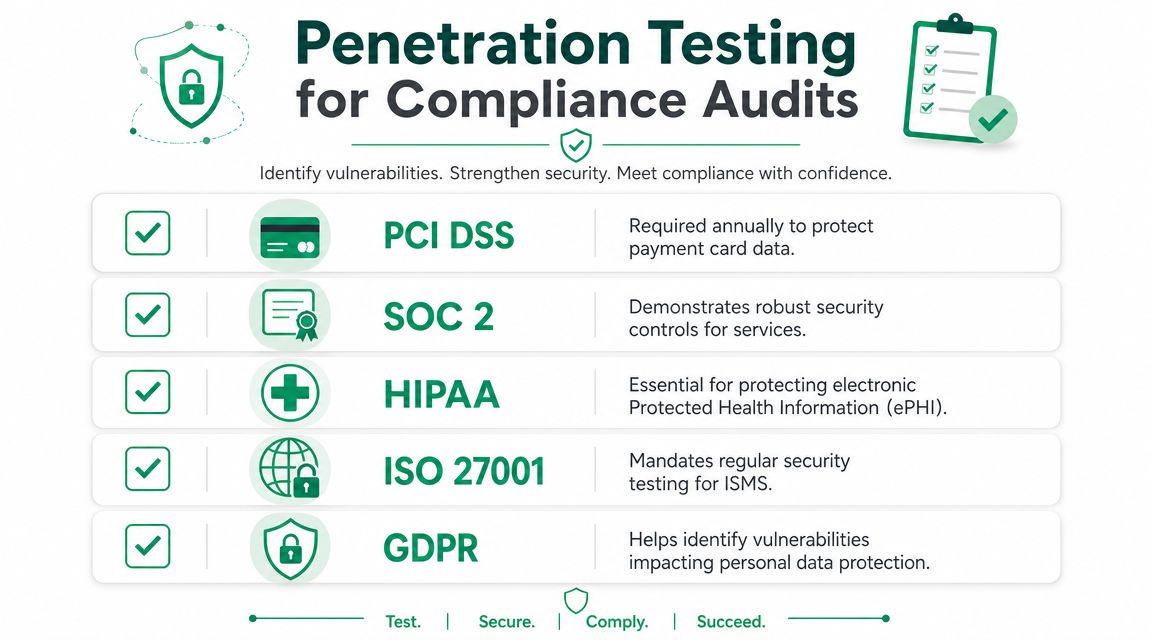
Most companies don't buy an external pentest for fun. They buy it because an auditor, customer, insurer, or procurement team wants proof that their public-facing systems have been tested by qualified people.
That's a reasonable demand.
A compliance program on paper isn't enough. Auditors want evidence that your controls hold up in practice. External penetration testing helps provide that evidence because it checks whether your internet-facing exposure can be abused.
What auditors want to see
Auditors usually care less about flashy exploit details and more about whether the engagement was credible and complete. They want to see that the test had authorization, defined scope, a recognizable methodology, documented findings, and evidence that the company responded appropriately.
That's why a serious report should make these points easy to verify:
- Scope was defined: The tested external assets are clearly listed
- Methodology was documented: The provider followed a professional process
- Findings were validated: The issues were tested, not guessed
- Remediation was addressed: The company has a plan to fix or accept risk
- Retesting can be shown: If needed, fixes can be confirmed later
If your goal is smoother reviews for SOC 2, PCI DSS, HIPAA, or ISO 27001 work, an audit-ready external pentesting process should give you exactly those artifacts.
Compliance is not the finish line
Plenty of companies treat the pen test like a checkbox. That's a mistake.
The test should satisfy the audit, but it should also help your team reduce real exposure. A report that only exists to be attached to an evidence request is wasted value. The best compliance-oriented penetration testing does both jobs at once. It supports the audit and gives your technical team a clean list of meaningful fixes.
Auditors don't want security theater. They want evidence that someone competent tested the controls and that your team took the results seriously.
If your provider understands that, the audit process gets easier. If they don't, you end up translating vague findings into something your assessor can use.
Choosing a Fast and Affordable Pentest Provider
Choosing a provider is not complicated if you ignore the sales fluff.
Start with the people doing the work. You want testers with credible hands-on certifications like OSCP, CEH, and CREST. Then ask for a sample report. If the sample is bloated, vague, or impossible to skim, expect the same from your engagement.

A smart buying checklist is short:
- Ask who tests your environment: Don't assume the senior person on the sales call does the actual work.
- Ask how findings are validated: Real pentests include manual confirmation, not scanner exports.
- Ask about turnaround: If they can't move quickly, they may not fit your audit or customer timeline.
- Ask how reports are written: Your developers and auditors both need to understand them.
- Ask about retesting: Fix verification matters.
Don't confuse enterprise pricing with enterprise quality. For many SMBs and startups, a fast, affordable penetration test is the better choice because it matches the actual need. Tight scope. Certified testers. Clear reporting. Quick delivery.
That's what good external pen testing should look like.
If you need a fast, practical, and audit-ready pen test without enterprise bloat, Affordable Pentesting is built for that job. Their team focuses on affordable penetration testing for startups and SMBs, with certified testers, useful reporting, and timelines that match real compliance and customer deadlines. Use the contact form to get the conversation started.