.svg)
Forensic Computer Services Practical Guide
You get an alert on a Tuesday morning. A shared drive is locked, a founder can't access customer files, and nobody on your team can answer the only questions that matter. What happened, what data was touched, and what do we do next?
That's where forensic computer services stop being an abstract security term and become a business continuity tool. If you can't reconstruct the incident fast, you burn time, money, and trust. Good forensics gives you facts. Bad forensics gives you panic, finger-pointing, and a bigger invoice.
Why You Need to Understand Forensics Now
A startup usually doesn't call a forensic team because things are going well. Someone clicked the wrong file, an employee copied data before leaving, or a cloud account started behaving strangely overnight. Your IT team can reset passwords and restore backups, but that doesn't tell you who got in, what they did, or whether the problem is still active.
That gap matters more than most founders realize. You are not just fixing systems. You are deciding whether to notify customers, how to answer auditors, and whether your team can safely keep operating.
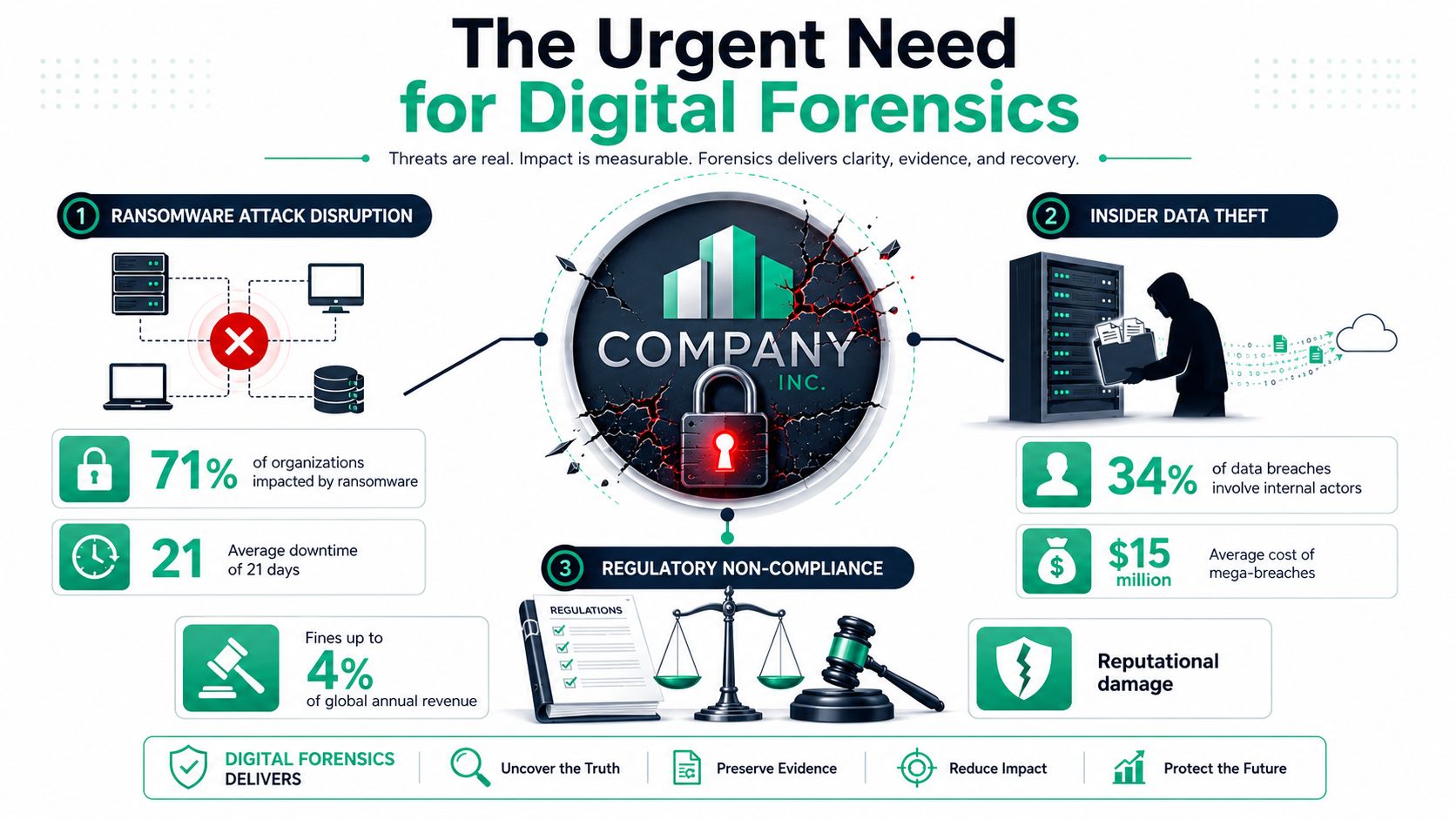
Business continuity starts with evidence
Forensic computer services answer the question basic troubleshooting can't. They focus on evidence, not guesswork. That means tracing activity on devices, accounts, and systems in a way that can stand up to legal review, insurance review, or a board meeting.
If you've ever heard someone say, "We think the attacker only touched one machine," that's exactly when forensics is needed. Thinking is not enough. You need a defensible record of what happened.
Practical rule: If an incident could affect revenue, customer trust, compliance, or employment decisions, treat it like an evidence problem, not just an IT problem.
The market is growing because businesses are dealing with more of these moments. The Global Computer Forensic Technologies and Services Market was valued at USD 8.7 billion in 2026 and is projected to reach USD 15.4 billion by 2033, growing at a CAGR of 9.2%, driven by cybercrime and compliance pressure, according to Coherent Market Insights research on the computer forensic technologies and services market.
Why startups and SMBs get hit harder
Large enterprises can absorb confusion for a while. Startups usually can't. If your product team is blocked, customer support has no answers, and leadership is waiting on a timeline, every slow hour hurts.
Forensics isn't just for court cases or huge breaches. It's for smaller incidents that can still derail operations, like unauthorized file access, suspicious logins, or a laptop tied to sensitive customer data going missing.
A founder should look at forensics the same way they look at cash flow. You don't need it every day, but when you need it, you need it immediately and you need clarity.
What Forensic Computer Services Really Are
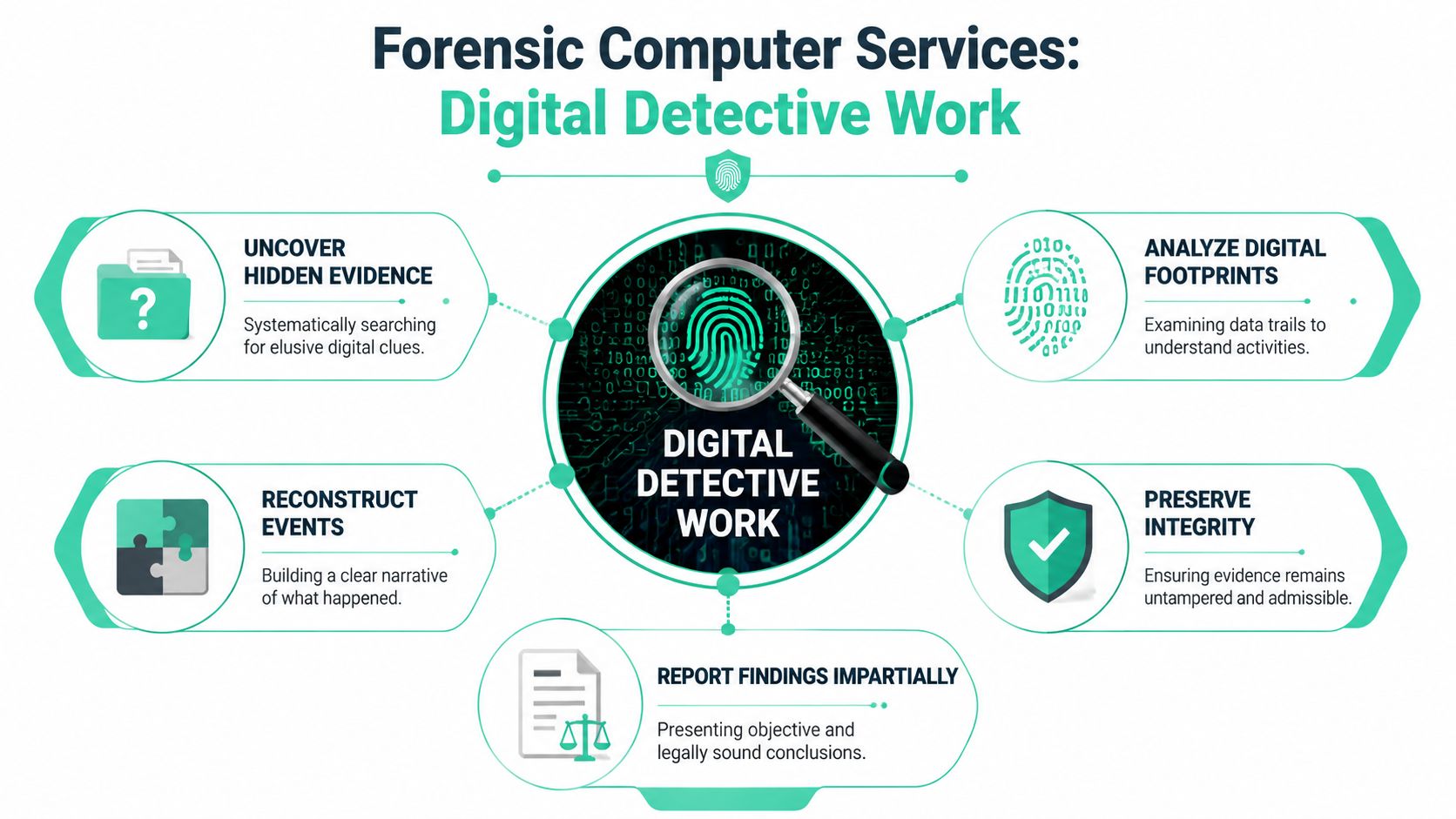
Hearing "forensics" often brings to mind police labs. In practice, forensic computer services are digital detective work for business systems. The job is simple to describe. Find the clues, preserve them properly, and rebuild the story of what happened.
Your internal IT team is usually focused on getting things working again. A forensic investigator has a different mission. They need to collect evidence without changing it, examine hidden artifacts, and produce findings that hold up under scrutiny.
It is not normal IT troubleshooting
If a machine is acting up, IT may reboot it, patch it, or wipe it. Those are often the right moves for operations. They can also destroy the evidence you need to understand the incident.
Forensic work is slower on purpose at the start. Investigators look for deleted files, user activity, timestamps, system artifacts, and traces that normal users never see. They document what they touched and how they touched it.
Here's the plain-English difference:
| Task | IT support focus | Forensics focus |
|---|---|---|
| Infected laptop | Get it back online | Preserve and examine evidence |
| Employee data issue | Restore access | Determine what was accessed or taken |
| Suspicious server activity | Stabilize the system | Reconstruct the timeline and scope |
| Legal or HR concern | Solve the tech issue | Produce defensible findings |
Why the process is so rigid
Digital forensics grew out of law enforcement work. It formally started in the 1980s, and in 1984 the FBI created the Computer Analysis and Response Team, or CART, which marked a major early step in investigating computer crime, as outlined in this history of when digital forensics started.
That history still shapes the field. The process is careful because evidence loses value fast if nobody can prove it stayed intact. If a report might end up in a regulator review, insurance dispute, employee matter, or lawsuit, the method matters as much as the finding.
Good forensic work doesn't just tell you what happened. It lets you prove it.
What a founder should expect
You should expect a forensic provider to explain findings in plain language. Not buzzwords. Not mystery. You need a timeline, affected systems, likely cause, and recommended next steps.
You should also expect them to separate facts from assumptions. "We confirmed these files were accessed" is useful. "It was probably fine" is not.
That's the heart of forensic computer services. They turn a messy technical incident into a factual record people can act on.
Key Types of Forensic Investigation Services
Not every incident needs the same kind of investigation. Smart teams match the service to the problem instead of buying a vague "full investigation" package and hoping for the best.
Disk forensics for stored evidence
Disk forensics looks at data stored on a computer drive or server image. Investigators use it when they need to recover deleted items, inspect file activity, or trace user behavior after the fact.
This is the right choice when an employee leaves under bad circumstances, sensitive documents disappear, or a machine was compromised and then shut down. The evidence is sitting on the disk, and the goal is to examine it without altering it.
Live response during active incidents
Live response deals with a machine that is still running. That matters because some of the most useful evidence disappears when you power a system off.
During ransomware or active intrusion events, live response helps capture what was happening in memory and what processes were running at the time. If your team is deciding whether to isolate a host immediately or observe it long enough to collect evidence, this service earns its keep fast.
If the system is still on and the incident is active, don't let someone casually reboot it.
Network forensics for traffic and movement
Network forensics focuses on how data moved across your environment. It helps answer questions about lateral movement, suspicious connections, and whether data left the company.
This is useful when logs show odd outbound traffic, a cloud workload starts communicating with unexpected services, or leadership wants to know whether a breach stayed contained. It also pairs well with prevention work. If your web app is exposed to the internet, Affordable Pentesting web app services can help you find weaknesses before network forensics becomes necessary.
Mobile forensics for phones and tablets
A lot of business communication now lives on phones. Mobile forensics focuses on texts, app activity, files, and device artifacts tied to a phone or tablet.
Use it when a company phone is involved in insider risk, unauthorized data sharing, or a dispute about who sent what and when. If your exec team runs major business decisions through mobile apps, you cannot ignore this category.
Which one do you actually need
Founders usually don't need to memorize service labels. They need to map incident types to likely investigative paths.
- Ransomware still spreading: Start with live response so you don't lose volatile evidence.
- Data missing after an employee exit: Use disk forensics first.
- Unknown exposure path across multiple systems: Bring in network forensics.
- Sensitive messages or files tied to a company phone: Ask for mobile forensics.
A serious provider should be able to tell you which service fits and why. If they can't explain that clearly, keep looking.
The Step-by-Step Forensic Investigation Workflow
Most buyers hate forensics because it feels like a black box. It shouldn't. A proper investigation follows a clear workflow, and if your provider can't walk you through it, expect delays, confusion, and weak reporting.
Computer forensics follows five legally validated phases: Pre-process, Acquisition, Preservation, Analysis, and Presentation, according to Splunk's overview of computer forensics phases. Those words sound formal, but the logic is simple.
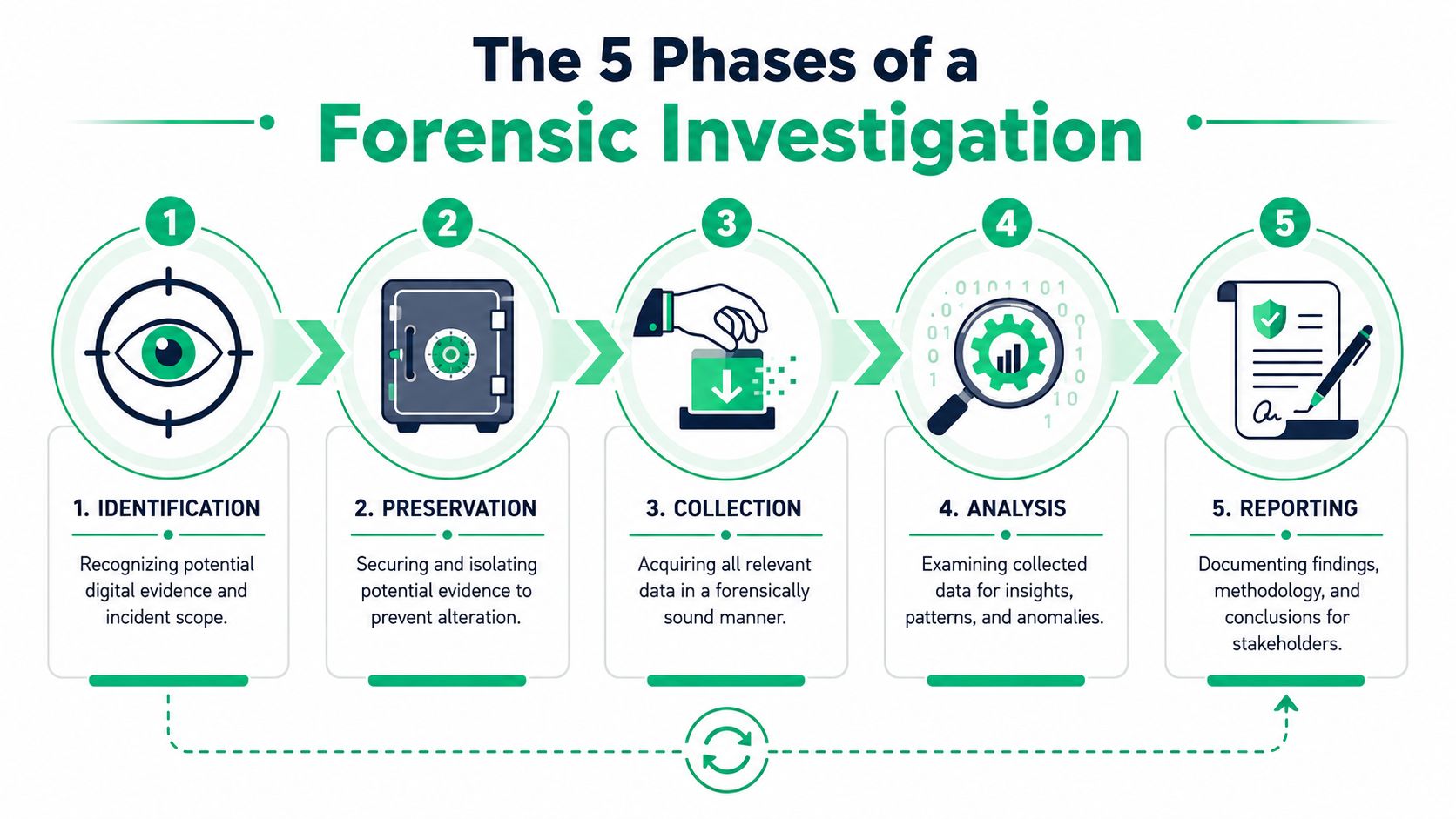
The five phases in plain English
Pre-process
This is the permission stage. The investigator confirms authority, scope, and what systems or devices can be examined. If this is sloppy, everything after it gets messy.Acquisition
Data is collected from devices, drives, accounts, or systems. The key point is that collection must be done in a way that doesn't corrupt or casually modify the evidence.Preservation
Evidence gets secured so nobody can later claim it was altered. Storage controls, documentation, and verification are essential.Analysis
Investigators review artifacts, correlate activity, and build the event timeline. At this stage, hidden files, user actions, and deleted traces start to make sense.Presentation
The provider delivers a report with findings, method, and timeline. This report should help leadership, counsel, auditors, HR, or insurers make decisions.
Why chain of custody matters
Chain of custody is just a record of who handled the evidence, when they handled it, and what they did. No more. But if that record is weak, your report can become a very expensive opinion instead of reliable evidence.
If you want a simple reference on what good documentation looks like, this reliable chain of custody process breaks the idea down in practical terms.
A forensic report is only as credible as the handling behind it.
What you should demand from the workflow
Don't accept vague status updates like "we're still looking into it." Ask for concrete outputs at each stage.
- At kickoff: You want scope, timing, and who approved the work.
- During collection: You want confirmation of what systems or devices were acquired.
- During analysis: You want a working view of likely incident path and affected assets.
- At close: You want a report that names facts, assumptions, gaps, and recommended actions.
The point of the workflow isn't paperwork for its own sake. It protects the usefulness of the result. If leadership needs to act fast, a disciplined process gives them something they can trust.
How Forensics Supports Compliance and Incident Response
Compliance frameworks don't care that your team was busy. If you handle sensitive data, you're expected to respond to incidents in a structured way. Forensics supports that by giving you a factual record of what happened and what you did next.
That matters for SOC 2, ISO 27001, HIPAA, PCI DSS, and similar programs because incident response is never just "we fixed it." You need evidence, timelines, decisions, and documentation. Forensics fills in the parts a normal ops ticket won't capture.
Prevention and response are different jobs
A pentest, pen test, or penetration test is proactive. It finds weaknesses before an attacker or insider uses them. Forensics is reactive. It helps you understand the damage after something already went wrong.
Those services support each other. Manual penetration testing for web applications typically costs $5,000 to $30,000, while external network tests range from $5,000 to $20,000, according to Deepstrike's penetration testing cost breakdown. For many startups, that spend is easier to justify when you compare it to the cost and disruption of a real incident investigation.
What smart teams do differently
Mature teams don't pick between pen testing and forensic readiness. They build both into their program.
- Run regular pentests: Manual testing catches issues scanners miss.
- Keep incident plans current: If nobody knows who approves evidence collection, you'll lose time.
- Preserve logs and access records: Investigators can't analyze what your systems never retained.
- Practice communication: Legal, engineering, and leadership need a shared playbook.
If your incident response process is thin, this piece from Affordable Pentesting on incident preparedness is a practical starting point.
Why speed matters here too
Traditional firms often drag this out. They schedule too late, collect too much, and produce a report after the business has already improvised around the damage. That's not useful.
A better approach is fast scoping, clear reporting, and strong manual security work before incidents happen. Certified testers with OSCP, CEH, and CREST backgrounds are especially valuable in preventive work because they know how real attackers think and where organizations usually miss the obvious. And yes, when you're buying a pentest, pen test, or penetration testing engagement, getting your report within a week matters because delays kill momentum.
How to Choose a Forensic Services Vendor
Most forensic vendors sound impressive on a sales call. That doesn't mean they'll be useful in the middle of a live incident. You need to screen for speed, clarity, and evidence discipline.
The biggest red flag is fuzzy pricing. A critical gap in the market is cost-to-resolution transparency, with 68% of SMBs delaying forensic engagement due to ambiguous pricing models, according to Forensic Discovery's explanation of computer forensics service pricing issues. If a provider can't explain what affects cost, they are asking you to sign up for uncertainty.
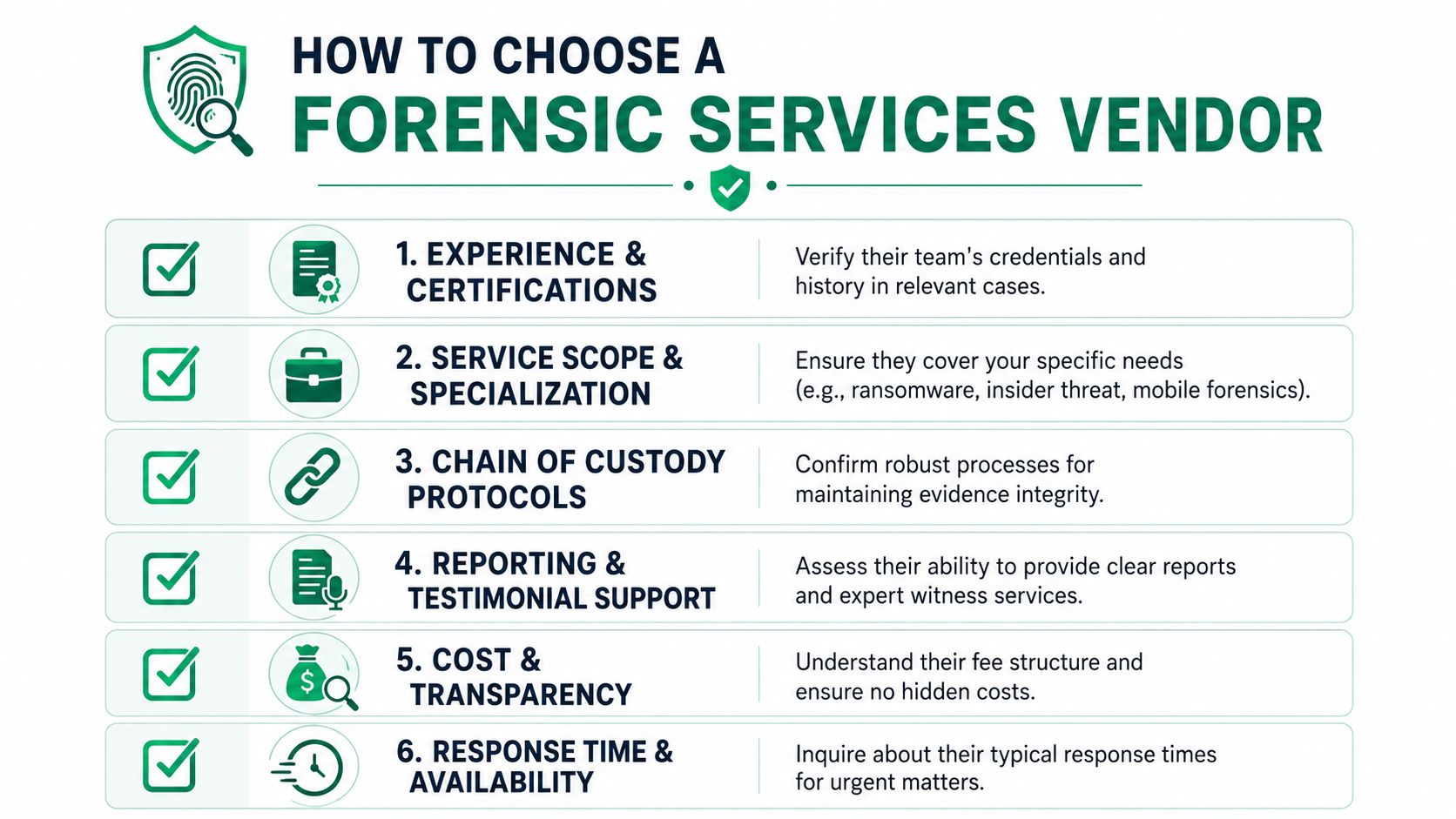
Ask these questions before you sign
- Can you start fast: If they can't begin this week, they may be too slow for an active issue.
- How do you scope cost: Ask what changes the bill. Device count, data volume, reporting depth, and urgency should be spelled out clearly.
- What evidence controls do you use: If they get vague on preservation or documentation, walk away.
- Who is doing the work: Ask about the actual analysts, not just the brand name on the proposal.
- What does the report include: You want findings, timeline, method, and next actions in plain English.
Expertise should be visible
Forensics is not a commodity service. The provider should be able to explain prior experience with ransomware, insider issues, cloud environments, and mobile evidence without hiding behind jargon.
The same standard applies in offensive security. When you buy a pentest, penetration test, or pen testing engagement, ask whether the team has OSCP, CEH, and CREST certified testers and whether the work is manual. Cheap but shallow testing wastes money. Expensive and slow testing wastes time.
Buy clarity, not theater. Fancy branding won't help you during a breach review.
Compare process, not just price
A useful shortcut is to compare vendors on a simple checklist.
| Decision point | Weak vendor | Strong vendor |
|---|---|---|
| Scope | Vague and broad | Specific and documented |
| Timeline | Slow to start | Clear response window |
| Pricing | Open-ended | Transparent about drivers |
| Reporting | Technical dump | Clear findings and actions |
| Evidence handling | Hand-wavy | Documented process |
If you want a broader framework for comparing technical service providers, this guide to choosing data recovery services is worth reading because the buying logic is similar. You can also use this internal checklist on Vendor Evaluation Criteria to pressure-test any security vendor before you commit.
Conclusion From Chaos to Clarity
When an incident hits, confusion is the enemy. Systems can be restored. Passwords can be rotated. But until someone builds a trustworthy record of what happened, leadership is still guessing.
That's what forensic computer services are for. They turn a breach, insider issue, or suspicious event into a timeline, a scope, and a set of facts you can act on. Done right, they support business continuity, compliance, legal defensibility, and recovery without dragging you through weeks of vague updates.
My advice is simple. Treat forensics as part of operating a serious business, not as a last-resort specialty. Pair strong incident handling with affordable manual pentests, fast reporting, and certified testers who can help you prevent the next problem instead of just reacting to the last one.
If you need help with proactive security testing or want a fast, clear response after an incident, use the contact form and start with a direct conversation.
Affordable Pentesting helps startups, SMBs, and compliance-driven teams get practical security help without the usual bloat. If you need an Affordable Pentesting partner for a pentest, pen test, penetration test, or guidance around incident readiness, reach out through the contact form for a clear scope, fast turnaround, and straightforward answers.