.svg)
You're probably here because someone on your team said, “We need to meet an ISO 9000 requirement,” and now you're trying to figure out what that means before you burn time and budget.
Good. That confusion is common, and it causes real waste. Companies start building documents, planning audits, and even lining up compliance work before they understand one basic fact: ISO 9000 is not the certification target. If you want a certifiable quality management system, the standard that matters is ISO 9001.
That distinction matters even more for tech teams juggling SOC 2, HIPAA, ISO 27001, vendor reviews, customer security questionnaires, and often a pen test or full penetration testing cycle on top of it. If your processes are sloppy, every audit gets harder. If your processes are documented and measurable, every audit gets easier.
What an ISO 9000 Requirement Actually Means
An ISO 9000 requirement usually refers to one of two things. They either want to know the basics of quality management, or they think ISO 9000 is the standard they can get certified against.
That second idea is wrong. The most common gap in existing coverage is the persistent confusion between ISO 9000, which covers vocabulary and principles, and ISO 9001, which contains the certification requirements. That's why businesses end up chasing “ISO 9000 certification,” which isn't possible, as explained by SEQM's explanation of ISO 9000.
What your team should do instead
Treat ISO 9000 like the shared language for quality. It helps people agree on terms, principles, and the logic behind a quality management system.
Treat ISO 9001 like the operating rulebook. That's where the auditable requirements live. That's what your certification body will assess.
If you're in security or compliance, this same naming precision matters elsewhere too. Teams that blur standards and requirements usually struggle with scope, evidence, and audit prep across frameworks, which is why it helps to get grounded in understanding ISO 27001 security before piling on another standard.
Practical rule: If someone says “we need ISO 9000 certification,” correct the phrase before you start the project.
The simple takeaway
An ISO 9000 requirement is usually a reference to the ideas behind quality management. It is not the checklist you certify against.
If your goal is customer trust, procurement approval, or formal certification, stop talking in circles and aim at ISO 9001.
The Difference Between ISO 9000 and ISO 9001
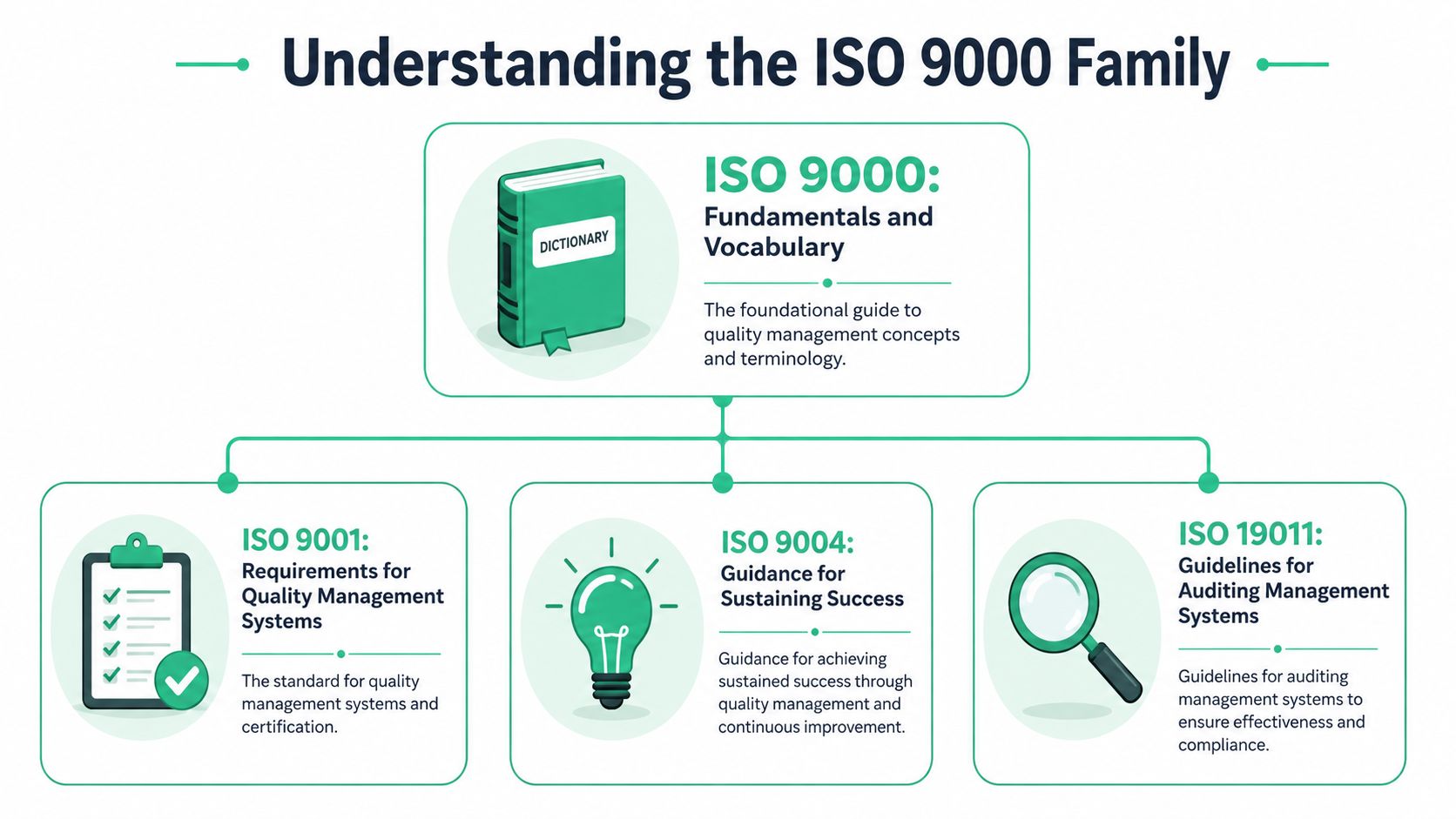
The fastest way to understand this is simple. ISO 9000 is the dictionary. ISO 9001 is the rulebook.
The dictionary tells your team what the words mean. The rulebook tells your team what it must do.
ISO 9000 defines the language
ISO 9000 gives you the fundamentals and vocabulary of quality management. That matters more than most founders think.
If your operations lead, engineering manager, compliance analyst, and executive team all use terms like “nonconformity,” “corrective action,” or “process” differently, your quality system falls apart fast. You end up with messy procedures, weak ownership, and bad audit interviews.
ISO 9001 defines the requirements
ISO 9001 is the only standard in the ISO 9000 family for which an organization can obtain formal certification. To achieve it, an organization must demonstrate that it follows ISO 9001:2015 guidelines, meets its own requirements, and fulfills all customer and regulatory requirements, according to Xometry's ISO 9000 and ISO 9001 overview.
That's the line that matters. Certification bodies don't certify you against ISO 9000 principles alone. They audit your system against ISO 9001 requirements.
A practical way to think about it
Here's the clean comparison:
| Standard | What it does | Can you certify against it |
|---|---|---|
| ISO 9000 | Defines concepts, terms, and quality principles | No |
| ISO 9001 | Sets the requirements for a quality management system | Yes |
That's why “ISO 9000 requirement” is often a fuzzy phrase. If you mean theory, ISO 9000 fits. If you mean action, audit evidence, and certification, you're talking about ISO 9001.
If your goal is passing an audit, don't stop at learning the terms. Build the records, controls, reviews, and accountability the auditor will ask for.
Where companies get stuck
Most businesses don't fail because the standard is mysterious. They fail because they stay too high level.
They read about customer focus, leadership, and improvement, then never turn those ideas into documented procedures, assigned responsibilities, management review records, or internal audit findings. That gap is where audits go sideways.
A Simple Summary of ISO 9001 Clauses
A founder says, “We already care about quality.” Then the auditor asks for the scope of the QMS, evidence of management review, training records, and corrective actions. The room gets quiet.
That gap is what the ISO 9001 clauses are designed to close. ISO 9001:2015 is built around clauses 1 through 10. Clauses 1 to 3 explain the standard. Clauses 4 to 10 are where your team has to show control, evidence, and follow-through.
Clauses 1 to 3 explain the rules
Clause 1 Scope defines what ISO 9001 covers.
Clause 2 Normative references points to the referenced standards used with ISO 9001.
Clause 3 Terms and definitions gives you the language used throughout the standard.
These clauses rarely cause audit findings by themselves. They still matter because sloppy definitions create sloppy procedures, sloppy scoping, and bad audit answers.
Clauses 4 to 6 decide whether leadership is serious
Clause 4 Context of the organization requires you to define the scope of your QMS, identify interested parties, and understand the internal and external issues that affect your system. For a tech firm, that usually means being clear about which products, teams, locations, and services are in scope.
Clause 5 Leadership requires top management to set policy, assign ownership, and stay involved. If the QMS lives only with an operations lead or compliance manager, expect problems. Auditors look for management participation, not passive approval.
Clause 6 Planning requires quality objectives, risk-based thinking, and controlled change. Startups and SMBs often fall short in this area. They move fast, change tools, change vendors, change release practices, and never document how those changes are reviewed or approved.
If your leadership team cannot explain the quality goals for the year, the QMS is weak.
Clauses 7 and 8 cover how work actually gets done
Clause 7 Support covers resources, competence, awareness, communication, and documented information. In plain English, your team needs the right tools, the right training, the right documents, and a clear way to keep those documents current.
Clause 8 Operation covers planning and controlling the work that affects product or service quality. This is the clause that forces discipline into day-to-day delivery. For software and managed service companies, that includes release handling, incident response, customer support workflows, supplier control, and testing practices such as SaaS pentesting when security testing affects service quality and customer commitments.
Use this test:
- If the activity affects customer outcomes, define the process.
- If people perform the process, assign ownership and train them.
- If you need to prove it happened, keep the record.
That is the difference between a policy set and a working QMS.
Clauses 9 and 10 prove the system is alive
Clause 9 Performance evaluation requires monitoring, measurement, internal audits, and management reviews. Auditors use this clause to see whether your system is managed or just documented.
Clause 10 Improvement requires you to respond to nonconformities, correct root causes, and improve the system over time. If the same problem keeps coming back, your corrective action process is weak, even if the form looks polished.
A document alone does not help much. Records, follow-up, and changed behavior do.
What auditors expect to see under these clauses
Auditors are checking whether the clauses connect into one operating system for the business.
Look for these gaps before the certification audit:
- Unclear scope: The QMS says one thing, but the business delivers more than the scope statement covers.
- Leadership absent from the system: No management review records, vague quality objectives, and no evidence that leaders make decisions based on QMS results.
- Procedures with no records: Teams say they follow a process, but there is no training log, approval trail, review record, or corrective action history.
- Internal audits that do nothing: Findings are raised, then ignored, or the audit is so shallow it never catches real issues.
- Improvement disconnected from security and operations: Quality issues, customer complaints, vendor failures, and security incidents are tracked in separate tools with no common review process.
That last point matters for tech firms. ISO 9001 can support security frameworks if you use it properly. The quality clauses give structure to ownership, change control, supplier review, evidence retention, and corrective action. Those same habits make SOC 2 work easier to document and defend.
Read the clauses as management requirements, not textbook headings. That is how you get ready for certification.
Why Tech Firms and SMBs Need ISO 9001
A lot of ISO content still sounds like it was written for factories. That's outdated thinking.
Tech companies need ISO 9001 because they run on processes too. Software releases, onboarding, support queues, vendor reviews, incident handling, change approval, customer complaint handling, and access management are all process problems before they become compliance problems.
This matters for security work too
The ISO 9000 family's principles of evidence-based decision making and process management are underutilized in cybersecurity contexts, despite their potential to streamline compliance audits for frameworks like SOC2 and HIPAA by creating documented, measurable processes, as noted in SiteDocs' discussion of ISO 9000 principles.
That's not academic. It's practical.
If your team already has to produce evidence for security controls, vendor management, access reviews, or vulnerability response, a solid QMS gives you structure. It helps you show how work happens, who owns it, what gets measured, and how failures are corrected.
Where ISO 9001 helps a tech stack
For a SaaS company, ISO 9001 can tighten up areas like:
- Release management: Define how code moves from development to production.
- Support handling: Show how incidents, complaints, and escalations are tracked.
- Vendor governance: Keep vendor selection and review from being ad hoc.
- Training and awareness: Prove that key staff know their responsibilities.
- Security coordination: Connect process records to audit evidence for adjacent frameworks.
That's also why teams handling SaaS pentesting often benefit from stronger process discipline. A pentest, pen test, or full penetration test gives you findings. Your QMS shows how you triage, assign, fix, verify, and prevent repeat issues.
Why founders should care
Founders often think ISO 9001 is “operations paperwork.” Bad move.
If your company wants enterprise deals, cleaner handoffs, faster onboarding, fewer repeat mistakes, and easier audit evidence collection, a QMS helps. It turns tribal knowledge into repeatable business behavior.
Security teams feel this too. You can run manual pentests, collect evidence from OSCP, CEH, or CREST-certified testers, and still struggle in compliance if your internal process for handling findings is inconsistent. Good penetration testing finds the issue. Good process management proves you can handle it.
Your Practical Path to ISO 9001 Certification
A founder usually realizes the gap too late. The sales team promises a customer that certification is "already in progress," then the auditor asks for evidence, ownership, internal audits, and management review records. Suddenly the company has files, but no working system.
That is the path to certification. ISO 9000 gives you the vocabulary and principles. ISO 9001 is the auditable standard, and auditors will judge what your team does.
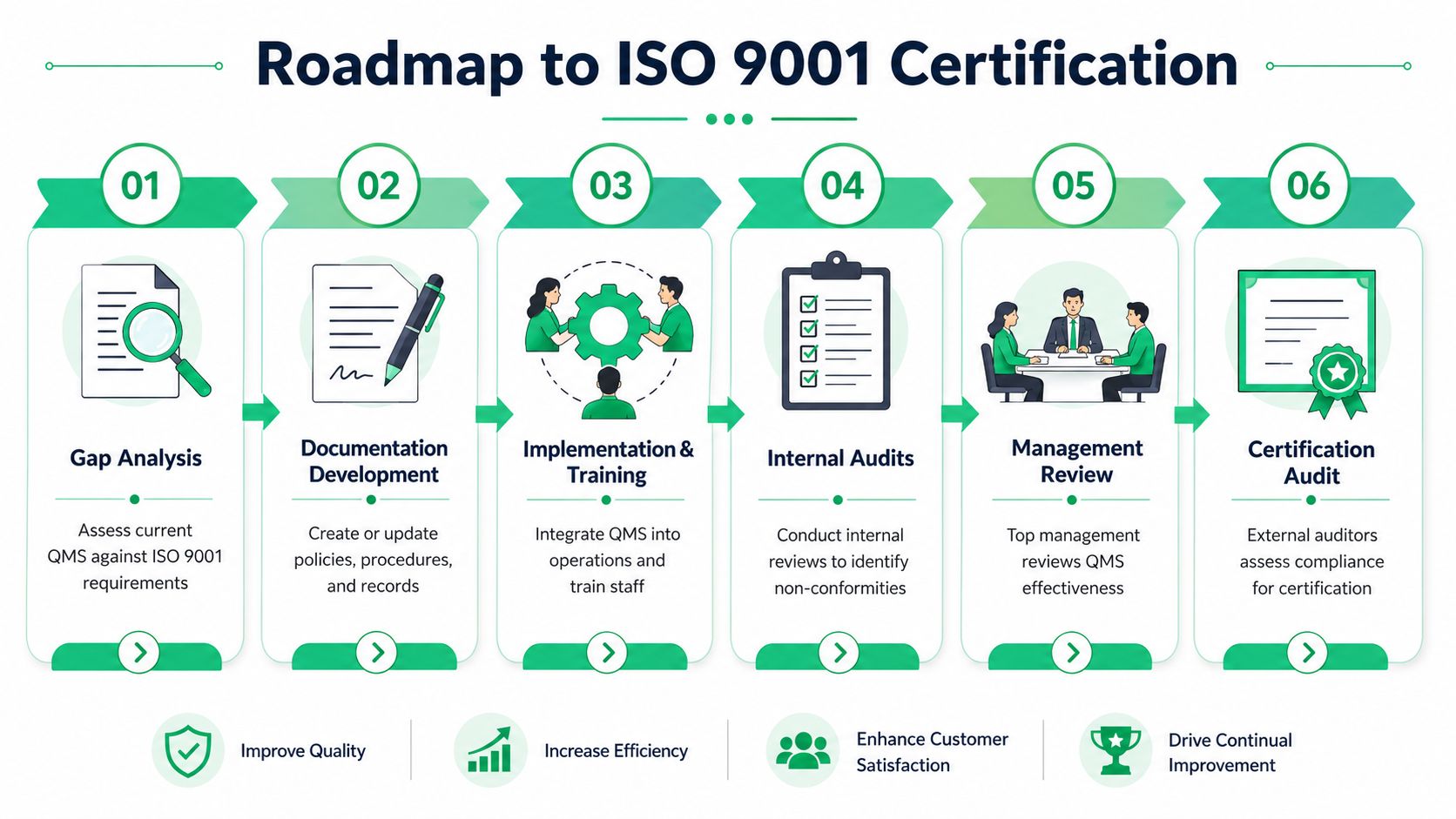
Start with a gap analysis
Check your current operation against ISO 9001 before you write a single procedure. You need to know what already works, what is missing, and what exists only in someone's head.
Look for weak scope definition, missing quality objectives, undocumented handoffs, poor training records, no structured corrective action process, and no proof that leadership reviews the system. For tech firms, add one more check. Make sure engineering, support, product, and security are using the same process language. That overlap matters if you also need SOC 2 or customer security reviews.
Build only the documentation you will use
Bad QMS design kills momentum fast.
Keep the system lean. Write policies, procedures, forms, and logs that match daily work. If your support team uses a ticketing workflow, document that workflow. If engineering handles changes through Jira and pull requests, reflect that reality instead of inventing a fake approval chain for the auditor.
This is also where traceability starts to matter. Approval history, version control, and record retention should be clear enough to survive scrutiny. The benefits of contract lifecycle audit apply here because auditors want the same thing your customers want. Proof of who approved what, when, and under which process.
Train people, then prove the system works
Training records alone are weak evidence. Auditors want to see that people follow the process under normal pressure.
Run the QMS long enough to produce real records. That means actual reviews, completed corrective actions, current KPIs, change records, supplier evaluations, and meeting outputs. If a manager cannot explain their role in the system, fix that before the audit.
If your team wants a practical way to pressure-test evidence quality, Affordable Pentesting's audit guide is a useful reference. It helps teams examine whether their controls and records would stand up in an audit, which is the mindset you need for ISO 9001 as well.
Audit yourself before the certification body does
Internal audits and management review are required parts of ISO 9001. Treat them as rehearsal, not paperwork.
Your internal audit should test whether the system is being followed, whether records are complete, and whether corrective actions remove the cause of a problem. Management review should show decisions from leadership, not a calendar invite and a vague set of notes. Auditors look for involvement from the top because weak leadership ownership usually means the QMS is cosmetic.
Choose a certification body that understands your business
Price matters, but a cheap auditor who does not understand software or service delivery creates friction you do not need.
Ask direct questions about audit stages, remote evidence review, sampling approach, and experience with SaaS, MSP, or product-led companies. You also want clarity on scope wording. A sloppy scope statement creates avoidable findings and weakens the value of the certificate.
Follow the audit path in order
The sequence is simple, even if the work is not.
- Assess the current state: Run a serious gap analysis against ISO 9001 requirements.
- Fix the core system: Define scope, ownership, objectives, procedures, and records.
- Operate the QMS: Use it in day-to-day work until you have credible evidence.
- Run internal audits: Find problems early and correct them properly.
- Hold management review: Record decisions, actions, and follow-up from leadership.
- Complete the certification audit: Stage 1 checks readiness. Stage 2 checks real implementation.
Teams that pass cleanly do not win on paperwork. They win because the business runs the way the documents say it runs.
Common Audit Failures and How to Avoid Them
Most audit failures are boring. That's the good news.
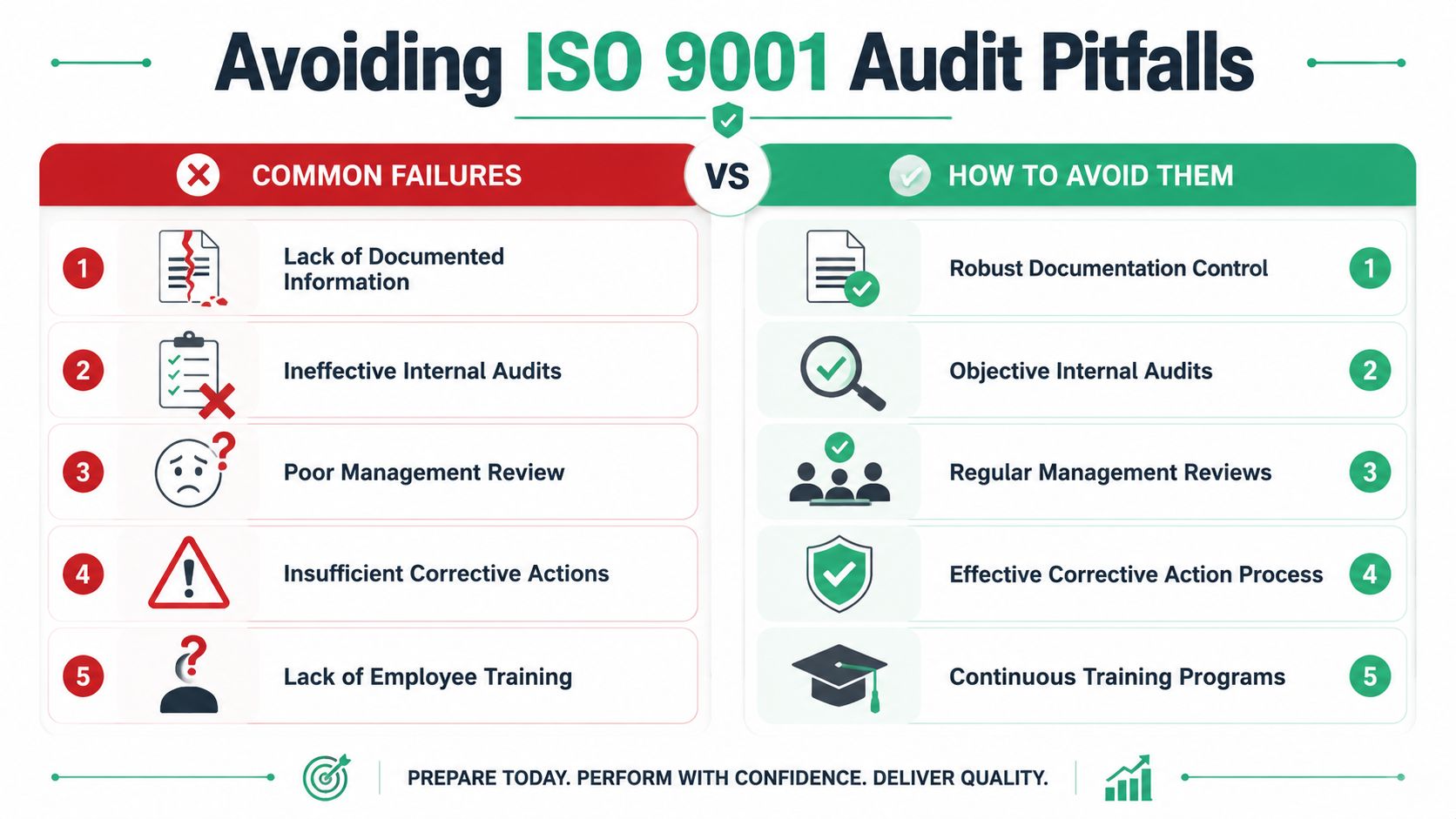
They usually come from ordinary discipline problems, not exotic compliance traps. Teams forget to control documents, skip internal audit depth, fake management ownership, or close issues without fixing root causes.
The failures that keep showing up
| Common failure | What to do instead |
|---|---|
| Undocumented or outdated processes | Keep current procedures tied to real work and controlled versioning |
| Weak internal audits | Use objective reviewers and document findings clearly |
| Poor management review evidence | Record decisions, actions, and follow-up from leadership meetings |
| Shallow corrective actions | Fix causes, not just symptoms |
| Untrained staff | Make role-specific training part of onboarding and change rollout |
One area people overlook is traceability. Contract changes, approvals, and obligations can create quality failures if nobody can prove who approved what and when. That's why the benefits of contract lifecycle audit are relevant here. Audit trails aren't just legal hygiene. They support accountability.
Auditors don't expect perfection. They expect consistency, ownership, and evidence that problems are handled properly.
The easiest prevention plan
Run short monthly checks on high-risk processes. Review whether people followed the procedure, whether the record exists, and whether unresolved issues have owners and due dates.
That habit catches more problems than last-minute document cleanup ever will.
The Final ISO 9001 Preparation Checklist
Right before the audit, don't brainstorm. Check the basics.
If your team can't answer simple questions quickly, the audit gets messy fast. The final prep step is making sure the system is visible, current, and understood by the people who operate it.
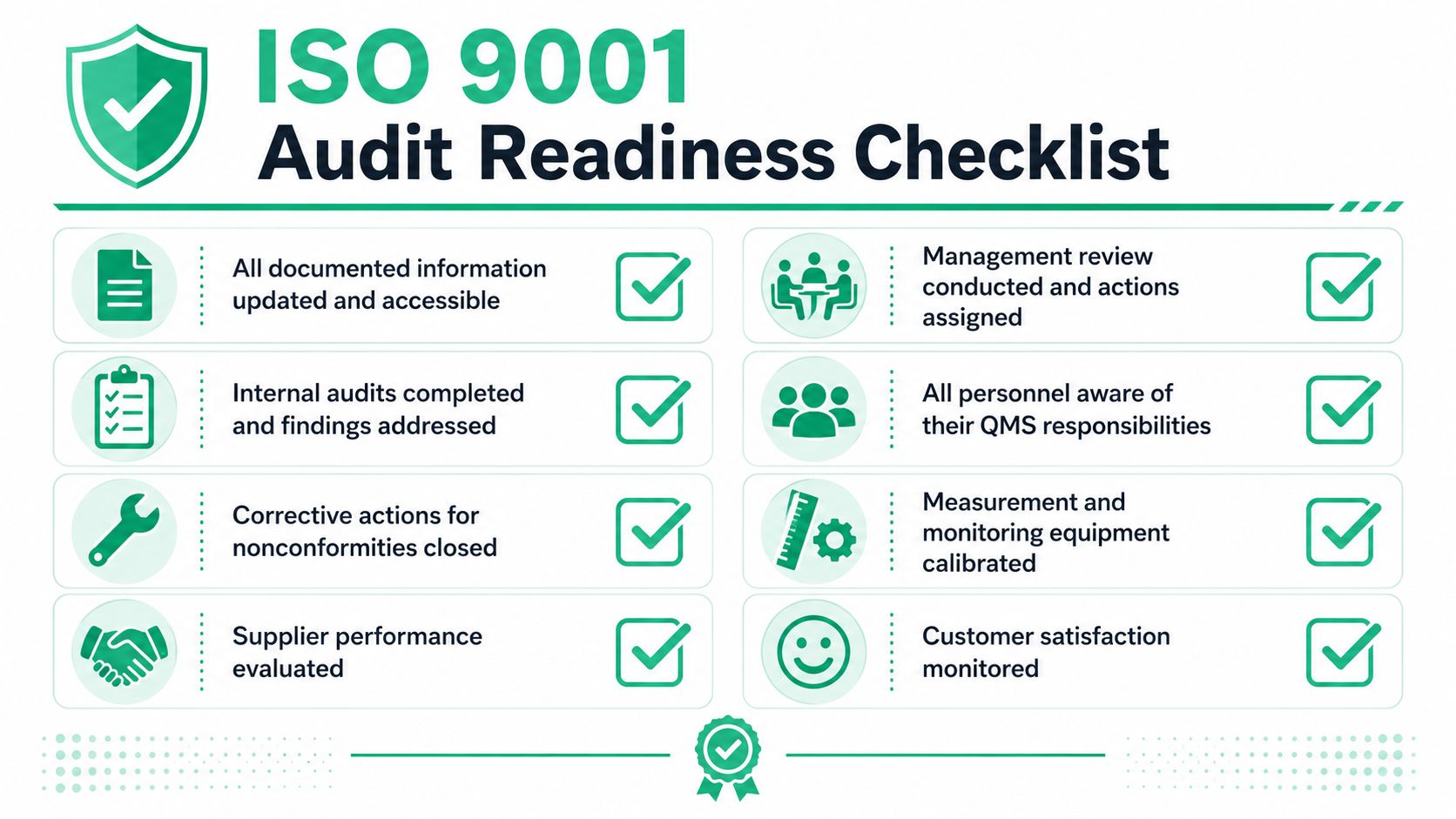
Use this pre-audit checklist
- Documents are current: Policies, procedures, forms, and records are updated and easy to access.
- Internal audits are complete: Findings were recorded, assigned, and addressed.
- Management review happened: Leadership reviewed performance and assigned actions.
- Staff know their role: People can explain what they do and how they follow the QMS.
- Corrective actions are closed: Open issues have evidence of resolution.
- Measurements are available: Monitoring data, service checks, or calibration records are organized where relevant.
- Supplier oversight exists: Vendor performance has been reviewed.
- Customer feedback is tracked: Complaints, satisfaction inputs, and response actions are visible.
Interview readiness matters
Auditors will talk to people, not just read files. Prepare managers and process owners to answer plainly.
Good answers are short and real. Bad answers sound memorized or vague. If someone says, “I think quality handles that,” you've got an ownership problem.
A helpful companion read here is quality manager's audit preparation insights, especially if your team needs a practical way to tighten documentation and interview readiness without overcomplicating the process.
Don't ignore adjacent security evidence
For many tech firms, the audit picture extends beyond ISO 9001. Customers may also ask about vulnerability management, a pen test, pentest remediation, or broader penetration testing practices.
That overlap matters. If you've had a manual pentest and got the report within a week, that speed only helps if your internal workflow can show triage, assignment, remediation, and verification. The same is true whether the work was called a pentest, pen test, penetration test, or penetration testing engagement. Good security evidence becomes stronger when your process around it is documented and repeatable.
Final check: If an auditor asked for proof right now, could your team pull it up fast, explain it clearly, and show who owns the next action?
If the answer is yes, you're in good shape. If the answer is “we'll clean it up before the audit,” you're not ready.
If your compliance work also includes security validation, Affordable Pentesting helps startups and SMBs get affordable manual pentests without the usual drag of overpriced firms, weak findings, or long delays. Their team uses certified pentesters with OSCP, CEH, and CREST backgrounds, and they focus on fast turnaround so you can get a clear report within a week and keep your audit timeline moving. Use their contact form if you need a pen test, penetration test, or broader penetration testing support tied to SOC2, HIPAA, PCI DSS, or ISO 27001 readiness.