.svg)

A single hacked laptop can wreck your audit timeline.
That's what a flat network does. One compromised device, one overly permissive rule, one forgotten internal service, and an attacker can move around far more freely than you think. If you're a founder, CISO, or IT manager trying to get through PCI DSS, HIPAA, GDPR, or SOC 2, this isn't just a security architecture problem. It's a scope problem, a testing problem, and a deadline problem.
Network segmentation benefits aren't abstract. They hit three things you care about right now. Smaller blast radius, cleaner audit boundaries, and faster proof that your controls work.
Introduction What Is a Flat Network and Why Is It So Dangerous?
A flat network is the security equivalent of a submarine with all the doors left open. If one compartment floods, the whole vessel is in trouble. In a business network, that means devices and systems can often talk to far more things than they should.
A lot of startups end up here by accident. They grow fast, add laptops, cloud workloads, vendors, test servers, VoIP phones, printers, and admin tools, then keep piling them onto the same broad internal environment because it's quick and easy.

That setup feels convenient until a phished employee account, infected laptop, or exposed internal service gives an attacker a foothold. Then your "internal network" becomes their playground. They don't need to break in over and over. They break in once and start moving.
Why flat networks fail fast
Here's the fundamental problem with flat networks:
- Too much trust by default means user devices can often reach servers, admin panels, and internal tools they never needed.
- Too many unknown paths make it hard for your team to answer a basic question during an audit. What can talk to what?
- Too much cleanup later turns one small incident into a broad internal investigation.
A flat network makes every small mistake more expensive.
This matters before your audit, not after it. If you wait until the penetration test to discover weak internal boundaries, you're already burning time.
What segmentation changes
Network segmentation fixes this by dividing your network into smaller zones with rules between them. Finance systems stay separate from employee laptops. Production stays separate from development. Guest Wi-Fi stays away from anything that matters.
That gives you control you can explain to an auditor and validate in an affordable internal network pentest, and it transforms your environment from "everything talks to everything" into "only approved systems communicate."
That's the difference between a painful audit and a manageable one.
What Is Network Segmentation in Simple Terms?
Network segmentation means breaking your network into compartments so one problem doesn't become everyone's problem.
Go back to the submarine analogy. If one compartment fills with water, you seal the doors and keep the rest of the vessel afloat. A segmented network works the same way. If malware lands on one machine or one part of the environment gets exposed, the rest of the business isn't automatically reachable.
Think in zones, not one big network
Most companies don't need more complexity. They need cleaner boundaries.
A simple example looks like this:
| Segment | What belongs there | What should be limited |
|---|---|---|
| Employee devices | Laptops, desktops, standard user systems | Direct access to servers and admin tools |
| Production systems | Customer-facing apps, databases, core services | Access from guest networks and unmanaged devices |
| Admin zone | Jump boxes, management tools, privileged access systems | General employee traffic |
| Guest or vendor access | Temporary or public connectivity | Any path to internal business systems |
That's network segmentation in plain English. You decide which zones exist, then you restrict traffic between them.
Why auditors and attackers both care
Attackers care because segmentation blocks lateral movement. That's the simple term for moving from one compromised system to another until they reach something valuable.
Auditors care because segmentation shows you've put thought into access control, data boundaries, and system isolation. If you're trying to explain your environment during a review, "we separate sensitive systems from general access and validate those controls" lands a lot better than "our firewall is pretty locked down."
If you want a plain-language technical refresher, Tbourke Solutions' network security guide gives a useful outside perspective on how segmentation fits into broader internal network design.
The practical takeaway
Founders often hear segmentation and think expensive redesign. That's the wrong frame. The first goal isn't perfection. It's stopping unnecessary communication.
Start with a few hard boundaries that matter:
- Separate user devices from sensitive systems
- Isolate admin access from everyday traffic
- Split guest and third-party access from internal operations
- Keep production apart from development when risk justifies it
If a user laptop can reach everything, you don't have meaningful containment.
That's why segmentation is one of the first things experienced pentesters test. Not because it sounds good in policy docs, but because weak internal boundaries are easy to exploit and hard to defend once an attacker gets in.
Key Security Benefits of Good Segmentation
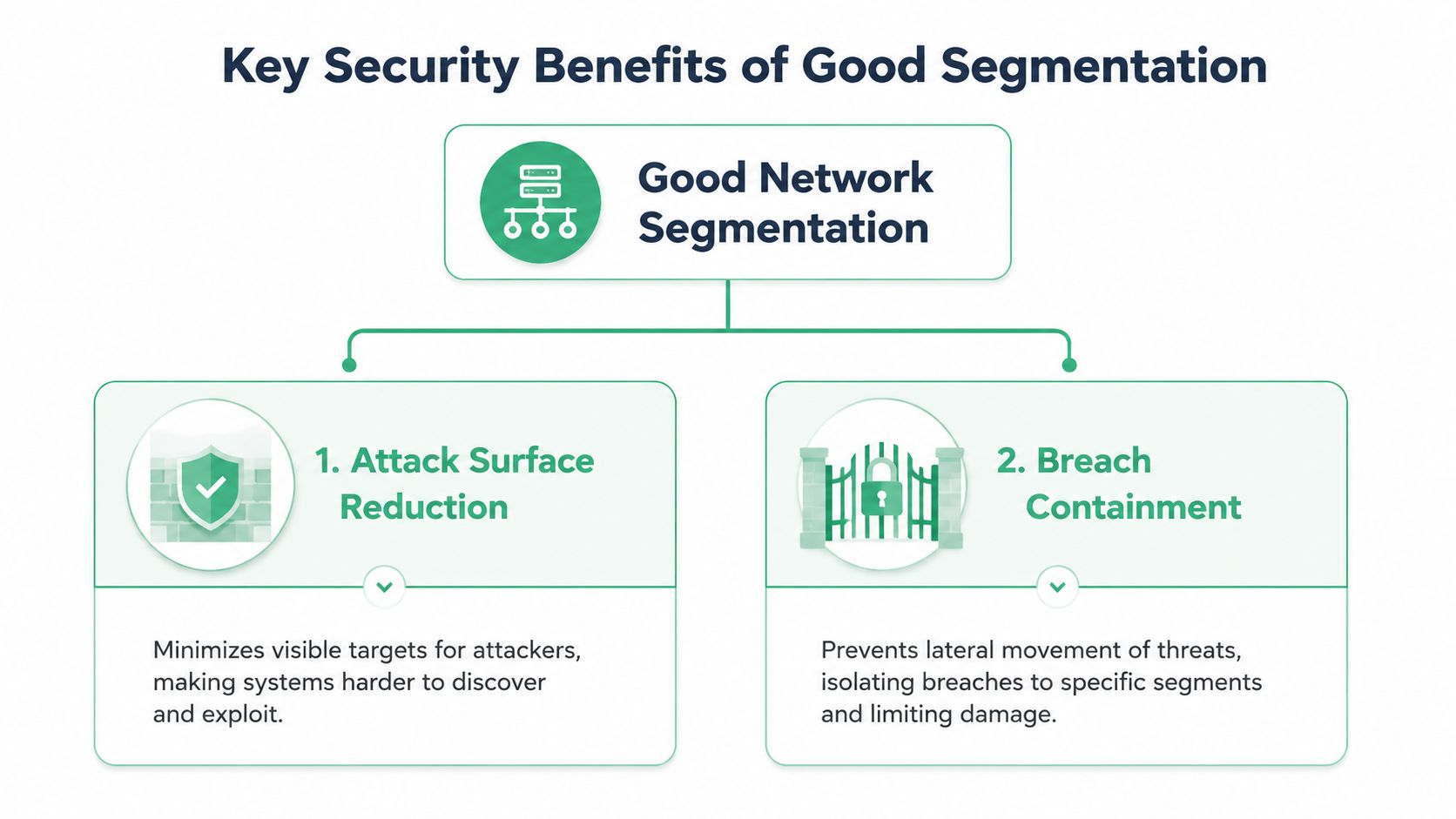
The biggest security win is simple. Good segmentation gives attackers fewer paths.
One industry source notes that 90% of organizations are exposed to at least one attack path, which is why segmentation is now treated as a core control for blocking lateral movement and containing breaches, according to Zero Networks on network segmentation.
Fewer visible targets
When systems are segmented properly, not every device can see every server, service, or management interface. That cuts down the attack surface. If a system isn't reachable, it's harder to probe, exploit, or abuse.
This matters a lot in growing companies. Startups tend to accumulate old services, temporary tooling, staging systems, and convenience access that nobody revisits. Segmentation forces you to decide what should be reachable, instead of leaving broad access in place because it's easier.
Breach containment that actually matters
Zero Networks also notes that a malware infection in one segment does not automatically spread to others, which reduces the attack surface and makes incident containment more effective in practice. That's the whole point. You assume something may go wrong, then you stop it from becoming a company-wide event.
Without segmentation, one compromised endpoint can become a path to domain services, admin utilities, internal apps, or sensitive records. With segmentation, the attacker keeps running into locked doors.
Here's what that changes operationally:
- Response gets faster because your team can focus on a smaller affected area
- Investigation gets cleaner because the likely communication paths are narrower
- Damage stays limited because not every asset is exposed from the first foothold
Practical rule: Design your internal network so a single compromised laptop can't become a shortcut to your crown-jewel systems.
Better security decisions for compliance teams
There's also a business angle that security teams sometimes underplay. Segmentation helps define what systems matter for regulated data and sensitive operations. That gives GRC and IT a cleaner line around what needs tighter monitoring, stronger controls, and deeper testing.
For PCI DSS, HIPAA, GDPR, and similar programs, that matters because your team needs a defensible story. Which systems handle sensitive data. Which systems can reach them. Which systems are out of scope because the boundaries are real.
Good segmentation doesn't replace a pen test, penetration test, or broader penetration testing program. It makes those tests more meaningful. Instead of proving that a flat environment is messy, you're proving that your controls hold under pressure.
How Segmentation Helps Pass Compliance Audits
If your audit deadline is close, segmentation isn't optional architecture cleanup. It's an advantage.
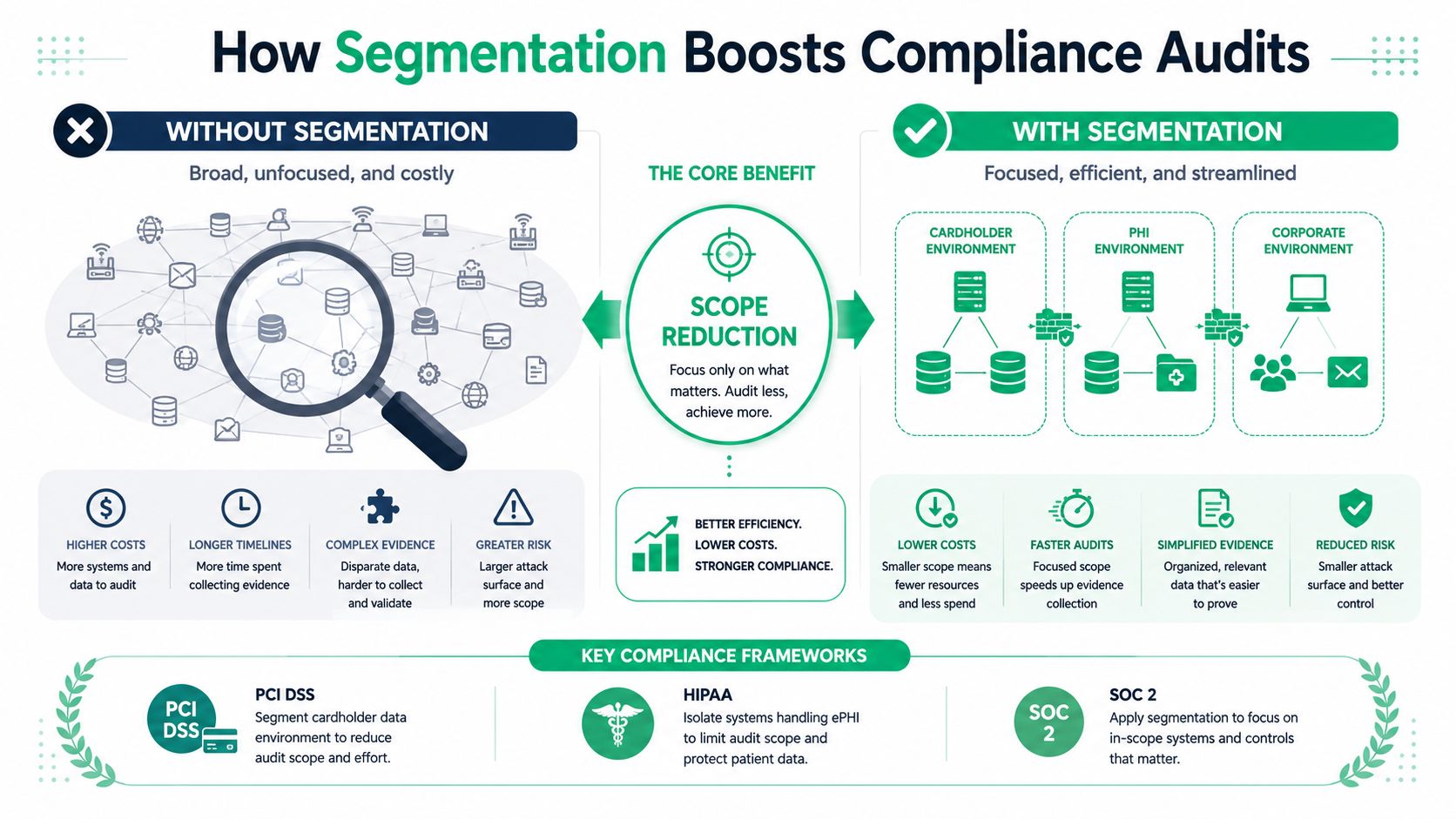
When you segment systems that handle sensitive data away from general business traffic, you narrow what needs extra scrutiny under frameworks such as PCI DSS, HIPAA, and GDPR. That matters because fewer in-scope systems usually means less evidence to gather, fewer boundaries to explain, and fewer places where a tester can find cross-environment access you didn't expect.
Smaller scope means less pain
A startup chasing compliance often makes the same mistake. It treats the whole network like one blended environment, then wonders why the audit feels sprawling and expensive.
A better approach is to isolate regulated or sensitive systems so your team can clearly show where the control boundary starts and stops.
| Without clear segmentation | With clear segmentation |
|---|---|
| More systems are pulled into review | Sensitive systems are separated into defined zones |
| Evidence gathering spreads across more teams | Evidence is tied to specific segments and rules |
| Pentest and audit discussions get messy | Testing can focus on meaningful boundaries |
That's why Affordable SOC 2 pentesting and similar assessments are easier to plan when the environment already has logical boundaries.
Auditors want boundaries they can understand
Auditors don't want a lecture on how clever your network is. They want clear answers.
- What systems hold sensitive data
- Who can access them
- What prevents broader internal reach
- How you know those controls work
Segmentation helps you answer all four. It turns vague claims like "access is restricted" into something testable.
A clean boundary beats a complicated explanation every time.
It helps operations too
Segmentation also solves a problem your IT team already feels. Flat networks get noisy.
As Palo Alto Networks explains, too many hosts in a single flat network create congestion, and in some cases performance can degrade so severely that no packet is delivered. Segmenting the network into smaller subnets relieves congestion and improves traffic flow, as described in Palo Alto Networks' overview of network segmentation.
That operational upside matters during audit prep. When something breaks, your team can isolate the issue to a segment instead of chasing it across the whole environment. You get better troubleshooting, cleaner change review, and fewer ugly surprises during validation.
For founders, that translates to one blunt point. Segmentation lowers friction. It helps security, compliance, and day-to-day operations at the same time.
Operational Benefits Beyond Just Security
A lot of leaders hear "network segmentation" and think cost center. That's too narrow. Good segmentation makes the network easier to run.
The first benefit is performance. Flat networks create noise because too many systems share the same space and too much traffic moves without meaningful boundaries. Your team feels that as weird slowdowns, messy troubleshooting, and hard-to-explain failures.
Why IT teams like segmentation too
When you break the environment into sensible segments, you reduce unnecessary traffic and make behavior easier to understand. If something goes wrong in one area, your team doesn't have to inspect the entire company network to find it.
That shows up in practical ways:
- Troubleshooting gets narrower because the fault domain is smaller
- Changes get safer because rules apply to defined zones instead of everything
- Ownership gets clearer because teams can document who manages what segment
Keep the design simple enough to live with
Companies overcomplicate things. They hear the benefits and start planning dozens of tiny segments before they've mapped basic traffic flows.
Don't do that.
Start with business boundaries first, then choose the control method that fits:
- User and endpoint zones for employee devices
- Server or application zones for production workloads
- Administrative zones for privileged access tools
- Third-party and guest zones for anything untrusted or temporary
A useful design is one your team can explain, maintain, and test.
The best segmentation plan is the one your admins can support on a Tuesday afternoon, not just the one that looks good in a diagram.
Watch for hidden friction
Segmentation can create operational headaches if you build it blindly. A blocked application dependency, a rushed exception, or a vague firewall rule can turn a good design into a support ticket factory.
That's why mature teams document approved paths early. Which systems must talk. Which should never talk. Which exceptions need review. This keeps the controls useful instead of brittle.
Security teams often pitch segmentation as protection. Operations teams should see it as clarity. Both are right.
Common Approaches to Segmenting Your Network
You don't need a PhD in networking to have a smart conversation about segmentation. You need the basic methods and the tradeoffs.
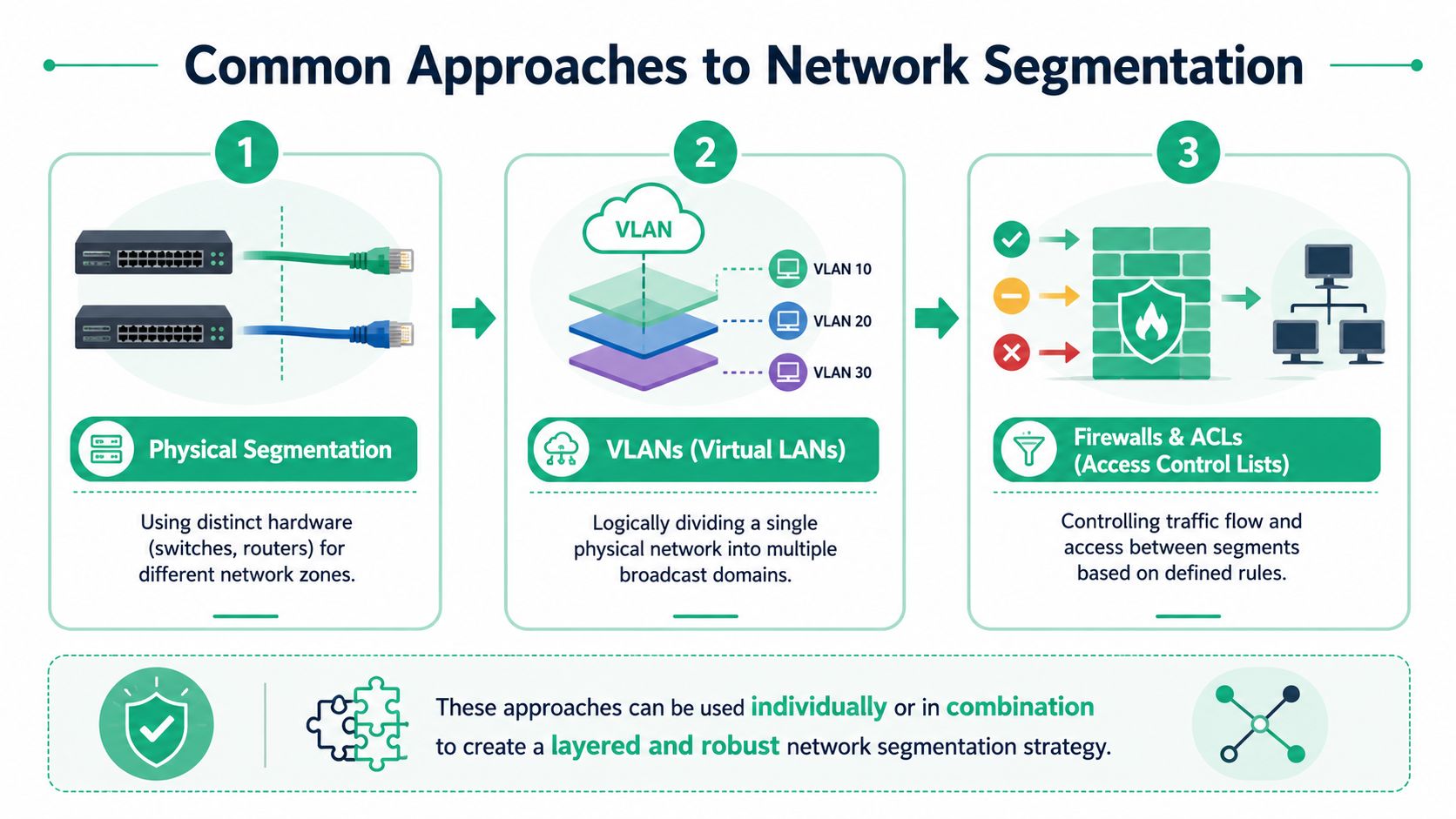
Most organizations use some mix of physical separation, logical separation, and policy-based filtering. The right choice depends on risk, budget, and how fast your environment changes.
The common methods
| Approach | Best use | Main drawback |
|---|---|---|
| Physical separation | High-trust boundaries, critical systems, stricter isolation | More hardware and more cost |
| VLANs | Practical internal separation inside shared infrastructure | Easy to misuse if rules between VLANs are loose |
| Firewalls and ACLs | Controlling traffic between segments | Rule sprawl if nobody governs changes |
| Cloud security groups and software-defined controls | Dynamic cloud workloads and hybrid environments | Can get messy fast without policy discipline |
If you're exposing internet-facing systems, a separate perimeter zone often makes sense too. A practical guide on networking DMZs from GoSafe Dark Web monitoring can help non-specialists understand how public-facing services should be separated from internal assets.
The modern tradeoff
Here's the part vendors often skip. More segmentation is not automatically better.
The modern challenge is that overly granular segmentation can slow releases and increase rule sprawl. Akamai also notes the shift toward identity-based and software-defined segmentation because static network boundaries are less effective when workloads move frequently, especially in hybrid environments, in its discussion of network segmentation benefits and strategy tradeoffs.
That means your strategy should fit your operating model.
- A small startup with one office and a modest cloud footprint usually needs clear major zones, not extreme microsegmentation.
- A regulated company with sensitive workloads may need tighter identity-aware controls and more formal policy management.
- A hybrid environment needs rules that survive change, or the documentation becomes fiction.
Segmentation without testing is guesswork
This is the part too many teams miss. Building segments is only half the job. You still need to know whether the controls block what they should block.
A VLAN label doesn't prove isolation. A firewall policy doesn't prove nobody added an exception six months ago. A cloud rule set doesn't prove an attacker can't pivot through an overlooked management path.
That's why you need to protect against flat networks in design and then validate the result with a real pentest, pen test, or full penetration test. Otherwise you're trusting diagrams instead of evidence.
Proving Your Segmentation Actually Works
A segmentation project isn't done when the rules are written. It's done when somebody tries to break through them and fails.
That's the gap often discovered too late. The VLAN exists. The firewall is in place. The cloud security groups look tidy. Then a penetration tester finds one misconfigured path, one overbroad rule, or one management interface reachable from the wrong segment, and the whole clean design starts to fall apart.
Configuration is not proof
Your auditor doesn't care that the diagram looks good. They care whether the boundary holds.
A proper pentest, pen test, or penetration test checks the actual paths between segments. Can a user workstation reach systems it shouldn't? Can a compromised host pivot into admin tooling? Can an attacker move from a lower-trust zone into a regulated environment?
Those are not theoretical questions. They're the questions that decide whether your segmentation reduces scope or just pretends to.
What a real validation should answer
A useful penetration testing exercise around segmentation should confirm things like:
- Blocked paths stay blocked from the perspective of an attacker, not just from the admin console
- Allowed paths are narrow and tied to actual business need
- Misconfigurations get caught before your auditor or a real attacker finds them
- Evidence is clear enough to support compliance discussions
If you haven't tested segmentation from inside the network, you're still assuming it works.
That's why fast, affordable manual penetration testing matters so much for startups and lean IT teams. You don't need a bloated engagement that drags on forever. You need experienced testers who know how to validate internal boundaries, produce useful findings, and get the report back quickly enough to help your audit instead of delaying it.
If you need to prove your segmentation works before an audit, Affordable Pentesting is built for that. Their certified pentesters, including OSCP, CEH, and CREST professionals, focus on affordable manual pentest, pen testing, and penetration testing services with fast turnaround, often delivering reports within a week. Use the contact form to get a quote and validate your internal controls before your auditor does.