.svg)
Your auditor is asking for a penetration test report. You ask a traditional firm for help, and they send back a bloated proposal, a long wait, and a report timeline that collides with your audit date. That's the normal mess, and it's exactly why so many teams end up overpaying for a pen test that lands late and says very little.
The fix is simpler than most firms make it sound. A good pentest, pen testing engagement, or full penetration testing project should follow a recognized method, produce traceable findings, and move fast enough to help your audit instead of slowing it down. If you're already reviewing your broader security posture, a strategic IT security health check can help frame where an application pentest fits in the bigger audit picture.
Stop Letting Pentests Delay Your Audit
Most audit delays aren't caused by the auditor. They're caused by security vendors who treat a straightforward web application assessment like a six-month consulting project.
That's bad operations. If you need evidence for SOC 2, PCI DSS, HIPAA, or an internal risk review, you need a repeatable testing method and a report that clearly shows what was tested, what was found, and what to fix first.
What usually goes wrong
Teams run into the same problems over and over:
- Slow scheduling: You finally get approval, then wait weeks just to start.
- Thin reports: You pay for a penetration test and get a dressed-up scanner export.
- Audit stress: The report doesn't map cleanly to a testing methodology, so your auditor asks follow-up questions.
- Wasted budget: Big firms charge for layers of project management you didn't ask for.
Practical rule: If a firm can't explain its web app testing method in plain English, expect delays, vague findings, and extra back-and-forth with your auditor.
The OWASP Testing Guide solves the methodology problem. It gives testers a recognized way to assess web applications and APIs without guessing, skipping major areas, or hiding behind generic language. That matters because the report becomes easier to defend in front of auditors, internal leadership, and customers doing vendor due diligence.
What a sane buyer should demand
Ask for these three things before you sign anything:
- A manual testing approach based on an accepted framework
- Clear evidence and reproducible findings
- A report fast enough to support the audit window you have
If you don't get all three, keep shopping.
What the OWASP Testing Guide Really Is
The OWASP Web Security Testing Guide is not a random checklist. It's a practical playbook for testing web applications the right way. OWASP describes it as the “premier cybersecurity testing resource” for developers and security professionals, and it's a globally used, open community resource for evaluating web application security on the OWASP Web Security Testing Guide project page.
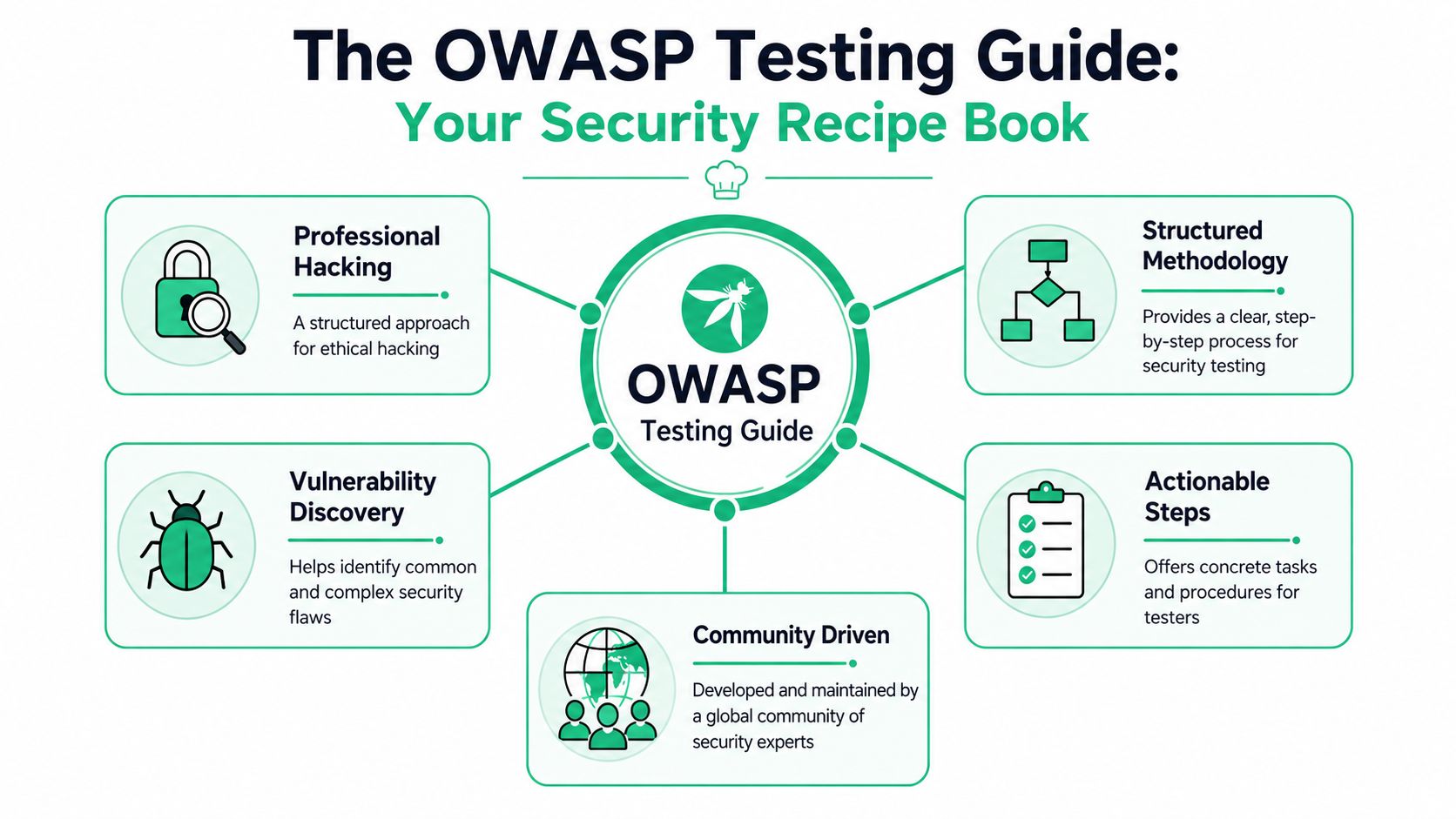
The OWASP Testing Guide functions as a recipe book for ethical hacking. It tells a tester what to examine, how to examine it, and how to document the result so the work can be repeated later.
Why that matters to you
An actual pentest is not the same as running an automated scan and exporting a PDF. A real penetration test includes human judgment. The tester has to look at how the app behaves, how users move through it, and where access controls fail in real life.
That's where the guide earns its keep:
- It creates consistency: Different testers can follow the same structure.
- It improves reporting: Findings can be tied back to named test areas.
- It cuts noise: You spend less time arguing about scope and more time fixing real issues.
The value isn't the document itself. The value is that a competent tester can use it to produce work that's consistent, explainable, and useful.
What separates it from a scanner
A scanner looks for obvious technical issues. The OWASP Testing Guide supports a broader manual review of things like access control, session handling, user flows, and business logic. That means the output is usually more useful for both remediation and compliance evidence.
If a vendor says they “follow OWASP” but can't show how findings map to a method, that's marketing. If they can show exactly what they tested and why, that's a penetration testing process you can trust.
How the Guide Is Structured for Testing
The reason the OWASP Testing Guide works is simple. It's organized like a method, not a pile of tips.
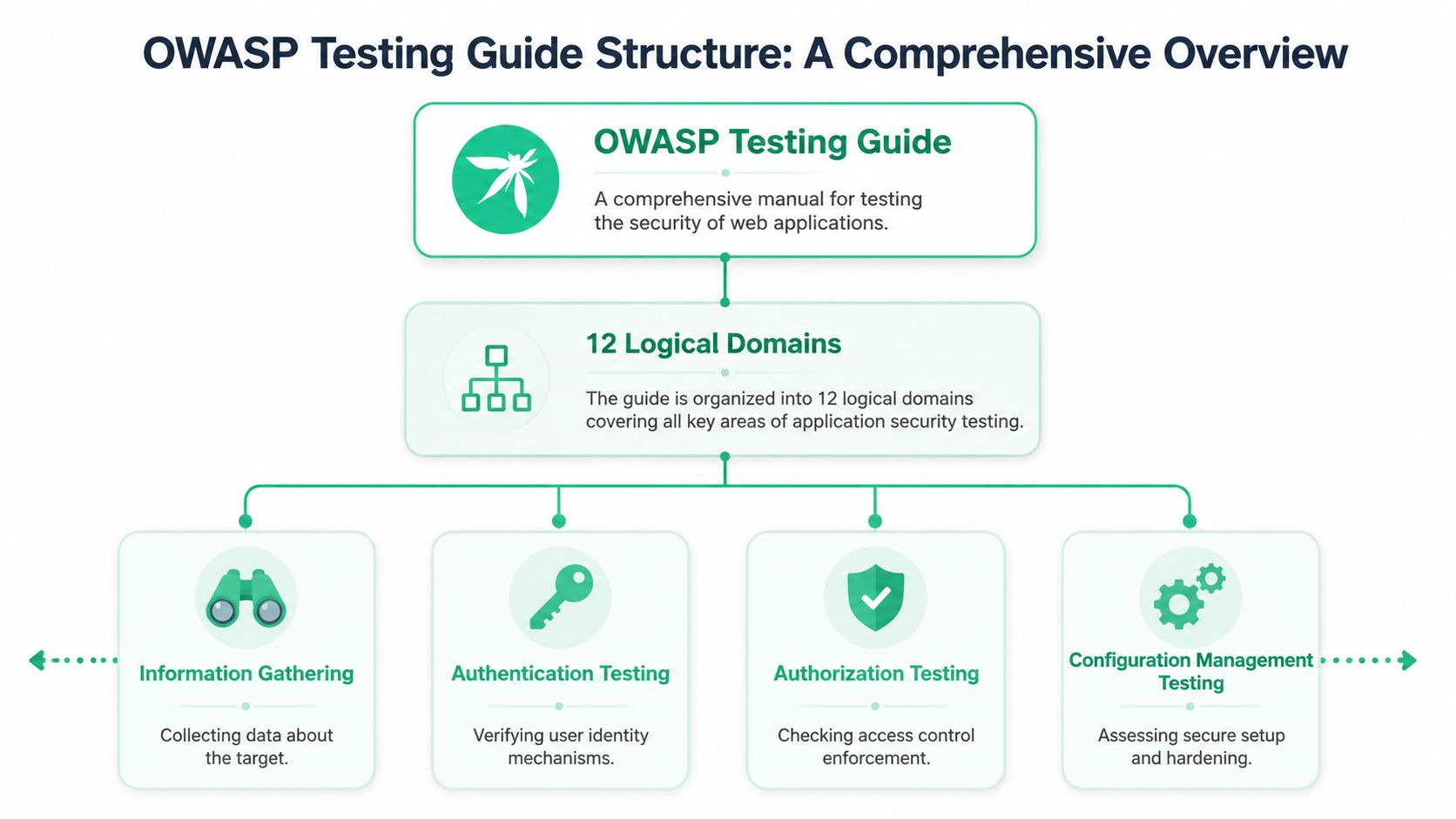
According to the OWASP v4.2 introduction and objectives, the guide defines 12 active-test categories covering the full web application attack surface: Information Gathering, Configuration and Deployment Management, Identity Management, Authentication, Authorization, Session Management, Input Validation, Error Handling, Cryptography, Business Logic, Client-side Testing, and API Testing.
What that looks like in practice
A tester doesn't just poke at the login page and call it done. The structure pushes them across the full app.
Here's the plain-English version:
| Area | What the tester is checking |
|---|---|
| Information gathering | What an attacker can learn before logging in |
| Authentication | Whether logins, passwords, and account checks are weak |
| Authorization | Whether users can reach data or actions they shouldn't |
| Session management | Whether sessions can be stolen, reused, or abused |
| Business logic | Whether the app's workflow can be manipulated |
| API testing | Whether backend endpoints expose the same weaknesses |
That's why a structured pen test feels different from ad hoc testing. The tester is moving through control families on purpose, not chasing whatever a scanner flags first.
Why managers and auditors care
A compliance officer wants to see that testing was systematic. An IT manager wants confidence that the obvious and non-obvious areas were both covered. A founder wants to know the report won't create more audit questions than it answers.
A good methodology reduces argument. It shows what was in scope, what was tested, and where the gaps are.
If you're comparing black-box and white-box approaches before a web application engagement, this piece on choosing effective software testing strategies is a useful primer. It helps frame how visibility into the application changes the testing depth and speed.
Why structure saves money
A structured methodology sounds formal, but it keeps costs under control. It prevents wasted tester time, avoids duplicate work, and makes reporting cleaner. That's one reason smaller teams should insist on a framework-backed penetration test instead of paying for “custom methodology” talk that often means less discipline, not more.
Practical OWASP Pentest Examples You Understand
Most buyers don't need another abstract explanation. They need to know what a tester does.
The OWASP guide includes over 90 individual tests with identifiers like WSTG-INFO-01 for reconnaissance, which helps testers produce auditable reports mapped to a stable taxonomy. Independent summaries also note it's especially effective at finding authorization, session, and business-logic flaws that scanners often miss, as described in this overview of the OWASP Web Security Testing Guide.
Example one broken access control
You have a customer portal. User A logs in and sees their own invoices. A tester asks a basic but critical question. What happens if User A changes a request so it asks for User B's invoice instead?
If the app returns someone else's data, that's a serious finding. A scanner might not catch it because the problem depends on understanding the app's user roles and object references.
Example two weak session handling
A tester logs in, signs out, then checks whether the old session still works. They also look at how the app handles session changes after login, password reset, or privilege changes.
If the app keeps a weak or reusable session token alive, an attacker who gets that token may continue acting as the user. That's not a theory problem. It's a real control failure.
Field advice: The ugly findings are often simple. Can one user act like another user. Can an old session still work. Can a workflow be abused out of order.
Example three business logic abuse
This is the category many teams underestimate. Say your app offers a discount, approval flow, coupon process, or account upgrade path. The tester checks whether that process can be manipulated in a way the developers didn't intend.
That might mean skipping a payment step, repeating a one-time action, or changing the order of requests. The issue isn't “bad code” in the usual sense. The issue is that the business process can be abused.
What the report should show
A useful penetration test report doesn't just say “high risk issue found.” It should show:
- What the tester did
- What happened
- Why it matters
- How to reproduce it
- How to fix it
That's what your engineering team needs. It's also what your auditor wants to see.
Mapping OWASP Tests to Your Compliance Needs
Compliance teams don't buy penetration testing because it sounds good. They buy it because auditors want proof that testing followed a recognized method and produced traceable findings.
That's where the OWASP Testing Guide is strong. The archived OWASP guide explains its compliance value as a framework of best practices for repeatable, evidence-based testing, which is especially important in regulated environments where auditors need standardized methodology and traceable results in the OWASP Testing Guide v4 archive PDF.
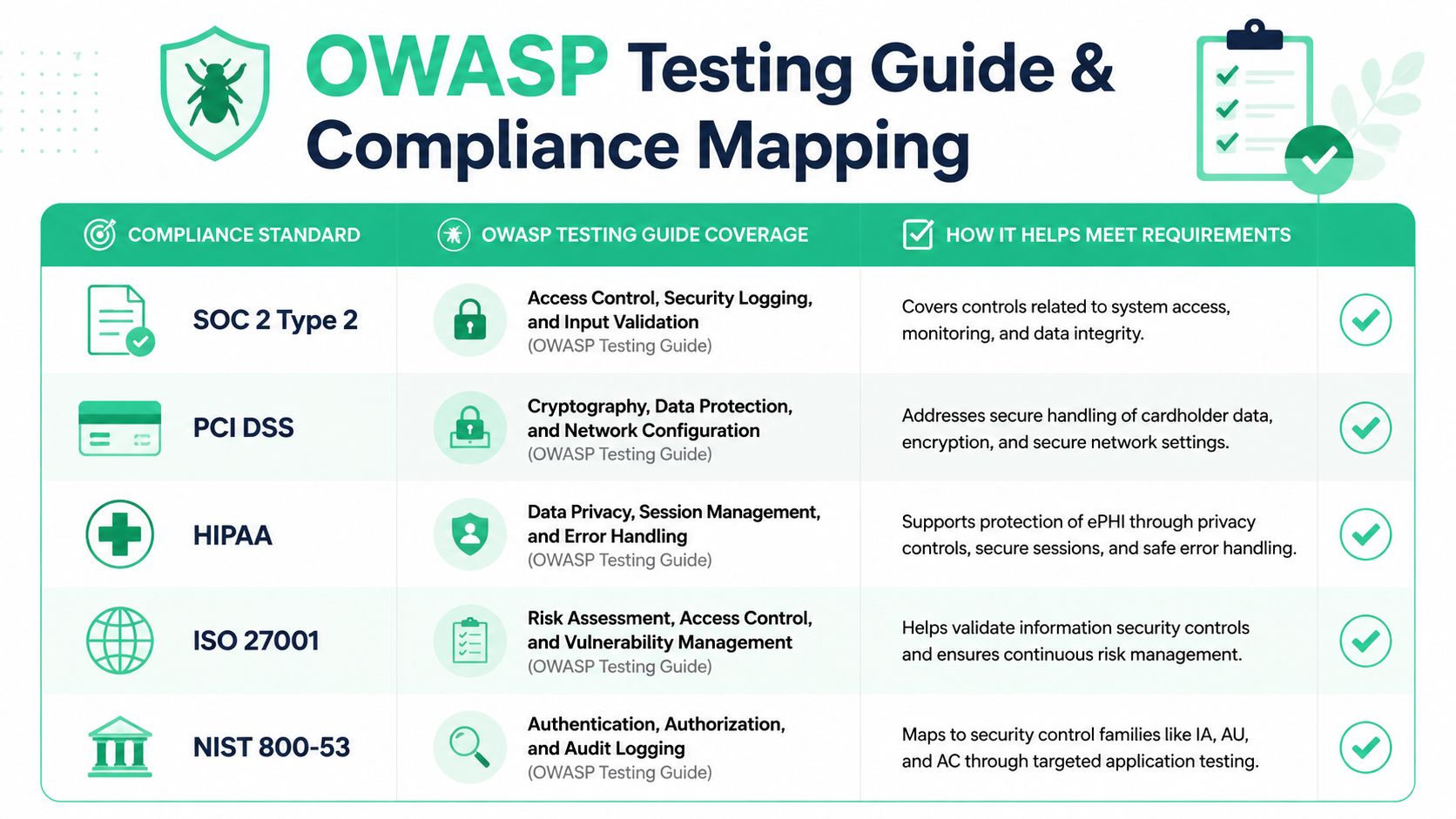
How auditors read a pentest report
Auditors usually care less about hacker theater and more about whether the test was structured, documented, and relevant to your environment.
Here's the practical mapping:
| Compliance need | OWASP testing areas that help |
|---|---|
| SOC 2 | Authentication, authorization, session management, input validation |
| PCI DSS | Input validation, cryptography, configuration, authentication |
| HIPAA | Authorization, session management, error handling, data protection checks |
This isn't about claiming a one-to-one control mapping for every framework clause. It's about producing evidence that security testing covered the application controls auditors routinely ask about.
What compliance buyers should ask for
When you order a pen test for audit support, ask these questions:
- Methodology clarity: What recognized framework is being used for web app testing?
- Evidence quality: Will findings include clear reproduction steps and remediation guidance?
- Traceability: Can the report show what test areas were covered, not just what issues were found?
If you also need a broader risk lens beyond external attack paths, this guide on proactive defense against internal threats is a useful companion read. It helps connect application findings to wider governance and operational risk.
Teams preparing for cardholder data reviews should also keep a Comprehensive PCI DSS testing resource handy. It helps translate pentest expectations into something finance, IT, and compliance can all work from.
Auditors don't need magic words. They need a credible method, evidence that the work was done, and a clean path from finding to remediation.
What not to accept
Don't accept a report that lists vulnerabilities without showing how the tester approached the application. And don't accept a vendor promise that “this should satisfy the auditor” if the report can't stand on its own.
A proper penetration testing deliverable should make your audit easier, not turn it into a negotiation.
Why Scanners Miss What This Guide Catches
Automated scanners have a place. They're useful for catching obvious issues, checking known patterns, and helping teams monitor changes between manual assessments.
But a scanner doesn't think like an attacker. It doesn't understand why a low-privilege user should never reach an admin-only action, or why a workflow can be abused by changing the order of requests. That's where manual pentesting matters.
The real difference
A scanner is good at breadth. A human tester is good at context.
Here's the split:
- Scanners catch known technical patterns and simple misconfigurations
- Manual testers catch broken authorization, weak session flows, and business logic abuse
- Good engagements combine both, but the report should clearly separate automated signal from manual validation
If your team is still sorting out the difference, this article on demystifying security audits for compliance is worth reading. It explains why a vulnerability assessment and a penetration test are not interchangeable.
Why auditors notice
Experienced auditors can usually tell when a “penetration test” was mostly scanner output. The report tends to be generic, repetitive, and light on proof. Manual testing leaves a different footprint. The findings are more contextual, the evidence is clearer, and the remediation advice is more specific to the application.
That distinction matters if you want the report to survive scrutiny.
How We Deliver An OWASP Pentest In A Week
Speed doesn't come from cutting corners. It comes from removing waste.
A focused web application penetration test can move quickly when the scope is clear, the testers are experienced, and the reporting process isn't buried under layers of admin overhead. That's the model that works best for startups, SMBs, and lean security teams.
What fast delivery actually requires
The process is straightforward:
Tight scope at kickoff
Define the application, environments, user roles, and any test accounts up front.Certified manual testers
Put experienced people on the keyboard. OSCP, CEH, and CREST matter because you want testers who know how to validate a real issue, not just echo tool output.OWASP as the roadmap
The guide keeps the work disciplined. It helps testers move quickly without skipping major web app areas.Clean reporting workflow
Findings are documented as the engagement runs, not dumped into a report at the end by someone who didn't do the testing.
Fast pentesting only works when the same team that finds the issue can explain it clearly and write it up without delay.
Why big firms often take longer
Large consultancies often slow things down with handoffs. Sales talks to delivery. Delivery talks to project management. Project management talks to the tester. Then the report gets reviewed by people who were nowhere near the keyboard.
That model costs more and usually produces less useful findings per dollar.
What buyers should prioritize
If you need results quickly, choose a provider that can answer these plainly:
- Who does the testing
- How findings are validated
- When you get the draft report
- Whether the report is auditor-friendly
If your main concern is balancing quality and budget, start with this guide to explore Affordable Pentesting. It lays out what a leaner, more practical buying process should look like.
Get Your Audit-Ready Pentest Report Now
You do not need a bloated engagement to get a credible pentest report. You need a recognized methodology, manual validation, and a report your auditor can follow without a second meeting to decode it.
The OWASP Testing Guide gives structure to the work. A skilled tester turns that structure into real findings. That combination is what makes a penetration test useful for SOC 2, PCI DSS, HIPAA, customer due diligence, and internal risk reviews.
The bottom line
If you're choosing between a cheap scanner report and an overpriced consulting marathon, reject both.
Choose a pen test that is:
- Manual enough to find real issues
- Structured enough to satisfy auditors
- Fast enough to meet your deadline
- Affordable enough to repeat when needed
Your audit doesn't care how fancy the sales deck was. It cares whether the testing was credible and whether the report is clear.
If that's what you need, stop waiting and get the process moving through the contact form today.
If you need an audit-ready report without the usual delays and inflated pricing, Affordable Pentesting is built for exactly that. Their team delivers manual pentests, pen testing, and penetration testing support for SOC 2, PCI DSS, HIPAA, ISO 27001, and more, with certified testers and a practical process that fits startups and SMBs.