.svg)

Your auditor asked for a pen test report. Your team is still fixing tickets. The vendor you talked to quoted a huge price, promised a long timeline, and then showed you a sample report that looked like a dressed-up scanner export.
That's the problem. Most companies don't need enterprise theater. They need a real penetration test, a usable pen testing report, and enough proof to satisfy SOC 2, PCI DSS, HIPAA, or ISO 27001 without burning a month on sales calls.
A lot of founders and IT managers get stuck between two bad options. One is the traditional firm that takes forever and costs a lot. The other is the cheap scan-checker that gives you a PDF full of generic findings and almost no evidence. Neither helps when an auditor asks simple questions like what was tested, what was exploitable, what was fixed, and where the proof is.
Why You Need a Pen Test Report
If you've got an audit date coming up, the pen test report is not a side deliverable. It's the evidence package that proves someone tested your environment and documented what matters.
That matters because the normal timeline is slow. A typical penetration test engagement generally takes four to six weeks from planning through final report delivery, with more time often needed for report development and remediation review meetings, according to HALOCK's penetration testing timeline overview. If your audit clock is already ticking, that timeline feels brutal.

Auditors Want Proof Not Promises
A real pen test report shows three things fast. First, what was in scope. Second, what an attacker could do. Third, what your team needs to fix next.
If your vendor can't explain those three things in plain English, the report probably won't help much. Auditors don't care that a company ran a tool. They care that the work was performed, documented, and tied to risk.
Practical rule: If the report reads like a software export with a logo on top, it's probably not enough.
Speed Matters More Than Most Firms Admit
You don't need endless process for a startup web app or a focused internal assessment. You need a manual pentest done by people who know how to test like attackers and write like adults.
That's why speed matters. Getting your report within a week after testing is a practical goal for fast-moving teams, especially when you're dealing with release cycles, compliance deadlines, and limited engineering time. Slow reports lose value because your environment keeps changing.
Cheap And Affordable Are Not The Same
Cheap usually means shallow. Affordable means the scope is focused, the testers are qualified, and the report is still good enough to act on and hand to an auditor.
That's the line you should care about. A real penetration testing report saves time twice. It helps you pass the audit review, and it gives your developers a clear fix list instead of vague noise.
What a Penetration Testing Report Actually Is
A penetration testing report is basically a house inspection for your software, cloud setup, or internal network. It doesn't just say “the window is weak.” It shows how someone could open the window, get inside, move around, and what to repair first.
Formally, a penetration testing report is a formal document detailing vulnerabilities found during a simulated attack, including evidence, risk ratings, and specific remediation recommendations. Frameworks like PTES, OWASP, and NIST shape the structure so it works as the main communication tool between ethical hackers and IT stakeholders, as explained in Wiz's guide to penetration testing reports.

It Should Tell A Story
A good pen test report isn't just a list of bugs. It tells the story of the simulated attack in a way your leadership team, engineers, and compliance people can all use.
That means the report should answer basic questions clearly:
- What was tested: Apps, APIs, cloud assets, internal systems, or user roles
- What was found: The actual weaknesses, not generic categories alone
- Why it matters: Business impact in plain English
- How to fix it: Specific steps your team can take
If you're securing web applications with pen testing, this matters even more because web findings often depend on context. A broken access control issue in one app might expose customer data. In another, it might only leak low-risk content. The report should explain the difference.
Human Review Is The Whole Point
A real pentest notably surpasses a scanner. A scanner might tell you a header is missing. A human tester shows whether that weakness can be combined with another issue to access sensitive data, change settings, or bypass controls.
That's why certifications like OSCP, CEH, and CREST matter. They don't guarantee a perfect report, but they do signal that the tester has trained for real offensive work and structured reporting. For startup teams, that usually means fewer empty findings and more practical ones.
The best report is the one your developer understands on the first read and your auditor accepts on the first pass.
A Good Report Reduces Friction
Your CISO or founder needs the summary. Your engineer needs the steps. Your compliance lead needs evidence. One document should serve all three without turning into a jargon dump.
That's what a penetration test report is supposed to do. It translates technical work into decisions.
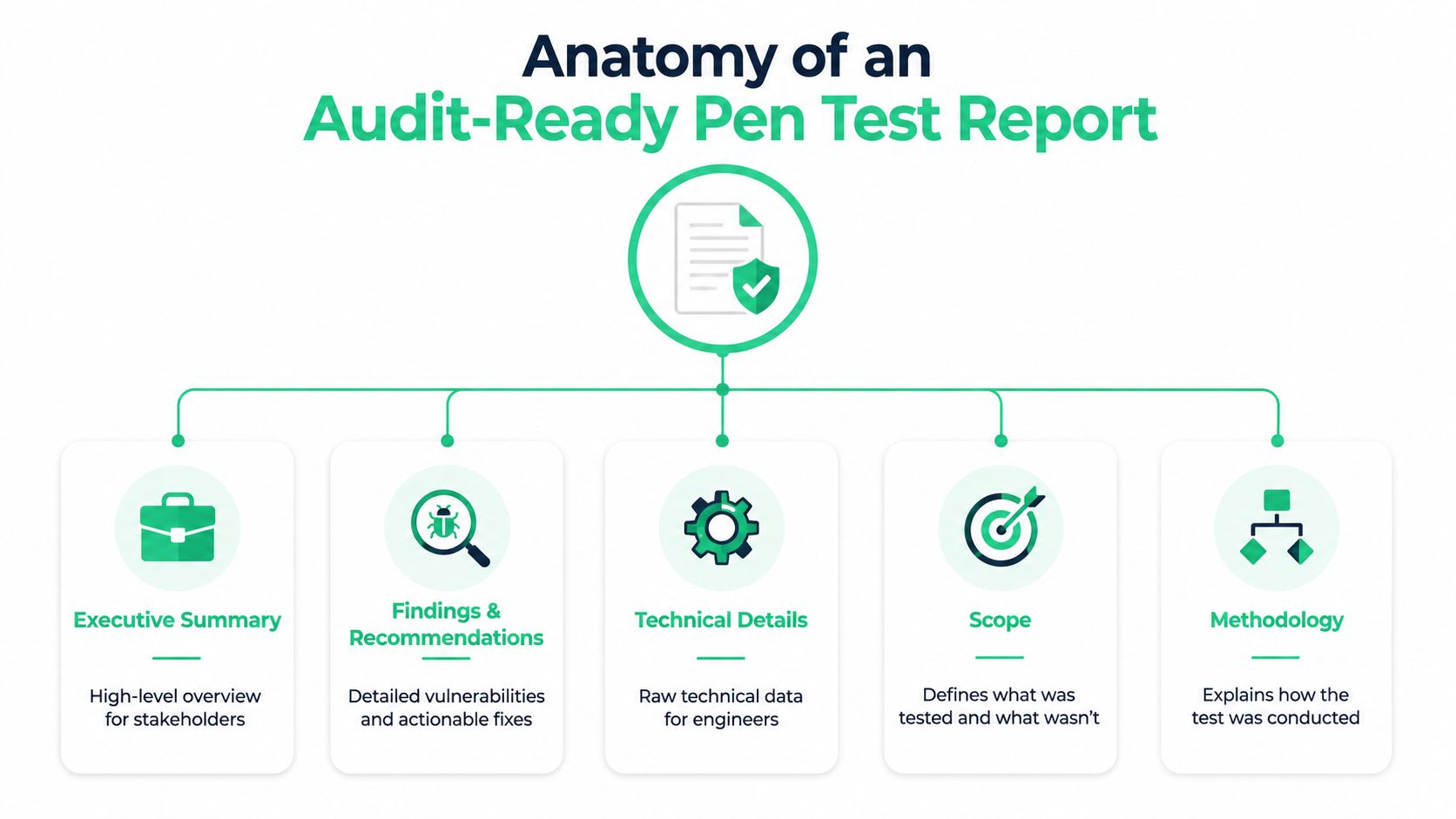
Anatomy of an Audit Ready Pentest Report
If you want a report that survives audit review, it needs structure. Not fancy design. Structure.
The Sections That Actually Matter
Here's the short version of what an audit-ready pen testing report should include.
| Report section | What it does | Why the auditor cares |
|---|---|---|
| Executive summary | Gives leadership a plain-English risk snapshot | Shows management saw the results |
| Scope | Lists what was tested and what was excluded | Proves the engagement matched your environment |
| Methodology | Explains how the tester performed the pen test | Shows the work was systematic, not random |
| Findings and recommendations | Details each vulnerability and how to fix it | Gives evidence and a remediation path |
| Technical appendix | Includes supporting artifacts and logs | Backs up the claims with proof |
Executive Summary First
This is the part your founder, board contact, or compliance lead will read. It should explain overall risk, major weaknesses, and what needs attention now.
If the summary is too technical, it fails. If it's too vague, it also fails. A good summary says what happened, what was exposed, and what the business should do next.
Findings Need Evidence
Every real finding should include proof. Screenshots, request and response details, output snippets, and enough context for an engineer to reproduce the issue.
Without evidence, the report turns into opinion. Auditors hate that. Engineers hate it even more.
Context Beats Generic Severity
Severity labels alone don't solve much. “High” is useful only if the report explains what that high-risk issue allows an attacker to do in your environment.
Professional reports should also map findings to MITRE ATT&CK so teams can connect each issue to real attack techniques. That mapping turns isolated vulnerabilities into attack narratives your defenders can use to tune detections and show auditors they're thinking about real-world threats, as described in the PTES reporting guidance.
A scanner says “there is a problem.” A pentester says “here is how I used it, here is what I reached, and here is how to stop me.”
The Appendix Is Not Filler
A lot of bad vendors treat the appendix like a dump folder. Good ones use it as evidence storage that supports the findings section.
Look for artifacts like:
- Raw outputs: Enough to validate what the tester saw
- Logs: Useful when you need to show test activity was documented
- Diagrams: Helpful when scoping is questioned
- Referenced evidence: Linked back to the exact finding it supports
That last part matters. Dumping pages of tool output into the back of the report without tying it to findings is lazy. It doesn't help your team fix anything, and it won't impress an auditor.
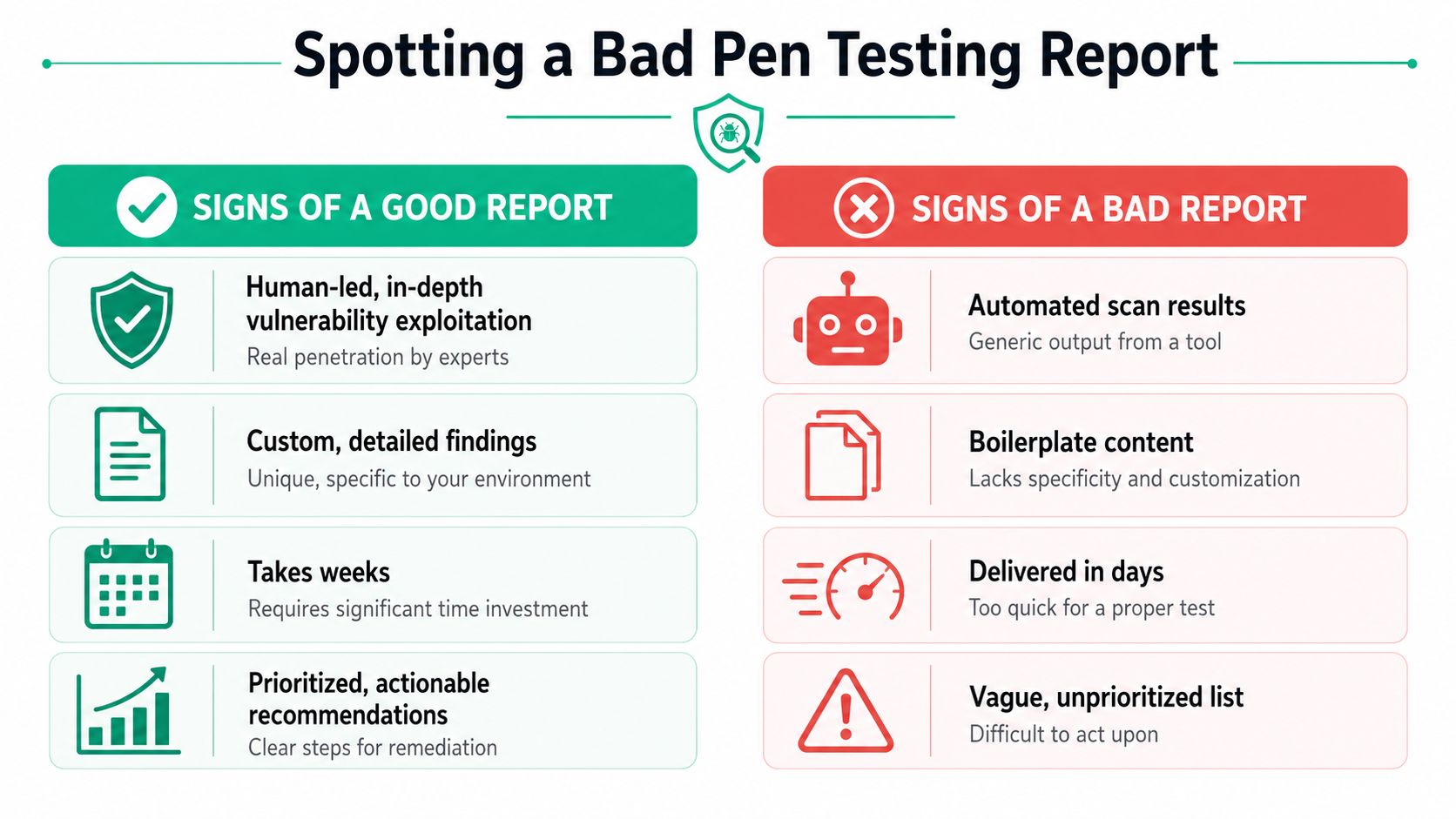
Spotting a Bad Pen Testing Report
A bad pen testing report usually looks polished at first. Nice cover page. Clean severity chart. Lots of pages. Then you read the findings and realize it's mostly boilerplate.
That's the trap. Many companies buy what they think is pentesting, but what they really get is an automated vulnerability scan with a human doing light cleanup.
What A Weak Report Looks Like
The biggest red flag is generic content. The report lists issues, but it never explains how the tester chained them together, what data was exposed, or what path an attacker used.
Another bad sign is missing proof. If there's no exploitation detail, no screenshots, no attack flow, and no clear remediation steps, you're probably looking at scanner output with branding.
Here's a simple comparison:
| Weak report | Strong report |
|---|---|
| Generic findings copied from a tool | Findings tailored to your app or network |
| No attack narrative | Clear story of how access was gained |
| Little or no evidence | Screenshots, logs, and reproducible steps |
| Vague remediation | Specific fixes for your team |
| Good for checking a box badly | Good for audits and real security work |
Why Auditors Reject The Cheap Stuff
There's a documented gap between a “vulnerability scan with human fact-checking” and a true penetration test. That gap leads to reports that fail compliance auditors. High-quality tests identify over 10 vulnerabilities on average and include CVSS severity baselines, while low-quality reports often miss the attack narratives expected for PCI DSS, HIPAA, and SOC 2, according to Software Secured's comparison of high and low quality pentests.
That should change how you buy. “Affordable” should never mean “no human exploitation.” It should mean focused scope, manual testing, useful reporting, and no fake enterprise packaging.
Fast Isn't Bad If The Work Is Real
A lot of buyers get confused here because some weak vendors promise delivery in days, while some good teams can also move fast. The difference is whether the report shows human judgment.
Ask blunt questions before you sign:
- Who is doing the testing: Ask whether the pentesters hold certifications like OSCP, CEH, or CREST
- Will findings include exploitation detail: If the answer is fuzzy, walk away
- Will the report explain business impact: It should
- Will there be a retest option: There should be
If the vendor can't explain the difference between a scan and a manual penetration test in plain English, don't trust the report.
Mapping Report Findings to Your Compliance Goals
Compliance teams don't need a giant theory lesson. They need to know how the pen test report helps answer audit questions.
A good report gives you evidence that your controls were tested, weaknesses were documented, and remediation can be tracked. That's why this document matters so much in SOC 2, PCI DSS, HIPAA, and ISO 27001 reviews.
Turn Findings Into Audit Evidence
Think of each finding as more than a bug. It's a record that shows your company looked for weaknesses, assessed risk, and created a fix plan.
For example:
- Access control failure: Shows whether users can reach data or functions they shouldn't
- Injection issue: Shows whether input handling is weak and could expose sensitive data
- Weak authentication flow: Shows whether identity controls can be bypassed
- Cloud misconfiguration: Shows whether your environment is secure in practice, not just on paper
That's the difference between “we take security seriously” and “here is the documented proof.”
Use The Report With Your Framework
If your audit is for SOC 2, pair the report with your change management records and remediation tickets. If it's for PCI DSS, use it to show tested payment-related scope and documented findings. If it's HIPAA, show how the report supports your risk management process.
Teams that need a narrower compliance path often benefit from focused SOC 2 compliance pentesting services because the scope, evidence, and report language tend to line up better with what the auditor asks for.
You should also keep supporting references on hand. This visual resource on strategies for robust cybersecurity compliance is useful when you need to explain to leadership how the pen test report fits into the bigger compliance program.

What Compliance Reviewers Usually Want
They usually want straightforward answers:
- What systems were tested
- What issues were found
- How serious the issues were
- What your team did about them
- Whether fixes were validated
If your report supports those answers cleanly, it does its job. If your team has to create a second document just to make the findings understandable, the original report wasn't strong enough.
How to Prioritize and Remediate Findings
Once the report lands, don't overcomplicate the next step. Fix what can hurt you most, prove it was fixed, and keep records clean.
That matters even more because the market keeps expanding around compliance-driven testing. The global penetration testing market was valued at USD 2.74 billion in 2025 and is projected to grow at a 15.29% CAGR through 2031, driven by frameworks like PCI DSS, HIPAA, and SOC 2 that require detailed reports to validate security posture, according to Mordor Intelligence's penetration testing market analysis.
Start With What Attackers Would Use First
Don't begin with the easiest fix. Begin with the finding that gives an attacker the most advantage.
A simple order works well:
Critical and high risk findings first
These are the items most likely to lead to meaningful compromise, data exposure, or privilege escalation.Anything internet-facing next
If an external attacker can reach it, move it up the queue.Privilege and access issues before cosmetic flaws
Broken auth beats a missing header every time.Fix chains, not single bugs in isolation
If two medium issues combine into real access, treat them like a serious problem.
Assign Clear Owners
Security teams usually don't own all the fixes. Developers, cloud engineers, DevOps staff, and IT admins do.
Keep the handoff simple:
- Engineering owns code fixes
- Cloud or infrastructure teams own configuration fixes
- Security validates remediation
- Compliance tracks evidence and dates
If your team needs a practical workflow, this practical guide to fixing vulnerabilities is a good model for turning findings into action items without creating ticket chaos.
Fixing vulnerabilities is only half the job. The other half is proving the fixes worked.
Retest Before You Call It Done
A retest is where the report becomes audit-ready again. Your team deploys the fixes, the tester validates them, and you get proof that the original findings were resolved or reduced.
That final validation matters. Without it, you're often telling the auditor “trust us, we fixed it.” With it, you're saying “the original issue was retested and the evidence is attached.”
Your Simple Pentest Report Handoff Checklist
Teams often don't fail at the penetration test. They fail in the week after it, when the report is sitting in someone's inbox and nobody owns the next move.
Use this checklist and keep it boring. Boring is good here.
Do These Steps In Order
Book the debrief fast
Meet with the pentester while the testing details are still fresh. Ask where the biggest risk is, what was exploitable, and what should be fixed first.Send the executive summary to leadership
Your founder, CISO, or compliance lead does not need every screenshot. They need the short version, the business impact, and the plan.Turn findings into tickets
Don't leave the report as a PDF artifact. Break each remediation item into tickets your developers and IT staff can work.Track evidence as you fix issues
Keep screenshots, pull requests, change notes, and validation records. This makes retesting and audit review much easier.
Package It For The Auditor
After fixes are in place, request the retest and collect the updated documentation. Then bundle the original report, the remediation notes, and the retest result in one clean package.
A smooth handoff usually includes:
| Item | Why it matters |
|---|---|
| Final report | Shows the original scope and findings |
| Remediation notes | Shows your team acted on the findings |
| Retest confirmation | Shows the fixes were validated |
| Scope details | Helps answer audit follow-up questions |
Keep The Process Repeatable
The best pen testing process is one your team can repeat without drama. Clear scope, manual testing, a readable report, fast remediation, and a retest. That's it.
If a vendor makes this feel confusing, they're part of the problem. Good penetration testing should reduce chaos, not create more of it.
If you need a real pen test report without enterprise pricing games, Affordable Pentesting is built for startups, SMBs, and compliance-focused teams that want manual pentests, fast reporting, and certified testers. Use the contact form to get a scoped quote and move your audit forward without wasting weeks.