.svg)
Your audit is coming up. Your cloud controls are documented, your endpoint tools are deployed, and then someone asks a simple question: who can walk into the office, tailgate through a side door, or reach the server closet?
That's where a lot of teams freeze.
Most startups and SMBs don't ignore physical security because they don't care. They ignore it because traditional firms make physical pentesting sound like a secret-agent exercise with enterprise pricing, slow timelines, and a bloated scope you never asked for. That's a mistake. Physical security testing is practical, scannable, and very doable if you scope it right.
What Is Physical Security Testing Anyway
Physical security testing is a controlled attempt to see whether someone can get into places they shouldn't. That could mean your office, your server room, your file storage area, or any room where sensitive systems and data live.
Imagine it as checking whether you locked your front door, except the “front door” now encompasses badge readers, visitor procedures, side entrances, reception staff, camera coverage, and employee habits. A physical pentest, pen test, or penetration test asks a blunt question: if a motivated outsider showed up today, would your controls stop them?
A lot of companies still treat this like a niche service for giant corporations. That's outdated. Real-world incidents keep pushing this into the mainstream. ISACA's white paper on physical penetration testing cites Pro-Vigil survey data showing that 28% of respondents saw an increase in physical security incidents in both 2021 and 2022, and it also cites a Market.us analysis saying 60% of companies encountered breaches in their physical security measures over the past 5 years.
That matters for one reason. Your office is part of your attack surface.
Practical rule: If someone can physically reach your laptops, networking gear, paper records, or unattended workstations, your digital controls are already under pressure.
You don't need to turn your office into a fortress. You need to test whether the basics work. That means doors that latch, badges that are verified, visitors who are challenged, and restricted rooms that stay restricted.
If you need a simple baseline before you pay for any pen testing, these Comprehensive workplace protection tips are a useful gut-check. They won't replace a physical penetration test, but they'll help you spot obvious holes before an auditor or intruder does.
Types Of Physical Penetration Testing Explained
Some founders hear “physical penetration testing” and think of movie nonsense. That's not what this is. A real tester uses ordinary human behavior, weak procedures, and overlooked entry points.
Social Engineering At The Front Door
A tester may show up looking like they belong. Maybe they act like a new hire who forgot their badge. Maybe they claim to be IT support. Maybe they carry a box and wait for someone polite to hold the door.
That's social engineering in the physical world. It tests whether your people verify identity or just wave someone through because it feels awkward to ask questions.
Many penetration testing engagements quickly expose critical vulnerabilities. A good tester doesn't need magic tools if your staff lets unknown people ride in on trust.
Entry And Access Control Testing
This part checks whether your doors, locks, RFID badges, alarms, and interior barriers hold up. Not in theory. In practice.
Common targets include:
- Main entrances: Can someone tailgate through a badge-controlled door without being challenged?
- Side and rear doors: Do they close fully, or do they stay cracked open during deliveries and breaks?
- Restricted rooms: Can a person who enters the office move into the server room, wiring closet, or records area too easily?
- Badge systems: Are access cards tightly controlled, or is there a weak process around issuing, sharing, and revoking them?
If you want the broader context on where a physical pen test fits beside app, network, and social engineering work, this guide to pentest types for businesses helps frame the options without overcomplicating it.
Surveillance And Detection Checks
Some offices have cameras everywhere and still miss the obvious. Physical security testing also checks whether your monitoring setup helps or just gives everyone a false sense of safety.
A tester looks for camera blind spots, doors that aren't watched, weak visitor sign-in habits, and alarms that are easy to bypass or slow to trigger a response. The issue isn't whether you bought security hardware. The issue is whether anyone would notice suspicious behavior in time to matter.
A camera that records an intruder after they reach your network closet is not a strong control. It's evidence.
Inside The Office Matters More
The first door is only half the job. Once a tester is inside, they'll look for unattended laptops, screens left open, exposed documents, spare badges, meeting room network access, and offices that hold sensitive material with no extra control.
This is why physical pentesting works. It doesn't stop at the lobby. It checks whether your internal habits are protecting you or insidiously undermining you.
How To Scope A Physical Pentest Affordably
A lot of companies waste money when a big firm shows up, throws around “red team” language, and hands you a massive proposal that treats your twenty-person office like a global bank.
Don't buy that plan unless you need it.
A smart physical pentest starts with what matters most, not with every square foot of your lease. If your audit is coming up, or your budget is tight, scope the engagement around the rooms and processes that create real risk.
Start With High-Value Areas
You probably don't need someone testing every conference room and kitchen entrance. You do need to know whether the places tied to sensitive data or business operations are exposed.
Focus first on:
- Server and network rooms: If someone reaches switches, firewall hardware, or backup devices, the rest of your controls can unravel fast.
- File and records storage: This matters if you handle HR files, customer records, legal paperwork, or regulated data.
- Executive and finance areas: Founders, HR, and finance teams often hold contracts, payroll details, and strategic information.
- Reception and visitor flow: Many failures happen before the intruder ever reaches a locked room.
Cut Scope Without Cutting Value
You save money by making the test precise. Define one office, a few in-scope entry points, a short list of critical rooms, and a clear list of acceptable test methods.
That gives you a practical engagement instead of an expensive adventure. It also makes remediation easier, because your report points to a manageable set of failures instead of drowning you in noise.
If you want a simple way to think about priorities before you request quotes, GM GROUP Services' risk assessment guide is a useful planning reference. It helps you separate “nice to check” from “must test now.”
Founder view: If a vendor can't help you narrow the scope, they're probably trying to grow the invoice.
Ask For A Tight Statement Of Work
Before you approve any penetration testing engagement, ask for plain language on these points:
- What locations are in scope
- What entry methods are allowed
- What hours the test can happen
- What evidence will be collected
- What report you'll receive
- How quickly you'll get results
If the answer sounds vague, expect a vague outcome. Good physical security testing should feel controlled, focused, and affordable.
Meeting Compliance With Physical Security Tests
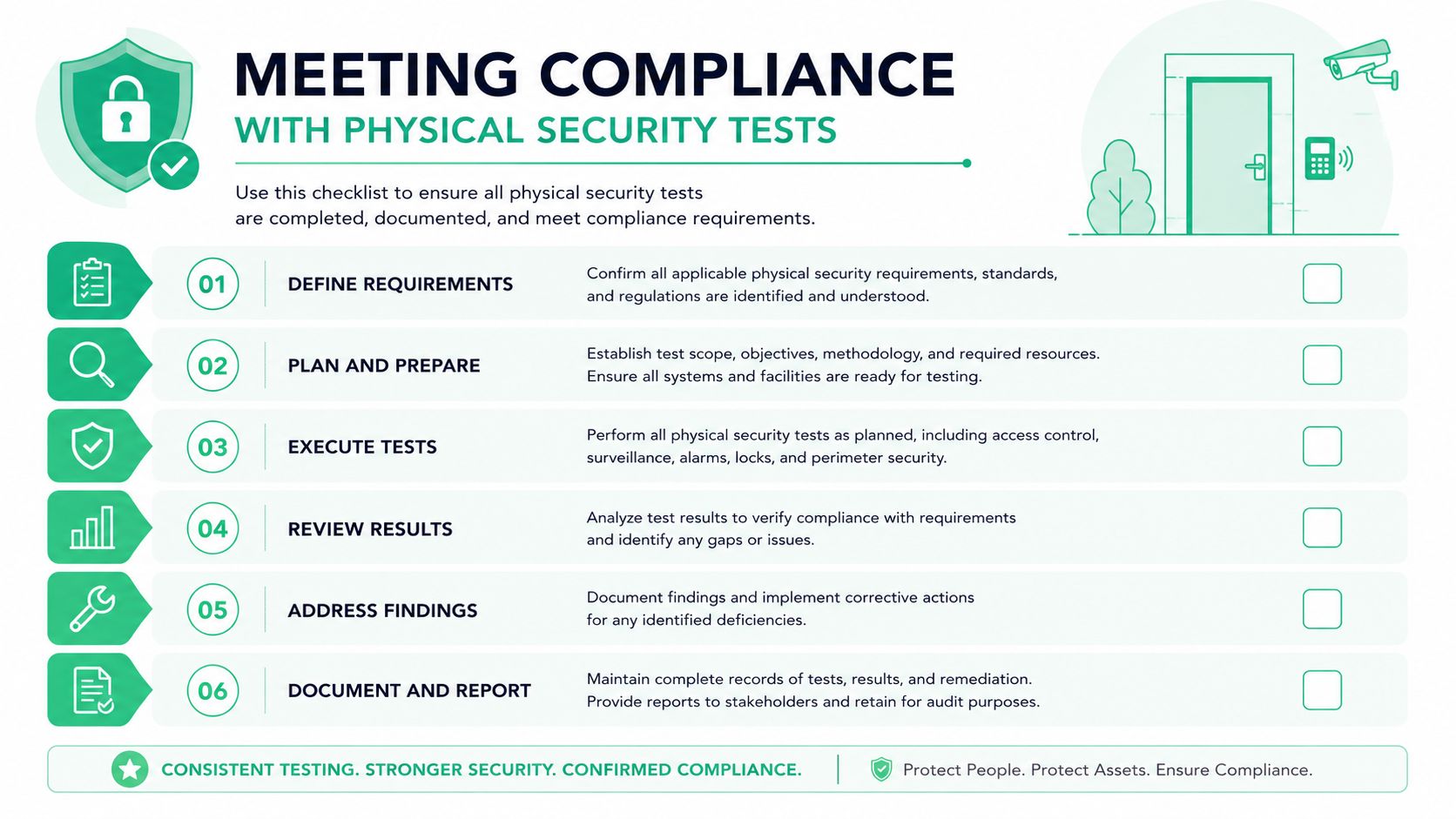
Auditors care about physical access for a simple reason. Data doesn't only live in the cloud. It lives on laptops, printed documents, backup devices, local infrastructure, and in rooms where people work.
If your compliance program says access is restricted, a physical penetration test gives you evidence that the restriction works in real life.
Why SOC 2 Reviewers Care
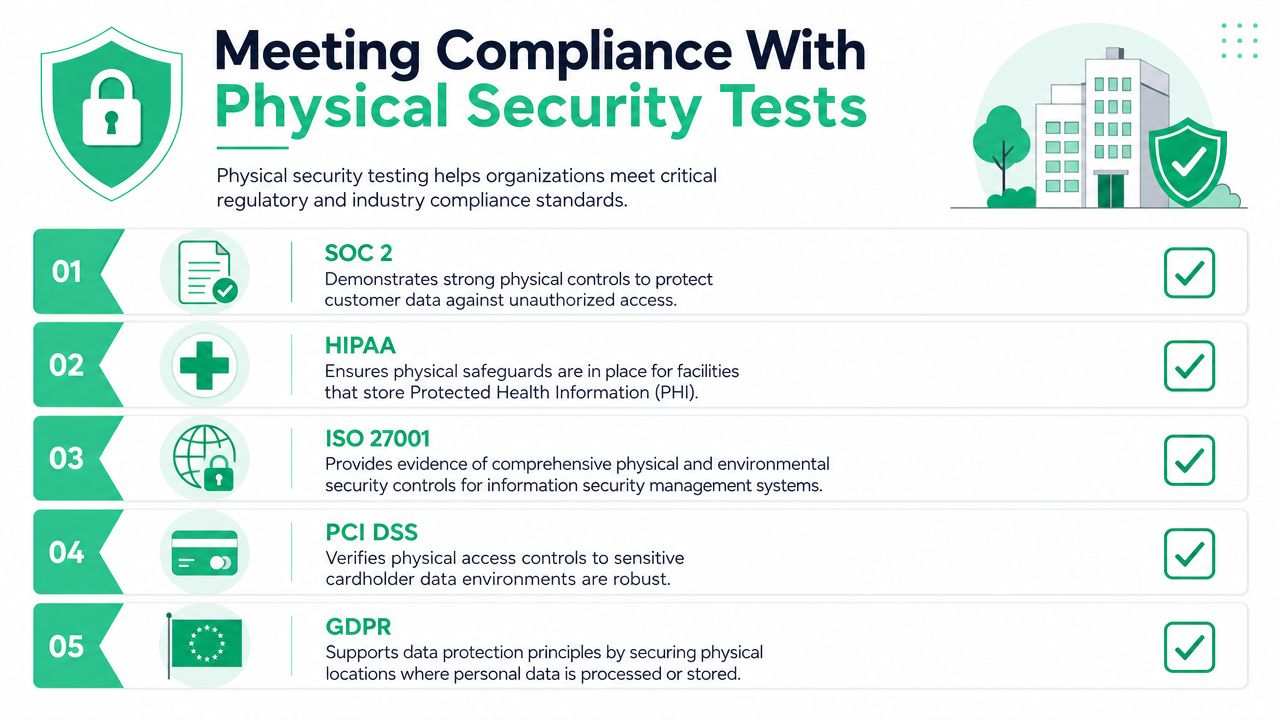
SOC 2 is about trust controls, not just software settings. If unauthorized people can enter spaces where systems or sensitive information are accessible, your security story gets weak fast.
A reviewer wants to see that physical access is limited, monitored, and backed by procedure. That means visitor handling, badge controls, locked areas, and actual enforcement. A physical pen test helps prove the control isn't just written down in a policy binder.
Why PCI DSS Gets Specific
If your business touches payment data, your cardholder environment matters. Auditors don't just care about encryption and access logs. They care whether somebody can physically reach systems, paperwork, or devices tied to payment processing.
That's why a penetration test of your office or facility can be useful evidence. It shows whether doors, interior restrictions, and staff behavior protect the environment the way your documentation says they do.
Why HIPAA Requires More Than Good Intentions
Healthcare and health tech teams often focus hard on digital safeguards. They should. But PHI can still be exposed through ordinary physical mistakes, like files left out, unsecured workstations, or rooms anyone can enter without challenge.
If you handle protected health information, physical safeguards aren't optional. Testing them is one of the clearest ways to show that your controls have substance. If that's your world, start with how to secure your HIPAA data and then make sure your facility controls match the same standard.
Auditors don't want a speech about your security culture. They want evidence that restricted access is actually restricted.
What Good Evidence Looks Like
A strong compliance-focused physical pentest usually helps you document:
- Access control failures: doors, locks, badges, or tailgating issues that create exposure
- Procedure gaps: visitor check-in, escort rules, challenge procedures, and room-level restrictions
- Supporting proof: photos, timelines, tester notes, and remediation steps you can track
- Follow-up actions: concrete fixes you can show during audit prep or control reviews
That's the point. Not theater. Evidence.
A Sample Physical Test Plan And Checklist
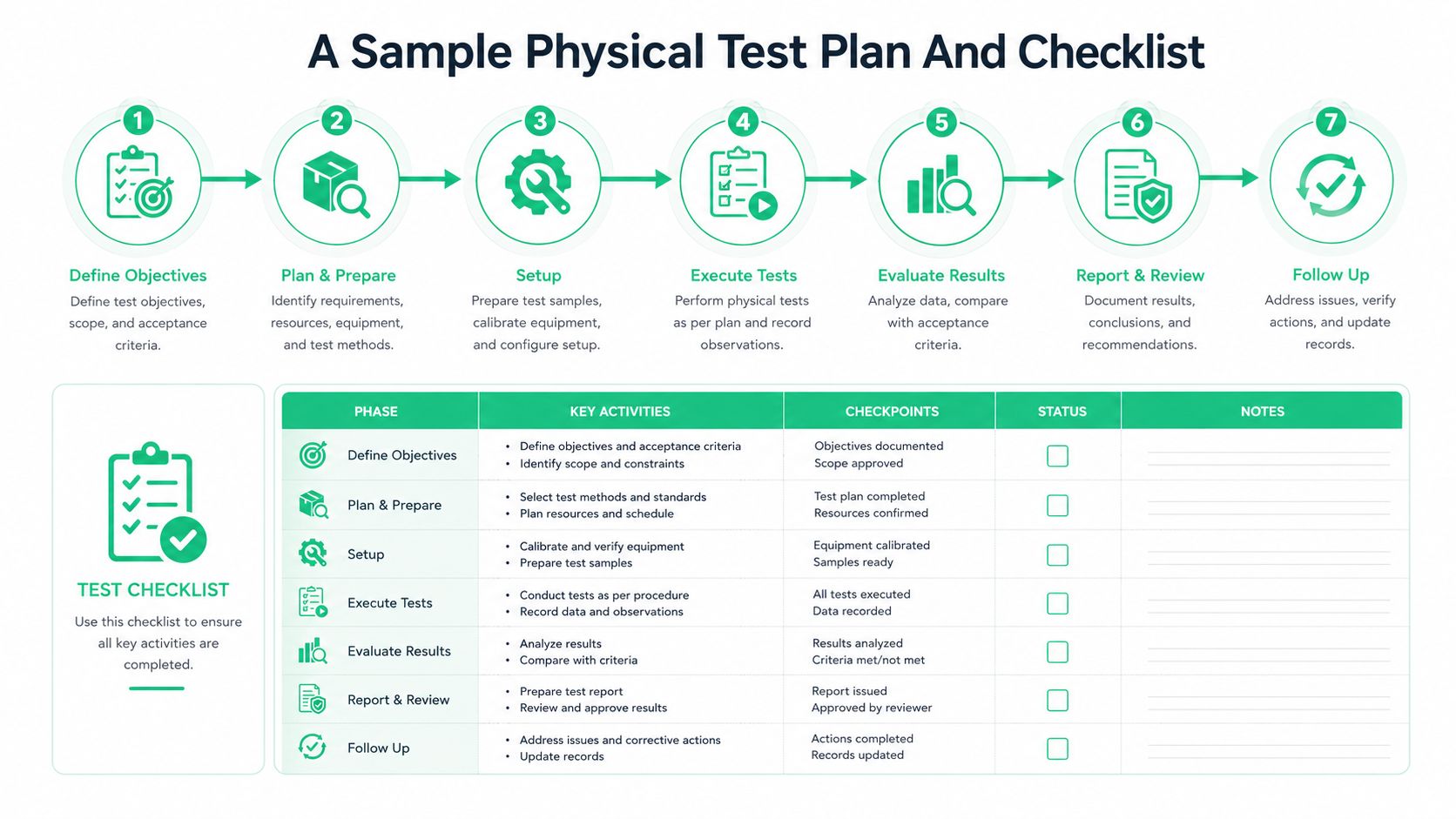
A good physical penetration test shouldn't feel chaotic. If it does, the vendor is sloppy. You want a clear plan, written rules, and a predictable reporting process.
Here's what a simple engagement usually looks like.
Rules Come First
Before the test starts, both sides should agree on scope, timing, safety boundaries, and emergency contacts. That includes what buildings are in scope, what doors or rooms can be tested, and what actions are off-limits.
No one should be guessing during a physical pentest. If the tester is allowed to attempt tailgating but not lock manipulation, that needs to be explicit. If executive offices are in scope but employee personal items are not, write it down.
A Simple Checklist That Works
Use this as a baseline:
Define scope clearly
Name the office, floors, rooms, entry points, and approved test windows.Set rules of engagement
Confirm allowed methods, escalation contacts, safety rules, and stop conditions.Gather recon information
Review public details, office layout clues, visitor patterns, and likely weak spots.Attempt entry
Test access through approved methods such as tailgating, pretexting, or badge process abuse.Test internal movement
Check whether the tester can move from public areas into restricted spaces.Capture evidence
Record what worked, what failed, and what control was bypassed.Deliver the report
Summarize findings, rank risk, and list concrete remediation actions.
What You Should Expect From The Vendor
A serious provider keeps the process professional. That means they won't damage property, create panic, or freestyle outside the agreed scope.
If you want a broader security perspective around offices, devices, and related infrastructure, this playbook for securing physical assets is worth reading alongside your physical test plan.
Good testing creates useful friction. Bad testing creates drama.
Understanding Your Fast Pentest Report
The test is only half the value. The report is what your leadership team, IT staff, and auditor will use.
If your vendor disappears for weeks and then sends a bloated document full of recycled boilerplate, that's not helpful. You need something readable, fast, and tied to action.

What A Good Report Includes
A useful physical pentest report should give you three things immediately.
- Executive summary: A short explanation leadership can understand without technical translation.
- Findings list: Each issue described plainly, with severity such as High, Medium, or Low.
- Fix guidance: Specific steps your team can take to close the gap.
You should be able to hand the report to an office manager, an IT lead, and a compliance person, and each one should know what to do next.
Speed Matters Because Audits Don't Wait
A fast report changes the whole engagement. If you get results within a week, you can fix urgent issues while the test is still fresh, update policies, and show progress before your audit window closes.
That's a big deal for startups. You don't have time for a month of silence after a pen test. You need findings while they're still useful.
How To Read The Findings
Don't treat every issue the same. Start with anything that gives an intruder direct access to systems, records, or restricted rooms. Then fix the process failures that made that access easy, such as weak badge checks or visitors moving without escorts.
After that, clean up the lower-risk issues that still create audit friction. Missing signage, bad visitor logs, or inconsistent door discipline may not be catastrophic on their own, but they tell auditors your controls aren't managed tightly.
A good penetration testing report doesn't bury you in theory. It tells you what happened, why it matters, and what to fix first.
Choosing Your Physical Pentesting Partner
Often, buyers get burned. They assume the biggest firm will deliver the best physical security testing, then end up stuck in a slow sales process with high fees, junior staff, and a report that says very little.
You want the opposite.
What To Avoid In Traditional Firms
A lot of large consultancies follow the same script:
| Problem | What it looks like |
|---|---|
| Slow quoting | Several calls before anyone will even discuss scope |
| Oversized proposals | Enterprise-style assessments for a single small office |
| Junior delivery teams | Senior people sell the work, less experienced testers perform it |
| Late reporting | Findings arrive long after the test, when urgency is gone |
| Thin value | Expensive engagement, very few actionable findings |
That model frustrates startups because it wastes time before the engagement even starts. It also creates a fake tradeoff between quality and affordability.
What A Better Partner Looks Like
Look for a provider that keeps things simple and sharp:
- Fast scoping: They can understand your office layout, audit need, and risk areas without dragging you through a long discovery process.
- Clear pricing: They explain what you're paying for and what's excluded.
- Manual testing: Real humans perform the work. That matters in physical pentesting because people and process failures are the target.
- Qualified testers: Ask whether the testers hold credentials like OSCP, CEH, and CREST.
- Quick reporting: You should know when the final report lands, and “soon” is not a timeline.
Questions You Should Ask Before Signing
Use these questions to separate serious vendors from polished sales teams:
- Who will perform the test
- What physical techniques are included
- How do you protect safety and avoid business disruption
- What evidence will be in the report
- How fast will we receive findings
- Have your testers handled compliance-driven penetration testing before
If a provider dances around those answers, move on.
The right partner should make physical pentesting feel accessible, not mysterious. You're not buying theater. You're buying a fast, affordable way to test your office, fix what's weak, and walk into your audit prepared.
If you need a physical pentest, pen test, or broader penetration testing support without the usual delays and inflated pricing, Affordable Pentesting is built for exactly that. Their certified testers help startups and SMBs get actionable findings fast, often with reports within a week. Use the contact form to request a quote and get a straightforward scope that fits your office, your audit timeline, and your budget.