.svg)
You're probably here because someone on your team said, “We need a red team,” while someone else said, “No, we just need a pentest for SOC 2 or PCI.” That confusion is common, and it wastes time.
Here's the blunt answer. Most startups, SMBs, and audit-driven teams do not need a full red team engagement first. They need a fast, well-scoped penetration test, clear findings, and a report they can hand to auditors and engineers without waiting months.
A red team has value. But if your budget is tight, your compliance deadline is close, or your team still needs basic visibility into real weaknesses, a pen test usually gives better business value right now. The smart move is matching the test to the problem, not buying the most dramatic service.
Defining The Goals of Penetration Testing
A penetration test is a controlled security assessment where an ethical hacker tries to find and validate weaknesses in a defined target. That target might be a web app, an external network, a cloud environment, or a mix of systems tied to a compliance scope.
The process is akin to checking every door, window, and lock on a building. The job is to find as many realistic weaknesses as possible inside the agreed scope, document them clearly, and show your team what to fix first. If you need a plain-English refresher on the basics, these affordable penetration testing services break it down well.
What A Standard Pentest Is For
A good pentest answers practical questions:
- What can an attacker reach: Internet-facing assets, apps, APIs, user roles, and exposed workflows
- What can they exploit: Weak authentication, bad access control, risky misconfigurations, broken business logic
- What should we fix first: The findings that create the clearest path to compromise
- What evidence can we show auditors: A dated report, tested scope, validated findings, and remediation guidance
That's why penetration testing is usually the right starting point for compliance. Auditors want proof that you're actively identifying and managing technical risk. A pentest gives them something concrete.
Practical rule: If your main question is “What are we vulnerable to?” you want a penetration test, not a red team.
Why Pentests Fit SMB Budgets Better
Many organizations don't need a cinematic attacker simulation. They need coverage, clarity, and speed. A standard pen test is built for that.
It's also the cleaner choice when your engineering team needs a fix list, not a long story about stealth and lateral movement. Pentesters spend their time looking broadly across the scope so you can improve security hygiene fast.
For a startup chasing SOC 2, a healthcare vendor handling sensitive data, or an e-commerce company dealing with PCI pressure, that matters. You need findings your developers can act on this sprint, not a giant engagement that drags across the quarter.
What You Should Expect In The Report
A useful penetration testing report should include:
- Clear scope details so auditors know what was tested
- Validated findings with business impact explained clearly
- Proof of exploitation where appropriate so the issue is real, not theoretical
- Remediation advice your IT and dev teams can implement
- Executive summary language that helps leadership understand the risk
If a vendor can't explain findings in plain English, that's a problem. If they send a report too late to help your audit or remediation window, that's also a problem.
Penetration testing is not glamorous. It's supposed to be useful. For most organizations, that's exactly why it's the smarter first investment.
How Red Team Engagements Simulate Real Attackers
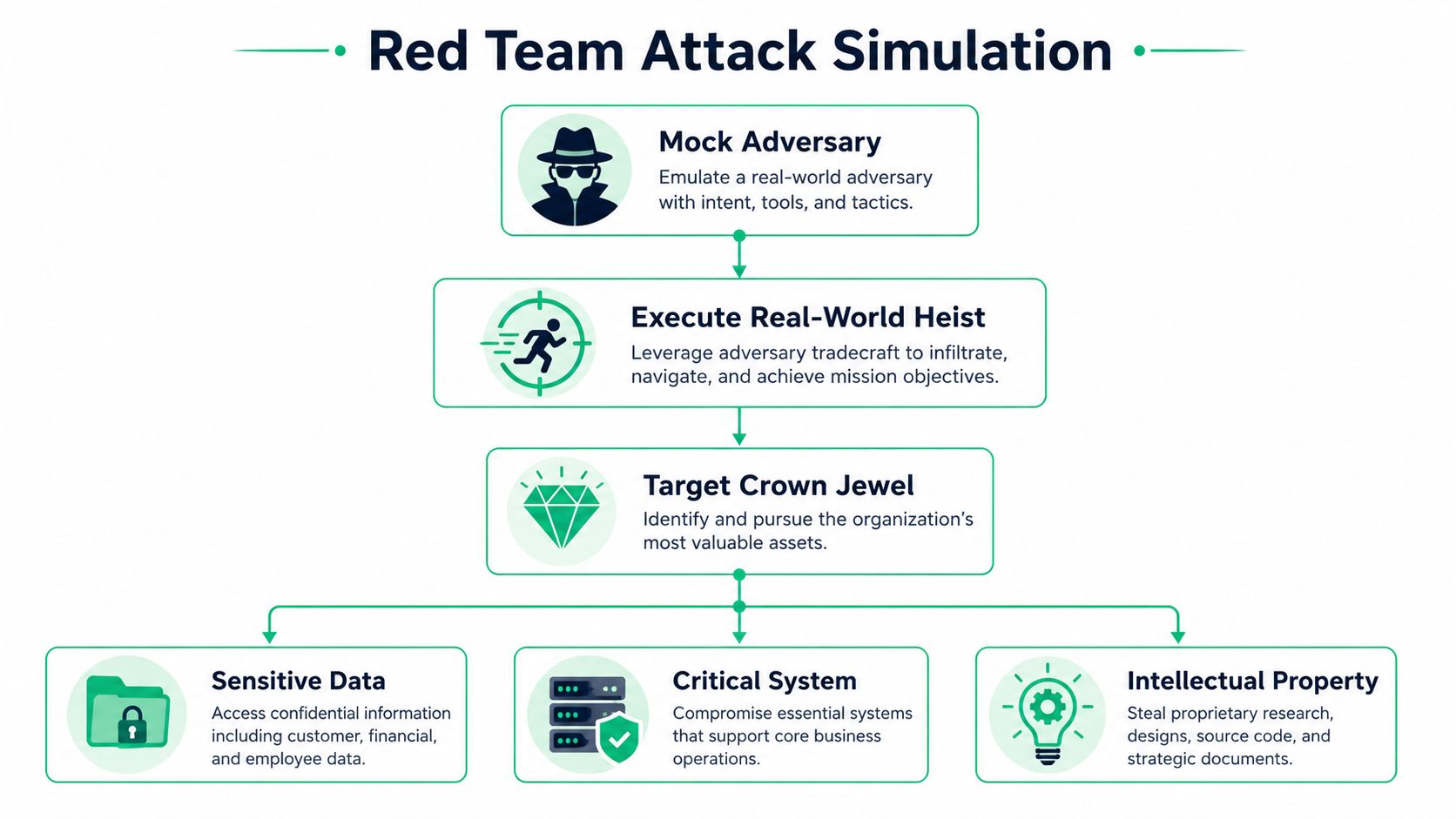
A red team penetration testing engagement is different. The goal is not to find every bug. The goal is to act like a determined attacker and reach a specific objective without getting caught.
That objective is usually a crown jewel. Customer data. Privileged access. A critical internal system. A sensitive cloud workload. The red team looks for one workable path, then pushes on people, process, and technology to see whether your defenses detect and stop them.
What Red Teams Actually Test
A red team doesn't care about producing the biggest possible vulnerability list. It cares about whether your security operations work in real conditions.
That means testing things like:
- Detection quality: Did your logs, alerts, and analysts notice suspicious behavior
- Response discipline: Did the right people escalate, investigate, and contain the threat
- Identity resilience: Could an attacker abuse weak access controls or privileged accounts
- Operational blind spots: Did attackers move through email, cloud apps, vendor access, or internal trust paths without being seen
A mature SOC is important. If you run a global security operations center, a red team can help validate whether your monitoring and response process holds up under pressure.
Why Red Team Engagements Take Longer
Red teams are built for stealth. According to Praetorian's red team vs penetration testing guidance, these engagements are typically weeks to months long, and practitioners often spend about 80% of effort on reconnaissance and 20% on exploitation.
That split matters. The red team is trying to behave like a real intruder, not like a scanner with a report template. They spend more time learning your environment, testing assumptions discreetly, and choosing the path most likely to succeed without raising alarms.
A red team is a maturity test. If you still need broad vulnerability coverage, it's probably too early.
When Red Teaming Makes Sense
Red teaming makes sense when your organization already has the basics in place. You've done penetration testing. You've fixed recurring issues. You have logging, alerting, and incident response people who can learn from the exercise.
If those pieces aren't stable yet, a red team often turns into an expensive way to rediscover basic problems. That's not a good use of budget.
Comparing Red Team vs Penetration Testing Methodologies
Most buyers don't need a philosophical debate. They need a practical side-by-side view they can use to choose the right test this quarter.
Start with this.
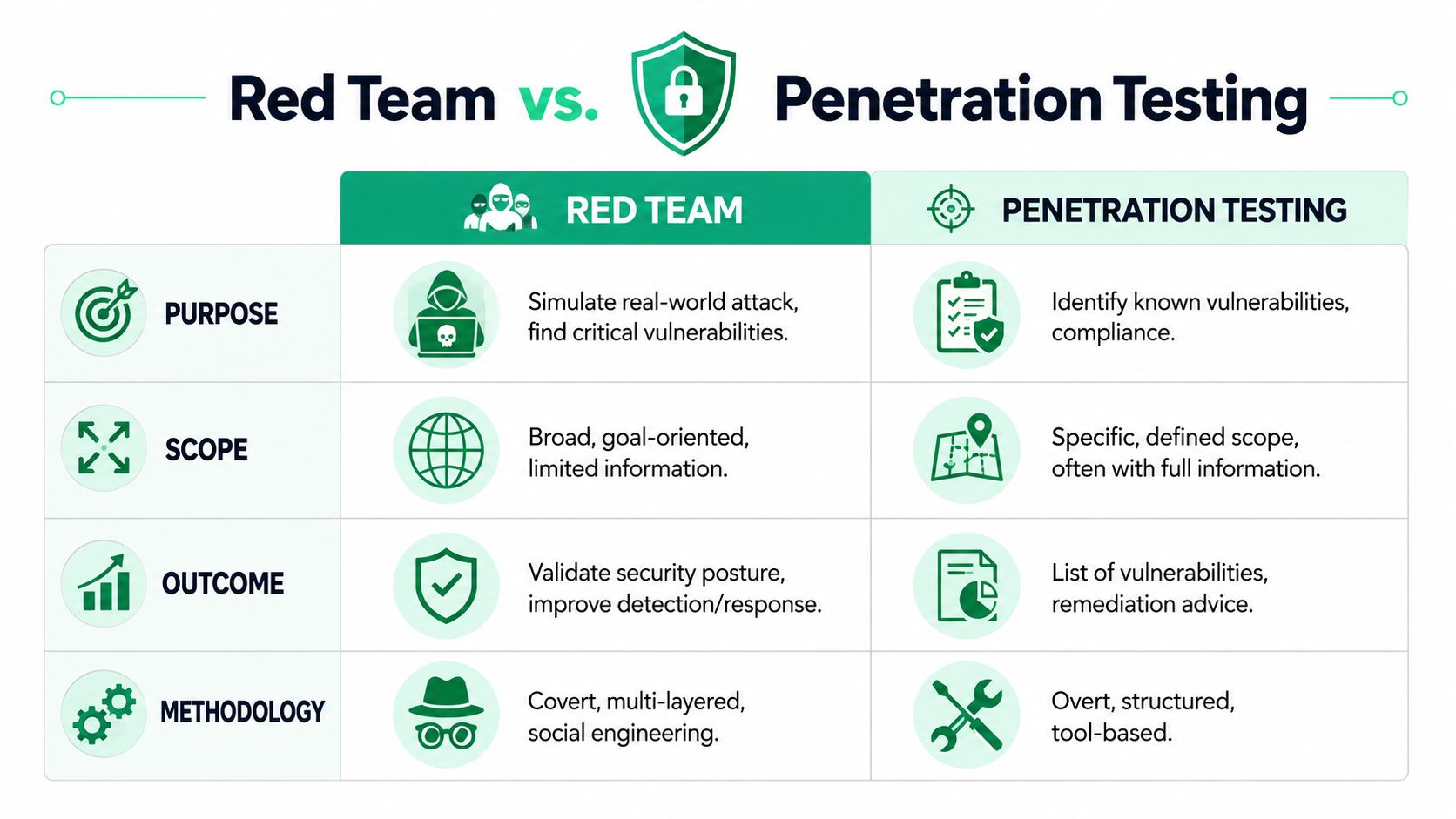
| Criterion | Penetration Testing | Red Team Engagement |
|---|---|---|
| Primary goal | Find and validate as many realistic weaknesses as possible in scope | Reach a defined objective and test detection and response |
| Typical focus | Security hygiene, exploitable flaws, remediation | Stealth, attacker behavior, operational readiness |
| Scope style | Narrower and defined | Objective-based and more attack-path driven |
| Best for | Compliance, remediation planning, baseline risk reduction | Mature programs testing people, process, and technology together |
| Deliverable | Finding list, risk summary, remediation guidance | Attack narrative, timeline, detection gaps, response evidence |
| Buyer value | Fast evidence for audits and engineering fixes | Deep validation of SOC and incident handling |
The Difference In Method
A penetration test is broad and structured. The tester is looking across the agreed environment for many ways in. That's why it usually produces a more useful remediation list for IT and engineering.
A red team is selective and patient. The operators care less about breadth and more about proving that one realistic attack chain works all the way to the objective.
If you want a solid mental model, a pentest checks the whole property for weak entry points. A red team tries to steal one valuable item without the alarm company noticing.
Why This Matters In The Real World
This isn't academic. A widely cited penetration testing dataset summarized by Pentest-Tools penetration testing statistics reports that pentesters were able to breach the network perimeter and access the local network in 96% of companies tested, with an average time of 5 days and 4 hours.
That should change how you think about budget. Attack paths are often shorter than internal teams expect. Waiting until you can afford a long, stealth-heavy red team may leave obvious weaknesses sitting in production.
Bottom line: If your environment hasn't had a recent, manual penetration test, start there. Don't skip the basics because “red team” sounds more advanced.
Which Methodology Produces Better ROI
For most SMBs, the answer is simple. Penetration testing gives better short-term ROI because it supports audits, helps remediation, and surfaces a wider set of fixable issues in less time.
That doesn't make red teaming bad. It makes it specialized.
A red team pays off when leadership wants evidence about response capability, not just vulnerability exposure. If your real question is “Can our defenders spot and stop this?” then red team penetration testing earns its keep. If your real question is “What do we need to fix before the audit?” then it's overkill.
Good security also depends on layered controls, not one flashy assessment. That's why practical guides like IT Cloud Global's security insights are useful context when deciding where a pentest or red team fits.
If you're weighing security test options for SMBs, use this rule. Buy the test that answers your most urgent business question, not the one with the most impressive name.
Mapping Security Tests to Your Compliance Needs
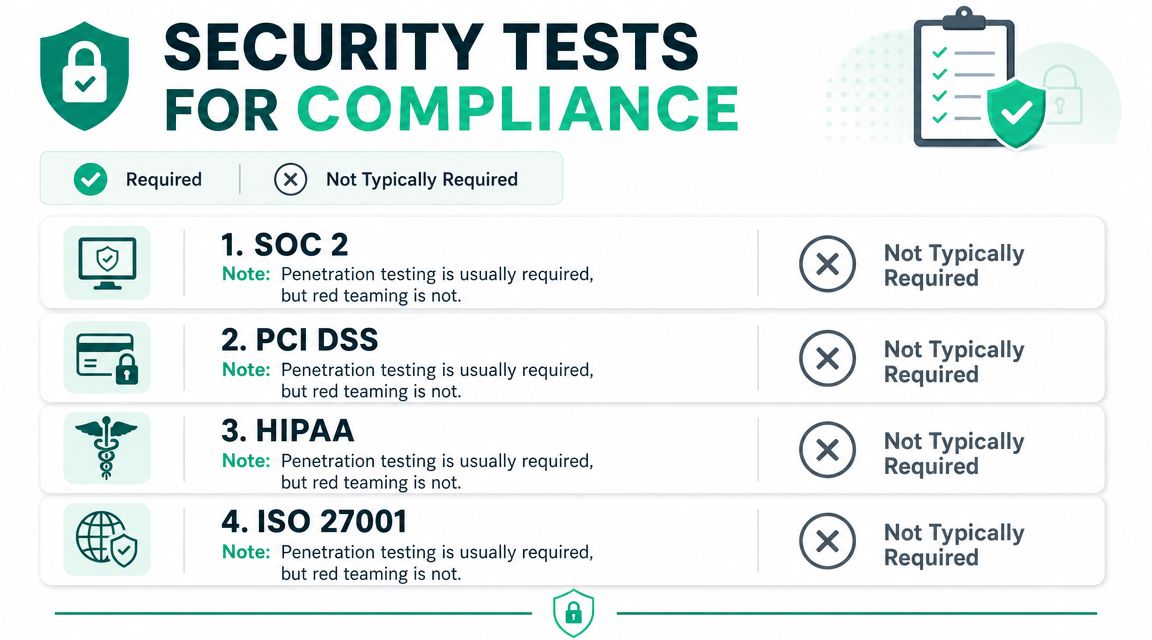
If your driver is compliance, this part is simple. Most frameworks expect evidence of risk assessment and technical validation. They do not usually require a full red team.
That's why companies preparing for SOC 2, PCI DSS, HIPAA, or ISO 27001 usually start with a penetration test. It's the cleaner fit for audit evidence, remediation tracking, and repeatable security hygiene.
What Auditors Usually Want To See
Auditors typically care about whether you can show that you test security controls, identify weaknesses, and fix them. A penetration test gives you direct evidence for that conversation.
Here's the practical mapping:
- SOC 2: A pentest helps demonstrate that you assess and address system risk in a disciplined way
- PCI DSS: Pen testing is commonly expected to validate the security of in-scope systems and changes
- HIPAA: Covered entities and vendors often use pentests to show due care around technical safeguards
- ISO 27001: Pentests support risk treatment and control validation
A red team can strengthen your security story, but for most audit paths it sits in the “nice to have if you're mature” bucket.
Where Red Teaming Fits In Regulated Environments
Red teaming becomes useful after you've already built basic coverage. That's especially true in regulated industries where sensitive workflows cross identity systems, vendor access, and segmented networks.
IOActive's guidance on penetration tests and red teaming is direct on this point. Organizations should start with penetration testing for coverage and hygiene, then use red-team operations to validate whether defenses detect and contain realistic attacker behavior. The value depends on measurable telemetry, not just the “gotcha” moment.
That last part matters. If the exercise doesn't produce evidence your security team can use to tune detections and improve response, it's not helping much.
Compliance usually starts with proof of testing. Security maturity adds proof of detection and response.
The Cheap Mistake To Avoid
Don't buy a red team because you think auditors will be impressed. Most would rather see a recent, scoped, well-documented penetration test and evidence that you fixed what mattered.
That approach is cheaper, faster, and easier to operationalize. It also gives your engineers something useful instead of a prestige artifact.
A Checklist For Choosing The Right Test
Teams often don't need more theory. They need a decision filter.
Use this checklist. If you answer “yes” to most questions on the left, start with a penetration test. If you answer “yes” to most questions on the right, a red team may be worth the spend.

Start With A Pentest If
- You have an audit coming up: You need evidence, scope clarity, and a report your auditor can review
- Your main goal is finding weaknesses: Your team still needs a prioritized list of exploitable issues
- You need quick remediation wins: Developers and IT need actionable findings they can fix now
- You don't run a mature detection program: A stealth exercise won't help much if nobody is ready to learn from it
- Budget is tight: You need the most coverage per dollar
Consider A Red Team If
Your organization has already done the basics and wants to answer tougher operational questions. You've had recent pentests, fixed recurring issues, and your defenders have the tooling and time to analyze an active simulation.
This is also where objective-based thinking matters. Abnormal's guidance on red team penetration testing makes the smartest point in this whole debate. The best-value red team isn't the most stealthy one. It's the one that tests detection against the 1-3 attack paths most likely to affect regulated data or revenue. For many organizations, a focused penetration test against those paths is the more practical starting point.
The Fast Decision Framework
Ask these questions in order:
- Do we need compliance evidence soon
- Have we had a quality pen test recently
- Can our team detect and investigate suspicious activity today
- Are we trying to improve remediation, or validate response
- Will we act on the results immediately
If your honest answers point toward basic coverage, don't overcomplicate it. Buy the penetration test.
The right test is the one your team can afford, absorb, and act on right now.
Get Your Affordable Pentest Report This Week
The old pentesting model is slow, expensive, and often bloated. Long sales cycles, recycled scanner output, and reports that arrive after the audit window are common complaints for a reason.
A better approach is straightforward. Use a manual pentest, keep the scope tight, focus on systems that matter to compliance or revenue, and work with certified testers who know how to write clear findings. Credentials like OSCP, CEH, and CREST matter because they show the tester has been held to a recognized standard, but the ultimate test is whether they can produce useful evidence fast.
Skill Matters More Than Hype
This matters even more as AI enters security testing. In agentic pentesting benchmark research, advanced agents achieved compromise on over 50% of targets, while simpler bots compromised fewer than 10%. The lesson is obvious. Methodology and operator quality matter more than flashy claims.
That's also why a cheap automated scan is not the same as a real pen test. You want a human tester who can chain weaknesses, validate impact, and explain what matters to your business and your auditor.
What Busy Teams Should Buy
If you're a startup founder, IT manager, compliance lead, or CISO with a deadline, buy the service that gets you usable answers fast:
- A manual penetration test
- A short timeline
- An audit-ready report
- A tester who can explain findings clearly
- Retesting or remediation guidance if needed
If that's what you need, review affordable manual pentesting services and choose a provider that can move this week, not next quarter.
Red team penetration testing has a place. But for most growing companies, the highest-value move is still a fast, affordable penetration test that finds real problems and gives your team time to fix them before the audit, the customer review, or the incident.
If you need a fast, audit-ready pentest without enterprise pricing or month-long delays, Affordable Pentesting is built for that. Their certified pentesters, including OSCP, CEH, and CREST professionals, deliver manual penetration testing for SOC 2, PCI DSS, HIPAA, ISO 27001, and more. Use their contact form to get a quick quote and start your pen test this week.