.svg)
Red Teaming vs Pentesting Guide
You need a security test. The auditor wants proof. A customer questionnaire is stuck in procurement. Your launch is close, and some expensive security firm is telling you the answer is a long engagement, a big invoice, and a report that shows up whenever it shows up.
Many teams get stuck there.
They hear red teaming vs pentesting and assume the more intense option must be better. Often, it isn’t. For most startups, SMBs, and compliance-driven teams, a pentest, pen test, penetration test, or penetration testing engagement is the right move. It’s faster, more focused, and better aligned with what auditors and buyers want to see.
Red teaming has a place. It’s just not the first thing most companies need.
Here’s the fast answer before we go deeper.
| Question | Pentest | Red teaming |
|---|---|---|
| Best for | Compliance, fast validation, scoped risk review | Testing real-world detection and response |
| Scope | Specific apps, networks, or systems | People, processes, tech, and often physical security |
| Typical length | 1 to 3 weeks according to OffSec’s comparison | 3 weeks to several months according to that same OffSec comparison |
| Cost profile | Better fit for SMB budgets | More expensive and resource-heavy |
| Main output | Vulnerability list with remediation steps | Attack path, missed detections, response gaps |
| Right time to buy | When you need an audit-ready report now | When your security team is mature and you want to stress-test them |
Choosing Your Security Test Under Pressure
A founder gets told by an enterprise prospect, “Send over your latest security assessment.” The team has a web app, a cloud environment, and a deadline that isn’t moving. They don’t need a lecture on threat emulation. They need the right report, fast.

That marks the genuine buying moment. Not a theory class. A decision under pressure.
Teams asking about red teaming vs pentesting often pose three business questions:
- Will this satisfy compliance
- How much will this cost
- How fast can we get a useful report
If that’s your situation, keep it simple.
The fast decision rule
Choose a penetration test when you need a scoped review of a web app, API, external network, or internal environment, especially if the goal is SOC 2, PCI DSS, HIPAA, customer due diligence, or basic risk reduction.
Choose red teaming when you already have defenders, monitoring, response workflows, and leadership buy-in for a broader exercise that tries to bypass all of that.
Practical rule: If you're still trying to close your first audit, vendor review, or security questionnaire, you probably need a pentest, not a red team.
Why people overbuy
Security vendors love complexity. Complexity sounds premium. But if you’re a startup or lean IT team, buying the wrong service hurts twice. You spend more, and you still may not get the specific evidence your auditor or customer asked for.
A lot of companies don’t need a simulated heist. They need a solid manual pen test, clear findings, proof of remediation priorities, and a report they can hand to an auditor without excuses.
That’s the filter to use for the rest of this decision.
What Is A Penetration Test Really
A penetration test is a controlled attempt to break into a defined target so you can find weaknesses before an attacker does. Consider checking the doors, windows, side gate, and garage on a house you own. You’re not testing the whole neighborhood. You’re testing the parts you asked the tester to inspect.
That’s why a pentest works for companies that need a clear answer fast.
What penetration testing does
A good pen test focuses on a specific scope. That might be a web application, an API, an external network, an internal network, or a cloud setup. The tester looks for exploitable weaknesses, proves impact where allowed, and documents what needs to be fixed.
The method became formalized in standards like NIST SP 800-115, and pentests often last 1 to 2 weeks and are commonly performed quarterly or annually according to Evalian’s breakdown of penetration testing vs red teaming.
For SMBs chasing SOC 2, PCI DSS, or HIPAA, that same Evalian breakdown says penetration testing is sufficient for vulnerability discovery. It also notes that 80 to 90% of breaches stem from known exploits, which is why finding and fixing common weaknesses matters.
Why startups need this first
A pentest gives you a usable list of problems. That’s the value.
You’re not paying for theater. You’re paying for someone to say, “Here are the weak points in your app or network. Here’s how serious they are. Here’s what to fix first.” That’s useful to engineering, helpful for compliance, and easy to explain to leadership.
If you want a plain-English primer, this overview of what is penetration testing is a good starting point.
What you get back
Most penetration testing reports include a mix of business and technical output:
- Executive summary for leadership and auditors
- Detailed findings with risk levels and proof of impact
- Remediation guidance so engineers know what to do next
- Scope documentation showing exactly what was tested
A pentest answers, “What’s broken in the systems we asked you to test?”
That’s a very different question from the one red teaming asks.
What a pentest is not
It’s not a months-long stealth operation. It’s not built to test whether your security team detects an attacker moving through your company. And it’s not meant to cover every employee, office door, or business process.
That’s not a flaw. That’s the point.
When people compare red teaming vs pentesting, confusion often arises. They treat focused testing like it’s somehow lesser. For most growing companies, focused is what you want.
What Is Red Teaming And Why It Is Different
Red teaming is not “a more expensive pentest.” It’s a different service.
Instead of checking a set of locks, red teaming acts like a real burglar trying to get a specific item out of the house without anyone noticing. The goal is not to hand you a long list of bugs. The goal is to see whether your organization can stop, spot, or respond to a realistic attack.

What red teaming measures
Red teaming looks at your full security posture. That includes technology, but also people and process. Can an attacker phish a user, pivot inside the environment, avoid detection, and reach a target objective?
According to Cycognito’s red teaming vs pentesting guide, red team engagements test detection and response through objective-driven simulations and succeed in 74% of cases by bypassing defenses through people, processes, and technology.
That same guide says red teaming often uses a black-box approach, meaning the team starts with little or no inside knowledge, and may include tactics like spear phishing. It also states that human factors are involved in 95% of breaches.
Why red teaming costs more
You’re paying for stealth, creativity, and broader coverage. Not just technical testing.
Cycognito’s guide says these engagements can run for weeks to months, often involve 3 to 5 or more specialists, and can cost 2 to 5 times more than a typical pentest. That should tell you something important. This is not the tool to buy just because it sounds impressive.
If you want a simpler explainer, this short guide to what is red team testing breaks it down well.
When red teaming makes sense
Red teaming is useful when your company already has:
- A security team that monitors alerts and responds to incidents
- Detection tooling such as SIEM, EDR, and logging workflows
- Enough maturity to benefit from learning how attackers slip past controls
- Leadership support for a broader exercise that may involve social engineering and internal coordination
Red teaming answers, “Could a determined attacker achieve a real objective without us stopping them?”
If you don’t have a mature blue team or formal response process, that answer may be interesting, but it won’t be the most efficient next step for your budget.
A Direct Comparison of Red Teaming vs Pentesting
A founder with an audit deadline and a limited budget does not need theory. They need to know which test gets the report, identifies problems, and avoids wasted spend.
Here is the practical comparison.
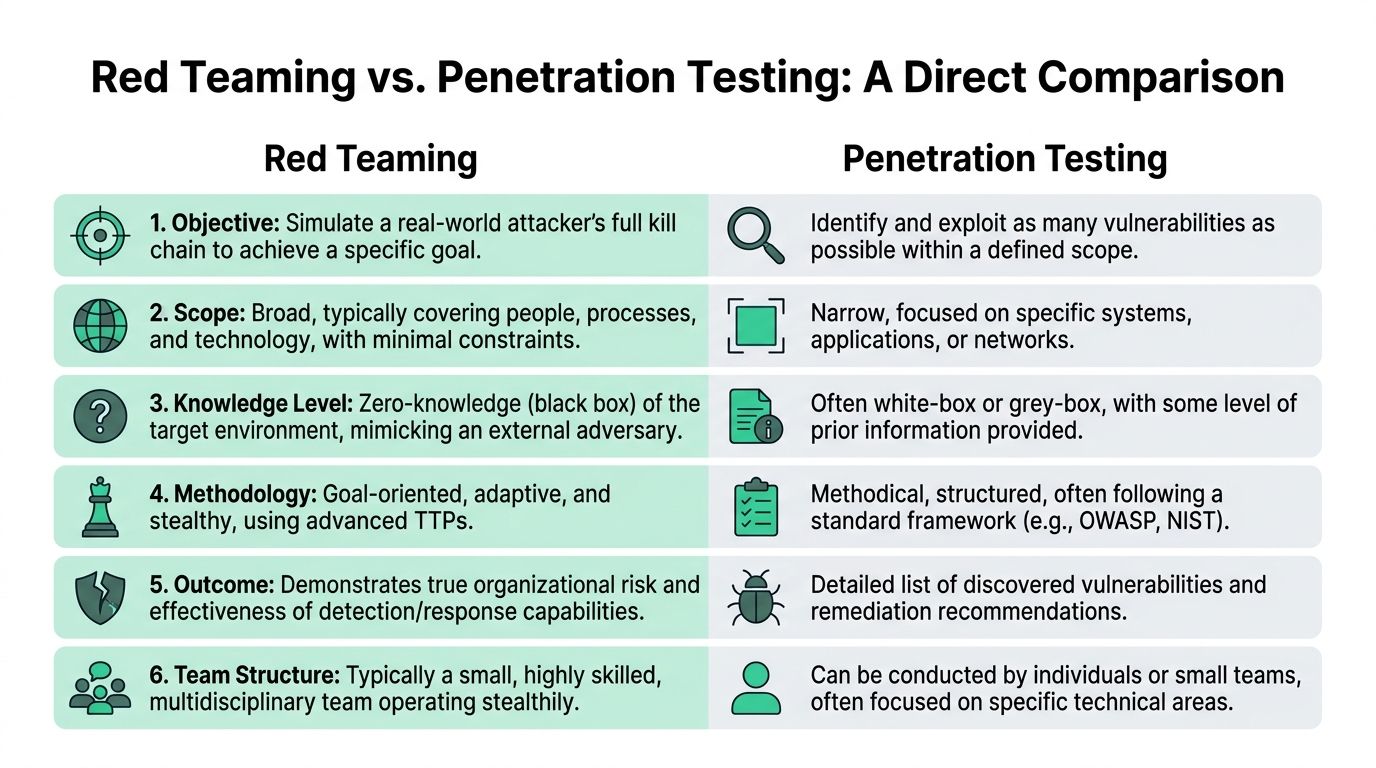
Side by side business view
| Criteria | Pentest | Red teaming |
|---|---|---|
| Main objective | Find vulnerabilities in a defined scope | Reach a business objective as an attacker |
| Typical scope | Web app, API, network, cloud environment | Multiple systems, users, and defenses |
| Approach | Structured test with agreed boundaries | Stealthy exercise with attacker behavior |
| Knowledge level | Often white-box or gray-box | Often black-box |
| Output | Findings, severity, and fix guidance | Attack path, detection gaps, and response lessons |
| Best buyer | Startup, SMB, compliance team | Security-mature company with active monitoring |
The fastest way to choose is to look at the question you need answered.
If you need to know what to fix in your product or environment, buy a pentest.
If you need to know whether your team can detect and stop a realistic attack, buy red teaming.
The difference is operational, not academic
A pentest is a scoped security review. You point the testers at a web app, API, network, or cloud segment and ask them to find weaknesses that matter. The result is a report your engineers can act on and your compliance team can file.
Red teaming is an attack simulation. The red team works toward a goal and uses the path that gets them there. The result is less about a clean list of vulnerabilities and more about how an attacker moved through your business without being stopped.
That distinction drives cost, speed, and usefulness.
Pentests fit tighter budgets and shorter deadlines
For startups and SMBs, speed matters. You may need a third-party report for SOC 2, a customer questionnaire, cyber insurance, or a sales deal that is already stuck in procurement.
A pentest fits that reality better. It has a defined scope, cleaner scheduling, and a report format buyers and auditors expect. It is also easier to rerun after fixes.
Red teaming takes more time, more coordination, and more money. If your company still needs the basics, secure code issues fixed, exposed services reviewed, access control tested, and a report in hand, red teaming is the wrong first purchase.
The deliverables solve different business problems
A pentest report helps you prioritize remediation. It tells engineering what failed, how serious it is, and how to fix it. That is what budget-conscious teams need when every security dollar has to reduce risk or satisfy an external requirement.
A red team report helps you examine readiness. It shows how an attacker chained small failures into a larger outcome, where detection broke down, and what your response team missed. If you end up dealing with a real incident, this kind of preparation shapes your plan for what to do after a data breach.
Both have value. They are not interchangeable.
Compliance value is not the same
If your target is SOC 2, PCI DSS, HIPAA, a customer security review, or an annual third-party assessment, pentesting is usually the better fit. Auditors and enterprise buyers want a defined scope, documented findings, severity ratings, and evidence that issues were remediated.
Red teaming can support a mature security program, but it is rarely the fastest or cheapest path to passing an audit. Buying it too early is how smaller companies burn budget and still end up needing a pentest afterward.
Compliance shortcut: If the ask is “show us a recent security assessment,” a pentest report is usually the cleaner answer.
What good compliance support looks like
You want a report that is:
| Need | Why it matters |
|---|---|
| Clearly scoped | Auditors need to know what was tested |
| Third-party produced | Internal self-assessment usually carries less weight |
| Actionable | Engineering needs remediation steps |
| Recent | Reviews care about current security posture |
| Readable | GRC, legal, and buyers may all read it |
That doesn’t mean every penetration testing report is equal. Some firms move slowly, deliver generic writeups, or return reports with thin findings that don’t help much. But the format itself is still the right tool for the job.
The smart sequence
The better order is straightforward.
Start with a pentest on the systems tied to compliance scope. Fix the meaningful findings. Keep records. Use that report for the audit or customer review.
After that, if your company grows into a more mature security program, you can add broader exercises later. Red teaming is an advanced validation step. It is rarely the first compliance purchase a startup or SMB should make.
How We Deliver Affordable Pentesting In A Week
The traditional security firm model is bloated. Long sales cycles, vague scoping, delayed scheduling, and reports that take forever to arrive. That’s why so many buyers feel burned.
A better model is simpler. Tight scope. Manual testing by certified people. Fast reporting. No enterprise theater.
What makes a fast pentest possible
It’s not magic. It’s process discipline.
- Clear scoping early so nobody wastes time debating what’s in bounds
- Direct tester access so technical questions get answered quickly
- Manual validation so findings are real, not scanner noise
- Tight reporting workflow so the final document doesn’t sit in review limbo
The point is not to rush carelessly. The point is to remove the admin drag that traditional firms normalize.
Why certifications still matter
You want testers who know how to think like attackers and write like professionals. Certifications don’t guarantee quality by themselves, but they are still a strong signal.
That’s why teams often look for pentesters with credentials such as OSCP, CEH, and CREST. Those names matter because buyers, auditors, and security leads recognize them. They help separate serious manual testers from firms that mostly resell automated scans.
What affordability should really mean
Cheap and affordable are not the same thing.
Cheap means low effort, thin testing, and weak reporting. Affordable means the scope fits the problem, the findings are useful, and the timeline supports the business. That’s the standard smart buyers should use.
If your environment includes collaboration platforms and privacy obligations, it also helps to understand adjacent compliance issues. This SharePoint GDPR compliance guide is a useful example of how operational systems can create real governance questions outside the pentest itself.
Good penetration testing should cost less than a bad breach response and less than months of procurement delay.
What a good buyer should expect
Ask for these basics before you sign anything:
- Manual testing details so you know it isn’t just an automated scan
- Report timeline with a firm commitment, not “usually”
- Tester qualifications including OSCP, CEH, CREST, or equivalent
- Scope clarity covering app, API, network, or cloud assets
- Retest options if you need validation after remediation
That’s how you keep the project useful and affordable.
The big picture is simple. If you need compliance support, customer assurance, or a focused review of real exposure, buy a pentest. If you already run a mature security program and want to test your defenders in a realistic attack scenario, then buy red teaming.
Most companies asking the question today should start with the first option.
If you need a fast, audit-ready pentest from certified testers without the usual enterprise bloat, contact Affordable Pentesting through the contact form and get the process moving.