.svg)
Your SOC 2 audit is on track. Then the auditor asks for your supply chain security process, and the room goes quiet.
That happens because a lot of startups define security too narrowly. They focus on their app, their cloud setup, and their employees. Auditors look wider than that. They want to know about the vendors that store your data, the tools your team connects to production, the open source packages in your build, and the contractors who can touch customer systems.
Supply chain security is not a big-company buzzword. For a startup or SMB, it usually comes down to a simple question. Who outside your company could create a security incident that becomes your problem?
Start there. Make a list of the vendors and software dependencies that can expose customer data, disrupt service, or affect how you ship code. If you need a practical way to do that without building an enterprise procurement program, start with how to manage vendor risks effectively.
Auditors do not want a polished story. They want evidence that you know your dependencies, rank the risky ones, and check them with a repeatable process. The fastest affordable way to back that up is usually not a stack of questionnaires from expensive firms. It is a focused review of your real exposure, plus penetration testing that shows whether those dependencies create an exploitable path into your environment.
Why Your Auditor Suddenly Cares About Your Vendors
It is 10 days before your audit report needs to go out. Your team has policies, screenshots, MFA, and access reviews ready. Then the auditor asks for your vendor risk process and evidence that third parties are not an easy path into your environment.
That question is showing up more because startups now run on outside services. Identity, cloud hosting, payroll, support, analytics, code repositories, CI/CD, contractors, and open source packages all sit in the path between your team and your customers. If one of those dependencies fails, gets breached, or ships malicious code, you own the incident. Your customers will not care whose logo was on the compromised system.
Auditors want proof you can spot the obvious risks
Saying you picked well-known vendors is not enough. Auditors want a short, repeatable process that shows you know which providers matter, what access they have, and what checks you performed.
Keep the rule simple. If a vendor stores customer data, processes sensitive information, has access to production, or can affect how code gets built and shipped, review them like a security dependency. If you need a practical starting point, use this guide on how to manage vendor risks effectively.
You do not need a giant procurement program. You need a list, a risk ranking, and evidence.
Why the pressure increased
Auditors are reacting to a real pattern. Supply chain incidents hit companies often, and the fallout is not limited to a few noisy enterprise cases. As noted earlier, industry reporting found that many organizations dealt with supply chain breaches, and the impact regularly included downtime, lost revenue, and spillover into downstream customers.
That last part is what gets attention in audits. A weak vendor can become your outage, your customer notice, your board update, and your control failure.
A small company feels this faster than a big one. You have fewer people to review vendors, less time to chase security questionnaires, and more reliance on SaaS tools to move quickly. That is exactly why auditors push on this point. They want to see whether your security program matches how your business operates.
What auditors are really checking
They are not asking you to predict every vendor breach. They are checking whether you can identify high-risk dependencies and respond like a competent operator.
That usually means evidence such as:
- a current vendor list with owners
- a clear way to mark high-risk vendors
- basic due diligence for vendors that touch sensitive systems or data
- contract terms or security commitments where they matter
- proof you tested real exposure, not just paperwork
The last item matters most. Questionnaires are cheap to send and easy to game. A focused pentest gives auditors something stronger. It shows whether a vendor connection, exposed integration, weak SSO setup, or insecure development dependency creates an exploitable path into your environment.
If you want a plain-English example of how outside dependencies create safety and security issues in another field, see AutoProv's insights for car security. The principle is the same. You are only as safe as the systems and partners you rely on.
What Supply Chain Security Actually Is
Supply chain security sounds bigger and scarier than it needs to. Keep it simple.
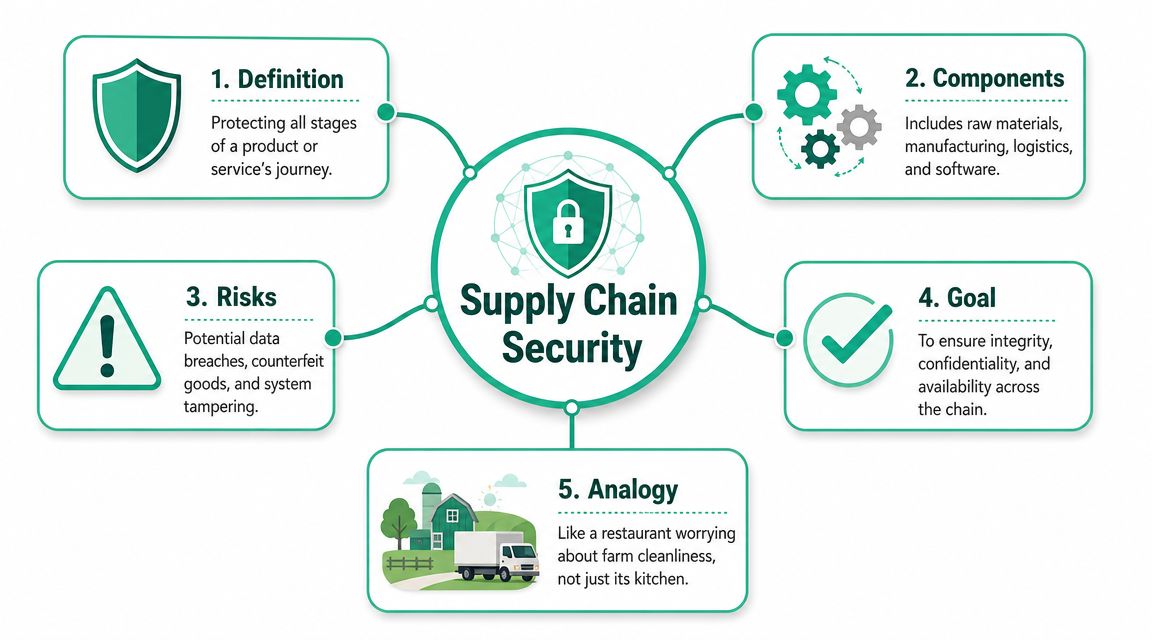
If you run a restaurant, you don't only care whether your kitchen is clean. You care whether the farm grew safe produce, whether the distributor stored it properly, and whether the truck delivered the right shipment without contamination. Tech works the same way.
Your supply chain includes more than vendors
It's often assumed that this is only about vendor questionnaires. It isn't.
Your supply chain includes things like:
- SaaS tools: Slack, Salesforce, GitHub, Google Workspace, ticketing tools, HR systems
- Software components: Open-source libraries, packages, containers, APIs, build tools
- Service providers: MSPs, consultants, developers, outsourced support teams
- Sub-processors: The companies your vendors rely on behind the scenes
That last one catches teams off guard. You may trust your vendor, but your vendor may rely on several other providers you never reviewed.
The security model changed
A big shift happened when NIST's cyber supply-chain risk management guidance started treating suppliers as security-critical dependencies, not just business partners. NIST's position is blunt. Security requirements should be included in procurement and managed across the entire chain of providers, as explained in NIST's workshop brief on cyber supply-chain best practices.
That change matters because it killed the old idea that "outside our walls" means "outside our risk."
A vendor with access to your data is part of your security perimeter, whether you wrote that down or not.
What actually goes wrong
Most supply chain failures come down to a few ugly but familiar problems.
| Risk area | What it looks like | Why it matters |
|---|---|---|
| Tampered software | A trusted update includes malicious code | You deploy the attack yourself |
| Weak vendor controls | A provider gets breached through poor security | Your data or operations get exposed |
| Hidden dependencies | A vendor relies on risky sub-processors | You inherit risk you never saw |
| Excess access | Contractors or tools have more permissions than needed | One compromise spreads faster |
A lot of people understand this better outside cyber than inside it. That's why AutoProv's insights for car security are useful. The same logic applies. Real security isn't just locking the obvious front door. It's checking every trust point that can be abused.
Threat actors love trusted paths
Attackers don't always smash through your firewall. Sometimes they wait for your team to trust the wrong thing.
They target software updates, developer tools, third-party integrations, and service providers because trust gives them a shortcut. If your team assumes a vendor or package is safe just because it's familiar, you've already made their job easier.
Supply chain security is really about one question. What are you trusting without checking?
Connecting Security To Your Compliance Needs
Compliance frameworks use different language, but they all care about the same thing. Can another company's weakness become your problem?
If the answer is yes, then your supply chain belongs inside your compliance scope.

What auditors are really mapping
When an auditor asks about vendors, they usually want proof in four areas:
- Selection: Did you review the vendor before using them
- Contracting: Did you include security expectations in the agreement
- Oversight: Do you track changes, incidents, or control updates
- Evidence: Can you show documents, reports, and actions taken
That's true whether you're talking about SOC 2, ISO 27001, HIPAA, or PCI DSS. The wording changes. The expectation doesn't.
How this shows up in common frameworks
SOC 2 auditors usually connect vendor security to your overall control design and operating effectiveness. If a critical provider handles customer data or supports key services, the auditor will expect you to show how you assessed and monitored that risk.
ISO 27001 pushes the same idea through supplier relationship controls. If a supplier affects confidentiality, integrity, or availability, you need controls around that relationship.
HIPAA raises the stakes when vendors touch protected health information. A healthcare startup can't pretend a billing tool or support platform is "just a vendor" if that provider can expose patient data.
PCI DSS works the same way with cardholder data environments and connected services. If a service provider affects payment security, their weakness can become your compliance issue fast.
Audit reality: A clean policy set won't rescue you if a critical vendor has direct access and you can't show any review.
One vendor problem can create multiple findings
The situation often frustrates founders, and I understand why. You're dealing with one business relationship, but it can trigger questions across several compliance domains.
A simple example:
- Your CRM stores customer records
- It connects to support workflows
- It syncs with your billing or sales systems
- It has broad employee access
- You never reviewed its security posture
That can create trouble for privacy, access control, risk management, vendor management, and incident response all at once. The auditor isn't being picky. They're following the data and access paths.
Don't overcomplicate the fix
You don't need a giant GRC platform to look competent here. You need a short, defendable process and clean evidence.
Start with a list of critical vendors. Gather their contracts, security documentation, recent assurance reports if they have them, and notes on what they can access. Then show that someone at your company reviewed that information and acted on it.
That's what passes scrutiny. Not a fancy dashboard. Not a hundred-page policy. Just evidence that your team knows who it trusts and why.
A Simple Process For Assessing Your Risk
Most startups do not need a giant vendor risk team. They need a repeatable process they can run without wasting a month on it.
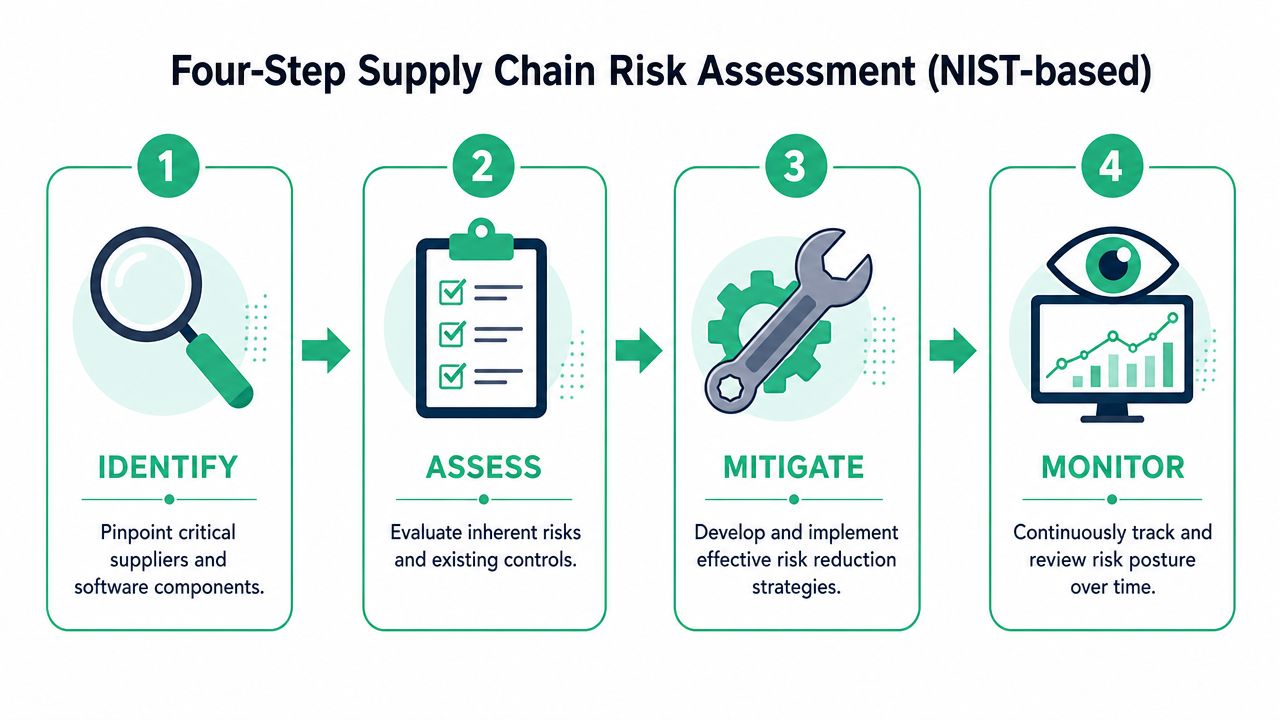
NIST gives you one. The model is a four-step loop: frame, assess, respond, and monitor, with monitoring requiring ongoing verification as conditions change, as described in NCSC guidance on securing your supply chain ecosystem. That's the right model because annual review alone is too lazy for a changing environment.
Frame the risk first
Don't start by sending questionnaires to every vendor you've ever touched. That's how teams waste time.
Start by identifying the handful of vendors and software dependencies that matter most. Think in plain terms:
- Customer data access
- Production access
- Authentication or identity role
- Payment or healthcare data exposure
- Ability to affect software releases
If you need a basic model for sorting and ranking this, use a qualitative and quantitative risk assessment approach to separate high, medium, and low-impact suppliers without pretending everything is equally dangerous.
Assess what matters
Once you've identified the critical set, check the basics.
Ask for security documentation. Review recent assurance reports if they exist. Confirm whether they use subcontractors. Check what data they store, what systems they connect to, and what access your team granted them.
Don't make this academic. You are trying to answer three questions:
- What could this vendor break
- What proof do we have that they take security seriously
- What would happen if they failed tomorrow
Most companies don't have a vendor problem. They have a prioritization problem.
Respond with simple controls
Small teams usually overthink things. You don't need ten layers of review to improve your posture.
For high-risk vendors, put in practical controls like:
- Contract language: Add security expectations during procurement and renewal
- Access limits: Remove unnecessary permissions and tighten integrations
- Fallback planning: Know what happens if the vendor goes down or gets breached
- Evidence collection: Save reports, screenshots, approvals, and review notes in one place
For software suppliers and dependencies, response also means limiting what gets into your environment unchecked. Approved repositories, change review, and build controls matter more than long policy documents.
Monitor like you mean it
This is the step companies skip, and it's the one auditors notice.
A vendor can change ownership, add a sub-processor, alter infrastructure, or expose new features without you hearing about it until something breaks. Monitoring means you revisit important suppliers when contracts renew, when incidents happen, when integrations expand, or when their role in your stack changes.
Set a calendar reminder if you have to. Small teams don't need perfect automation. They need discipline.
How To Manage Vendor And Software Risk
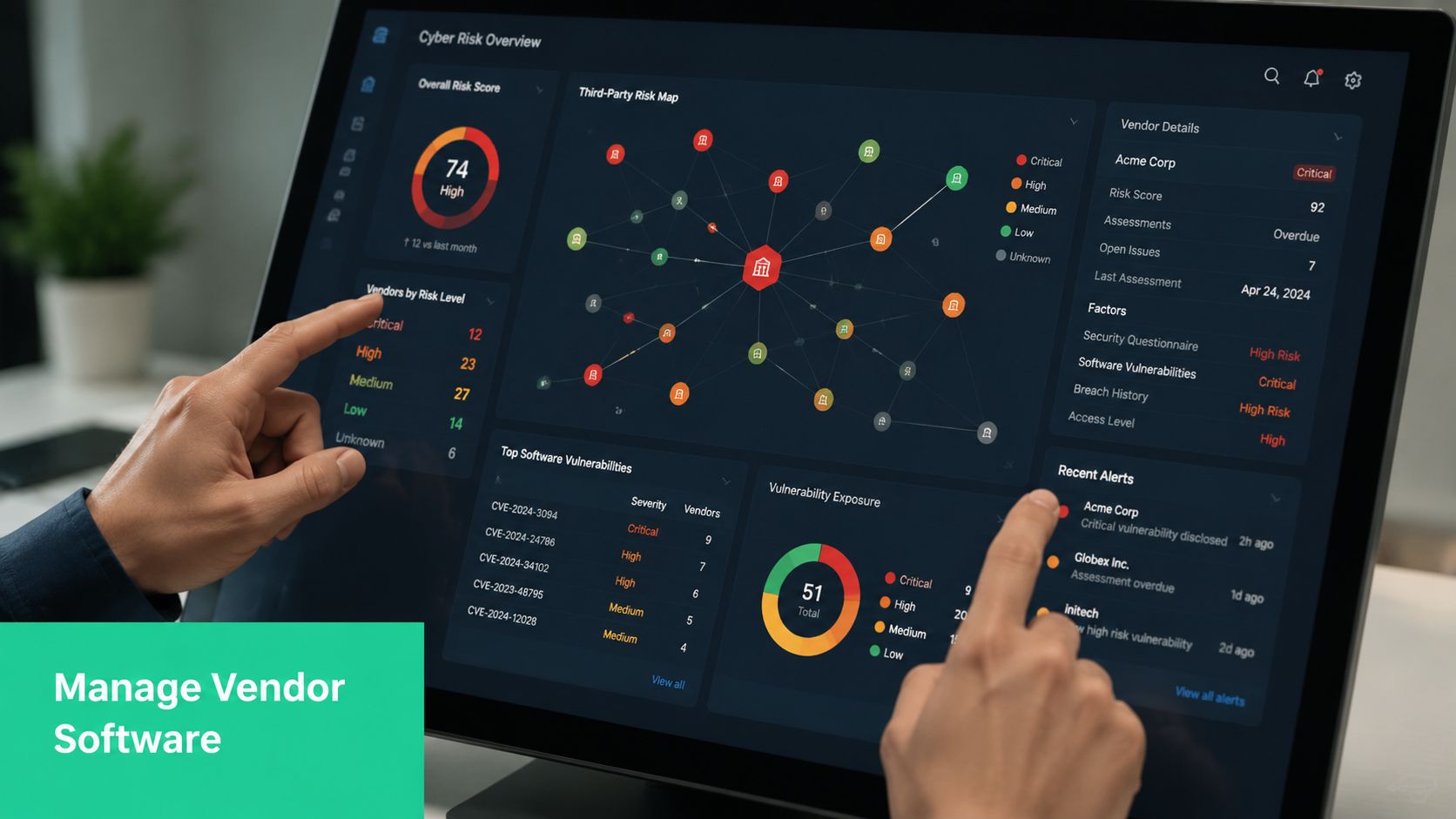
A founder signs a new SaaS tool on Friday because the demo looked great. Two weeks later, that tool has production access, pulls customer data, and nobody can explain what security review happened. That is how small companies create supply chain risk. Not with one dramatic mistake, but with routine buying decisions that never got tightened up.
Management starts after assessment. Your job is simple. Keep risky vendors on a short leash, and keep untrusted code out of production unless your team can verify what it is and where it came from.
Ask vendors for evidence, not promises
Sales calls are cheap. PDFs full of marketing language are cheap too. Ask for proof that would still matter after a breach.
For any vendor that touches customer data, production systems, authentication, or code deployment, ask for:
| Ask for this | Why it matters |
|---|---|
| SOC 2 report or security package | Shows whether controls were documented and reviewed |
| Recent pentest summary | Shows whether someone tested real attack paths instead of just filling out a questionnaire |
| Sub-processor list | Shows who else may touch your data |
| Incident notification terms | Shows how quickly you'll hear about a breach or outage |
| Access model and integration scope | Shows what the tool can actually reach in your environment |
If a high-impact vendor cannot produce basic evidence, treat that as a purchasing problem, not a paperwork problem. Limit scope, delay rollout, or pick someone else.
This also applies to your own audit prep. If you need evidence that stands up to SOC 2 review, get clear on what auditors expect and line it up with affordable SOC 2 pentesting for startups instead of paying a large firm to hand you recycled templates.
Put software dependencies under control
Vendor risk is only half the job. The other half sits in your codebase.
If your team ships packages, libraries, containers, or third-party actions without tracking them, you have a software supply chain problem. The fix is not complicated. Keep an SBOM. Use approved repositories. Require review for dependency changes. Sign builds and track provenance so your team can prove what got built and where it came from.
The NCSC-aligned guidance summarized in this software supply chain overview points to the same basics. Know your components, control your build path, and reduce blind trust.
Here is the blunt version. If nobody on your team can answer which third-party components are in production right now, then your security depends on luck.
Set hard rules for risky vendors and tools
Startups waste time writing policy language nobody follows. Set a few rules your team will enforce.
Use controls like these:
- No production access before review. If the tool touches sensitive data or critical systems, someone signs off first.
- Least-privilege integrations. Give vendors the minimum access they need, nothing more.
- Time limits on exceptions. If you approve a weak vendor because the business needs it, set an expiration date and revisit it.
- Named owner for each critical vendor. One person is responsible for the relationship, the evidence, and the renewal review.
- Offboarding steps. Remove tokens, revoke accounts, and confirm data handling when the contract ends.
These controls are cheap. They also solve the problems auditors usually find first.
Recheck risk when something changes
Annual review alone is lazy. Real risk changes when the vendor, the integration, or your own environment changes.
Re-review a vendor or software component when any of these happen:
- A new production integration goes live
- The vendor gets access to more data
- The vendor changes ownership or adds a new sub-processor
- A security incident affects the vendor
- Your team changes architecture, authentication, or deployment flow
That is the standard to hold. Save the evidence in one place, keep the rules simple, and focus your effort where a failure would hurt the business. Auditors do not want a giant vendor management program from a big consultancy. They want proof that you identified the risky suppliers, restricted access, tracked changes, and tested whether those controls hold up.
Get Audit Ready Evidence With A Pentest
Your auditor asks for proof that your supply chain controls work. You send policies, vendor questionnaires, and a spreadsheet of approvals. They come back with the same question. What has been tested?
That is the gap a manual pentest closes.
For SMBs, supply chain security does not need a giant program or a six-figure advisory project. Auditors want evidence that the systems your vendors touch cannot be abused through weak integrations, broken access controls, exposed admin paths, or sloppy authentication. A good pentest gives you that evidence fast, and it usually does more for your audit package than another policy update.
Why a pentest carries weight
A real penetration test shows whether an attacker can use the environment the way it exists today, not the way your documentation says it should work.
That matters with supply chain risk because third-party connections change constantly. New APIs get added. Permissions expand. Old tokens stay active longer than anyone remembers. A manual tester can find those paths and show you where trust in a vendor or integration is too broad.
Auditors respond well to this because it is evidence from testing. It is not just written intent.
Manual testing beats scan-only reports
A lot of firms sell a vulnerability scan and call it a pentest. Founders pay enterprise prices, wait weeks, and get a report full of noisy findings that nobody trusts.
Buy manual testing instead.
A strong engagement does four things:
- Confirms real exploit paths, not just tool output
- Explains the risk in plain English
- Removes false positives before the report reaches you
- Produces evidence you can hand to auditors and engineers
If you are preparing for SOC 2, start with the systems that matter most and get a report your auditor can read without interpretation. For startups, affordable SOC 2 pentesting for startups is usually the smartest route.
Auditors want proof that someone tested the environment and found what matters.
What to look for in a penetration testing provider
Ignore logo walls and sales decks. Ask how the work is done.
Look for providers that use experienced human testers and can explain their method clearly. Certifications such as OSCP, CEH, and CREST can help as a screening signal, but the report quality and testing depth matter more than the badge.
Ask these questions before you sign:
- Is the work manual, automated, or a mix
- How quickly will you deliver the report
- Will findings be written clearly enough for auditors and developers
- Do you offer a fast retest after fixes
- Will you show which issues are exploitable versus theoretical
If the answers are vague, move on.
Speed and cost matter
Startups do not need a bloated statement of work. They need usable evidence this week.
The fastest affordable path is simple. Test the production systems that handle sensitive data, internet-facing access, authentication, and vendor integrations. Fix the serious issues. Save the final report and retest results. Hand those to your auditor.
That is how SMBs should approach supply chain security. Keep the paperwork lean. Spend money on testing that proves your controls hold up. If a vendor connection, software component, or integration can expose customer data, a manual pentest is often the clearest evidence you can buy.
If you need a fast, affordable way to produce audit-ready security evidence, Affordable Pentesting is built for exactly that. Their team uses certified testers with OSCP, CEH, and CREST backgrounds, focuses on manual pentest work instead of lazy scan-only reports, and delivers clear findings quickly so startups and SMBs can move on their SOC 2, PCI DSS, HIPAA, and ISO 27001 timelines without getting stuck in big-firm pricing or delays.