.svg)
Your team gets a security alert after hours. It says a user logged in from an unusual location, downloaded files, and touched a system that normally stays quiet. You have two bad options if nobody owns that alert. Ignore it and hope it's noise, or wake up half the company and burn time on a false alarm.
That's the practical answer to what is a SOC analyst. A SOC analyst is the person who takes that alert, checks the facts, figures out whether it's real, and starts the right response before a small problem turns into an incident, an audit failure, or both.
For most IT managers, founders, and compliance leads, this role stops being abstract the minute customers ask about monitoring, logging, incident response, or evidence for SOC 2. Demand reflects that reality. Employment for information security analysts, which includes SOC analysts, is projected to grow 29% from 2024 to 2034, and the median annual wage reached $124,910 in May 2024 according to the U.S. Bureau of Labor Statistics.
Why Your Business Needs a Digital First Responder
At 2 AM, your firewall, cloud console, or endpoint tool doesn't tell you the full story. It only tells you something looks wrong. A SOC analyst is the digital first responder who turns that signal into a decision.
In practice, that means checking whether the alert is tied to a real person, a misconfigured script, a stolen session, or an attacker moving through your environment. Without that human review, teams either overreact to noise or miss the alerts that matter.
Many businesses think security starts with buying tools. It doesn't. It starts with having someone who can interpret what those tools are saying inside your cybersecurity command center.
What the role means for the business
A SOC analyst protects more than servers and laptops. They protect uptime, customer trust, and your ability to answer hard audit questions with evidence instead of guesswork.
When an auditor asks how you detect suspicious activity, you need more than a checkbox. You need monitoring, tickets, investigation notes, escalation paths, and incident records. That's the SOC analyst's daily work.
Practical rule: If nobody owns alert review, nobody owns early breach detection.
What goes wrong without one
Most small teams already have some security tooling. They often have a firewall, endpoint software, cloud logs, and maybe a SIEM. What they don't have is enough time to look at those signals consistently.
That gap creates familiar problems:
- Missed priority alerts because everyone assumes someone else checked them
- False alarms consuming hours because there's no triage discipline
- Weak audit evidence because investigations aren't documented
- Slow decisions during incidents because roles aren't clear
A SOC analyst brings order to that mess. That's why the role keeps getting more valuable as attack volume grows and environments spread across cloud, SaaS, endpoints, and identity systems.
The Core SOC Analyst Role and Tiers
A simple way to explain the role is this. A SOC analyst detects, analyzes, and responds to suspicious activity. They sit in front of dashboards and alert queues the way a guard watches security cameras, except the job is harder because most alarms are noisy and actual threats hide inside normal business traffic.
The frontline work is alert triage. Analysts review what fired, who triggered it, what system was touched, how it happened, when it started, and where else the activity appears. The CIAT overview describes SOC analysts as the front line of defense, with Tier 1 analysts monitoring dashboards, investigating the “who, what, how, when, and where” of an incident, and escalating confirmed threats. It also notes that Tier 1 readiness is often reached within 6-12 months of study with certifications like CompTIA Security+.
A lot of managers also need to understand team shape, not just job duties. If you're comparing staffing options, it helps to learn about SecOps models for SMBs before you decide whether to hire one analyst, build shifts, or outsource coverage.
How the tiers usually work
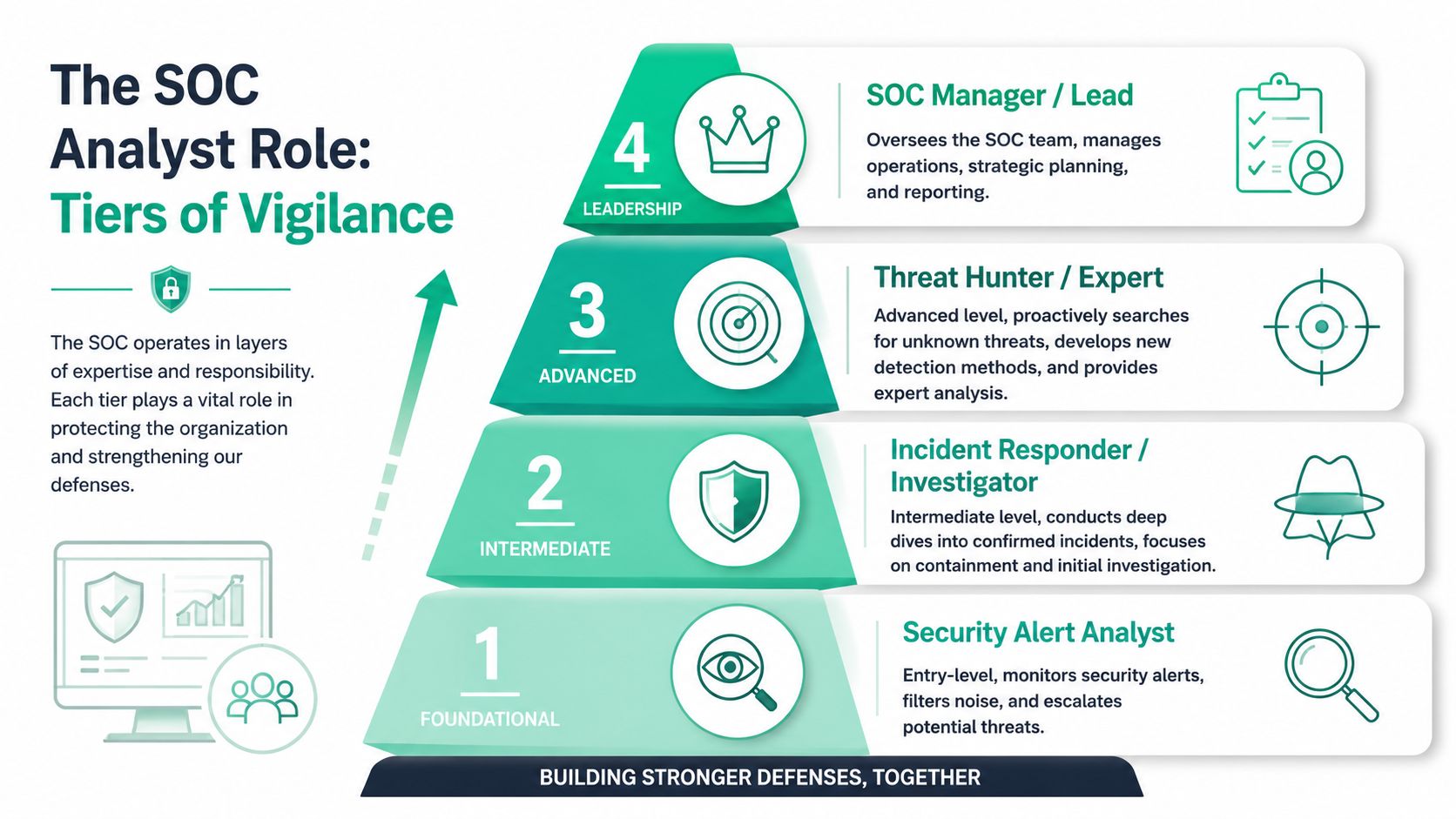
The classic SOC model has three analyst tiers plus a lead or manager above them. It's still a useful way to understand responsibility, even if many teams now blend duties.
| Tier | Primary Focus | Key Responsibilities |
|---|---|---|
| Tier 1 | Alert triage | Monitor dashboards, review alerts, dismiss obvious false positives, collect context, escalate real incidents |
| Tier 2 | Investigation and containment | Deep-dive into confirmed threats, analyze scope, coordinate initial response, document findings |
| Tier 3 | Threat hunting and detection improvement | Hunt for hidden threats, improve detections, tune rules, guide difficult investigations |
| SOC Manager / Lead | Operations and reporting | Run the team, handle escalation paths, report risk to leadership, manage workflow and priorities |
What each tier actually looks like
Tier 1 is where the role is often envisioned. This analyst lives in the queue. They check login anomalies, malware alerts, suspicious PowerShell activity, unusual admin behavior, and cloud events that don't fit a normal pattern.
Tier 2 handles the incidents that need real investigation. They pull together endpoint details, identity logs, firewall data, and cloud records to decide whether the issue is contained or spreading.
Tier 3 focuses less on waiting and more on searching. They build better detections, look for behaviors tools missed, and help the team catch attacks earlier.
The mistake many companies make is hiring for “SOC analyst” when they really need to define whether they need alert coverage, investigation depth, or detection engineering.
For an IT manager, that distinction matters. If you hire one person and expect 24/7 monitoring, deep forensics, threat hunting, and audit reporting, the problem isn't the analyst. The problem is the plan.
A Day in The Life Tasks and Tools
A SOC analyst's day usually starts with handoff notes and an alert queue. They check what came in overnight, what's still open, what was escalated, and whether anything affects production systems, sensitive data, or customer-facing apps.
Then the demanding work begins. They work through alerts in a SIEM, which stands for Security Information and Event Management. A SIEM pulls logs into one place so the analyst can search and correlate activity. They also use EDR, or Endpoint Detection and Response, to inspect what happened on laptops, servers, and workstations.
The core tools in plain English
These are the tools teams often rely on:
- SIEM platforms collect and organize security logs so analysts can investigate patterns across systems.
- EDR tools show what happened on endpoints and can help isolate a device if needed.
- SOAR platforms automate repetitive response steps, like enrichment or ticket routing.
- Identity and cloud logs fill in the missing context. Without them, an alert rarely makes sense.
The hard part isn't opening dashboards. It's connecting the pieces fast enough to make a call.
Why the work is changing
The old model of a junior analyst living only in basic alert triage is fading. The traditional three-tier SOC model is flattening as AI now handles 60-70% of Tier 1 alert triage. That changes what entry-level work looks like. Even newer analysts now need to understand cloud telemetry and detection engineering, not just click through alerts.
That shift matters to the business because many important incidents start in places older playbooks didn't emphasize enough, like identity systems, SaaS tools, and cloud workloads. If your team runs customer-facing software, that also ties directly to web application penetration testing. A SOC analyst watches for abuse in production. A penetration test helps show where an attacker might get in to begin with.
Good analysts don't trust a single alert or a single tool. They verify with context from endpoints, identity, cloud, and network records before they decide.
A normal day isn't glamorous. It's disciplined. Review, correlate, escalate, document, repeat. That's exactly why it works.
Essential Skills and Certifications to Get Hired
If you're hiring for this role, don't overcomplicate the baseline. A good SOC analyst needs to understand how systems talk, how users behave, and what normal activity looks like before they can spot something abnormal.
That starts with practical skills, not theory-heavy resumes. Analysts need to read logs, understand Windows and Linux behavior, follow an authentication trail, and explain what they found in plain English to IT, management, and auditors.
Skills that matter on the job
The best candidates usually show strength in a few areas at once:
- Networking basics: They should understand traffic flow, remote access, firewalls, and why odd connections stand out.
- Operating system awareness: Windows event logs and Linux system logs matter because incidents leave traces there.
- Log reading: If they can't read logs calmly and accurately, they'll struggle in the role.
- Clear writing: Incident notes need to make sense to people outside security.
- Judgment under pressure: A SOC analyst often has to decide whether to escalate now or gather more evidence first.
Certifications and proof of ability
For entry-level screening, CompTIA Security+ remains the most common baseline certification. CompTIA CySA+ is also increasingly relevant because it maps more directly to analyst work.
But certifications alone don't tell you whether the person can handle a live queue. For hiring managers, a portfolio of lab work, documented investigations, and practical exercises often says more. That's one reason many teams are moving toward fairer, more effective hiring based on demonstrated capability instead of pedigree alone.
This is also where pentest experience can help a candidate stand out. Someone who has worked with findings from a manual pentest, reviewed pen test reports, or helped remediate penetration testing results often understands attacker behavior better than someone who has only studied theory. The same goes for exposure to certified testers. Teams that work with practitioners holding OSCP, CEH, or CREST credentials usually get clearer remediation guidance because those testers know how to explain risk in operational terms.
Hiring tip: Ask the candidate to walk through one suspicious login alert and tell you what evidence they'd gather before escalating it.
If they answer with tool names only, keep digging. If they explain the sequence, the context, and the business impact, you're probably talking to someone useful.
The Standard Incident Handling Workflow
A solid SOC doesn't improvise its way through an incident. It follows a repeatable workflow so the team can move fast without creating extra damage.
The flow usually starts with a simple trigger. An endpoint alert fires. A cloud admin action appears outside the normal pattern. A user reports suspicious email behavior. The analyst's first job is to confirm whether the event is only unusual or actually harmful.
The workflow in practice
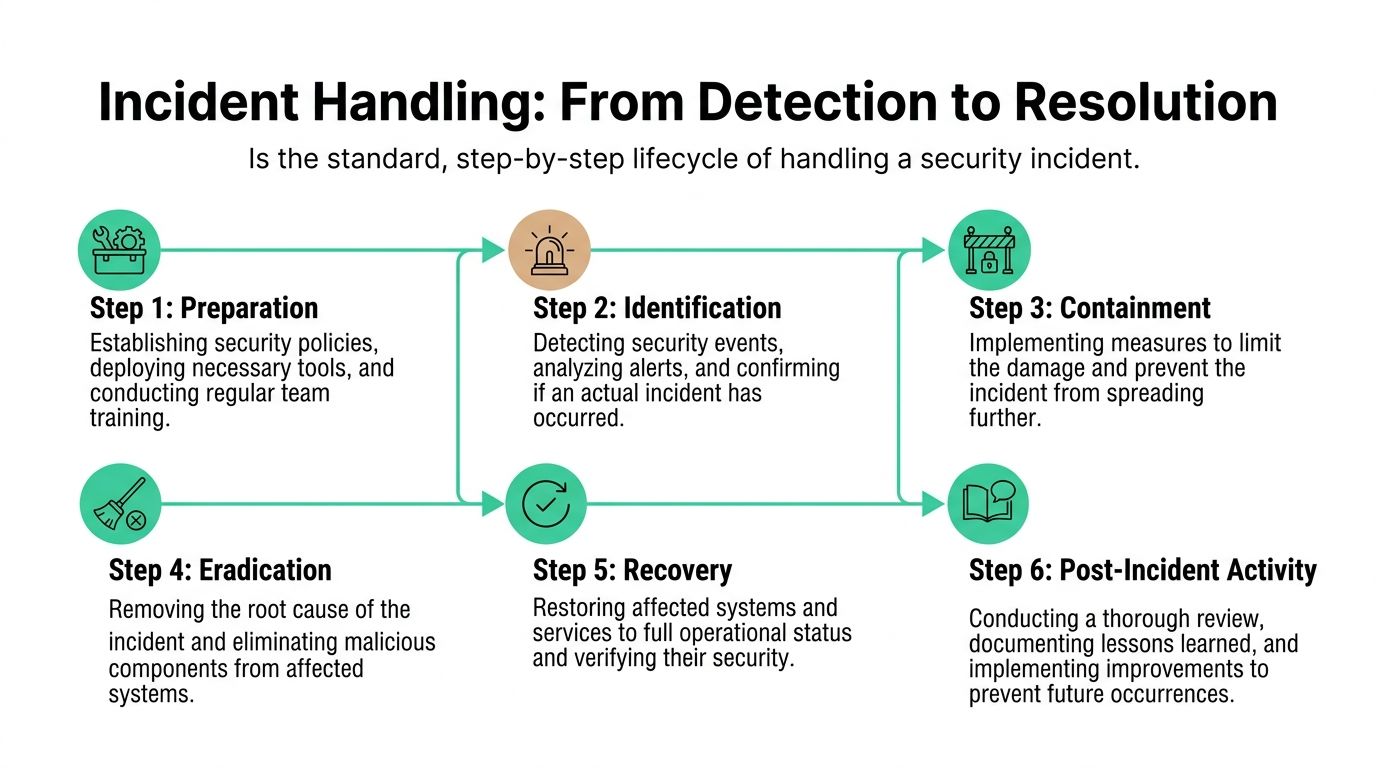
A standard incident handling sequence looks like this:
Preparation
Policies, tools, logging, access, and training need to exist before anything breaks.Identification
The analyst reviews the evidence and decides whether the alert is a real incident.Containment
The team limits damage. That might mean isolating a device, disabling an account, or blocking a malicious process.Eradication
They remove the cause. That can include deleting malware, revoking persistence, rotating credentials, or fixing the abused weakness.Recovery
Systems return to normal operation, with extra checks to confirm the threat is gone.Post-incident activity
The team documents what happened, what failed, what worked, and what needs to change.
Where things usually break down
This workflow sounds clean on paper. In real environments, analysts often lose time because data lives in separate tools. A 2024 Swimlane report found that 78% of SOC analysts cite “siloed tools and missing data” as their top challenge, which leads to delayed response and a higher chance of dismissing real threats as false positives.
That's why strong incident response depends on more than a SIEM. The analyst may need Active Directory logs, cloud records, endpoint activity, and firewall events just to answer a basic question like whether one account was compromised or several.
If you're tightening your process, these 10 incident response strategies are a useful operational reference because they push teams to define ownership, communication paths, and evidence handling before the next alert hits.
During an incident, speed matters. Clean documentation matters just as much because auditors and leadership will ask how you knew, what you did, and when you did it.
A capable SOC analyst isn't just reacting. They're preserving the timeline that lets the business recover, learn, and prove control.
How SOC Analysts Drive Compliance Audits
A lot of companies first feel the need for a SOC analyst when a customer questionnaire lands in the inbox. Suddenly the questions aren't about features. They're about logging, monitoring, alerting, incident response, and evidence.
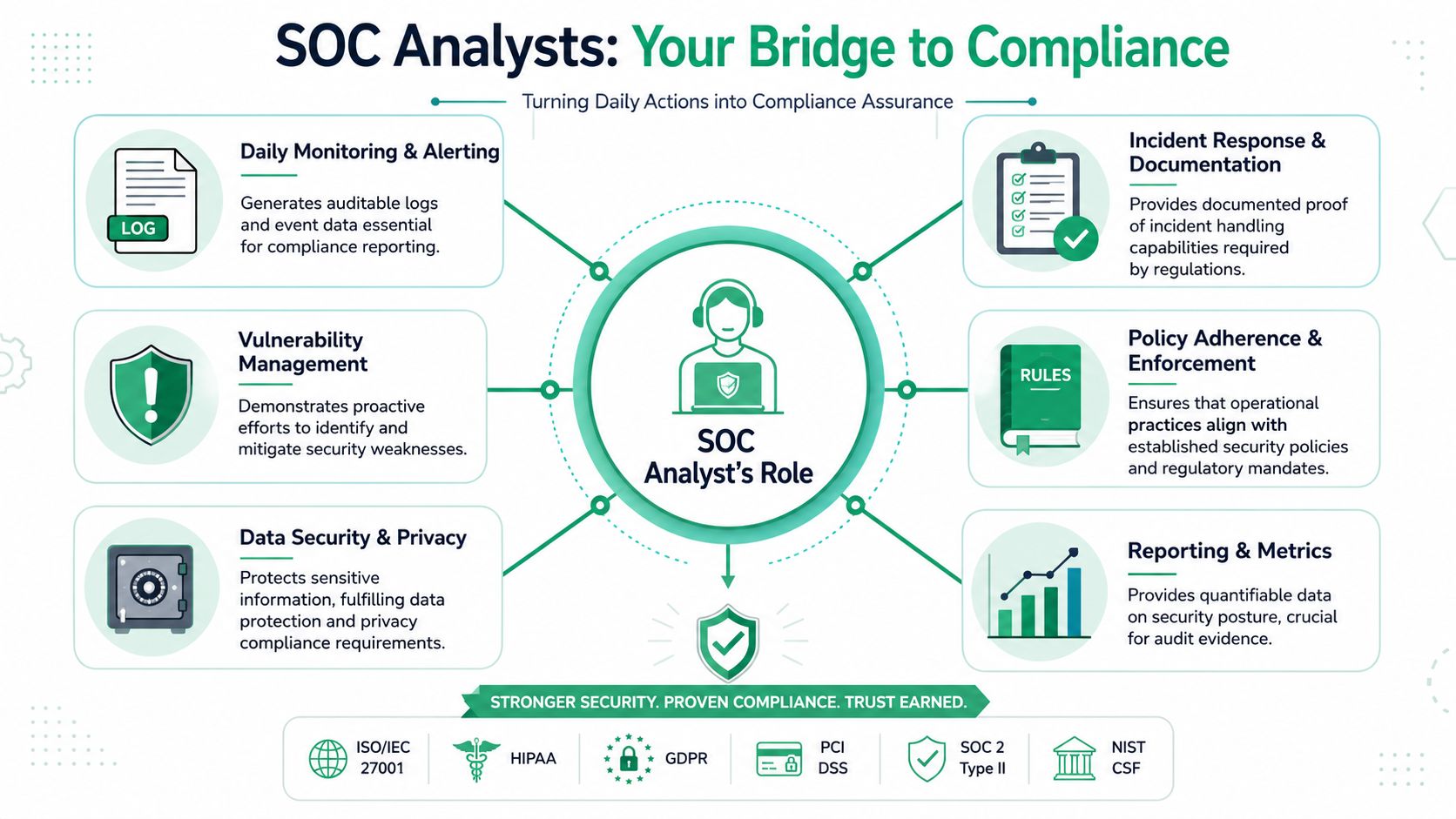
That's where the role ties directly to the bottom line. A SOC analyst creates and maintains the operating proof behind your controls. If you're pursuing SOC 2, PCI DSS, HIPAA, or ISO 27001, auditors want to see that security isn't just written down. They want records that show it's happening.
What auditors usually care about
A SOC analyst supports audit readiness in several concrete ways:
- Continuous monitoring: Alert review shows that suspicious activity is being watched, not ignored.
- Incident documentation: Tickets and reports prove the team can identify and respond to security events.
- Log retention and review: Auditors often ask for evidence that logs exist and are reviewed.
- Vulnerability follow-up: Security findings only matter if someone tracks remediation and validates closure.
Why monitoring alone isn't enough
Here's the trade-off many teams miss. Monitoring can show that you're watching. It does not prove your controls withstand attack.
That's where a manual penetration test matters. A standard commercial manual pen test typically costs between $10,000 and $35,000 according to Blaze Information Security's penetration testing cost breakdown. Lower-cost automated scan services exist, but they often lack the manual analysis auditors expect from a serious penetration testing engagement.
For smaller companies, that cost and timeline can become the blocker. They need something affordable, real, and fast enough to support an audit window. They also need useful findings. Nobody wants to wait weeks for a report that only repeats what a scanner already said.
That's why smart teams pair SOC monitoring with a manual pentest performed by certified testers who can validate exploitability, explain business impact, and deliver an audit-ready report quickly. Credentials like OSCP, CEH, and CREST matter here because they signal hands-on training and recognized testing standards.
If audit readiness is the pressure point, it helps to secure your SOC 2 compliance with testing that produces evidence quickly instead of dragging out the process. Fast reporting matters because many teams need results within a week, not after the audit meeting has already happened.
Hiring In-House Versus Outsourcing Your SOC
Most growing businesses don't struggle to understand what a SOC analyst is. They struggle to decide how to get the function in place without overbuilding or underfunding it.
If you hire in-house, you gain direct control. The analyst learns your environment, your users, and your business rhythms. That context helps with judgment calls, especially when alerts touch sensitive systems or internal workflows.
The downside is operational weight. One person can't provide full coverage, own every tool, manage detections, handle incident response, and also keep documentation audit-ready forever.
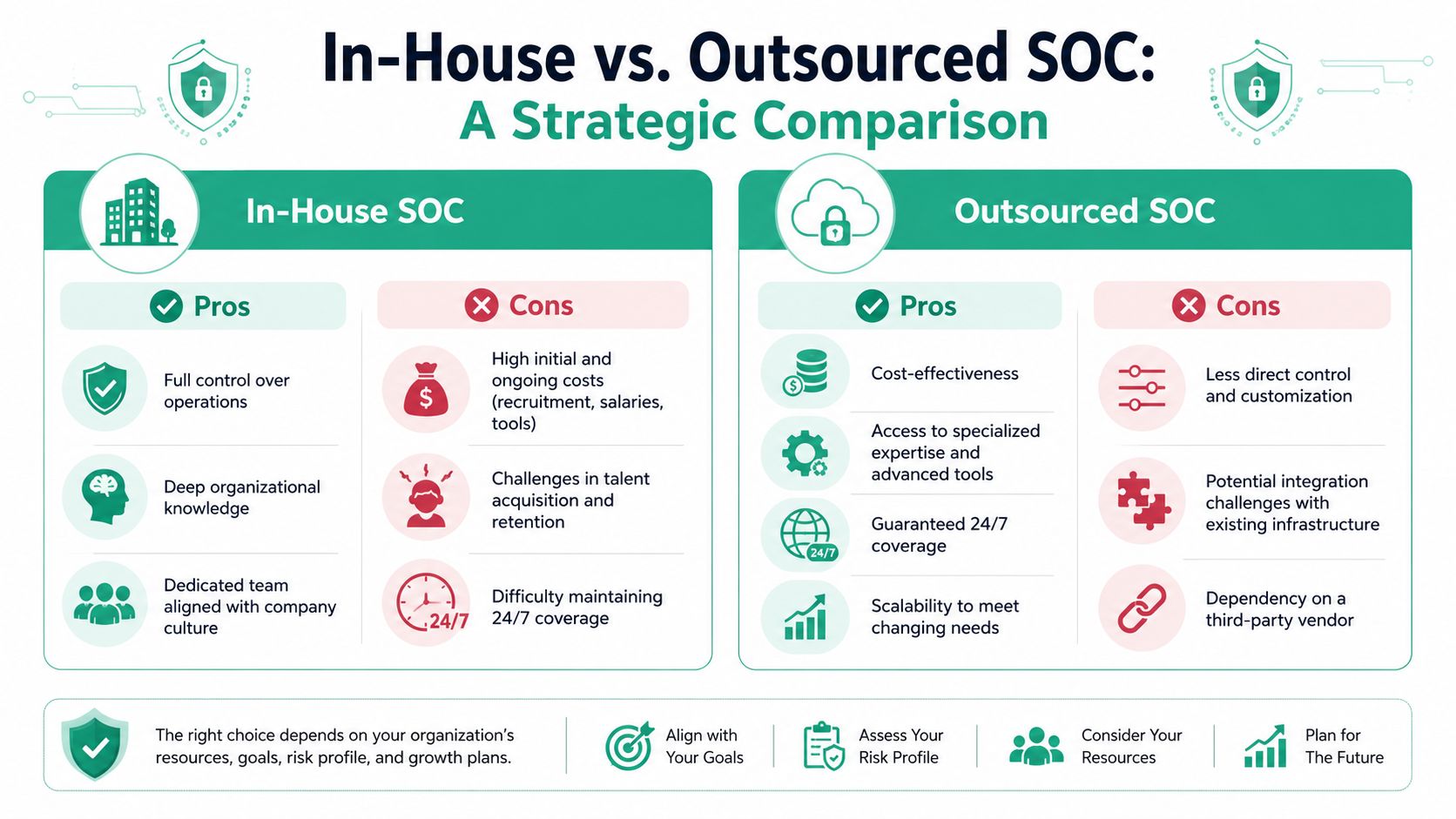
Side by side trade-offs
| Option | Strengths | Limits |
|---|---|---|
| In-house SOC analyst or team | Direct control, strong business context, close alignment with IT and leadership | Harder to cover nights and weekends, staffing pressure, tool overhead, retention risk |
| Outsourced SOC or MSSP | Broader coverage, access to specialized experience, easier scale, operational consistency | Less direct control, onboarding takes effort, quality depends heavily on the provider |
Questions to ask before deciding
A few questions usually make the decision clearer:
- Do you need true 24/7 monitoring? If yes, one internal hire won't solve it.
- Do you have someone to manage the tooling? Buying a SIEM isn't the same as running one well.
- Will the analyst also own audit evidence? If so, documentation discipline matters as much as technical skill.
- Can you separate noise from priority incidents today? If not, outside help may stabilize operations faster.
When interviewing an in-house candidate or a managed provider, ask sharp practical questions:
- How do you validate an alert before escalating it
- What logs do you need first if an account looks compromised
- How do you document containment steps for audit review
- What would you do if the endpoint tool shows activity but identity logs are missing
The best answers are calm, specific, and operational. The wrong answers sound polished but vague.
If you need a fast, affordable way to validate the environment your SOC is watching, Affordable Pentesting provides manual pentest, pen test, and penetration testing services built for startups and SMBs. Their certified pentesters, including professionals with OSCP, CEH, and CREST-aligned expertise, focus on useful findings, affordable pricing, and reports delivered within a week through their contact form.