.svg)

You're probably dealing with the same mess everyone else is. Vulnerability scans keep dumping findings into your queue. Cloud changes faster than your docs. Someone wants SOC 2, PCI DSS, HIPAA, or ISO 27001 evidence by the end of the month. And the security firms pitching you help want a giant budget, a long kickoff, and weeks of waiting for a report that says very little.
That model is broken.
Most startups and SMBs don't need more noise. They need a practical way to figure out what can hurt them, what needs fixing first, and what can wait. That's where exposure management matters. Not as another buzzword. As a common-sense way to stop treating every alert like a crisis and start reducing real risk.
Stop Chasing Alerts and Start Reducing Risk
If your team is buried in scanner output, the problem usually isn't lack of data. It's lack of focus. Security tools are good at producing lists. They're bad at telling a lean team what matters right now.
That's why so many IT managers and founders feel stuck. You know there are issues. You just don't know which ones are noise, which ones are dangerous, and which ones an auditor will care about first.
Why alert overload keeps winning
Most companies still run security like a checklist project. Quarterly scans. A few tickets. Maybe a penetration test right before an audit. Then everyone acts surprised when the same problems come back.
That approach misses the point. Attackers don't care about your spreadsheet. They care about what they can reach, chain together, and abuse.
Practical rule: If your team can't explain why an issue matters to the business, it shouldn't jump to the top of the remediation list.
Exposure management fixes that by changing the question. Instead of asking, “What vulnerabilities do we have?” it asks, “Which weaknesses create a realistic path to compromise?”
What a sane security program looks like
A sane program does a few things well:
- Knows what exists: Assets, apps, identities, cloud systems, and forgotten internet-facing services
- Ranks by real risk: Not just by severity labels
- Validates key findings: So teams fix proven problems, not theoretical ones
- Documents decisions: Which makes streamlining security and compliance a lot less painful
That last point matters more than people admit. Good security and good compliance usually come from the same habit. Clear prioritization, fast validation, and evidence that someone followed through.
What Exposure Management Really Means for You
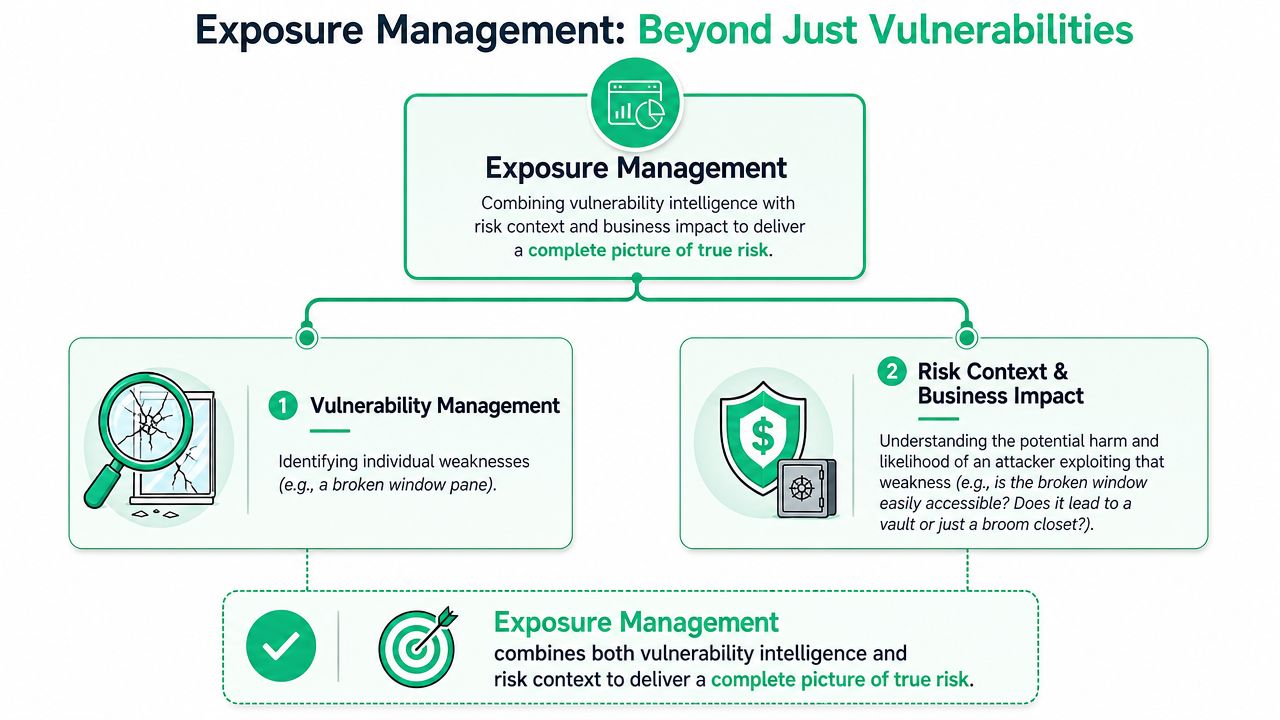
Here's the simplest answer to what is Exposure Management. It's a continuous, risk-based way to find weaknesses across your environment and decide which ones are worth fixing first.
That sounds abstract, so let's make it plain. Vulnerability management gives you a list of open windows. Exposure management shows you which open window lets an attacker get into the room with the payroll server, admin account, or customer data.
It's not just about CVEs
A lot of teams think security risk starts and ends with software flaws. That's too narrow. Exposure management also cares about misconfigurations, weak permissions, unmanaged assets, risky services, and identity issues that create exploitable paths.
Rapid7 puts it clearly in its explanation of what exposure management means in practice. It's a continuous, risk-based discipline that goes beyond listing vulnerabilities by correlating asset visibility, exploitability, and business context so teams can identify which exposures are reachable and worth fixing first.
The difference that actually matters
Many vendors muddy the water. They act like exposure management is just vulnerability management with a prettier dashboard. It isn't.
Use this simple comparison:
| Approach | Main question | Typical output | Real value |
|---|---|---|---|
| Vulnerability management | What flaws exist | Long list of findings | Basic hygiene |
| Exposure management | What can be reached and abused | Prioritized attack paths | Better decisions |
If you want the broader view before you go deeper, it helps to discover attack surface management, because you can't prioritize what you haven't found.
Exposure management is what happens when security finally grows up and admits that not every finding deserves the same response.
Why this matters for small teams
Startups and SMBs don't have time to treat every medium-risk finding like a fire drill. Your dev team has product deadlines. Your IT team is already wearing three hats. Your security budget probably doesn't match your risk.
That's why exposure management is useful. It forces discipline. You stop patching by panic and start fixing the issues that create a direct path to impact.
The Simple Workflow of Exposure Management
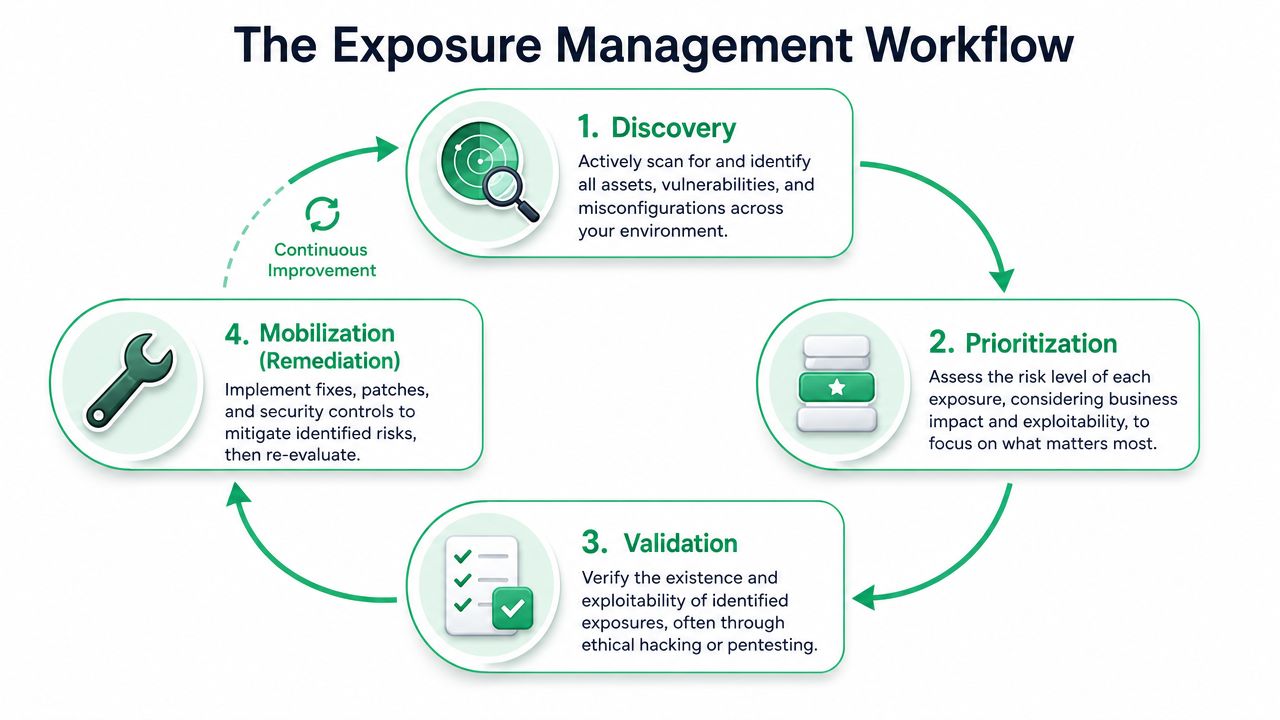
The workflow is straightforward. Not easy, but straightforward. Think in four moves: discovery, prioritization, validation, and mobilization.
Discovery starts with honesty
Discovery means finding what you own and expose. That includes endpoints, cloud workloads, user accounts, SaaS apps, public-facing systems, and the random old thing no one wants to admit is still running.
This step is boring, but skipping it is how companies get blindsided. If an asset is unmanaged, undocumented, or forgotten, it's often easier to exploit.
A practical discovery pass should cover:
- Internet-facing systems: Websites, APIs, remote access tools, and admin portals
- Cloud assets: Storage, compute, security groups, and identity roles
- User access: Admin accounts, stale accounts, and excessive permissions
- Shadow IT: The systems people spun up without telling anyone
Prioritization means cutting the list down
The issue isn't typically one of discovery. It's a prioritization problem. XM Cyber says organizations typically have about 15,000 exposures across their environments, and the least-secure companies have 6x more exposures than the best-protected ones, according to its state of exposure management findings.
That should kill the fantasy that you can fix everything fast. You can't. You need triage.
Don't rank findings by severity score alone. Rank them by whether the asset matters, whether an attacker can reach it, whether access can be chained, and whether the weakness opens the door to something more important.
Validation is where theory gets tested
This is the step too many teams skip. They scan, sort, and ticket. Then they assume the highest-scoring findings are the biggest danger.
That's lazy security.
Validation means proving whether an identified exposure is exploitable in your environment. A manual pentest, pen test, penetration test, or penetration testing engagement earns its keep through this process. A good tester checks whether weaknesses can be chained across apps, infrastructure, and identities. They don't just repeat scanner output.
If a finding hasn't been validated, treat it as a lead, not a verdict.
Manual testing matters because attackers don't exploit isolated CVEs in a vacuum. They use context. They look for weak auth, bad trust boundaries, exposed admin functions, reused credentials, and simple paths your tooling can't fully interpret.
Mobilization is where teams usually stall
Mobilization means getting fixes into the hands of the people who can make them happen. Devs need reproduction steps. IT needs ownership. Leadership needs clear priority. Compliance needs evidence.
Use a simple handoff model:
- Assign ownership: Every confirmed issue needs a real person attached
- Give business context: Explain what the issue can lead to
- Set order of operations: Fix the path-opening issues first
- Retest important fixes: Don't assume the patch solved the exposure
A workflow only works if it keeps looping. Environments change. New assets show up. Access drifts. Exposure management isn't a one-time project. It's ongoing discipline with proof built in.
Connecting Exposure Management to Your Compliance Audits
Auditors don't expect perfection. They expect process. That's a big difference, and it's where a lot of companies waste time and money.
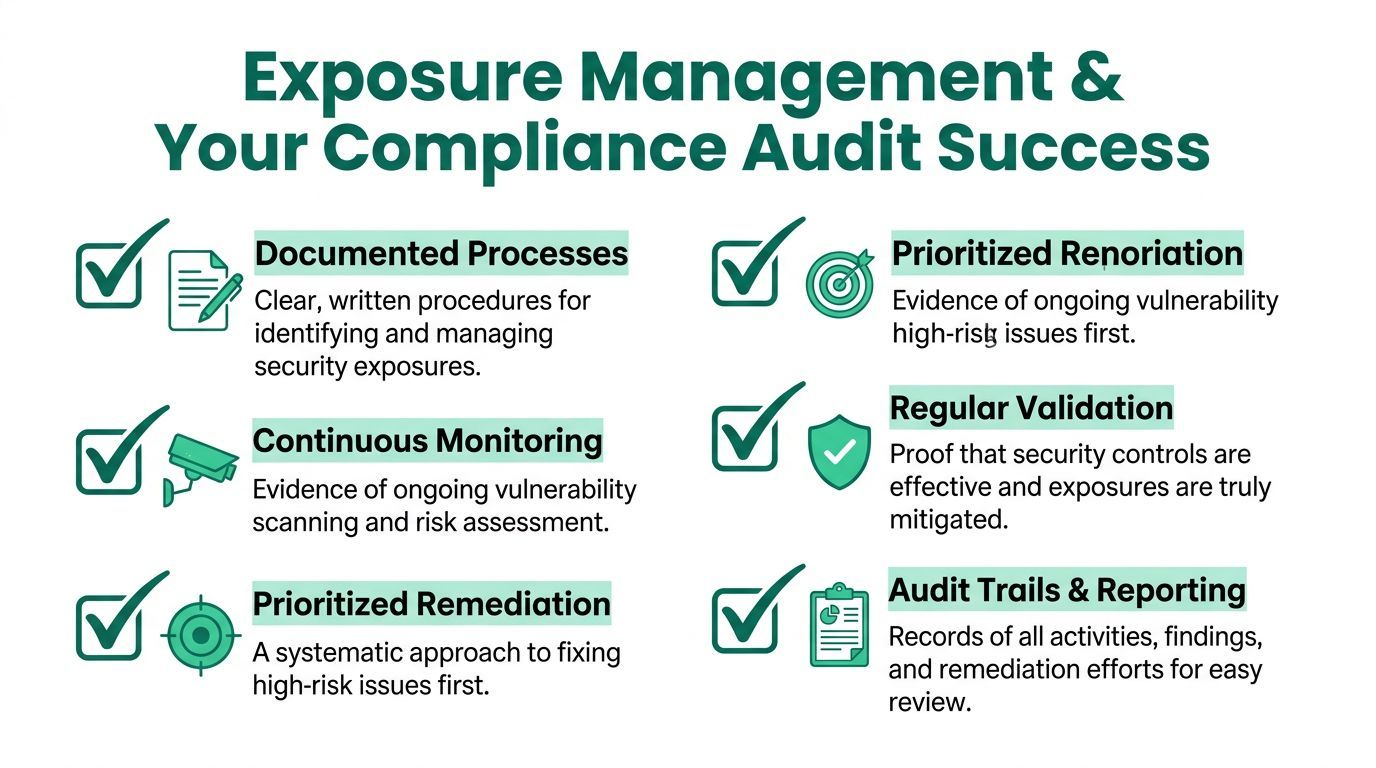
If your security story is just “we ran some scans,” you're making your audit harder than it needs to be. Auditors want to see that you have a repeatable way to identify risk, prioritize what matters, validate important issues, and track remediation.
Why auditors like structured programs
A structured exposure management process gives you a defensible answer when an auditor asks why one issue was fixed immediately and another was deferred. You can point to reachability, business impact, validation results, and remediation tracking.
That's much stronger than saying, “The scanner marked this critical.”
SAFE describes modern frameworks like CTEM as a unified view across company assets, including cloud, IT, identities, and applications, to turn broad visibility into action. Its guide on exposure management and CTEM aligns well with what auditors usually want to see from a mature program.
What evidence actually helps
For SOC 2, PCI DSS, HIPAA, and ISO 27001, the useful evidence tends to look familiar:
- Documented procedures: How you identify and review exposures
- Risk-based decisions: Why certain issues were prioritized
- Validation records: Proof that important findings were tested
- Remediation tracking: Who fixed what, and when it was retested
If you need audit-specific validation on internet-facing systems, external testing often provides direct help meeting SOC 2 external pentest needs.
Auditors rarely get excited by tool sprawl. They respond to clear records, repeatable decisions, and evidence that someone closed the loop.
Compliance gets easier when security is practical
This is the part expensive consultants often miss. Compliance isn't helped by giant decks, vague risk statements, or bloated roadmaps. It's helped by a simple system people can run month after month.
Exposure management gives you that system. Manual penetration testing strengthens it because it verifies whether your controls hold up in actual conditions. That's the kind of evidence that survives audit questions without drama.
How to Make Exposure Management Practical and Affordable
Let's say the quiet part out loud. A lot of exposure management advice is written for giant enterprises with giant budgets, giant teams, and giant tolerance for procurement nonsense.
That's not your world if you're running a startup or SMB.
Don't buy a platform to avoid doing the work
A massive platform won't save you if your team can't validate findings and fix them quickly. For smaller companies, the staffing burden is the primary constraint. Reach points out in its guide for SMBs that the question isn't just whether you can find exposures, but whether the process reduces risk without a huge operational lift. That's why practical exposure management for smaller teams often comes down to targeted validation instead of buying oversized tooling.
That's the common-sense path. Use solid discovery and monitoring tools. Then spend your money where it counts most, on confirming what's exploitable and fixing it.
What practical looks like
A workable SMB approach usually looks like this:
- Keep discovery lightweight: Use the tools you already have to inventory internet-facing assets, cloud resources, and identities
- Prioritize by exposure path: Focus on what could lead to admin access, sensitive data, or customer-facing disruption
- Use manual validation: A skilled pen tester can separate real attack paths from scanner clutter
- Fix in short cycles: Small batches move faster and get done
If email is part of your risk picture, and it usually is, pair your exposure work with effective email defense strategies so you're not ignoring one of the most common entry points into a business.
Why speed matters more than ceremony
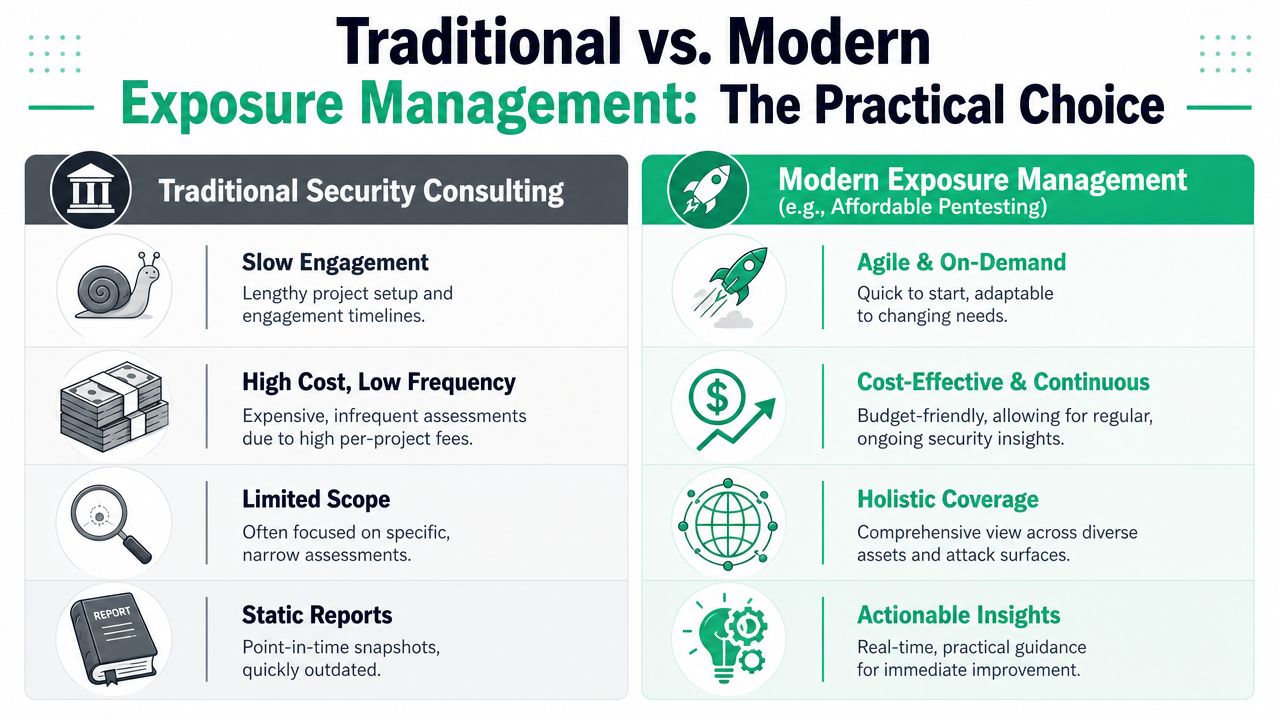
Traditional firms love process theater. Discovery calls. Scope workshops. Long SOWs. Reports that arrive when your audit window is already closing. That's expensive and dumb.
Small teams need fast answers. A good penetration testing process should start quickly, validate the exposures that matter, and produce a report within a week so your team can move. The point is to create action, not paperwork.
Credentials matter too. If you're paying for validation, use certified pentesters with backgrounds like OSCP, CEH, and CREST. You want people who know how attackers think and can explain findings in plain English.
Real-World Scenarios for Startups and SMBs
A SaaS startup getting ready for its first SOC 2 audit usually starts the same way. They run vulnerability scans, review cloud settings, and end up with a pile of findings that all look urgent. The founders panic because the engineering team is small and can't stop feature work for a month.
The smart move is to stop treating every finding as equal. They narrow the scope to customer-facing systems, admin access paths, and identity issues tied to production. Then they use a manual pentest to validate what can be exploited. That shifts the team from generic scanning to confirmed attack paths across assets, identities, and business context, which is the operational shift highlighted in Palo Alto Networks' explanation of why exposure management needs validation.
Scenario one with a lean SaaS team
What usually gets confirmed in that kind of environment isn't a hundred dramatic flaws. It's a handful of real weaknesses that matter. Maybe an exposed admin function, weak access controls in a web app, a cloud permission issue, and an old staging service no one locked down.
That gives the startup a roadmap it can use:
- Fix exposed paths first: Anything tied to production data or privileged access
- Defer low-impact noise: Not everything deserves immediate engineering time
- Use the report as audit evidence: Validation plus remediation notes tell a clean story
Scenario two with a PCI deadline
A small e-commerce company faces a different kind of pressure. Payment deadlines don't care that your IT manager also handles vendors, laptops, and firewall changes. They need confidence that the cardholder environment isn't exposed before the compliance deadline hits.
In that case, a fast penetration test helps in two ways. First, it validates whether public-facing weaknesses can lead anywhere meaningful. Second, it gives the business a report it can use to show that testing happened, issues were reviewed, and remediation was taken seriously.
The right test doesn't create chaos. It removes uncertainty.
For both companies, the pattern is the same. Discovery gives them visibility. Prioritization cuts the list down. Validation proves what's real. Remediation becomes manageable because the work is tied to actual risk, not scanner panic.
Your Actionable Next Steps for Better Security
If you've made it this far, here's the blunt answer to what is exposure management. It's the discipline of finding what can hurt you, proving what's exploitable, and fixing the things that actually change your risk.
Most companies already have enough alerts. They don't have enough validated insight.
Use this shortlist:
- Inventory what's exposed: Especially internet-facing apps, cloud assets, and admin paths
- Stop trusting severity scores alone: Business context matters more than labels
- Validate before you overreact: Scanner output is a starting point, not the finish line
- Document remediation decisions: That helps security and compliance at the same time
- Get a third-party penetration test: A manual pen test gives you proof, not guesses
If your current security process is slow, overpriced, and producing little value, change the process. You do not need a bloated consulting engagement to get clear answers. You need focused validation, useful reporting, and a timeline that matches how real businesses operate.
If you need a fast, affordable pen test, penetration test, or penetration testing engagement for SOC 2, PCI DSS, HIPAA, ISO 27001, or general risk validation, Affordable Pentesting is built for that. Their certified pentesters, including OSCP, CEH, and CREST professionals, deliver practical findings and reports within a week, without the bloated price tag and delays that waste everyone's time. Use their contact form to get a no-obligation quote that fits your budget and timeline.