.svg)

Purple teaming is a collaborative cybersecurity exercise. Instead of attackers (Red Team) and defenders (Blue Team) working separately, they team up. This joint effort makes your security defenses stronger, faster.
Think of it as a live practice session. Our certified penetration testers act as ethical hackers. Your IT staff defends against them, learning and fixing security holes in real time.
What Is Purple Teaming and Why It Matters
Traditional security testing is slow and frustrating. You hire a pen testing firm, they take weeks, and hand you a report full of problems. Then, it's your job to figure out how to fix it all.
Purple teaming is different. It's a hands-on workshop, not just another penetration test. The name "purple" comes from mixing the offensive Red Team with the defensive Blue Team to improve your security posture together.
Red vs. Blue vs. Purple Team At a Glance
The goal of a purple team is simple. The goal isn't just to find security flaws. It's to make your own team better at spotting and stopping real-world threats quickly.
| Team Type | Primary Goal | How They Work | Typical Outcome |
|---|---|---|---|
| Red Team | Find vulnerabilities by simulating real-world attacks. | Works in isolation to breach defenses, often covertly. | A report listing security holes and successful attack paths. |
| Blue Team | Defend the organization's systems and data. | Monitors, detects, and responds to threats in real-time. | Alerts, incident response actions, and system hardening. |
| Purple Team | Improve detection and response capabilities. | Red and Blue teams work together in an open, collaborative loop. | A stronger, more skilled security team with validated defenses. |
More Than Just a Pen Test Report
The outcome of a purple team exercise is not a report card. It's a powerful boost to your team's skills. This is perfect for businesses tired of slow timelines and reports that don't lead to action.
Our approach is built for businesses that need results without the enterprise price tag. We provide affordable manual pentests that give you access to expert ethical hackers with certifications like OSCP, CEH, and CREST. You get your comprehensive report within one week.
Tangible Benefits of Purple Team Exercises
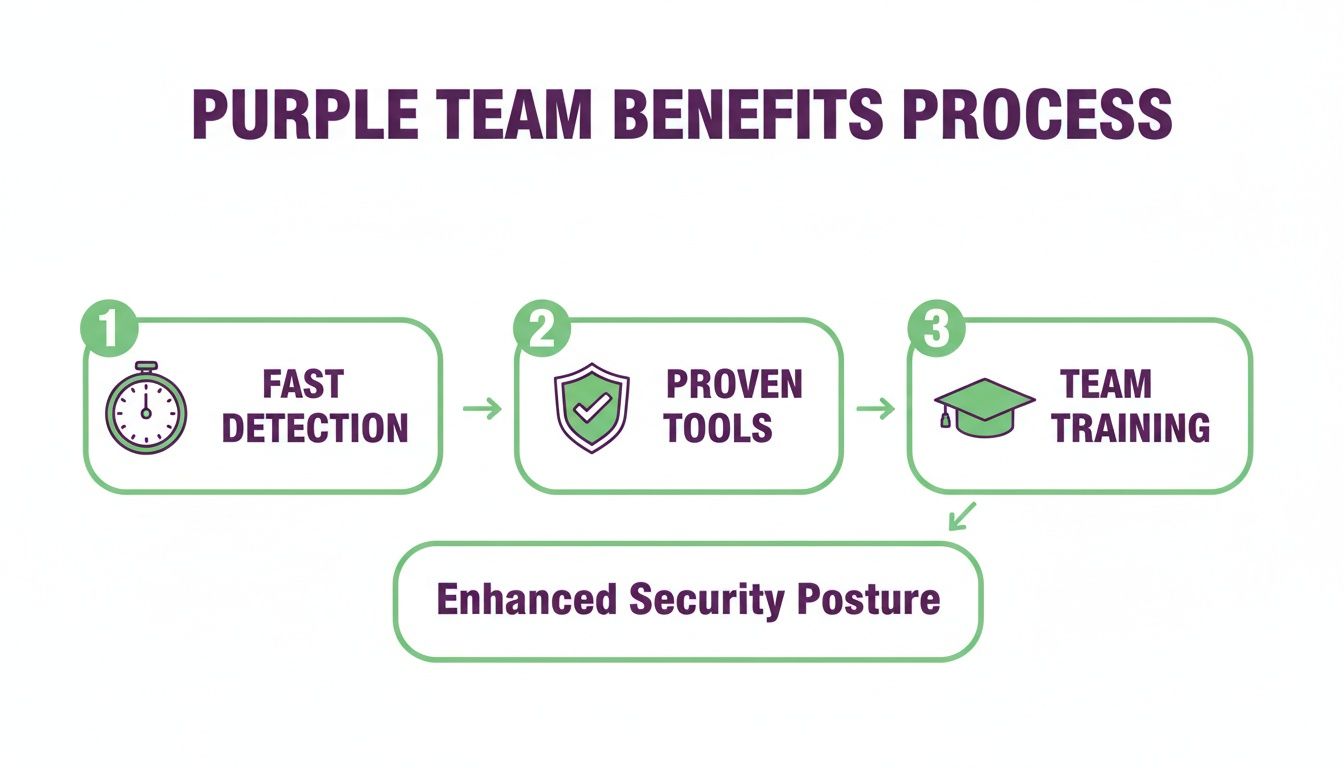
Forget waiting weeks for a pentest report. A purple team exercise delivers immediate, measurable gains by focusing on what actually works. These benefits solve your biggest headaches, like wasting money on security tools you can't prove are working.
The whole point is to get a much higher return on your security investment. It’s better than running separate red and blue team exercises.
Stop Wasting Money on Security Tools
You spend a lot of money on security software. But how do you know if it’s configured correctly and doing its job? A purple team exercise gives you instant, undeniable proof.
Our OSCP and CREST certified pentesters will simulate a real-world attack. You get to see firsthand if your expensive security tools detect and block it. If a tool fails, we work with your team right then to fix the configuration.
Dramatically Faster Threat Detection
In a real security incident, every second matters. The faster you spot a threat, the less damage an attacker can do. Purple teaming is one of the most effective ways to shrink your response time.
Your team gets hands-on practice spotting the signs of a live attack. According to a 2024 Ponemon study, companies using purple teams cut their incident response times by 40%. This is a huge shift in your team's ability to protect the business.
Get Security Training That Actually Sticks
Reading about cyberattacks is one thing; defending against a live one is completely different. Purple teaming provides invaluable, hands-on training for your security team that no online course can replicate. Your team defends its home turf.
Our affordable pentest model makes this advanced training accessible. We deliver the expertise of CEH and OSCP certified professionals without the high costs of traditional firms. We also deliver your full report within a week, so you can act on lessons learned.
How a Purple Team Engagement Actually Works
A purple team engagement is a structured, hands-on workshop. It is designed for rapid, measurable improvement. It's a live drill that builds muscle memory, not a report that gathers dust.
The whole point is to get your team and our team in the same room. We test, detect, and fix issues in real-time. Our certified pentesters play the role of the attackers, and your IT team defends.
Phase 1: Planning And Scoping
Before any attacks, we start with a focused planning session. We get straight to the point: what are you trying to achieve? Are you prepping for a compliance audit or worried about a specific threat?
We define the rules, identify the target systems, and set up clear communication. This ensures a clear plan focused on getting you the answers you need, fast.
Phase 2: Execution And Live Collaboration
This is where the real value is created. Our OSCP, CEH, and CREST certified pentesters start simulating attacks. Instead of working alone like in a traditional pentest, we're on an open channel with your defenders.
When we launch an attack, your team tries to spot it. If they miss it, we pause, show them what happened, and work with them to tune their tools. This immediate feedback loop is what makes purple teaming so powerful.
A Simple Purple Team Engagement Runbook
This table shows the constant back-and-forth that makes purple teaming effective. It is a collaborative training session, not just a test. This process trains your team and validates your tools all at once.
| Phase | Key Activities | Your Team's Role (The Defenders) | Our Team's Role (The Attackers) |
|---|---|---|---|
| 1. Planning | Define objectives, scope, and rules of engagement. | Provide system details and identify key defensive personnel. | Propose attack scenarios aligned with your business risks. |
| 2. Attack Simulation | Execute a specific attack technique (e.g., credential dumping). | Monitor security tools (SIEM, EDR) for signs of the attack. | Announce the technique and execute it against the target. |
| 3. Live Feedback | Huddle to discuss detection and response effectiveness. | Share what alerts were (or were not) generated. | Explain the attack path and why it succeeded or failed. |
| 4. Defense Tuning | Implement immediate improvements based on feedback. | Adjust detection rules, block indicators, or modify configurations. | Provide guidance on effective mitigation and re-test the fix. |
| 5. Reporting | Document all techniques, outcomes, and recommendations. | Contribute to the summary of lessons learned and action items. | Consolidate all findings into a final, actionable report. |
Phase 3: Debriefing And Reporting
A purple team engagement ends with a debrief where both teams analyze the exercise. We review every attack, what was caught, what was missed, and why. We boil all the lessons down into a prioritized action plan.
Our process is built for speed. You won't wait weeks for a report. We deliver a complete, easy-to-read summary within one week. If you're ready to see how this approach can strengthen your defenses, reach out through our contact form.
Using Purple Teaming for Compliance and Audits
Compliance audits are often a painful exercise. Purple teaming changes that by giving you hard evidence that your security controls actually work. You get to prove your security posture, not just describe it on paper.
Instead of handing an auditor a policy document, you can give them a report. It proves your defenses were tested against a real attack. This shifts the entire conversation with an auditor to demonstrating real security readiness.
Satisfy Auditors with Real-World Evidence
Frameworks like SOC 2, PCI DSS, and HIPAA all require security testing. A basic pen test report might check the box. A purple team report tells a much better story and shows you actively find and fix gaps.
An auditor is far more impressed by a report that says, "We simulated a ransomware attack and our EDR successfully blocked it," than a policy document. The final report from our OSCP, CEH, and CREST certified pentesters becomes that concrete proof.
Tailor Exercises to Specific Compliance Needs
The best part about purple teaming is its flexibility. We design the engagement to simulate the exact threats that your industry and compliance framework care about most. This targeted approach ensures the exercise delivers maximum value.
For PCI DSS, we focus on attacks targeting cardholder data. For HIPAA, we simulate attempts to steal patient records. For SOC 2, we build scenarios that align with the Trust Services Criteria. This helps you sail through your next audit. For more help, you can use a security audit checklist.
An Affordable Path to Continuous Compliance
Many businesses assume advanced security testing is too expensive. Traditional firms quote high prices for slow exercises that don't offer the feedback needed for real improvement. We think that's a broken model.
Our approach is different. We deliver affordable manual pentests and purple team exercises. You get a comprehensive report with clear findings within a week. If you're looking for practical ways to get ready for a SOC 2 audit, you might be interested in learning more about our approach.
When to Choose Purple Teaming Over a Pentest
Knowing whether you need a classic pentest or a purple team exercise can be tricky. Both are valuable, but they solve different problems. Picking the right one at the right time is key to getting the most from your budget.
A traditional penetration test is about getting a snapshot of your vulnerabilities. A purple team exercise is about training your team to spot and shut down a real attack. It's a live-fire drill for your security team.
Choose a Penetration Test When…
A standard penetration test is your best bet for a point-in-time assessment. A pen test gives you a clean, documented report of security flaws that you can hand to your teams to start fixing. It is the right move for launching a new app or getting a simple compliance report.
If you don't have a dedicated security team to collaborate in a live exercise, a traditional penetration test gives you actionable results without needing their active participation. If you're still sorting out your needs, our article comparing a pen test vs. vulnerability assessment can help clarify the basics.
Choose Purple Teaming When…
A purple team exercise is a more strategic move to level up your security maturity. You should go for purple teaming when your goals are about improving people and processes, not just patching systems. It's about proving your defensive capabilities.
These are the perfect scenarios for a purple team exercise. You need to validate your security tools. You want to train your security team. You need to shrink your detection and response times. Or you need to satisfy advanced compliance requirements.
Get Started With Affordable Purple Teaming
Tired of pentests that cost a fortune and tell you almost nothing new? If you're sick of old-school firms that take months to deliver a thin report, there's a better way. Our purple team exercises are built for businesses that need real results.
We built our approach to solve the biggest frustrations that IT managers, CISOs, and startup founders face. It's a clear alternative that puts speed, value, and genuine improvement first.
Your Path to Stronger Security
Here’s what you get when you work with us. You get affordable expertise with direct access to our OSCP, CEH, and CREST certified pentesters. You get rapid reporting, with a comprehensive, actionable report within one week.
You also get actionable findings. We don't just dump a list of problems on your desk. Our reports give you clear guidance that your team can use to fix gaps and shut down attack paths right away.
Take the Next Step
Ready to see how a fast, affordable purple team exercise can strengthen your security? Our process is simple and totally transparent. We’ll work with you to define the scope and get straight to building a stronger, more confident defense.
Let's start the conversation. Fill out our contact form, and we'll show you how our approach to the pen test, penetration test, and collaborative security validation can make all the difference.
Your Purple Teaming Questions, Answered
If you're tired of the slow, expensive cycle of traditional security testing, you've probably heard about purple teaming. We get these questions all the time from clients looking for a faster, more effective way to get secure. Here are the direct answers to the most common questions.
How Much Does a Purple Team Exercise Cost?
Every project is different, but our model is built to be affordable. We don't have the massive overhead of traditional firms, so we can offer transparent pricing that won't destroy your budget. Our whole goal is to make real security validation accessible.
We provide a custom quote based on the specific systems you need to test. This way, you only pay for what you need. Just fill out our form, and we can map out a plan that fits your budget.
How Long Does a Purple Team Engagement Take?
We are built for speed. The hands-on exercise itself might run for a few days, but you will have a full, actionable report in your hands within one week of completion. That’s a core part of our promise.
No more waiting months for a report while attackers have free rein. Our fast turnaround means your team can start patching holes and hardening your defenses immediately.
Do We Need a Mature Security Team for This?
Not at all. In fact, that's one of the biggest misconceptions about purple teaming. You don't need a huge, established security operations center to get incredible value from this.
For less mature teams, this is an amazing training opportunity. Your team gets to learn directly from our OSCP and CEH certified experts. For experienced teams, it’s the perfect chance to stress-test your advanced defenses.
What Is the Real Difference From a Regular Pen Test?
This is the most important question we get. The difference is the goal. It’s collaboration and training versus just getting a list of findings.
A regular pen test is like getting a report that lists all the broken locks on your doors. A purple team exercise is like having an expert work with your security guards, showing them how attackers pick locks in real-time and training them to stop it.
Ready to move beyond slow, expensive reports and build a truly resilient security posture?