.svg)
You're probably here because an auditor, a customer, or a government contract requirement dropped RMF in your lap and made it sound like you need a full compliance department to deal with it.
You don't.
If you're asking what is RMF, the practical answer is simple. It's a structured way to decide what matters, protect it, test it, approve it, and keep watching it. Done right, RMF saves time because you stop guessing which controls matter. It saves money because you stop buying random security work that looks impressive but doesn't help you pass audits or reduce real risk.
Most startups and SMBs get burned in two ways. They either ignore structure and scramble before every audit, or they hire overpriced firms that turn security into a paperwork factory. RMF gives you a middle path that works.
Understanding the Risk Management Framework Simply
Think of RMF like a GPS for security decisions. It doesn't just tell you to “be secure.” It tells you where to start, what to protect first, how to test whether it works, and when leadership needs to accept risk instead of pretending a spreadsheet solved it.

That matters because most compliance pain comes from chaos. One team buys tools. Another writes policies. Nobody agrees on scope. Then an auditor asks basic questions and the whole company starts digging through Slack, Google Drive, and ticket history.
RMF is structure, not red tape
RMF stands for Risk Management Framework. NIST and related guidance frame it as a lifecycle for managing security risk, not a one-time approval ritual. Historical guidance also describes RMF as the modern replacement for old Certification and Accreditation methods, moving organizations away from legacy approval models and toward security, privacy, and cyber supply chain risk management built into the system lifecycle, as outlined by RMF.org's overview of RMF.
That's the part people miss. RMF isn't a checklist you complete once and forget. It's a way to make repeatable security decisions so your team doesn't reinvent the wheel every quarter.
If you want a quick plain-English definition, this RMF glossary is a useful reference. If you want a more practical take on how teams apply risk frameworks in practice, see Affordable Pentesting on risk frameworks.
Practical rule: If your security process only produces documents and never changes engineering decisions, it's broken.
Why startups and SMBs should care
A lot of smaller companies hear “RMF” and assume it's only for federal systems. That's the wrong takeaway. The useful part for commercial teams is the operating model. You identify important systems, decide what could go wrong, pick controls that fit the risk, test them, and keep monitoring.
That's exactly how sane companies prepare for SOC 2, HIPAA, PCI DSS, and customer security reviews without wasting money.
Here's what RMF helps you avoid:
- Random control buying by forcing you to tie safeguards to actual business risk
- Audit thrash by creating a documented logic for why your controls exist
- Fake confidence by requiring testing instead of trusting screenshots and policy PDFs
- Endless rework by giving your team a repeatable process instead of starting from zero every time
The real value of RMF
The smartest way to use RMF is as a shortcut. Not a bureaucratic burden. You don't need to copy government paperwork line for line. You need to adopt the discipline behind it.
For a founder, that means fewer nasty surprises right before a deal closes. For an IT manager, it means cleaner scoping and better evidence. For a compliance lead, it means your audit story finally makes sense.
Walking Through The Six Steps of RMF
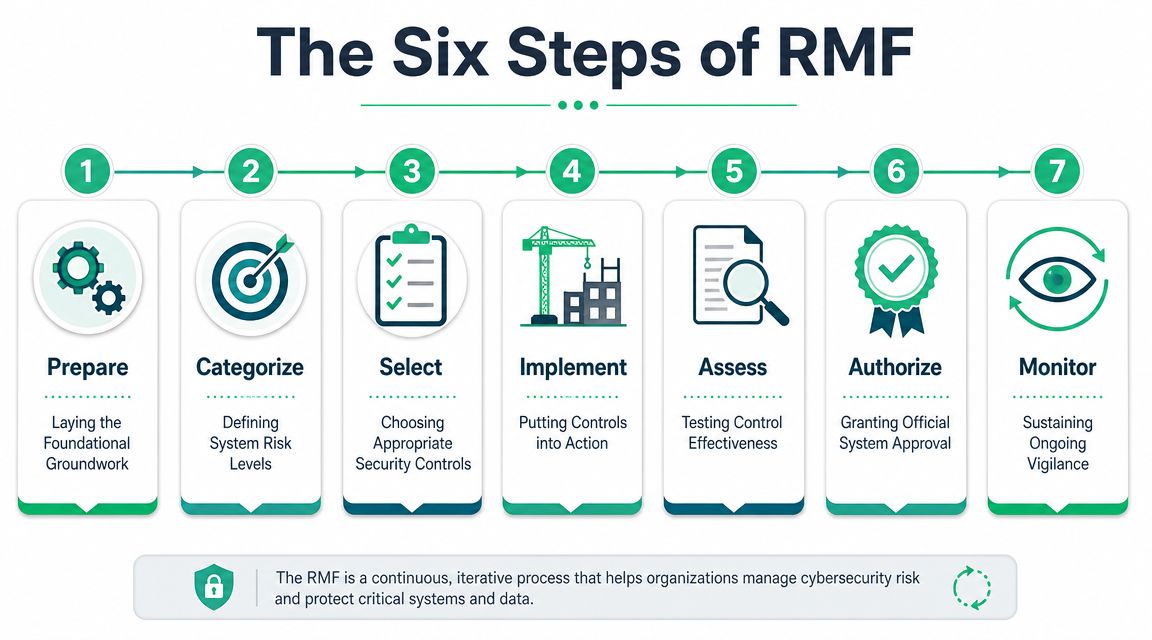
NIST describes RMF as a structured process built around core steps and notes that control selection draws from NIST SP 800-53, a catalog of over 1,000 security controls used in federal and enterprise environments, according to NIST's RMF project page.
That sounds big and ugly. It doesn't have to be.
Prepare and categorize first
Prepare means getting the groundwork straight. You define the system boundary, identify who owns it, list the important assets, and decide how your team will manage risk.
Small companies usually skip this and pay for it later. If nobody can answer “what exactly is in scope,” every audit and every pen test turns into a mess.
Categorize means deciding how serious a failure would be. Is this system a brochure website, an internal admin panel, or a production app holding patient or payment data?
That decision drives everything else. If you treat a customer data platform like a landing page, your controls will be too weak. If you treat a low-risk tool like a classified system, you'll waste time and money.
Select and implement controls
Select means choosing the security controls that match the risk. In plain English, you're deciding what safeguards this system needs.
For a startup, that might mean MFA, logging, access reviews, endpoint protection, secure development practices, backups, vendor review, and incident response basics. The point isn't to install everything. The point is to choose controls you can justify.
Implement means putting those controls into the operational environment. Policies on paper don't count if the production system doesn't match them.
This is where engineering and IT need to stop treating compliance as someone else's problem. If the selected controls aren't configured, enforced, and documented, they don't exist.
Most RMF failures happen before testing. Teams either scope the system badly or pick controls they never actually put in place.
Assess, authorize, and monitor continuously
Assess means checking whether the controls work. In this stage, penetration testing, a penetration test, a pen test, and broader penetration testing evidence become critical.
A pentest gives you real proof. Not guessed proof. Not checkbox proof. If an attacker can bypass auth, exploit a web app flaw, or move laterally because of weak segmentation, your assessor needs to know that now, not after an incident or an audit finding.
Authorize means a responsible leader formally accepts the risk of operating the system. That sounds formal because it is. Somebody has to say, “We understand the remaining risk and we're willing to run this system.”
Monitor means you keep watching for changes. New integrations, code changes, admin turnover, cloud misconfigurations, and fresh vulnerabilities all shift risk. If you don't monitor, your authorization becomes stale almost immediately.
Here's the practical version of the flow:
- Prepare by defining scope, owners, and assets
- Categorize by deciding how damaging a failure would be
- Select controls that fit the specific risk
- Implement those controls in production
- Assess with reviews, validation, and a penetration test
- Authorize with clear business sign-off
- Monitor for drift, changes, and new weaknesses
RMF isn't hard because the steps are confusing. It's hard because companies rush the first four steps and then expect a pentest to rescue bad scoping and weak controls.
Key RMF Roles in Your Organization
RMF role names sound like they belong in a giant federal office. In reality, they map cleanly to the people you already have. You probably don't need new hires. You need clear accountability.
Who usually owns what
The Authorizing Official is the person who accepts business risk. In a startup, that's often the CEO, CTO, or founder. In an SMB, it may be the CIO or a business unit leader who owns the system outcome.
The System Owner is the person responsible for the system itself. That's usually the Head of Engineering, Infrastructure Manager, or IT Manager. They don't need to know every control detail, but they do need to know what's in scope and what the system depends on.
The Information System Security Officer or similar security lead keeps the process honest. In a small company, this might be a security manager, GRC lead, DevSecOps lead, or even an experienced IT/security generalist wearing multiple hats.
What this looks like in a smaller company
You don't need perfect titles. You need ownership that survives an audit and holds up during a real security review.
A practical mapping often looks like this:
- Founder or CTO as AO because they're the one deciding whether the company can live with the remaining risk
- Engineering or IT lead as System Owner because they control the environment, roadmap, and implementation
- Security or compliance lead as ISSO equivalent because they track controls, evidence, and assessment follow-through
- Developers and admins as implementers because they configure the systems and fix the findings
If everybody “owns security,” nobody owns RMF. Assign names, not departments.
Keep the roles lean
Don't turn this into theater. One person can hold multiple roles in a small company as long as the responsibility is clear and documented.
What matters is that your auditor, your customer, and your internal team all know who approves risk, who runs the system, who tracks controls, and who fixes the gaps. That clarity alone cuts a lot of wasted time.
Mapping RMF to SOC 2 and HIPAA
Most companies don't adopt RMF because they love frameworks. They adopt structure because they need to pass audits, answer customer questionnaires, and stop bleeding time every time compliance comes up.
That's why RMF is useful outside government. It creates evidence that auditors already want to see. You assessed risk. You picked controls intentionally. You tested them. You documented decisions. You kept monitoring. That's not “extra work.” That's the backbone of a credible audit story.
If your team is working on SOC 2, this guide on mastering your SOC 2 audit process is a practical companion to RMF thinking.
Why RMF maps well to common audits
SOC 2, HIPAA, and PCI DSS use different language, but they all reward disciplined risk management. They want to see that controls aren't random and that you can prove they operate as intended.
RMF helps because it forces your team to connect the dots. Why is this control here? What risk does it reduce? Who approved it? How do you know it works?
That's the same logic auditors look for, even if they never say “RMF” out loud.
How RMF streamlines common audits
| RMF Step | How It Helps with SOC 2 | How It Helps with HIPAA | How It Helps with PCI DSS |
|---|---|---|---|
| Prepare | Defines system boundaries, owners, and evidence sources for cleaner audit scoping | Identifies covered systems and responsible personnel | Clarifies cardholder data environment scope and ownership |
| Categorize | Supports risk-based control decisions tied to Trust Services Criteria | Helps evaluate where protected health information creates higher impact | Distinguishes systems that need tighter payment security attention |
| Select | Justifies why specific controls were chosen | Aligns safeguards to the Security Rule in a documented way | Supports choosing controls relevant to payment data protection |
| Implement | Shows controls are operating in real systems, not just policy docs | Demonstrates actual administrative, technical, and operational safeguards | Proves required safeguards are in place in practice |
| Assess | Provides testing evidence, including a pentest or pen test report | Confirms safeguards work and exposes real weaknesses | Validates payment security controls under realistic conditions |
| Authorize | Shows leadership reviewed and accepted residual risk | Documents management accountability for security decisions | Demonstrates formal oversight of operational risk |
| Monitor | Supports ongoing evidence collection and change awareness | Helps maintain security posture as systems and workflows change | Reduces drift between validated state and current state |
The shortcut most teams miss
A lot of teams run audits as isolated projects. They prepare for SOC 2 one way, HIPAA another way, and customer reviews in a third format. That's expensive and dumb.
A single RMF-style process lets you reuse the same logic across all of them. Your risk decisions become consistent. Your evidence gets cleaner. Your pentest report becomes more valuable because it supports multiple compliance conversations instead of sitting in a folder until renewal time.
How Penetration Testing Powers Your RMF
The Assess step is where RMF stops being theory. During this phase, you find out whether the controls you selected and implemented can survive contact with a real attacker.
That's why penetration testing matters so much. A penetration test doesn't care how nice your policy binder looks. It checks whether an attacker can get in, escalate privileges, abuse weak logic, or pull data they shouldn't touch.

A pentest gives you proof
Vulnerability scans are useful. They are not enough on their own. RMF assessment needs evidence that your controls work in an operational environment, and a human-led pentest is one of the clearest ways to get that evidence.
A good pen test answers questions that automated tooling often misses:
- Can authentication be bypassed
- Can one user access another user's data
- Can weak authorization expose admin functions
- Can a small misconfiguration turn into a serious breach
- Can an attacker chain multiple low-severity issues into a real compromise
That's the difference between compliance theater and meaningful assessment.
A clean scan doesn't prove your app is secure. It only proves the scanner didn't find an obvious issue that day.
Why traditional penetration testing frustrates buyers
A lot of firms charge like a law office, move like a government queue, and deliver reports bloated with filler. You wait weeks, pay too much, and get a document full of generic findings or recycled language that doesn't help engineering fix anything.
That hurts twice. First, you waste budget. Second, you lose time, and time is what kills audit readiness.
For RMF, that delay is brutal. The assess step can block authorization decisions, procurement, customer commitments, and internal sign-off.
What good penetration testing should look like
You want a manual pentest performed by people who know how attackers think and know what auditors expect. Certifications like OSCP, CEH, and CREST matter because they show formal testing discipline, but the report quality matters just as much.
A strong penetration testing process should give you:
- Fast scheduling so the assess step doesn't stall the whole project
- Clear findings that explain business impact in plain English
- Actionable remediation so your team knows what to fix first
- Audit-ready reporting that supports compliance reviews
- Reasonable turnaround because waiting forever for a report is pointless
If you need a practical checklist for getting more value from a pen test, read how to secure your SOC 2 audit with pentesting.
For startups and SMBs, speed matters. Affordability matters. Clear reports matter. A pentest that arrives quickly and tells you exactly what to fix is one of the best investments in the entire RMF workflow.
Your RMF Action Plan for Fast Compliance
You don't need a giant transformation project to start using RMF well. You need a simple operating rhythm your team can maintain. For most startups and SMBs, the first ninety days are enough to build momentum and stop the usual compliance chaos.
For defense environments, this mindset is even stronger. DoD acquisition guidance treats RMF as a required cybersecurity process for systems containing IT, and it ties authorization and monitoring to operational decisions across the lifecycle, not just paperwork, as described by the Defense Acquisition University overview of RMF in DoD systems.

Days 1 through 10 define the boundary
Start by naming the system you're talking about. Be specific. Is it your production SaaS app, your cloud environment, your internal admin portal, or all of them?
Then identify your crown jewels.
- List sensitive data such as customer records, health data, payment flows, source code, secrets, and admin functions
- Identify key components like the app, API, cloud accounts, identity provider, laptops, and third-party integrations
- Assign an owner for the system and a leader who will accept residual risk
- Write the boundary down so nobody argues about scope later
Most compliance delays begin because scope is fuzzy. Fix that first.
Days 11 through 30 choose sensible controls
Now decide what protections the system needs. Don't start with a giant wishlist. Start with basics that reduce real risk and are easy to explain to an auditor.
Focus on controls like these:
- Access controls with MFA, strong admin restrictions, and role-based permissions
- Logging and review so important events are recorded and checked
- Endpoint and cloud hardening to reduce easy compromise paths
- Backup and recovery so ransomware or operator error doesn't wreck the business
- Secure development rules for code review, secret handling, and change control
- Vendor oversight for critical services that store or process sensitive data
Days 31 through 60 implement and document
At this stage, teams either make progress or drift back into wishful thinking. Put the selected controls into the environment and document what you did.
Create a short internal record for each major control. Who owns it, where it lives, how it works, and what evidence proves it's active. That record doesn't need to be fancy. It needs to be true.
Don't document your dream environment. Document the one you actually run.
A lightweight system security plan, shared responsibility matrix, or control register is enough for many SMBs if it's maintained diligently.
Days 61 through 70 test like it matters
Schedule a pentest, pen test, or penetration test against the systems that matter most. For web apps, APIs, external attack surface, and high-risk internal paths, manual testing gives you the strongest signal.
This is the point where a lot of cheap-looking shortcuts get exposed. Weak auth flows, insecure direct object references, privilege escalation, admin exposure, cloud mistakes, and risky defaults all tend to show up here.
What you want from the engagement is simple:
- Real testing by qualified humans
- A report that engineering can act on
- Findings grouped by risk and business impact
- Delivery fast enough to keep compliance moving
Days 71 through 90 review, approve, and keep monitoring
Take the findings, fix what matters most, and decide what residual risk remains. Then have the responsible leader sign off that the system can operate with those remaining risks.
After that, keep the process alive:
- Track major changes such as new features, vendors, infrastructure updates, and admin access changes
- Review findings status until remediation is done or risk is formally accepted
- Refresh testing on a regular basis and after meaningful changes
- Update documentation so audits don't become archaeology projects
RMF proves useful rather than merely performative. You create a cycle your team can repeat. Audit prep gets faster. Security reviews get less painful. The company stops lurching from one compliance fire drill to the next.
If you've been asking what is RMF, that's the answer that matters. It's a practical system for making better security decisions, producing stronger audit evidence, and avoiding waste. Start small. Be disciplined. Test the controls in practical settings. That's how you move faster without getting ripped off.
If you need the assess step done properly, talk to Affordable Pentesting through the contact form. Their team focuses on affordable manual pentests, fast turnaround, and audit-ready reporting so startups and SMBs can move on with SOC 2, HIPAA, PCI DSS, and other compliance work without waiting around for overpriced firms to get back to them.