.svg)
SOC 2 compliance is not a certification. It's an independent audit report based on five Trust Services Criteria that shows whether your company securely manages customer data, and a Type II report usually covers three to twelve months of control performance.
If you're here, you're probably dealing with the same mess everyone deals with. A prospect wants SOC 2. Procurement is stalling. Your team is busy. And some traditional compliance vendor is trying to turn a straightforward project into a slow, expensive marathon.
Here's the blunt version of what is SOC 2 compliance. It's proof that your security controls are real, documented, and working. Not in theory. Not in a slide deck. In logs, tickets, policies, approvals, incident records, and testing results that an auditor can inspect.
That's why startups and SMBs get stuck. The hard part usually isn't understanding the words. It's getting the evidence together fast enough, without wasting money on bloated consulting or waiting forever on a pen test report that should've been done already.
Explaining the Five Trust Service Criteria
SOC 2 is a voluntary framework created by the AICPA in 2010, built around five Trust Services Criteria: security, availability, processing integrity, confidentiality, and privacy. Security is the required foundation in every SOC 2 audit, while the other four depend on your scope and customer needs, as explained in this overview of the SOC 2 compliance checklist.
The simple way to think about it is this. SOC 2 asks whether you protect customer data in a way that matches the service you provide. It doesn't force every company into the same mold.

Security is the required baseline
Security is the castle wall. It covers the basics that stop unauthorized people from getting into systems and data. Think user access, authentication, logging, monitoring, vulnerability management, and incident response.
If you're asking where to start, start there. Every SOC 2 audit includes security, which is why many teams line up pentesting for SOC 2 compliance early instead of waiting until the audit gets blocked.
Practical rule: If a control exists on paper but you can't show that it was enforced, an auditor won't care.
The other four depend on your service
Availability means your systems are up and usable when customers need them. For a SaaS platform, that usually means monitoring, capacity planning, backups, and response plans for outages.
Processing integrity means the system does the right thing with the data. Inputs, outputs, and workflows should be complete, valid, accurate, timely, and authorized. If your product handles transactions, calculations, or automated workflows, this matters.
Confidentiality is about protecting sensitive information that isn't necessarily personal data. Trade secrets, customer files, contracts, and internal business data all fit here.
Privacy focuses on personal information and how you collect, use, retain, disclose, and dispose of it. If your business handles personal data directly, this criterion deserves serious attention.
Scope should match your business model
A lot of companies overscope because they panic. They try to include everything, every system, every workflow, every promise they've ever made in a policy. That drives cost up and slows the project down.
A better move is to pick the criteria that fit the service you sell. A narrow, well-defended scope is easier to audit than a giant, sloppy one. That's the difference between a clean SOC 2 project and a painful one.
Choosing Between SOC 2 Type I and Type II Reports
Your biggest prospect asks for a SOC 2 report. Sales wants something fast. The auditor starts talking about Type I and Type II like this is a philosophical debate. It is not. You are choosing between a report that shows controls exist and a report that shows they operated effectively over time.
Type I covers control design on a specific date. Type II covers control design plus evidence that the controls operated consistently during an observation period.
That difference decides how seriously customers take your report.
Snapshot versus operating history
A Type I report is useful if you just built the program and need proof that your controls are in place now. Policies, access settings, approval flows, and technical safeguards matter here.
A Type II report carries more weight because auditors test whether those controls kept running as expected over time. That means you need recurring evidence, not just clean documentation on audit day.
| Attribute | Type I Report | Type II Report |
|---|---|---|
| What it shows | Control design at a point in time | Control design and operating effectiveness over time |
| Evidence style | Policies, configurations, setup | Policies plus records showing repeated operation |
| Buyer confidence | Useful, but limited | Stronger proof for procurement and security reviews |
| Best fit | Early-stage readiness | Enterprise sales and mature assurance needs |
Which one should you choose
Choose Type I if you need a near-term milestone, your security program is still taking shape, or a customer will accept initial assurance while you build audit history.
Choose Type II if you sell to larger companies, face security reviews from procurement teams, or want the report that avoids the same argument on every deal call. Buyers who know what they are doing usually ask for Type II. They want evidence that access reviews happened, changes were approved, incidents were handled, and testing was not skipped.
If you are sorting out what customers will ask for, Affordable Pentesting for SOC 2 explains how report expectations connect to security testing evidence.
Type I helps you show progress. Type II helps you close deals with less friction.
Why startups get this decision wrong
Founders often pick Type I because it looks faster and cheaper. That is fine if it matches the sales motion. It is a mistake if your pipeline is full of mid-market or enterprise buyers who will turn around and ask, "When will Type II be ready?"
That delay costs more than doing the work properly from the start. You spend money on the first report, then scramble to maintain controls long enough to earn the second one, while customer deals sit in review.
The smart move is simple. If you need credibility now and stronger assurance later, use Type I as a short stop, not the finish line. Build your controls so they can survive a Type II review, and get security testing done early enough that remediation does not blow up your observation window.
Navigating the SOC 2 Attestation Process
You do not fail SOC 2 because the process is mysterious. You fail because nobody owns the evidence, testing starts too late, and the audit firm runs on its own slow timeline. Treat the attestation like an execution problem, not a paperwork exercise, and it gets a lot simpler.
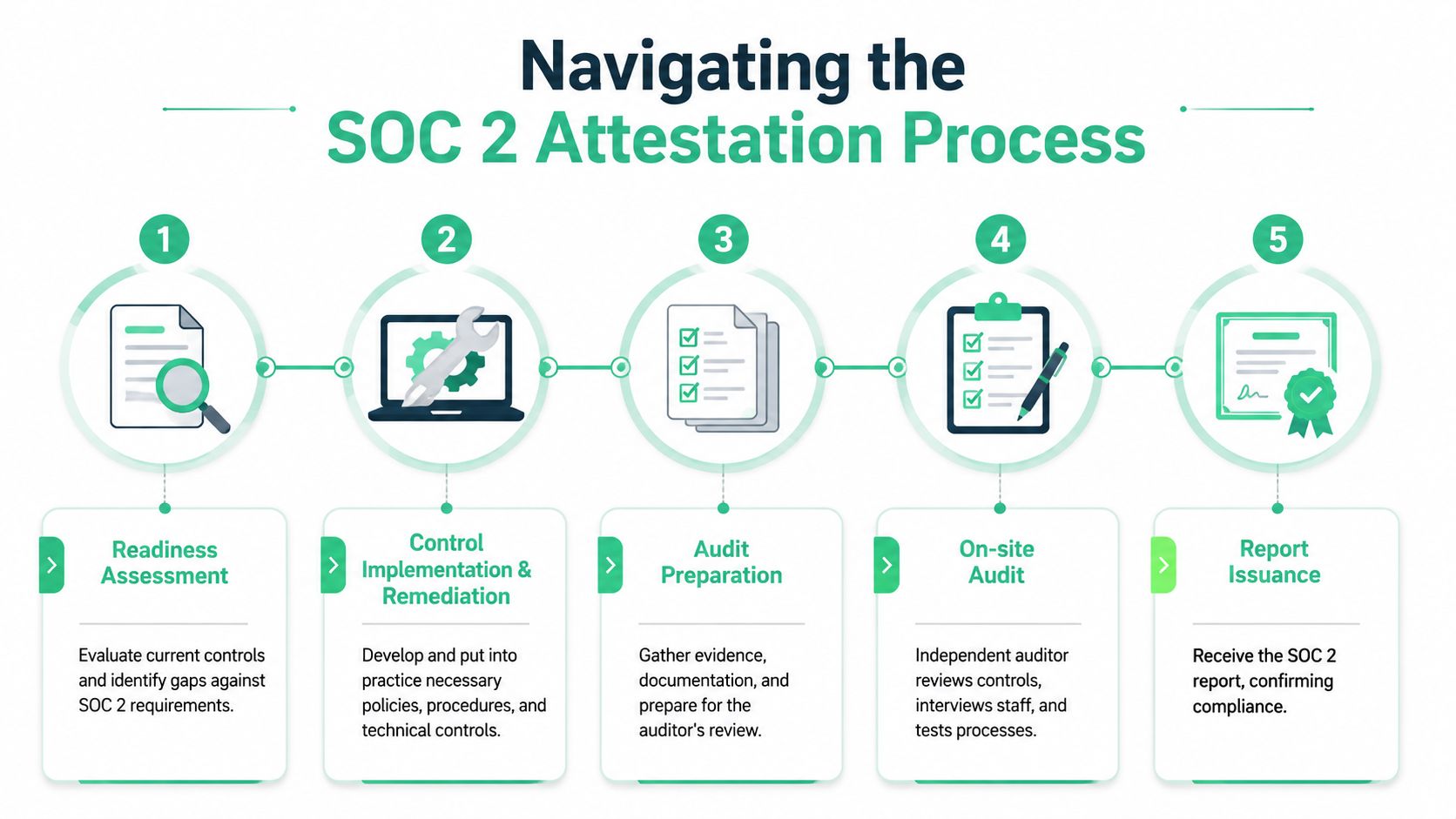
What the process actually looks like
Readiness review
Map your systems, people, and vendors to the controls in scope. Find weak spots before the auditor does.Control implementation
Close the gaps. That usually means tightening access approvals, logging, change management, backups, employee onboarding and offboarding, and vendor oversight.Evidence collection
Pull the proof as you operate, not in a last-minute scramble. Auditors want screenshots, tickets, logs, approvals, incident records, and security test results that line up with the control story you are telling.Audit fieldwork
The auditor tests what you claim is happening. If your evidence is messy, inconsistent, or missing dates and owners, fieldwork drags.Final report
Once the auditor can trace controls to evidence and see they held up during the review period, the report gets issued.
Where the process breaks down
The delay usually starts before fieldwork. A startup spends weeks writing policies, then realizes the pen test was never scheduled, cloud assets were never scoped correctly, or findings cannot be fixed before the auditor asks for proof.
That is why you should line up external penetration testing for your SOC 2 early, while you still have time to remediate and document the fix. Fast testing is not a nice extra. It keeps the whole attestation from slipping.
For Type II, consistency matters more than cleanup. You need controls that operate over an observation period, and a rushed round of fixes right before audit fieldwork does not prove that.
Controls have to exist, work, and leave evidence behind.
Run the audit like a real project
Assign owners and deadlines. Engineering should own infrastructure and change control evidence. IT should own endpoints, identity, and access operations. Security or GRC should track requests, collect artifacts, and keep the evidence organized in one place. Leadership should remove blockers fast, especially when remediation needs engineering time.
Do not expect the auditor to build the case for you. Their job is to test it. Your job is to present a clean record showing each control addressed a real risk and worked the way you said it did during the review period.
Teams that move quickly do one thing differently. They build evidence as part of normal operations and get security testing done before the calendar turns against them.
Why Fast Penetration Testing Is Crucial For SOC 2
You are six weeks from your audit window, sales is pushing to send the security package to a big prospect, and someone finally asks for the pen test report. The old-school firm you talked to needs three weeks to start, two more to deliver, and another round to retest. That is how a simple requirement turns into a blown timeline.
A pentest is not the whole SOC 2 effort. It is often the task that jams everything else if you leave it too late. Slow firms profit from that mess. They drag out scheduling, charge enterprise prices, and deliver bloated reports that create more back-and-forth than useful action.
Why auditors care about the pen test
Auditors are looking for proof that your security controls hold up in practice, not just on paper. A penetration test gives them one more piece of that proof. It shows your internet-facing systems were tested the way an attacker would test them, and it gives you documented findings, remediation work, and retest results to support the story your controls are supposed to tell.
That matters because policy-first teams get exposed fast. A nice access control policy means very little if an external tester can still reach an admin panel, abuse weak authentication, or chain small misconfigurations into real access.
Fast testing keeps the project on schedule
The right sequence is simple.
- Test early enough to fix real issues: Leave time for engineering to remediate without blowing up sprint planning.
- Track remediation properly: Save tickets, approvals, screenshots, config changes, and retest notes.
- Hand auditors a clean package: Give them a report that clearly shows scope, methodology, findings, fixes, and final status.
If you need external penetration testing for your SOC 2, pick a provider that can start quickly, communicate clearly, and produce an auditor-friendly report without weeks of pointless delay.
A scan will not save you
A vulnerability scan has value. It does not replace a manual pentest.
Scanners catch known issues they are built to detect. Human testers check logic flaws, exposed workflows, weak assumptions, and attack paths that automated tools routinely miss. If you buy a cheap scan to save money, then end up paying again for a real pentest during procurement or audit review, you did not save anything. You added delay and cost.
Startups and SMBs should be especially strict here. You do not have spare budget for duplicate work, and you do not have time to wait on a giant consulting firm to treat your company like a low-priority account.
What a good provider should deliver
Look for a team that can scope quickly, test manually, explain findings in plain English, and retest without drama. Certifications such as OSCP, CEH, and CREST can help you vet the team, but the report quality and turnaround time matter more than logo collections.
Affordable Pentesting provides manual penetration testing for compliance-driven teams that need audit-ready reporting on a tight timeline. That model fits SOC 2 well because the goal is straightforward. Find the actual issues, fix them fast, document the work, and keep the audit from turning into an expensive waiting game.
A pen test should remove blockers, not create them.
Avoiding Common SOC 2 Scoping Mistakes
Most SOC 2 pain is self-inflicted. Teams either scope too much because they're nervous, or scope too little because they want a shortcut. Both choices come back to bite them.
The right scope follows the data. If customer data touches a system, person, process, or vendor, you need to understand that path before the audit starts.
Bad scope wastes time and money
SOC 2 technical scope is driven by data-flow and control boundaries, which is why organizations typically need to map where customer data is stored, processed, and accessed before the audit starts, as explained in Secureframe's guide to SOC 2 requirements.
That means you should trace the actual route of customer data through your product, cloud environment, support workflow, admin tools, and vendors. Not the version in your head. The genuine one.
Two mistakes show up constantly
- Over-scoping everything: You include systems that don't support the service in scope. That creates more controls, more evidence, and more audit questions.
- Under-scoping critical systems: You leave out something that stores, processes, or exposes customer data. That creates credibility problems fast.
Auditors want the chain of proof
A policy alone doesn't prove much. Auditors want to see the cause-and-effect chain. The control addresses a defined risk, and logs, tickets, or attestations show it worked during the review period, as noted in the Secureframe source above.
If you can't explain why a system is in scope or out of scope, your scope probably isn't ready.
Pick criteria that match the service
A basic SaaS app often starts with Security. A platform promising uptime obligations may need Availability. A service handling sensitive records may need Confidentiality or Privacy. The point is focus.
Don't buy complexity you don't need. Smart scoping makes the audit cheaper, faster, and easier to defend.
Your Practical SOC 2 Startup Checklist
Most founders and IT managers don't need another giant spreadsheet. They need a starting list they can act on this week. Use this as your first pass.
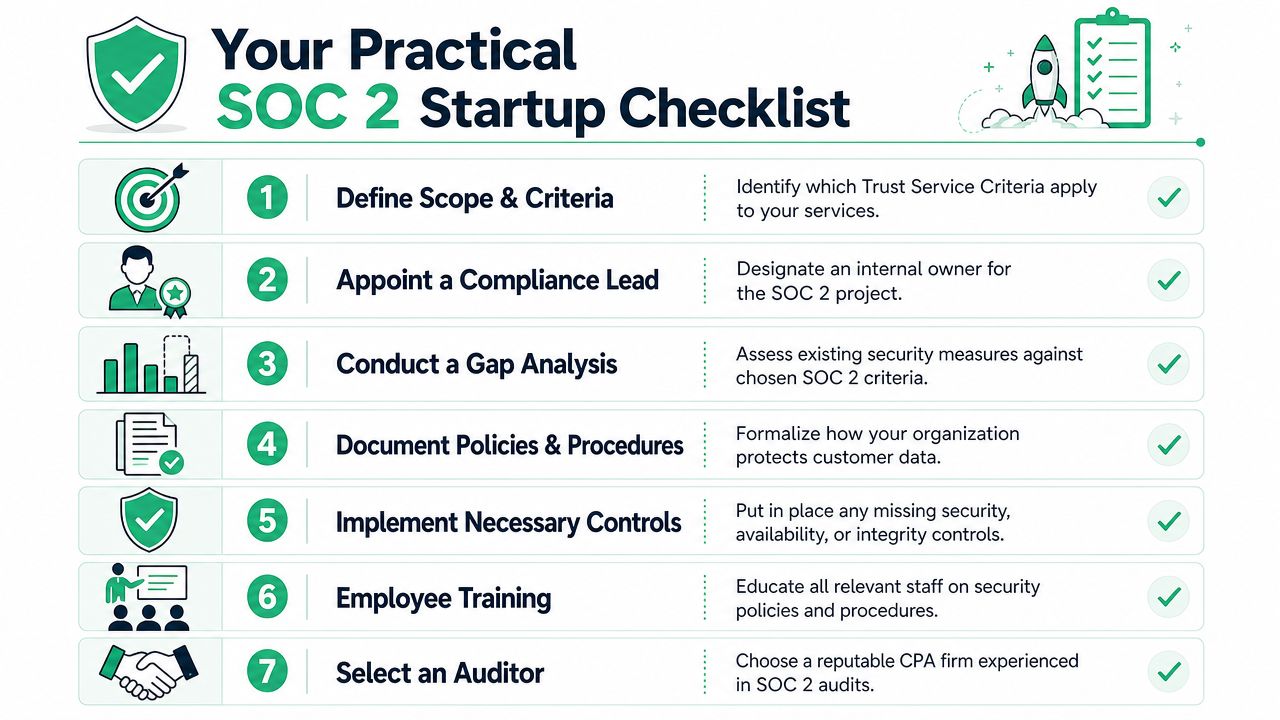
First steps that actually move the project
Define your scope
Decide which product, environment, and customer data flows belong in the audit.Choose the right criteria
Start with Security, then add only the Trust Services Criteria your business model needs.Assign one owner
If nobody owns the project, it turns into side work and drifts.Map your systems and vendors
List where customer data is stored, processed, accessed, and shared.Review existing controls
Check what already exists for access control, logging, change management, backups, incident response, and risk tracking.
The next steps prevent rework
- Document policies clearly: Keep them readable and tied to real operations.
- Collect evidence as you go: Save approvals, tickets, screenshots, and logs in one place.
- Train the people involved: Staff should understand the rules they're expected to follow.
- Pick your auditor carefully: You want a firm that communicates clearly and doesn't create unnecessary churn.
- Schedule a penetration test early: Leave room for fixes and retesting before audit pressure hits.
A practical way to sanity-check your preparation is to compare your internal list against outside guidance on Church Extension Fund data security. It's useful because it keeps attention on operational controls, not just paperwork.
Keep the checklist lean
You do not need to solve every security problem in one pass. You need a defensible scope, functioning controls, and evidence that holds together.
That mindset is what keeps SOC 2 from turning into an expensive side quest.
Answering Your Top SOC 2 Compliance Questions
Is SOC 2 compliance mandatory
No. SOC 2 is voluntary.
That said, voluntary doesn't mean optional in the market. One industry estimate projects 15,000 to 20,000 SOC 2 reports will be issued annually in 2026, up from about 10,000 to 12,000 in 2023, which shows how common SOC 2 has become as a trust signal for vendors handling sensitive data, according to these SOC 2 compliance statistics for 2026.
Is SOC 2 a one-time project
No. If you want to keep showing customers current assurance, you need to treat it as an ongoing program.
Controls need maintenance. Evidence needs upkeep. Teams change, systems change, and customer expectations don't pause because you got one report.
If we use AWS, Azure, or GCP, are we automatically compliant
No. Your cloud provider can support your control environment, but it does not make your company SOC 2 compliant by default.
Your configurations, your access control, your change process, your incident handling, and your evidence are still your responsibility.
What usually slows the project down
Three things. Bad scope, weak evidence habits, and slow security testing.
The teams that move fastest make decisions early, keep evidence organized, and don't wait until the last minute for a penetration test report. If you need that piece handled quickly, use the contact form and get a quote before it becomes the bottleneck.
If you need a fast, audit-ready penetration test for your SOC 2 project, Affordable Pentesting is built for teams that want clear findings, quick turnaround, and a straightforward process without the usual consulting bloat. Use the contact form to get a quote and keep your audit timeline moving.