.svg)

You open a spreadsheet with names, emails, billing details, support notes, maybe even health or payroll data. Your stomach drops a little because you know one thing right away. If that file leaks, nobody cares that your team is small, your budget is tight, or your cloud stack is complicated.
That panic is useful. It means you're asking the right question.
Who is responsible for protecting PII? You are. Your team is too. Your vendors are involved. But the buck stops with your company because you're the one collecting the data, using it, and benefiting from it. If you're a founder, IT manager, CISO, or compliance lead, this isn't a theory problem. It's an operations problem, a legal problem, and a reputation problem all at once.
A lot of companies make this harder than it needs to be. They argue about shared responsibility, buy another tool, and hope a policy document will save them. It won't. PII protection is a chain, and every link matters. Leadership, HR, engineering, cloud vendors, and your own testers all play a part. If one link is weak, the whole thing fails.
Your PII Protection Starts With This Question
A founder asks for a quick export before a board meeting. The file lands in someone's inbox with customer names, email addresses, billing details, support history, and maybe employee records. At that point, PII protection stops being a policy topic and becomes your problem.
Start with the only question that matters. Who is responsible for protecting PII when your company collects it, stores it, shares it with vendors, and uses it every day?
The answer is simple. If your company decides to collect personal data and use it for business purposes, your company owns the responsibility to protect it. You can split work across engineering, HR, support, legal, and outside vendors. You still own the outcome.
That matters even more in the U.S. because PII obligations are spread across sector-specific and state laws instead of one single federal rule. The Federal Trade Commission's privacy and data security guidance shows how companies can face enforcement based on how they collect, secure, share, and represent personal data to users and customers, as outlined by the FTC's privacy and security guidance for businesses. If you handle health data, student data, financial data, children's data, or consumer data from multiple states, the rules stack up fast.
Treat PII responsibility like a chain. Leadership approves risk. Employees handle data. Engineers build access paths. Vendors store and process records. Cloud providers run the infrastructure. Any weak link can expose the whole business.
Practical rule: Assume responsibility first. Then assign owners, restrict access, and verify the controls.
A common oversight
Many organizations mistakenly believe responsibility stays fuzzy until there is a breach. It does not. Responsibility becomes clear the moment a customer, regulator, enterprise prospect, or investigator asks basic questions about your data.
Can you answer these without guessing?
- What PII do we collect?
- Why do we keep it?
- Who can access it?
- Which vendors process it?
- How have we verified that our controls work?
If those answers are slow, incomplete, or spread across five people and twelve tools, you have a weak chain.
Fix that now. Map the data, name the owners, cut unnecessary access, and validate the setup with a fast, affordable penetration test. Policies do not prove your PII is protected. Testing does.
Understanding Data Controller vs Data Processor Roles
Most confusion starts here. Companies hear "shared responsibility" and assume that means shared liability. That's not how this works.
Under GDPR, the difference between a data controller and a data processor matters a lot. The controller decides why and how personal data gets used. The processor handles that data on the controller's behalf. If your startup collects customer details through your app and stores them with a cloud vendor, your startup is usually the controller.
The restaurant and delivery app example
Consider a restaurant scenario. You decide the menu, the prices, and what customers can order. A delivery app helps move the food, but customers still blame your restaurant if the order goes wrong.
Data works the same way. You choose to collect names, emails, payment details, support messages, or employee records. A vendor like a cloud host, CRM, payroll platform, or analytics provider may process that data, but your company still owns the decision to collect and use it.
The controller versus processor distinction is not academic. GDPR puts final legal responsibility on the controller even when the processor handles the data, and 68% of PII breaches occur via third-party vendor vulnerabilities, which is why vendor contracts and verification matter so much according to this breakdown of controller and processor responsibility.
Data Controller vs Data Processor Responsibilities
| Responsibility | Data Controller (Your Company) | Data Processor (Your Vendor) |
|---|---|---|
| Decides why data is collected | Yes | No |
| Decides what data is collected | Yes | No |
| Chooses where data is processed | Yes | Usually no, except within agreed services |
| Must ensure lawful handling | Yes | Must follow controller instructions |
| Owns vendor due diligence | Yes | No |
| Needs contract terms for data handling | Yes | Yes |
| Keeps final accountability under GDPR | Yes | No |
What this means in practice
If you use AWS, Microsoft 365, Google Workspace, Stripe, HubSpot, or a payroll provider, don't tell yourself the vendor "has security covered." They have part of it covered. Your company still has to choose the vendor carefully, configure access correctly, limit what data gets shared, and review whether the relationship still makes sense.
Here's the blunt version:
- Controller means accountable: You made the business decision to collect the data.
- Processor means involved: They handle the data, but they don't erase your exposure.
- Shared work does not mean shared blame: Regulators and customers start with you.
If you outsource processing, you outsource tasks. You do not outsource responsibility.
This is why founders need to stop treating vendor onboarding like a purchasing exercise. It's a security decision.
Assigning PII Protection Roles Internally
Once you accept that your company owns the problem, the next question is internal. Who does what?
A lot of teams make one person the "privacy owner" and call it done. That's lazy, and it fails fast. Protecting PII only works when responsibilities are split clearly across leadership, security, IT, legal, HR, and everyday employees.
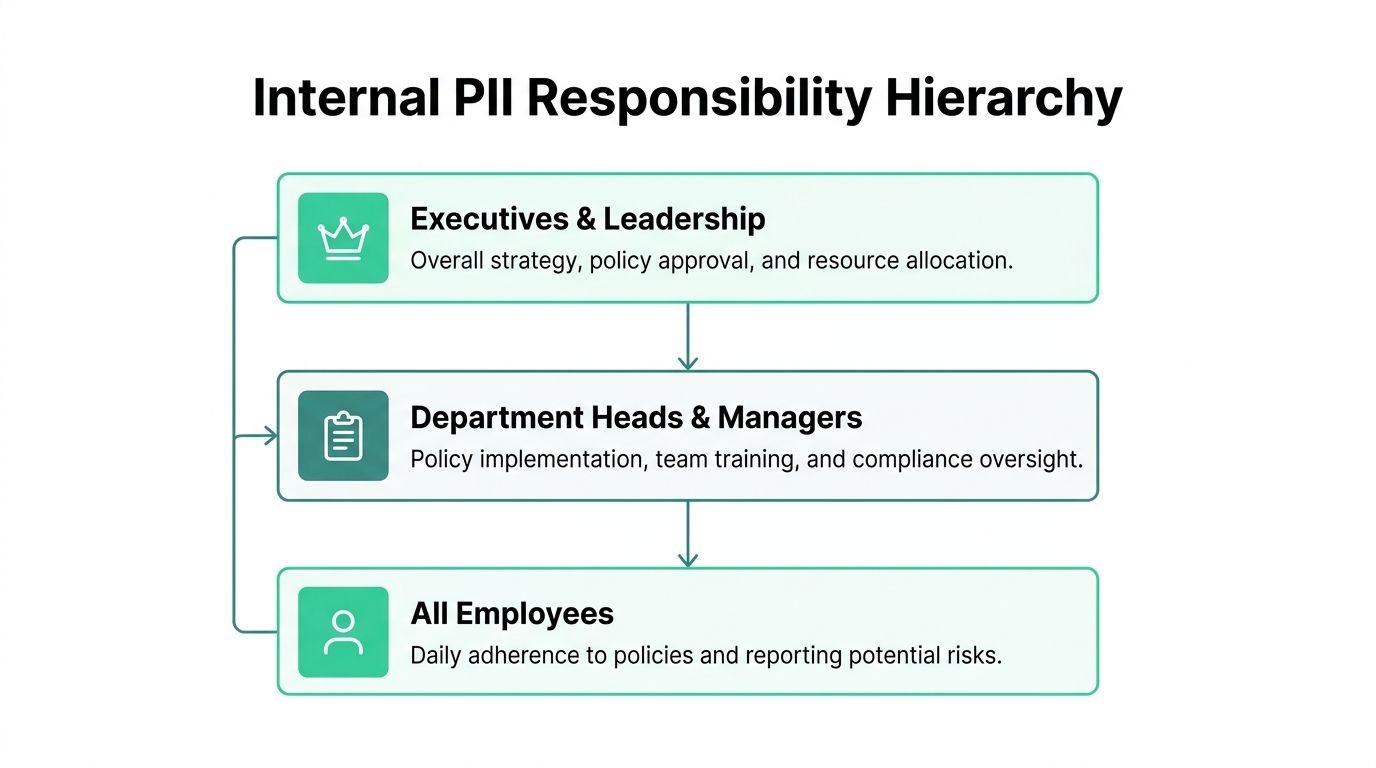
The top owns the standard
Leadership sets the tone. If the CEO wants fast growth but refuses to fund access controls, security reviews, or training, the company has already chosen risk. Executives approve policy, assign budget, and decide whether PII protection is real or just slide-deck material.
Global frameworks like GDPR and U.S. statutes such as HIPAA require organizations to designate an accountable individual for compliance and put technical safeguards like encryption and access controls in place. They also place legal and operational responsibility on the company to educate employees and enforce policy, as outlined in this PII compliance checklist.
The middle translates policy into action
Managers and department heads make security real in daily operations. Engineering leaders control development practices. IT leaders manage devices, identity systems, and access. HR handles employee records and training. Legal and compliance teams review obligations and contracts.
If department heads don't understand their role, policies sit in a folder while risky habits spread.
- Security lead or CISO: Owns the protection strategy, technical safeguards, and escalation path.
- IT and Ops managers: Set access controls, patch systems, and manage accounts.
- HR leaders: Protect employee PII and make sure training happens.
- Legal or compliance owners: Match company behavior to HIPAA, GDPR, PCI DSS, contracts, and internal commitments.
The bottom handles the daily risk
Most PII mistakes don't start in the boardroom. They happen in everyday work. Someone sends the wrong attachment. Someone keeps a spreadsheet too long. Someone gives a contractor access they don't need. Someone reuses a shared admin account because it's easier.
That means every employee has a real part in the chain.
Manager test: If a new hire doesn't know how to handle customer data by the end of week one, your process is broken.
Use this internal checklist:
- Name one accountable owner for privacy and security coordination.
- Map each department's data use so you know who touches what.
- Limit access by role instead of giving broad convenience access.
- Train employees in plain language so they know what PII is and what to do if something looks wrong.
- Enforce consequences when people ignore policy.
PII protection fails when everyone is vaguely responsible. It works when each person knows their lane.
Managing Risk With Your Third-Party Vendors
Your vendors can become your biggest blind spot. That's especially true for startups that run everything through SaaS tools, cloud storage, contractors, payment providers, and customer support platforms.
Trust is not a security strategy. A clean website, a polished sales call, and a promise that they take privacy seriously means nothing unless you verify it.

Why SMBs miss this risk
Small and mid-sized teams often focus on their own app, their own laptops, and their own employees. Meanwhile, vendors are storing backups, processing payments, sending emails, logging support chats, or syncing user data through APIs.
Every one of those relationships can expose PII if you don't control it. That includes vendors your team signed up for without formal review.
What vendor due diligence should look like
You don't need an enterprise budget to do this well. You need discipline.
- Ask for security documentation: A SOC 2 report, security overview, or compliance materials should be easy for serious vendors to provide.
- Read the data processing terms: Your Data Processing Agreement should clearly define who does what, what happens during a breach, and how data gets deleted.
- Limit shared data: Don't give a vendor more PII than they need to perform the service.
- Review access and integrations: Check which APIs, admin roles, and sub-processors are involved.
- Reassess regularly: A vendor that looked fine last year may not be fine now.
If you're building a formal program, this guide on how to secure your supply chain threats is a practical place to tighten your process.
A vendor breach becomes your customer problem the second your customer data is involved.
A basic vendor checklist
Use a short scorecard before approval:
| Check | What to confirm |
|---|---|
| Data use | Why the vendor needs PII at all |
| Access scope | Which users, admins, or systems can see it |
| Contract terms | Breach notice, deletion, and responsibilities |
| Security proof | Audit reports, certifications, or policy docs |
| Exit plan | How you get data back and ensure deletion |
Most companies don't need more vendors. They need fewer vendors, better reviewed.
How Compliance Frameworks Define PII Responsibility
A founder launches in three states, signs one hospital pilot, adds billing, and assumes one privacy policy covers it. It does not. The rules change with the data you collect, the markets you sell into, and the vendors that touch that data. That is why PII responsibility works like a chain. Every link has obligations, but your company still owns the outcome.
Compliance frameworks matter because they turn vague security advice into assignments your team can act on. They define who decides why data is collected, who processes it, how quickly incidents must be reported, what records must exist, and what safeguards regulators expect to see. If you collect the data, the burden lands on you first.

The legal map is fragmented
The U.S. does not give startups one clean national rulebook for all PII. Federal laws cover specific sectors. States add their own privacy and breach rules. If you have EU users, GDPR enters the picture. The International Association of Privacy Professionals keeps a useful tracker of state privacy legislation, and it makes the point clearly. Requirements stack up fast.
That fragmentation creates risk in ordinary startup decisions. A product feature can trigger a new disclosure duty. A new customer segment can pull you into a regulated category. A cloud region, support workflow, or analytics tool can change where PII goes and who is accountable for it.
What the major frameworks actually require
The names differ, but the pattern is consistent. Identify the data. Limit who can access it. Document your controls. Monitor vendors. Detect incidents quickly. Prove the controls work.
- GDPR: Requires lawful processing, data minimization, accountability, and breach notification within 72 hours in many cases. Fines can reach up to €20 million or 4 percent of annual global revenue, and enforcement has been very real, including a €746 million penalty against Amazon in 2021, according to the CNIL decision summary. Regulators across Europe have also issued major cumulative GDPR penalties over time, as tracked by the CMS GDPR Enforcement Tracker.
- PCI DSS: Applies if you store, process, or transmit payment card data. It is unusually specific about validation. PCI DSS requires penetration testing on a defined schedule and after significant changes. The current standard spells that out in PCI DSS v4.0.1 requirement 11.
- HIPAA and similar regulated programs: Focus on administrative, technical, and physical safeguards. They also expect assigned responsibility, documented policies, access control, and auditability.
If you need a practical way to organize these expectations, the SOC 2 Trust Services Criteria give startups a usable control structure even when SOC 2 is not the law driving the requirement.
Responsibility on paper is not enough
A written policy does not prove your chain is secure. It only proves someone drafted a policy. Real accountability means you can show who owns each link, what control protects it, and whether that control survives testing.
Public privacy notices can still be useful signals. Review them for clarity about collection, sharing, retention, and user rights. Halo AI's data handling is one example of how a company explains those responsibilities in plain language.
Use compliance frameworks as a map, not a trophy. Then validate the map with fast, affordable pentesting, because regulators care about documented controls and attackers care about the gap between the document and the system.
Prove Your PII Protection Is Working
A founder signs off on MFA, access rules, and a vendor review. Two weeks later, a tester changes one parameter in an API request and pulls another customer's records. That is how PII failures happen. The chain looks fine on paper until someone tries to break a weak link.
If you collect PII, you need proof that your controls hold up in practice. That means penetration testing. It is the fastest way to check whether the responsibilities you assigned to engineers, admins, vendors, and cloud providers are producing security, or just documentation.
Testing is where accountability gets real
Policies assign responsibility. Testing verifies performance.
A manual penetration test shows whether attackers can bypass auth, abuse business logic, pivot through a cloud misconfiguration, or reach data they should never see. That matters because PII exposure usually comes from ordinary failures. Broken access control. Weak session handling. Overprivileged accounts. Public storage. Admin functions left exposed.
The point is simple. Shared responsibility does not reduce your accountability. You own the result.
Why startups delay testing, and why that is a mistake
Founders often delay a test because they expect a big bill, a slow process, and a weak report. That concern is reasonable. Traditional firms can be expensive and slow. One review of U.S. penetration testing costs says standard engagements often land around $18,000 to $18,500, with cloud testing reaching $45,000 and mobile app testing reaching $35,000.
Timing is another problem. According to this guide on penetration testing timelines, a strong manual penetration test usually takes 2 to 4 weeks, and the full project, including planning and delivery, can take 4 to 6 weeks. Analysts at Strike Graph explain the early phases in this overview of pen testing phases, noting that pre-engagement often takes 2 to 3 days and active reconnaissance can last 4 to 6 days before scanning begins.
That model does not fit many startups. Waiting a month to validate your PII controls is a bad trade if you are shipping weekly.
What to require from a pentest provider
Set a practical standard and hold the line.
You want experienced testers who can examine web apps, APIs, cloud configuration, authentication flows, and authorization logic. You want manual testing backed by tooling, not a scanner dump with a logo on it. You want findings that map to business risk and clear remediation steps your team can act on this sprint.
For teams comparing providers, Wisely's penetration testing solutions show one way firms present these services. Your filter should stay simple. Can the provider test the parts of your chain that handle PII, explain what broke, and deliver fast enough to matter?
Bottom line: if no qualified tester has tried to break your app, API, or cloud environment, you do not know whether your PII protections work.
If you need a practical starting point, Affordable Pentesting is built for web application testing that fits startup budgets and timelines. That is the standard to aim for. Fast validation, clear findings, and evidence that every link in your PII chain can stand up to pressure.
Your PII Protection Action Plan Today
You don't need a giant transformation project to get moving. You need a sequence and some discipline.
Start here:
- Inventory your PII first. Find the customer, employee, and partner data you already collect. Include spreadsheets, SaaS apps, cloud storage, support tools, and backups.
- Name one accountable owner. One person should coordinate privacy and security decisions across departments, even if multiple teams do the work.
- Cut unnecessary data. If you don't need it, stop collecting it. If you no longer need it, delete it.
- Lock down access. Give people access based on job need, not convenience.
- Review every vendor touching PII. Check contracts, access scope, and breach responsibilities.
- Match your controls to your obligations. HIPAA, PCI DSS, GDPR, state laws, and customer contracts may all matter depending on your business.
- Train employees like this matters. Because it does. Short, direct training beats a giant annual slideshow nobody remembers.
- Document your basics. Incident response, data handling, retention, and vendor review shouldn't live only in someone's head.
- Validate everything with a pentest. Fast, affordable penetration testing is how you prove your policies aren't fiction.
For a legal perspective on common security fundamentals, this guide to protecting your startup's data is a useful companion read.
Responsibility for protecting PII is shared across your company and your vendors. Final accountability is not shared. It's yours. Act like it, test like it, and you'll be in far better shape than the companies still hiding behind policy templates.
If you need a fast, affordable way to validate your real-world PII defenses, Affordable Pentesting is built for startups, SMBs, and lean security teams. Their OSCP, CEH, and CREST certified pentesters deliver manual pen test, pentest, penetration test, and penetration testing services without the bloated pricing and long delays that frustrate most buyers. Use the contact form to get a quote and move from assumptions to proof.