.svg)
Your auditor asked for cloud security evidence. Your team uses AWS. Someone on the call says, “Can't we just send the AWS SOC 2 report?”
That's the moment a lot of startups and SMBs get bad advice.
One firm tells you to buy a giant compliance package you don't need. Another drags out a simple evidence request into weeks of back and forth. Meanwhile, your audit clock keeps moving, and nobody gives you a straight answer on what the AWS SOC 2 report proves.
Here's the blunt version. The AWS SOC 2 report matters. You probably need it. But it does not cover your app, your IAM mess, your security groups, your logging setup, or the way your team uses AWS. If you're sorting out understanding data protection duties, that distinction matters a lot.
If you're under pressure, start with a practical checklist, not theory. A good fast SOC 2 compliance guide helps you line up the evidence your auditor wants instead of wasting time on vendor fluff.
Your SOC 2 Audit Needs Evidence Now
A founder gets an email from a customer. Security review is blocked until the company shows proof that its cloud environment is covered. The founder asks the engineer. The engineer asks the IT manager. The IT manager downloads a few AWS documents and hopes that's enough.
It usually isn't.
Your auditor isn't asking whether AWS has good controls in general. Your auditor wants to know whether your system is secure, whether the vendors you rely on are covered, and whether you can prove the boundary between AWS's controls and your own. That's where people get trapped. They assume the cloud provider's paperwork covers everything above it.
Practical rule: Treat the AWS report as inherited evidence, not complete evidence.
Traditional security firms make this worse. They talk in circles, bill like a law office, and act like every startup needs an enterprise consulting engagement. You don't. You need the right report, the right scope, and proof that your side of the shared responsibility model is handled.
Here's the common pain:
- Audit pressure: The request lands late, and now you need evidence fast.
- Cloud confusion: People mix up AWS controls with customer controls.
- Bad vendor advice: Expensive firms push broad projects when you need targeted proof.
- Missing technical validation: The paperwork exists, but your own environment still hasn't been tested.
The AWS SOC 2 report is one of the core pieces of vendor evidence in a cloud-hosted environment. Use it. But don't kid yourself. It's one brick in the wall, not the whole wall.
What the AWS SOC 2 Report Is Exactly
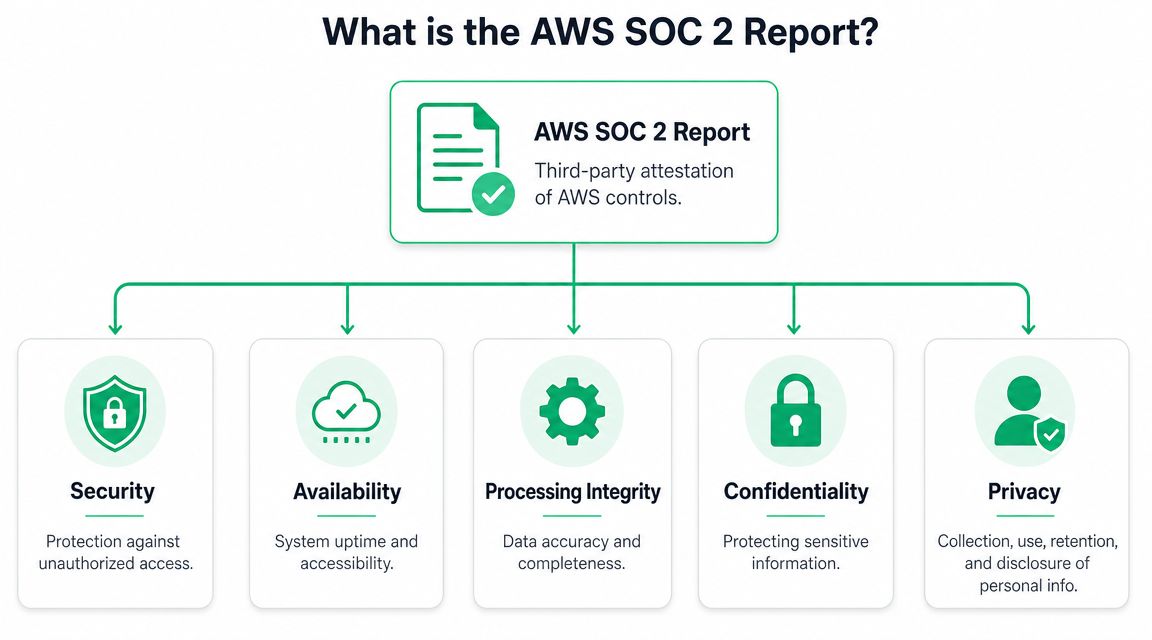
The AWS SOC 2 report is a third-party attestation on controls AWS runs inside its own environment. AWS says the report covers the SOC 2 Trust Services Criteria for Security, Availability, Confidentiality, and Privacy, according to the AWS SOC FAQs.
Your auditor can use that as vendor evidence. Your auditor cannot use it as proof that your app, identities, network paths, and exposed assets are secure.
What Type II actually means
AWS provides a Type II SOC 2 report. That matters because Type II examines whether controls were designed appropriately and whether they operated effectively across a review period. AWS has also published reports covering a 12-month window, including a period from April 1, 2024 through March 31, 2025, and offers bridge letters in Artifact to address timing gaps between annual reports.
That is the kind of detail auditors care about. They want evidence tied to a real period, not a glossy statement that controls existed on one date.
A Type I report answers whether a control was in place. A Type II report goes further and tests whether that control kept working during the stated period.
What the report helps you prove
Use the AWS SOC 2 report for what it is good at. It helps support reliance on AWS for the infrastructure and control areas AWS manages.
| Audit concern | What the AWS SOC 2 report helps with |
|---|---|
| Vendor assurance | Shows AWS went through an independent control review |
| Inherited infrastructure controls | Supports reliance on AWS-managed portions of the environment |
| Audit period coverage | Shows the dates your auditor can map to AWS evidence |
| Gap periods between reports | Bridge letters can help explain coverage between report cycles |
That is useful evidence. It is also incomplete evidence.
What the report does not prove
This is the part founders and lean IT teams get wrong under audit pressure. The AWS SOC 2 report does not prove your security groups are locked down, your IAM roles are least-privilege, your S3 buckets are configured correctly, your production logging works, or your application is free of exploitable flaws.
It also does not prove your customer-facing attack surface has been tested.
That gap becomes painful during your own SOC 2 audit. The auditor accepts AWS for AWS. Then they turn to your environment and ask for proof on your side of the line. If all you have is AWS paperwork, you are still missing technical evidence. That is why a fast, affordable pentest is usually the common-sense move. It closes the part AWS never covered in the first place.
How to Get the Report from AWS Artifact
Your auditor asks for vendor evidence. You already know AWS has a SOC 2 report. The problem is getting the right file fast, checking that it fits your audit period, and not wasting a week handing over the wrong document.
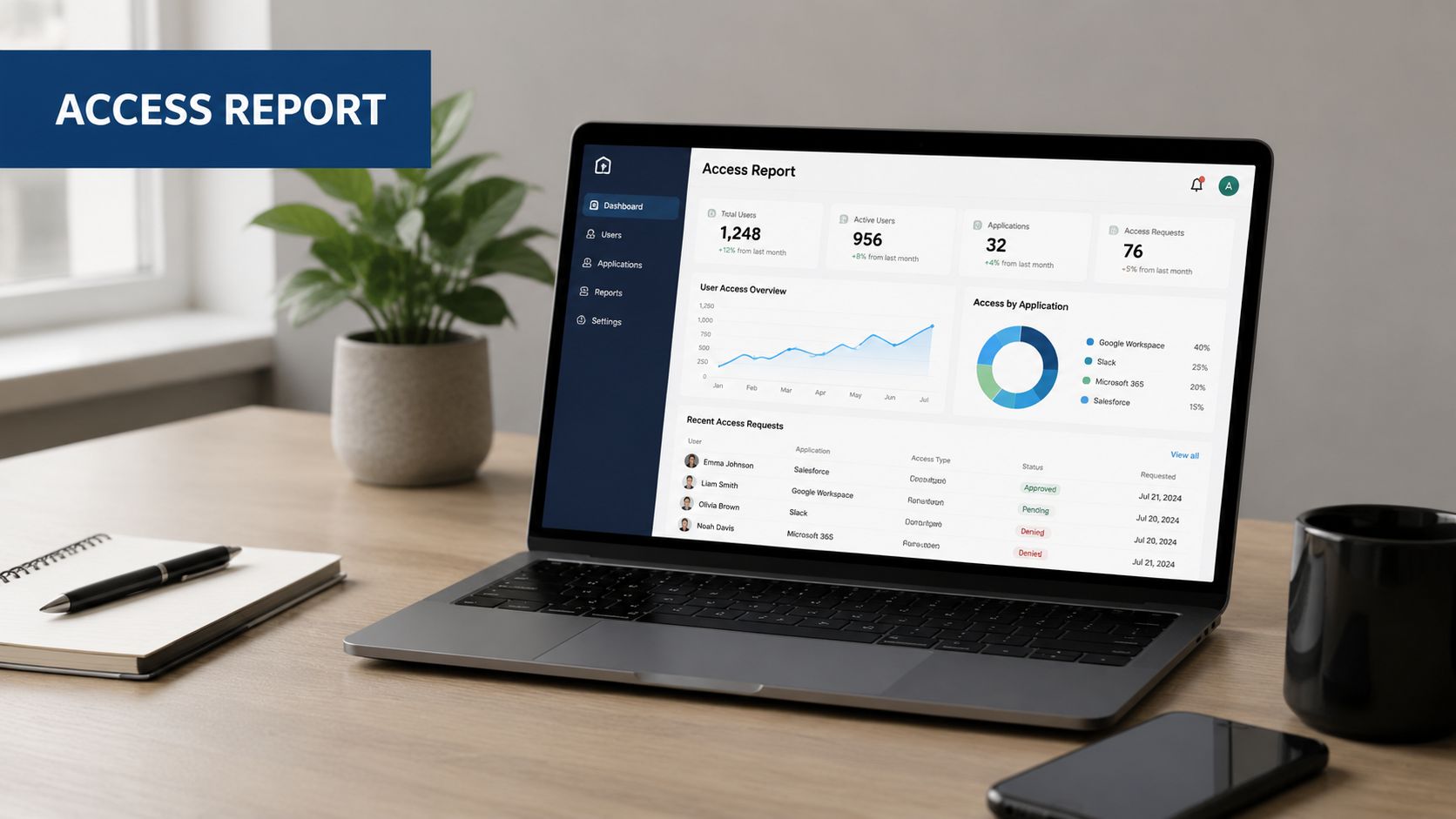
AWS makes the report available through AWS Artifact inside the AWS Management Console. You do not need to chase a rep or open a long procurement thread. You need access to the right AWS account and enough discipline to pull the current report, not some random PDF someone saved six months ago.
Steps to get it without wasting time
Sign in to the AWS Management Console and open AWS Artifact. From there, go to the compliance reports area and search for the AWS SOC 2 report.
Then do the work in this order:
- Locate the current AWS SOC 2 report in Artifact.
- Accept any required terms or agreements tied to access.
- Download the report and save it in your audit evidence folder.
- Download the bridge letter if your audit window falls between report periods.
Keep a clean copy with the download date and the AWS account it came from. That sounds basic. Under audit pressure, basic steps are exactly what teams skip.
Check the document before you hand it to an auditor
Do not send the file the minute it lands on your desktop.
Review the report period first. If the dates do not line up with your audit window, your auditor is going to ask for an explanation. Then verify service scope. If your stack depends on specific AWS services, confirm those services are covered in the report you downloaded.
Check regions and locations too. Evidence only helps if it matches the environment you run. Last, check freshness. If your architecture changed, an older report may still help for AWS-managed controls, but it will not fix the evidence gap in your own environment.
That is the mistake that burns startups and SMBs. They treat downloading the AWS SOC 2 report like the task is done. It is not done. It is one vendor document in a larger audit package, and your auditor will still want proof about your side of the environment.
Understanding the Shared Responsibility Model
You download the AWS SOC 2 report, feel relieved for five minutes, then your auditor asks for proof that your own environment is locked down. That is where teams lose time and money. They confuse AWS coverage with customer coverage, and the audit clock keeps running.
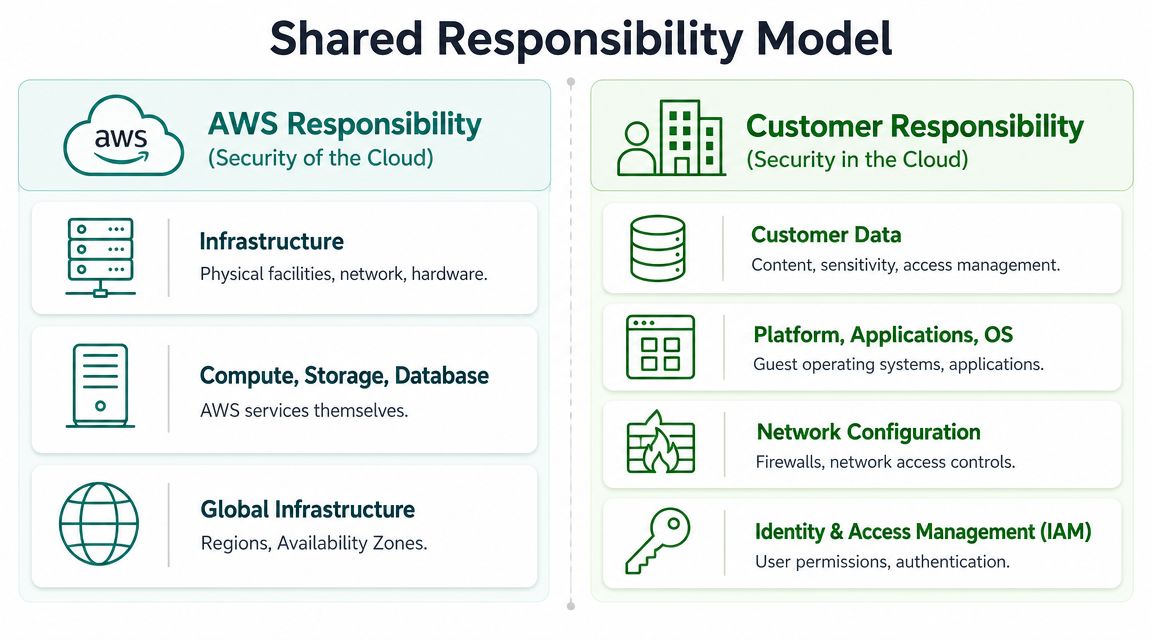
AWS is responsible for security of the cloud. You are responsible for security in the cloud. Your auditor cares about both, but you only control one of them.
What AWS covers and what you cover
AWS has published recent SOC reports covering a large set of AWS services, as noted in its AWS Security Blog announcement about the current report cycle. That scope applies to AWS-managed infrastructure and services. It does not cover your tenant configuration, your application code, your user access decisions, or the way your team operates the environment.
That leaves your team on the hook for the controls auditors probe during fieldwork:
- IAM policies: who has access, how privileges are approved, and whether access is reviewed
- Network exposure: security groups, public endpoints, segmentation, and internet-facing services
- Encryption choices: whether encryption is enabled, enforced, and managed correctly
- Application security: code flaws, auth issues, broken access control, and risky business logic
- Logging and monitoring: whether logs are enabled, retained, reviewed, and tied to response
- Backups and incident response: whether recovery works and whether your team can prove it
If your team made the decision, your team owns the evidence.
Where startups and SMBs get burned
The shared responsibility model is simple. The implementation is where companies fail.
| Area | AWS side | Your side |
|---|---|---|
| Compute host | AWS secures the underlying infrastructure | You secure the operating system, workloads, and runtime settings |
| Identity | AWS provides IAM services | You assign permissions, enforce least privilege, and review access |
| Storage | AWS secures the storage platform | You control bucket access, data classification, and exposure |
| Encryption | AWS provides key and encryption services | You enable them correctly and manage usage |
| Logging | AWS provides logging tools | You turn them on, keep records, review alerts, and respond |
This is why a vendor report alone does not save you.
An auditor can accept AWS evidence for data center and platform controls, then immediately ask for proof that your S3 buckets are private, MFA is enforced, production access is restricted, and critical findings are fixed. If you cannot show that, the AWS report is just background material.
A lot of teams try to patch this with screenshots, scattered tickets, and whatever their compliance software happened to collect. That creates noise, not evidence. If you are still selecting the right audit tools, pick tools that help you document control ownership clearly instead of dumping another dashboard on your team.
Why this matters in your audit
Your customer is not buying AWS. Your customer is buying your product running on AWS.
That distinction matters because the actual audit gap sits between the AWS report and your own control evidence. Auditors want to see that your environment is configured securely and that the controls work in practice. They also want proof that technical risk has been tested, not just described in a policy.
That is why teams hit a wall late in the process. They have the AWS report. They do not have proof that their own app, permissions, exposed services, and tenant settings were tested. That gap is exactly where a fast, affordable pentest makes sense. It gives you evidence for the part AWS will never cover, which is the part your auditor can still write up.
Using the Report for Your Own SOC 2 Audit
Your auditor is already in the portal. They have the AWS SOC 2 report. Then they ask for proof that your team configured AWS securely, reviewed access, tracked changes, and tested the parts AWS does not touch. If your answer is a pile of screenshots and a vendor PDF, you are about to waste weeks.
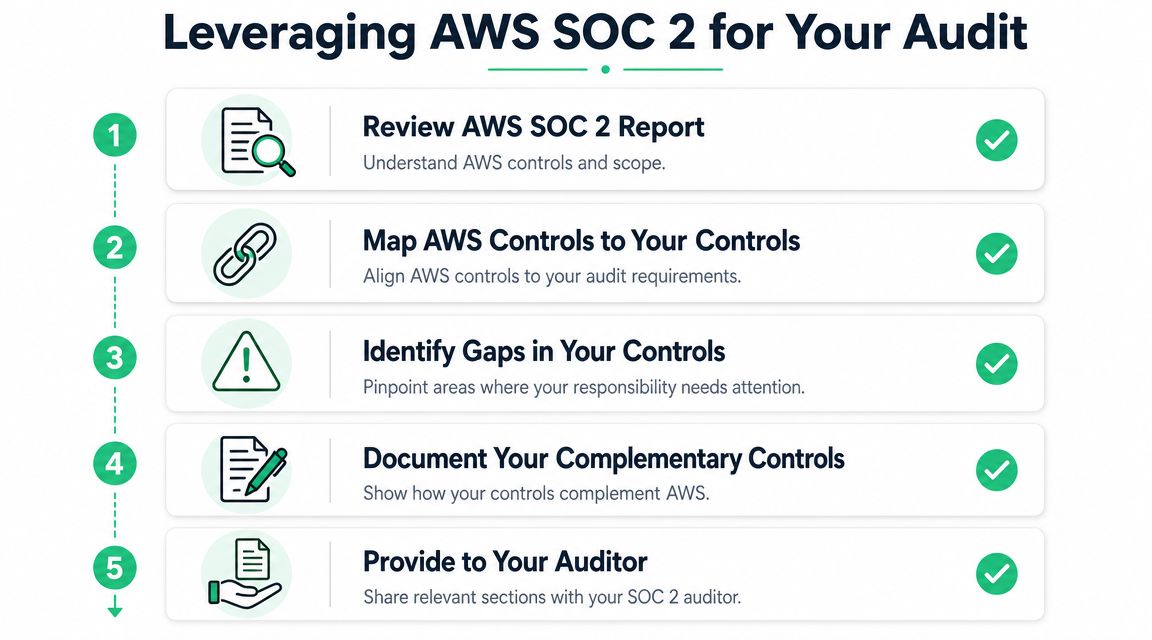
The right move is straightforward. Use the AWS report to support inherited controls, then build your own evidence around it. Do not hand over the full report and expect the auditor to connect the dots for you.
Apply the report to your audit, not to your wishlist
Review the report against your actual stack. Look at the AWS services you use, the systems that store customer data, and the controls your team still owns inside your accounts and applications.
Then turn that into an evidence package your auditor can follow without guessing.
- Map inherited controls: Use the AWS report for the infrastructure and platform controls AWS operates.
- Attach your proof: Add evidence for your IAM settings, logging, backups, encryption choices, change management, and incident response.
- Define the boundary clearly: Show which controls belong to AWS and which controls belong to you.
- Match the audit period: Use the current AWS report and make sure it lines up with the period under review.
Teams often get burned. They treat the AWS report like a shortcut. It is not. It is one part of the file, and only for the controls AWS owns.
Check the report before you rely on it
Before you cite the report, confirm four things.
Audit period
Your vendor evidence needs to line up with the period your auditor is testing.Services covered
Make sure the AWS services in your environment are within the report scope you downloaded.Regions and deployment details
If your hosting footprint changed, verify the report still matches what you run today.Architecture changes on your side
New accounts, new services, and new third-party integrations change your control story fast.
Old vendor evidence creates easy audit findings. So does vague ownership.
Build an evidence set that answers the real question
Your customer is not asking whether AWS passed SOC 2. They are asking whether your product, in your AWS environment, met the control requirements during the audit period.
Your package should answer that directly. Include the AWS report, the specific inherited controls you rely on, your own control evidence, and clear technical validation for the systems you manage. If your evidence is spread across random folders and screenshots, fix that before the audit starts. Teams that are still selecting the right audit tools should prioritize clear control ownership and evidence tracking over flashy dashboards.
The gap is always the same. AWS can support part of your story. Your auditor still needs proof for the rest. That is the evidence gap that stalls audits and sends companies scrambling for real testing at the last minute.
Filling Gaps with Affordable Penetration Testing
The AWS SOC 2 report doesn't test your app. It doesn't validate your tenant configuration. It doesn't prove your authentication flow, session handling, authorization logic, exposed endpoints, or cloud misconfigurations are safe.
That's why a pentest, pen test, or penetration test still matters.
Auditors want evidence that your real attack surface has been evaluated. Not with a generic scan dump. Not with a vague “we use AWS” answer. They want proof that someone tested the parts you control and documented the findings clearly enough to support the audit.
Where penetration testing fits
A proper penetration testing engagement helps cover the exact areas the AWS report leaves open:
- Web application flaws: Broken access control, input handling issues, session problems
- Cloud configuration mistakes: Overexposed services, weak permissions, risky defaults
- Authentication and authorization gaps: Users doing things they should never be able to do
- Evidence for auditors: A report that shows what was tested, what was found, and what was fixed
Companies get ripped off all the time. They hire a big-name firm, wait forever, pay too much, and get a report with barely any useful findings or with language so vague it doesn't help engineering or audit.
You need the opposite. You need a manual pentest from people who know how to test real applications, explain the results in plain English, and move fast enough to match an actual audit deadline.
What good looks like
Look for a penetration testing team that gives you:
- Certified testers: OSCP, CEH, and CREST matter because credentials are a quick signal that the people doing the work have real training
- Manual testing: Automated scanners alone are not enough
- Audit-ready reporting: Clear scope, clear findings, clear remediation notes
- Fast turnaround: If your audit is close, slow delivery is a liability
- Reasonable pricing: Startups and SMBs shouldn't have to fund a massive consulting machine just to get a useful pen test
If your compliance package has the AWS report for inherited controls and a solid penetration test for your side of the environment, you're in much better shape. If you need help understanding what that should look like, these simplified SOC 2 security assessments give a practical view of how security testing supports the audit.
Your cloud provider's paperwork is important. Your own security proof is what closes the gap.
If you need a fast, affordable way to close those gaps, Affordable Pentesting is the common-sense option. Our certified pentesters, including OSCP, CEH, and CREST professionals, deliver manual pentest, pen test, and penetration testing reports within a week for many engagements, without the bloated pricing and slow timelines that waste your audit window. Use the contact form, tell us your deadline, and get a report your security team and auditor can use.