.svg)
Your audit is coming. Your team is busy. Someone is asking for evidence, control mappings, policies, screenshots, logs, and maybe a pen test report you should have started weeks ago.
Most startups make the same mistake. They either panic and hire a big consulting firm to run a slow, expensive project, or they skip straight to remediation without knowing what matters. Both paths waste time.
A compliance gap analysis is the faster move. It tells you where your current setup falls short against the framework you care about, what an auditor is likely to question, and what needs to get fixed first. Done right, it cuts noise, tightens scope, and gives you a reportable plan instead of a mess.
Why Your Next Audit Depends on a Gap Analysis
Your auditor asks for evidence next week. Your team has policies in a folder, a few controls half-implemented, and no clear record of what satisfies the framework. That is the point where startups waste money. They either buy software they do not need, or hire a big firm to turn a simple scoping problem into a long project.
A gap analysis fixes that fast. It compares your current controls, policies, and operating practices against the framework you are targeting and shows what is covered, what is weak, and what is missing before you spend money on remediation. This overview of compliance gap analysis workflows gives the basic mechanics, but its value is practical. You get a list an auditor will care about, not a pile of generic recommendations.
For startups, the point is speed and sequencing. You are rarely dealing with one tidy requirement set. You are dealing with customer security reviews, contract terms, internal process gaps, and sometimes regional obligations layered on top. If that includes European resilience rules, this primer on DORA and NIS2 compliance gaps shows how quickly the work expands when nobody sets priorities early.
What a gap analysis really does
A useful gap analysis is blunt. Take each requirement. Compare it to the actual environment. Decide whether you can prove it.
You usually end up in one of these buckets:
- Covered: The control exists and you can show evidence.
- Partial: Something exists, but it is incomplete, inconsistent, or poorly documented.
- Missing: The control does not exist.
- Unclear: Ownership is fuzzy, or nobody can produce proof.
Practical rule: If an auditor asked for evidence tomorrow and your answer would be "we think we do that," treat it as a gap.
That standard matters because the next step is not abstract governance work. It is targeted remediation and evidence collection, followed by validation steps such as a penetration test when the framework or auditor expects one. A solid SOC2 readiness assessment helps you get to that point without paying for months of consulting theater.
Why startups should care now
Founders often push this work until audit season. That is a mistake.
Skipping the gap analysis means you are guessing, and guessing is expensive. You fix low-priority controls, miss the evidence the auditor will request, and delay required testing until the end. Then the pentest becomes a rush job instead of a planned evidence-gathering step that supports the audit.
A good gap analysis gives you a shorter path. It tells you what to fix first, what to document, what to leave out of scope, and when to schedule the pentest so the final report lands when you need it. That is how startups get audit-ready without the cost and drag of the big firm model.
Defining Your Scope for Common Compliance Frameworks
Most compliance projects get bloated before they even start. Not because the framework is impossible, but because nobody defined scope tightly enough.
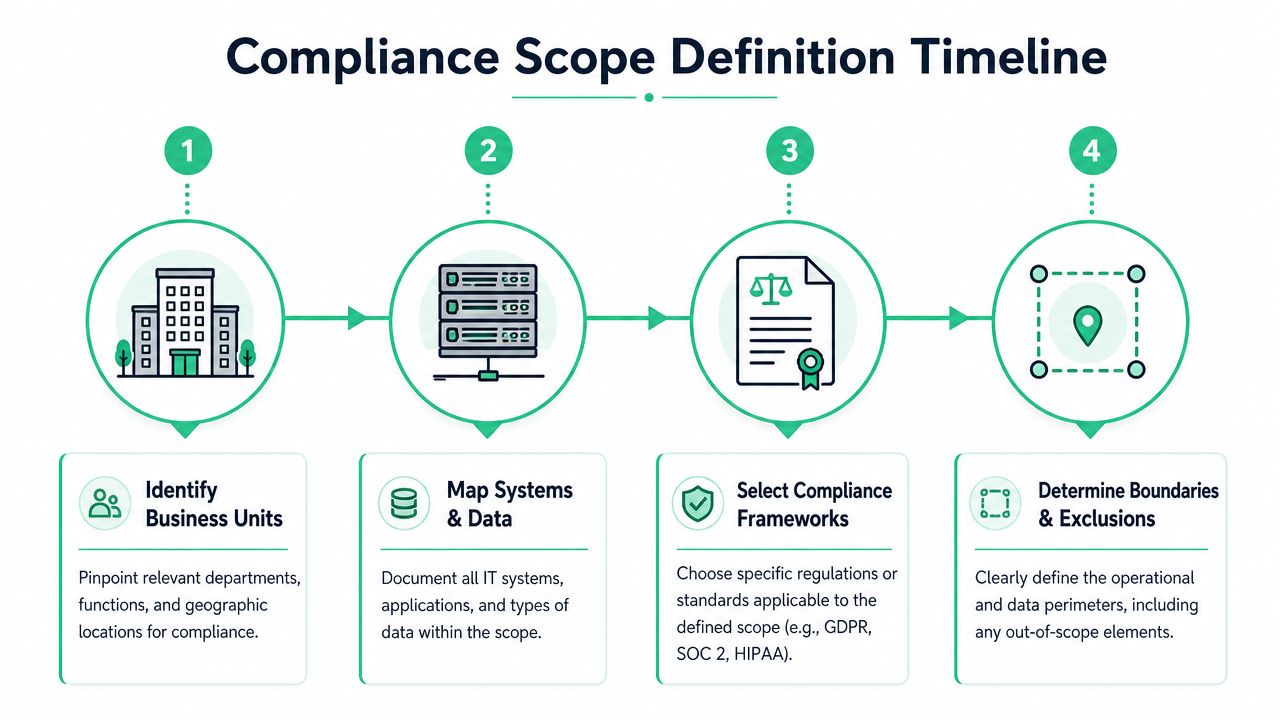
Scope means deciding what parts of the business, systems, people, and data fall under the framework. If you get this wrong, you drag in extra systems, extra evidence, extra meetings, and extra cost for no reason.
Start with boundaries, not aspirations
Don't scope your whole company just because it feels safer. Scope the systems and teams that touch the regulated data or support the service in question.
For startups and SMBs pursuing SOC 2, PCI DSS, HIPAA, or ISO 27001, the biggest cost driver is usually remediation sequencing, because the method works best when you focus resources on the controls most likely to block certification or create enforcement exposure, according to Secureframe's discussion of compliance gap analysis.
That means your scoping decision affects cost immediately. A loose scope creates more work. A defensible scope creates a shorter path to audit readiness.
What should be in scope
Use four simple filters:
- Business units that support the audited service
- Systems and apps that store, process, or transmit the relevant data
- People and roles that administer those systems
- Vendors that materially affect the control environment
If a system doesn't touch the audited service, doesn't hold the regulated data, and doesn't support the people who do, it probably doesn't belong in scope.
Tight scope isn't cheating. It's how mature teams keep compliance work tied to reality.
Compliance framework focus for startups and SMBs
| Framework | Primary Focus Area | Best For Companies That... |
|---|---|---|
| SOC 2 | Security controls around services and customer data | Sell SaaS or technology services to business customers |
| HIPAA | Safeguards for protected health information | Handle healthcare data directly or through a business associate role |
| PCI DSS | Protection of cardholder data | Process, store, or transmit payment card data |
| ISO 27001 | Information security management system | Need a broad security management framework recognized across markets |
If you're still sorting out which trust criteria and systems belong in scope, this guide for SOC 2 compliance is a useful starting point.
Scope mistakes that burn budget
The common failures are boring, but they kill timelines:
- Including every tool: Your HR platform, design apps, and test environments don't all belong in scope by default.
- Ignoring data flow: Teams list systems by vendor name instead of tracing where sensitive data moves.
- Forgetting shared ownership: Engineering, IT, HR, and legal each own pieces of compliance. If one team is left out, evidence gets missed.
- No exclusions list: If you don't document what's out of scope, people keep pulling random items back in later.
A clean scope statement should answer three questions fast. What service is being assessed. What data matters. What systems and teams support it.
How to Map Controls and Collect Evidence Efficiently
Once scope is locked, the work becomes mechanical. That's good. Compliance gets expensive when people turn it into philosophy.
A rigorous compliance gap analysis should run as a controlled workflow. Define the exact framework, inventory current policies and controls, map each control to a specific requirement, then document each deviation with its risk and impact, as outlined in MetricStream's compliance gap analysis guidance.
Use a spreadsheet before buying software
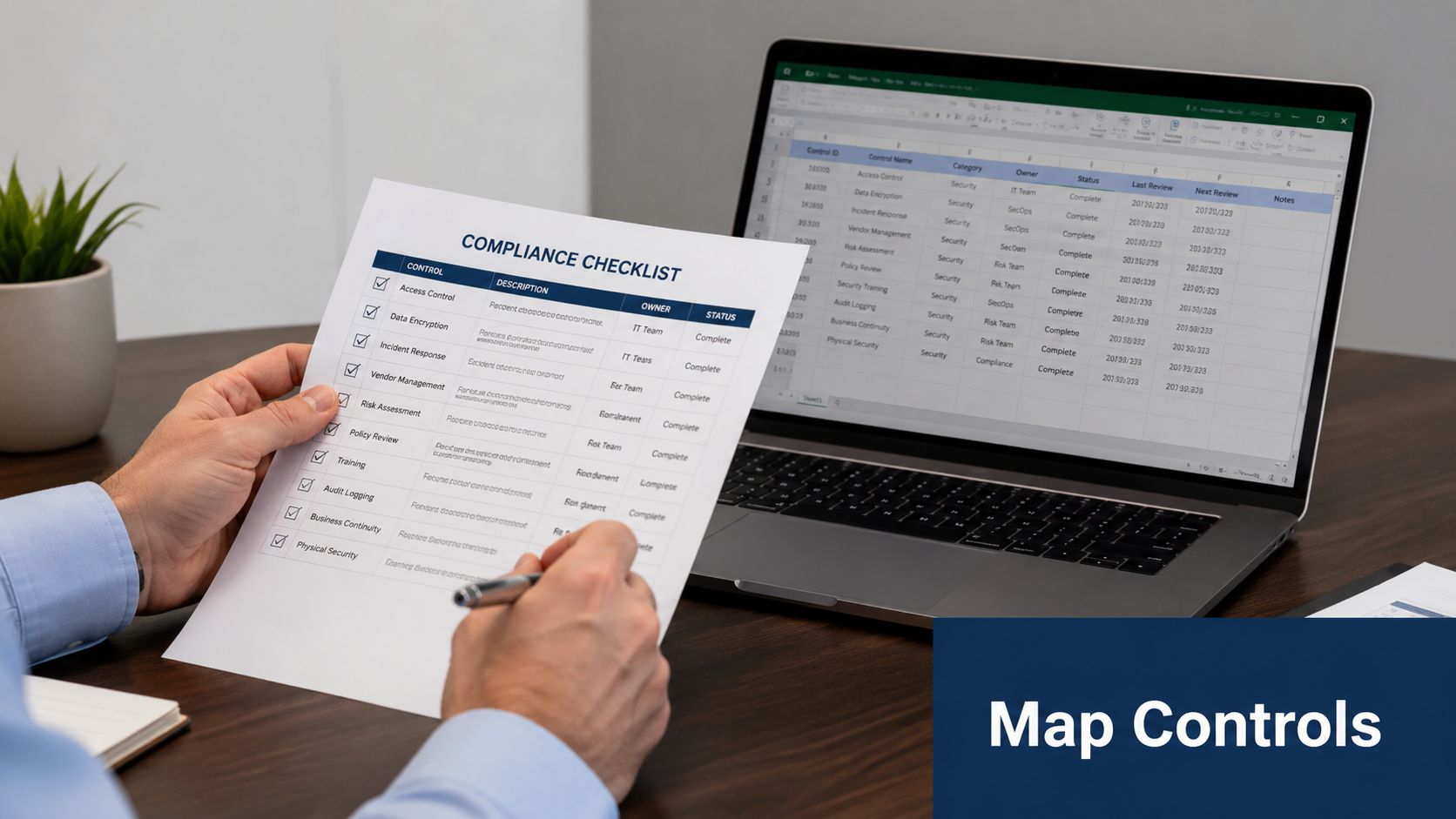
You do not need a giant GRC platform on day one. For many startups, a spreadsheet is enough if it's structured properly.
Set up columns like these:
- Requirement ID
- Requirement summary
- Existing control
- Evidence available
- Status
- Gap description
- Owner
- Target date
- Notes
This works because it forces one requirement to map to one clear answer. No vague hand-waving. No giant folders named "audit stuff."
What counts as a control
A control is anything you rely on to meet a requirement. That can be a written policy, a recurring process, or a technical setting inside a real system.
Examples are easy to understand:
- Policy control: Access control policy
- Process control: User access review performed on a schedule
- Technical control: MFA enforced in your identity provider
- Operational control: Backup restoration procedure tested and documented
The mistake I see all the time is teams writing policies and calling that done. A policy is not proof. It's just one piece of the story.
Collect evidence from the real environment
Good evidence comes from two places. Documentation and operating reality. You need both.
Here are the evidence types that usually move the project forward:
- Screenshots from production systems: Identity provider settings, logging configuration, MFA enforcement, device management rules
- Exported records: Access reviews, onboarding and offboarding logs, ticket history, training completion logs
- Policies and procedures: Current approved versions, not drafts sitting in somebody's desktop folder
- System records: Alerts, audit logs, backup results, vulnerability remediation tickets
- People evidence: Named owners who can explain how a control runs
If the evidence only exists because someone prepared for the audit last night, your control probably isn't operating well enough.
Keep evidence review fast
Don't build a giant evidence pile first and sort it later. Review as you collect.
A small team can move quickly with this workflow:
- Pull one requirement.
- Identify the matching control.
- Ask for one best evidence item first.
- Decide status immediately.
- Log the gap or mark it covered.
That pace matters. It stops endless internal meetings where everyone debates maturity instead of deciding whether the requirement is met.
Creating a Practical Risk and Remediation Roadmap
Finding gaps is easy. Turning them into a plan people will execute is the hard part.
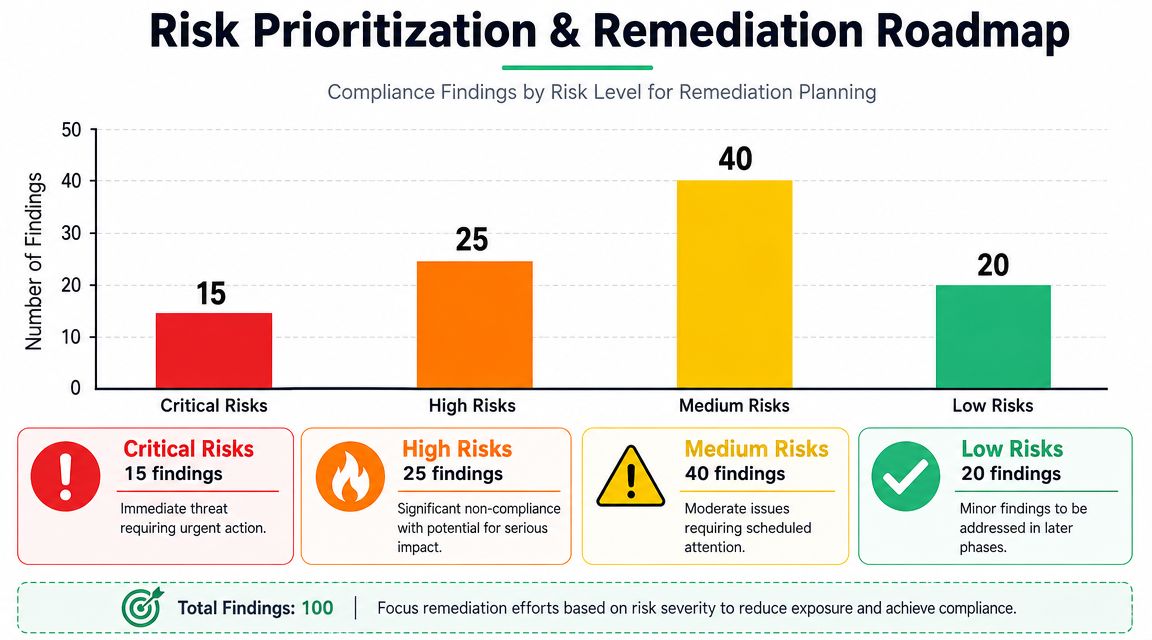
The best output from a compliance gap analysis is a prioritized remediation register that separates missing controls from ineffective controls and ties each gap to a measurable corrective action, producing an implementation plan, as explained in Centraleyes' compliance gap analysis glossary.
Separate missing from ineffective
These are not the same problem.
A missing control means you don't have the thing at all. No policy. No access review. No logging standard. Nothing.
An ineffective control means something exists, but it isn't working well enough in practice. Maybe MFA is enabled for some systems but not all. Maybe offboarding exists on paper but doesn't happen consistently. Auditors care about this distinction because the fix is different.
Use plain risk categories
You don't need a fancy scoring engine to get moving. A simple ranking model works if your team applies it consistently.
Use categories like these:
- High risk: Likely to block the audit, create clear exposure, or leave sensitive data weakly protected
- Medium risk: Important issue, but not likely to stop the entire process immediately
- Low risk: Cleanup work, documentation polish, or non-blocking maturity improvements
This is enough for most startup environments. Overcomplicated scoring slows decisions and gives people false confidence.
The right first question is not "How many gaps do we have?" It's "Which gaps can actually sink the audit or expose the business?"
What a usable remediation register looks like
Your roadmap should fit on one screen without scrolling forever. If it doesn't, it's probably too abstract.
A practical register includes:
- Requirement
- Gap summary
- Gap type
- Risk level
- Corrective action
- Owner
- Due date
- Evidence needed for closure
- Current status
If a fix doesn't have an owner, it won't happen. If it doesn't have closure evidence defined up front, you'll end up redoing work later.
Include training where it matters
Some gaps are technical. Others are behavior problems. If people are mishandling data, skipping reviews, or failing process steps, training belongs in the roadmap too.
For teams that need a quick starting point, this Video-based compliance training template can help organize role-based training without turning it into a giant HR project.
Keep remediation tied to the audit
Don't let the roadmap turn into a full security transformation program. You're trying to get audit-ready, not rebuild the company.
That means your first wave of remediation should focus on evidence-producing controls. The controls that an auditor is most likely to test, challenge, or expect to see running on a repeatable cadence.
Where Penetration Testing Fits in Your Plan
Many teams become confused regarding this point. A compliance gap analysis tells you whether controls exist and whether your documentation lines up with the framework. It does not tell you whether those controls can stand up to a real attack.
That difference matters. A gap analysis is a checklist-style review of missing elements, while a separate effectiveness evaluation, like a pentest, measures how well the program operates in reality, according to Compliance.com's explanation of gap analysis versus effectiveness evaluation.

Gap analysis checks presence
Think of compliance gap analysis like a pre-flight checklist. Do you have access control. Do you review accounts. Do you manage vulnerabilities. Do you have an incident response process.
Those are valid questions. But they don't answer whether an attacker can still break in through a weak web app, a bad auth flow, exposed business logic, or poor authorization checks.
A documented control can still fail in execution. That's the blind spot.
A pen test checks reality
A pen test, pentest, or penetration test asks a different question. If a skilled attacker targeted the environment, what could they do?
That's why auditors and buyers often want more than a policy set. They want proof that key systems have been tested in practice. A real penetration testing engagement helps you produce that proof.
Not all tests are equal, though.
Automated scans are not enough
A vulnerability scanner has value. Run it. Use it. Fix what it finds.
But don't confuse scanning with a real pen testing engagement. Automated tools are good at known signatures and common misconfigurations. They are bad at context, business logic, chained attack paths, privilege escalation nuance, and the weird edge cases that experienced human testers catch.
That is why a manual penetration test is usually the smarter choice when you're collecting evidence for compliance. An auditor wants to see that someone competent evaluated the environment directly, not that you clicked "scan" and exported a PDF.
What to look for in a pentest team
If you're buying a pentest, ask direct questions.
- Who is doing the work: Named testers matter more than a glossy firm brand.
- What certifications do they hold: OSCP, CEH, and CREST are useful signals that the tester has been through formal offensive security assessment.
- Is the work manual: If most of the effort is automated, the report usually shows it.
- How fast is the report delivered: If you have an audit window coming, long turnaround times create their own compliance problem.
- Will the report be usable for auditors: You want clear scope, methodology, findings, severity, and remediation notes.
A cheap scan with no meaningful findings can cost more than a solid manual pentest, because you still won't have evidence an auditor respects.
When to schedule the penetration test
Don't wait until the very end if major fixes are still pending. But don't run it too early either, or you'll test an environment that changes before the audit.
The practical sequence is straightforward:
- Finish the initial compliance gap analysis.
- Fix the obvious control gaps that affect the target environment.
- Run the pen test against the in-scope systems.
- Remediate material findings.
- Keep the final report and remediation evidence ready for the auditor.
For web-facing products, pentesting services for web apps are often the most relevant place to start because that's where auditors, customers, and attackers tend to focus first.
Speed matters more than people admit
The traditional model punishes startups. Big firms love long timelines, bloated scoping calls, and reports that arrive after your audit pressure is already peaking.
You don't need that. You need a competent manual penetration testing engagement, performed by certified testers, with a report you can hand to an auditor quickly. For a startup, speed is not a nice extra. It's part of staying compliant without dragging the project into another quarter.
Get Audit-Ready Without the Big Firm Price Tag
The fastest path is usually the least glamorous one. Scope tightly. Run a clean compliance gap analysis. Map controls to requirements. Gather real evidence. Build a short remediation register. Then validate key controls with a proper pentest.
That approach works because it cuts out theater. You stop paying for giant slide decks, endless workshops, and vague maturity language that doesn't help you pass an audit.
Startups do not need a six-month consulting circus to get this done. They need a defensible scope, clear ownership, practical remediation, and a fast penetration test report an auditor will accept.
If you're smart about sequencing, compliance becomes manageable. If you're sloppy about sequencing, even simple frameworks turn into expensive chaos.
The big-firm version of this process is usually slower, heavier, and packed with extra layers nobody asked for. The lean version is better. It respects your time, your budget, and the fact that your engineers still have a product to ship.
Get the gap analysis done. Fix what matters first. Run the pen test. Move.
If you need a fast, affordable path to an audit-ready penetration test report, Affordable Pentesting is built for exactly that. Their team focuses on startups and SMBs that need manual pentests, pen tests, and penetration testing for SOC 2, PCI DSS, HIPAA, ISO 27001, and similar frameworks, without the slow timelines and inflated pricing of traditional firms. If your audit clock is already ticking, use their contact form and ask for a same-day quote.