.svg)
Computer Science for Cyber Security Explained
You may be in this exact spot right now. You paid for a pentest, pen test, or full penetration testing engagement, got a polished PDF back, and learned almost nothing useful. A few low-risk findings, a lot of screenshots, and no clear answer on what would let an attacker into your business.
That usually means the team tested symptoms, not systems. They ran tools, checked boxes, and missed the deeper flaws because they didn't understand how the application, network, operating system, and code really work underneath.
If you care about real security, computer science for cyber security isn't an academic side topic. It's the difference between finding a bad header and finding the bug that leads to account takeover, ransomware access, or a compliance failure. That's also why strong manual pentesting matters. A real tester thinks through the system, validates impact, and gets you useful answers fast instead of burying you in scanner output.
Why Computer Science Is Your Security Secret Weapon
A weak penetration test looks busy. It does not look smart.
You see a stack of scanner findings, generic remediation text, and maybe a compliance-friendly summary page. What you don't see is whether the tester understood your authentication flow, session handling, trust boundaries, or how one small bug could chain into a larger breach. That gap comes from weak technical depth.
Cybersecurity sits inside computer science. It depends on the same foundations used to build software and run infrastructure in the first place. If a pentester doesn't understand how systems are built, they won't understand how attackers break them.
Why this matters in business
Startup founders and IT managers often treat a pen test like an insurance document. Buy one, file the report, move on. That's a mistake.
A real pentest should help you answer practical questions fast:
- What can an attacker reach
- Which finding creates real business risk
- What should my team fix first
- Can we remediate without slowing the roadmap
If your provider can't explain the root cause in plain English, they probably don't understand it well enough to test it properly.
Practical rule: If a tester can't explain how the bug works under the hood, don't trust the severity rating.
The market keeps rewarding deeper skill. The Bureau of Labor Statistics projects 29% employment growth for information security analysts between 2024 and 2034, with a median annual wage of $124,910, which reflects the value of specialized computer science skills in security roles, according to the University of Tulsa summary of BLS data.
What founders should demand
Don't just ask whether a firm does penetration testing. Ask whether its testers understand operating systems, networking, code behavior, and cryptography well enough to spot what automation misses.
That matters even more if you want affordable manual pentests and reports within a week. Speed only helps if the findings are real. Fast and shallow is useless. Fast and technically deep is what protects the business.
The Four Pillars of Computer Science for Security
Think of a pentester like a building inspector. A bad one looks at paint and door handles. A good one checks the foundation, wiring, plumbing, and locks because that's where failures become disasters.
That is what computer science for cyber security looks like in practice. Not theory for theory's sake. Core knowledge that helps a tester find the bug behind the bug.
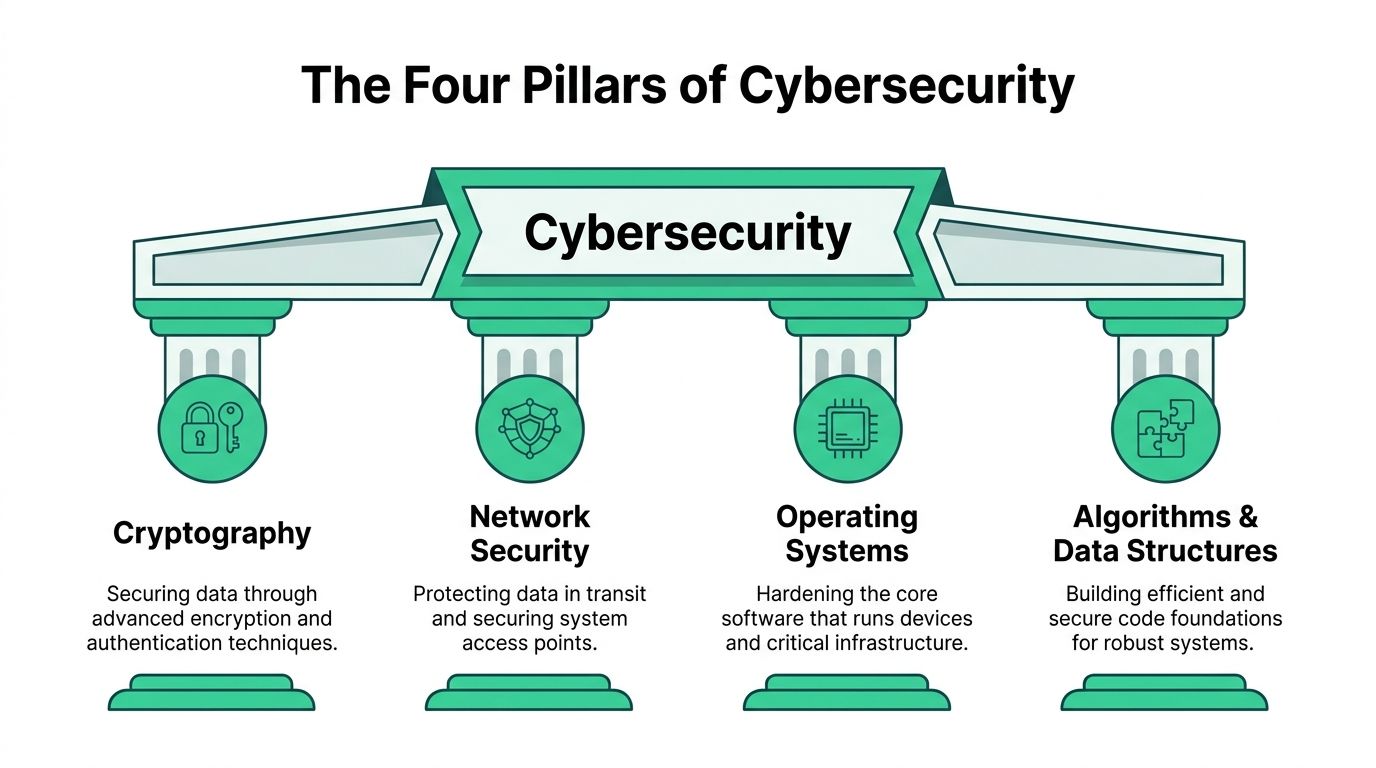
The gap is real. Employers are finding cybersecurity graduates "lacking this foundation" in areas like "computer architecture, data, cryptography, networking, secure coding principles, and operating system internals", according to the CSIS Technology Policy Program.
Operating systems and architecture
This is the foundation and frame of the building. It covers how memory, processes, permissions, files, and system calls work.
A tester with this background can spot dangerous privilege boundaries, weak service configurations, and old code paths that let users do things they shouldn't. In a legacy environment, that can mean the difference between "low-risk issue" and "full server compromise."
Networking and data movement
This is the plumbing and wiring. It explains how systems talk, trust, and expose services.
In a pen test, networking skill helps a tester trace how traffic moves between internet-facing apps, internal services, cloud components, and admin paths. That's how you catch exposed management panels, trust assumptions between subnets, or a firewall rule that inadvertently opens the wrong door.
A scanner sees open ports. A strong tester sees relationships, paths, and abuse cases.
Algorithms and data structures
This sounds academic, but it isn't. It is about how software organizes work and handles input.
When a tester understands control flow, parsing, state changes, and input handling, they can follow the app's logic instead of just poking random endpoints. That's how they find broken authorization, race conditions, and weird edge cases in APIs that automation often misses.
Cryptography and trust
This is the locks-and-safes pillar. It covers encryption, hashing, signatures, token handling, and identity checks.
A tester doesn't need to invent new crypto to be effective. They do need to understand when developers used it badly. Weak token logic, broken password reset flows, and unsafe secret handling often come from teams using crypto tools without understanding the trust model. If you want a solid reading list, these essential cryptology reads for IT managers give useful background without drowning you in theory.
Here is the simple takeaway:
- Operating systems help testers understand host-level abuse
- Networking helps them map attacker movement
- Algorithms and data structures help them reason through app behavior
- Cryptography helps them validate whether trust is real or fake
Miss one pillar and your penetration test gets shallow fast.
How Deep CS Knowledge Prevents Costly Breaches
Breaches rarely start with a dramatic movie-style hack. They start with a small technical mistake that somebody didn't fully understand.
That is why manual pentesting still matters. The global financial impact of cybercrime is projected to reach $15.6 trillion by 2029, according to VikingCloud's cybersecurity statistics summary. If you're hiring for a pen testing engagement, you're not paying for screenshots. You're paying for judgment.
Story one with networking depth
A startup asks for a penetration test on its web app. The scanner output looks clean enough. Nothing dramatic. A junior tester might stop there.
A deeper tester traces how the app talks to internal services and notices a trust assumption in the way requests pass through a gateway and firewall path. On paper, the control exists. In practice, one route allows traffic that should never be reachable externally. That small misconfiguration becomes a path to sensitive internal functions.
The fix is usually simple once someone identifies the path. But finding it takes networking knowledge, not just tools.
Story two with low-level systems knowledge
Now take a company with an older internal application that still handles user input in unsafe ways. Automated tools may flag general input issues, but they often won't prove whether malformed input can corrupt memory or destabilize the process.
A tester who understands C, memory handling, and system behavior sees the danger quickly. They don't just report "possible crash." They show the dev team why the bug exists, what conditions trigger it, and why an attacker could turn instability into control.
Good penetration testing doesn't just identify a crack. It tells you whether that crack reaches the vault.
If you want a practical companion resource for your internal team, MD TECH TEAM's security advice is a useful checklist-style read for website hardening basics. It won't replace a manual pentest, but it helps teams tighten common weaknesses before testing starts.
The business point is simple. Deep CS knowledge shortens the path from "we think we're okay" to "here is the actual exploit path and here is how to fix it." That's how you avoid expensive surprises.
What to Ask Before Hiring a Pentesting Firm
Most buyers ask the wrong questions. They ask about pricing first, brand name second, and timeline last. Then they wonder why the penetration testing report is thin.
Start with skill depth. That's what drives finding quality.
Ask about the testers, not just the company
For many entry-level technical roles, recruitment managers prioritize hands-on experience and a solid CS foundation over a specific cybersecurity degree, as discussed in this industry conversation on hiring without a computer science degree. That's relevant here too. A flashy degree title doesn't guarantee a good pentester.
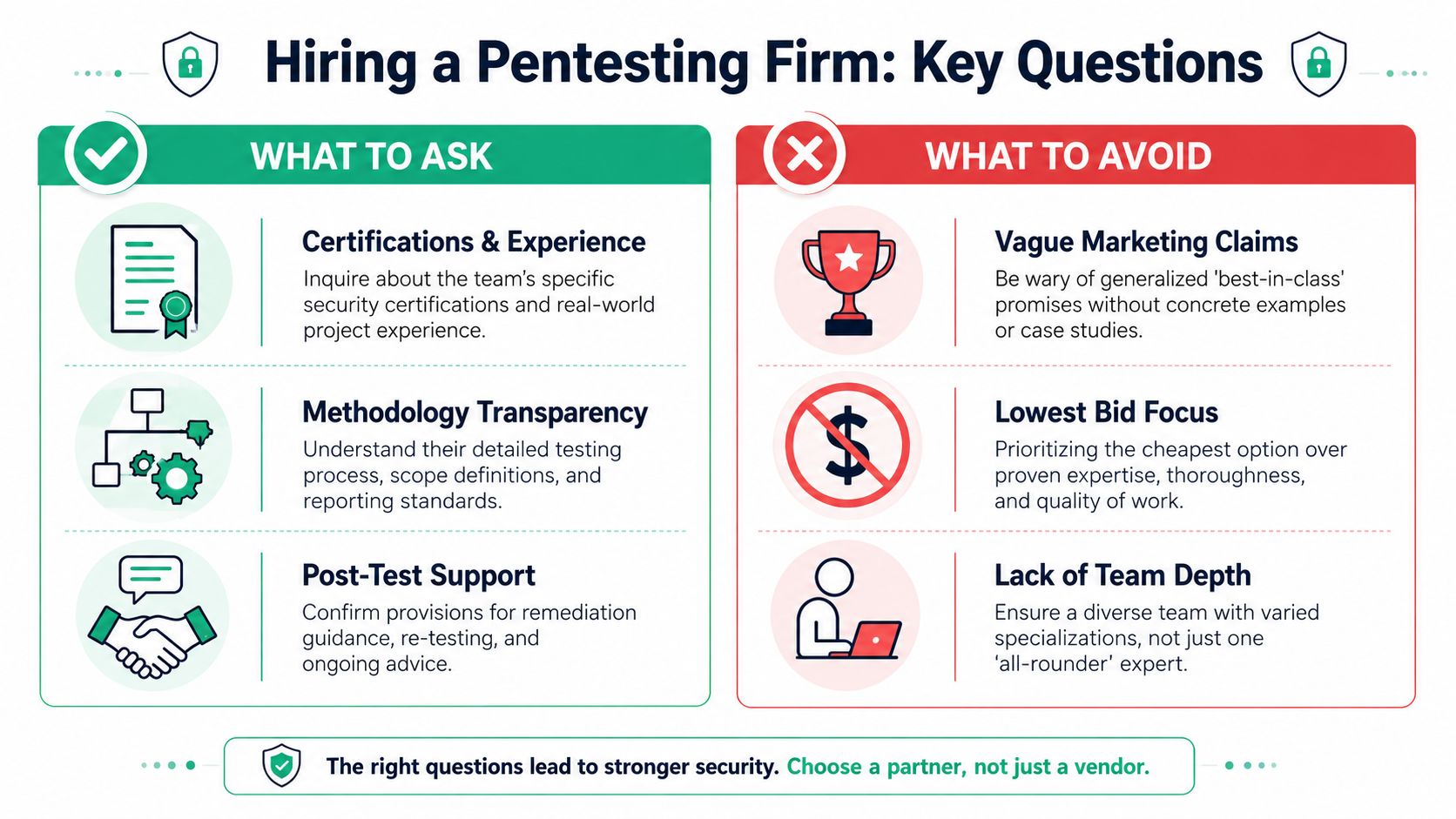
Ask direct questions like these:
Who will perform the test
You want to know whether your pen test is being handled by senior testers or handed to junior staff runningBurp Suite,Nmap, or a scanner with minimal review.What certifications do your testers hold
Look for credentials like OSCP, CEH, and CREST. Certifications don't replace skill, but they do help show a baseline of hands-on competence and professional discipline.How much of the work is manual
If the answer sounds like "we combine smart automation with expert review," keep pushing. Ask what manual validation looks like. Ask how they test business logic, authorization, and attack chaining.
Ask how the engagement works
A serious provider should explain scope, methodology, retesting, and reporting clearly. If they hide behind vague language, move on.
Use this checklist:
Methodology clarity
Ask how they handle reconnaissance, validation, exploitation, and proof of impact. You want a process, not a buzzword.Reporting speed
If you need reports within a week, say it upfront. Speed matters, especially when you're trying to close findings before a customer review, audit, or release deadline.Remediation support
Ask whether the team explains fixes in plain English your developers can act on. Good pentesting saves engineering time because the report is clear.
Hiring signal: The best firms talk about root cause, attack paths, and remediation tradeoffs. Weak firms talk mostly about tool coverage.
Know the red flags
Some warning signs show up fast:
Too cheap to be believable
If a manual penetration test is priced like a commodity scan, you're probably buying automation with a nicer report cover.No technical depth in sales calls
If nobody can explain how they test authentication, role boundaries, or internal trust assumptions, they won't find much.Generic samples only
If every sample report looks identical, the work probably is too.
If you're comparing providers, this guide on choosing your pentesting partner is a practical way to pressure-test the shortlist.
Mapping CS Skills to Different Security Roles
Not every security role needs the same technical depth. But every role benefits from a deep understanding of system operation. If your team treats computer science as "just for developers," you create communication gaps, weak reviews, and bad risk decisions.
Here is a simple map you can use when hiring, training, or assigning ownership.
Computer science skill requirements by security role
| CS Topic | Penetration Tester | Security Engineer | GRC Analyst |
|---|---|---|---|
| Operating systems | Essential | Essential | Good to know |
| Computer architecture | Essential | Good to know | Good to know |
| Networking | Essential | Essential | Good to know |
| Algorithms and data structures | Essential | Essential | Helpful for context |
| Secure coding principles | Essential | Essential | Good to know |
| Cryptography | Essential | Essential | Good to know |
| Operating system internals | Essential | Helpful depending on stack | Helpful for report review |
| Data handling and system logic | Essential | Essential | Good to know |
What this means in practice
A penetration tester needs broad and deep technical skill because the job is to break assumptions. They need enough systems knowledge to pivot between web apps, APIs, cloud services, internal networks, and host behavior during one engagement.
A security engineer uses many of the same CS foundations differently. Instead of proving exploitability, they design controls, harden systems, review code, and build safer defaults. They need strong reasoning around system design and implementation choices.
A GRC analyst doesn't need to exploit a flaw. But they do need enough technical grounding to read a pentest report, ask sensible questions, and understand whether a finding is a paperwork issue or an exposure with real business impact.
When GRC, engineering, and pentesting teams share basic technical language, remediation gets faster and arguments get shorter.
Where companies get this wrong
A lot of teams create a false split. Technical staff handle "real security," while compliance staff handle "documents." That approach slows everything down.
A better approach is to expect each role to understand the level below the surface. Your GRC analyst should understand what a broken access control finding means. Your engineer should understand why a tester chained two low-severity issues into one serious path. Your pentester should explain findings clearly enough that leadership can act on them.
That is how computer science for cyber security becomes operational, not academic.
Fast-Tracking Your Team's Essential CS Knowledge
You do not need to send your whole team back for a four-year degree. You do need to stop pretending that shallow exposure is enough.
The fastest path is hands-on learning tied to real attack and defense work. If your team can read about a concept, test it in a lab, and explain the business impact, the learning sticks.
Start with practical repetition
Use small, repeatable exercises:
Build a home or office lab
Spin up a simple app, a database, a proxy, and a logging stack. Let the team break authentication, review traffic, and trace how data moves.Use CTFs and cyber ranges
Capture the Flag exercises train offensive thinking. They teach people to follow clues, test assumptions, and persist through weird edge cases.Read code, not just blogs
Developers and testers should review vulnerable sample apps and patched versions side by side. That is where secure coding concepts stop being abstract.
Focus on the right learning areas
If you manage a small security team, prioritize these first:
- Operating systems basics so staff understand processes, permissions, and logs
- Networking fundamentals so they can trace traffic and trust boundaries
- Web app logic so they can reason about sessions, roles, and inputs
- Crypto basics so they can spot bad token and secret handling
For teams that want a broad primer, Access Courses Online's take on computer science access and learning paths is a decent starting point for framing what foundational study should include.
Keep it tied to real testing
Don't let training drift into trivia. Every learning activity should connect to what your team sees in audits, pen testing reports, or engineering reviews.
A simple internal rule works well:
- Learn a concept
- Reproduce it in a lab
- Explain how an attacker would abuse it
- Write the fix in plain English
That process turns knowledge into action. If your newer staff need a practical starting point, this guide to ethical pentesting gives a simple overview of how offensive testing should be approached responsibly.
The teams that improve fastest aren't always the teams with the biggest training budget. They're the ones that practice consistently and keep tying core CS knowledge back to actual vulnerabilities.
Frequently Asked Questions About CS in Security
Do I need a computer science degree
No. You need the foundation.
A specific degree title is not what makes someone effective in cybersecurity or pentesting. What matters is whether they understand systems, networking, code behavior, and security logic well enough to find and fix real issues. If you're exploring a nontraditional career path, this guide on a path to cybersecurity jobs is a useful read.
What programming language is best
There isn't one best language for every security task.
Python is useful for automation and quick tooling. C helps when you're dealing with low-level behavior, exploit analysis, or memory issues. JavaScript matters for web application testing because modern apps live in the browser and API layer. The right pen test often requires more than one language.
Learn enough programming to understand what the application is doing, not just enough to copy payloads.
Is AI reducing the need for CS skills
No. It's increasing the need.
AI can speed up repetitive tasks and help teams review more data faster. But it does not replace understanding. If anything, AI makes weak thinking more dangerous because people trust output they can't verify. A tester still needs CS fundamentals to judge whether a finding is real, whether an attack path is practical, and how a fix should be implemented.
If you need a penetration test that finds meaningful issues, explains the root cause clearly, and gets your report back fast, talk to Affordable Pentesting through the contact form. Their team focuses on affordable manual pentests for startups and SMBs, with certified pentesters holding credentials like OSCP, CEH, and CREST, so you get practical findings without the bloated pricing and slow turnaround of traditional firms.