.svg)

You're probably dealing with this right now. Someone handed you a quote for factory cyber security that looks like it was built for a global car maker, not a small or mid-sized plant with old PLCs, one overworked IT team, and no appetite for downtime.
That's the core problem in cyber security manufacturing. Most advice assumes you can buy a giant platform, redesign your network, and wait months for a consulting firm to finish a report. Most factories can't. They need practical controls, a real pen test or penetration test to prove those controls work, and results fast enough to matter.
Your Factory's Biggest Hidden Risk
The hidden risk isn't just malware. It's believing factory security has to be huge, expensive, and slow.
That belief is wrong. The global manufacturing cybersecurity market is projected to grow from USD 10.97 billion in 2025 to USD 17.39 billion by 2030, yet only 45% of manufacturing companies feel well-prepared for IT/OT convergence and 13% report being completely unprepared according to this manufacturing cybersecurity market outlook. Spending is growing, but readiness is lagging, especially for SMB manufacturers.
Big budgets don't fix bad priorities
A lot of factory leaders get pushed toward enterprise programs before they've locked down the basics. That usually means they buy software first and discover later that no one mapped the OT network properly, remote access is still messy, and nobody has verified whether an attacker can move from office systems into production.
That's why smaller manufacturers get stuck. They don't need another giant slide deck. They need a short list of actions that lower risk now.
- Separate what matters most: Keep office systems and plant systems from living on the same flat network.
- Control remote access: If a vendor or engineer can reach MES, ERP, or HMI systems, that access needs stronger protection.
- Validate with a real test: A manual pentest, pen test, or penetration testing engagement shows whether your controls hold up under pressure.
Legacy OT makes this worse
Old equipment changes the math. You can't treat a legacy SCADA environment like a modern cloud app. Patching is slower, downtime is costly, and some systems were never built with security in mind.
That's why old software debt on the factory side matters just as much as old machines. If you want a plain-English look at how aging software risk keeps getting harder to manage, this piece on worsening legacy code challenges is worth your time.
Practical rule: If your security plan depends on replacing half your plant before risk goes down, it's the wrong plan.
The right approach is smaller and tougher. Lock down access. Segment the network. Inventory the systems that keep production moving. Then use a penetration test to prove what's exposed and what isn't.
Why Your Factory Is a Prime Cyber Target
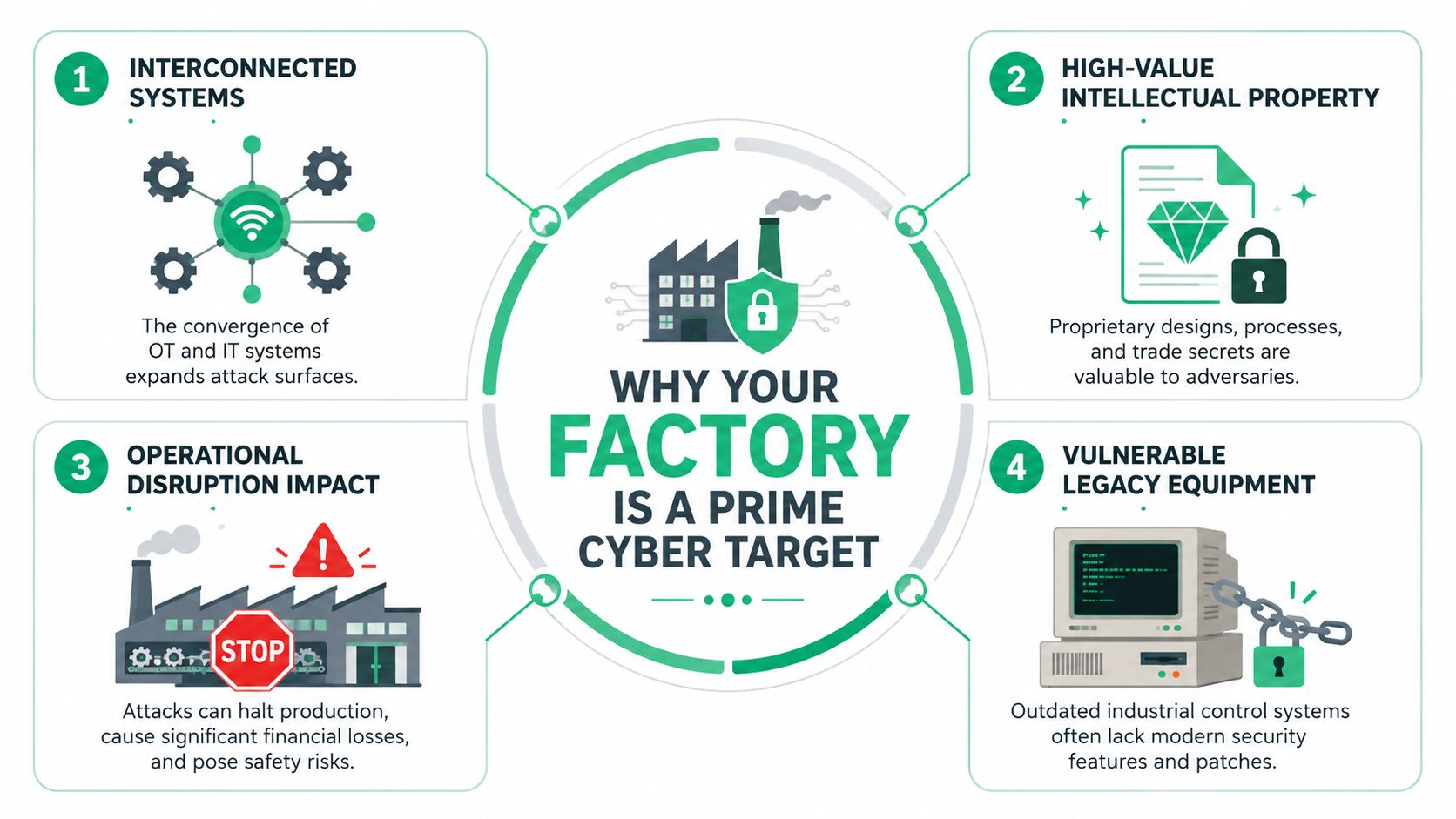
Manufacturing gets hit because attackers know downtime hurts you fast. In an office breach, someone may lose data. In a plant breach, you can lose production, delay shipments, and create safety headaches at the same time.
That makes factories attractive targets. Your IT environment is the front office. Your OT environment is the vault, the conveyor, the batch controller, the HMI screen, and the gear that makes money.
Attackers want leverage, not noise
The manufacturing sector has been the most targeted industry for cyberattacks for three consecutive years, accounting for 22% of all incidents. Ransomware drives 90% of total financial losses, and data breaches cost industrial organizations 13% more than the global average according to Bitsight's manufacturing threat analysis.
That tells you something important. Attackers aren't picking factories by accident. They pick them because the pressure to restore operations is intense.
OT changes the consequences
A normal IT compromise is bad enough. You lose files, credentials, or customer data. An OT compromise is different because it can affect the systems that run the line.
Think about these common factory realities:
- Legacy control systems: Older PLC, SCADA, and HMI environments often stay in service for years because they still run production.
- More connected devices: Sensors, gateways, and remote support links create more entry points.
- Mixed ownership: IT owns some systems, engineering owns others, and attackers love those gaps.
When attackers jump from business systems into operations, the issue stops being “Can they read our files?” and becomes “Can they interrupt the plant?”
A factory doesn't need to be a high-profile brand to be worth attacking. It only needs weak access controls and a production schedule that can't tolerate disruption.
What smart teams do first
You don't need a complicated theory to understand the fix. Start with the paths attackers use.
| Risk area | What breaks | What to do |
|---|---|---|
| Remote access | Vendors or staff connect into sensitive systems with weak controls | Tighten access and review every route into OT |
| Flat networks | Attackers move from IT into OT too easily | Create hard separation points |
| Old systems | Legacy equipment can't always run modern defenses | Add protective layers around them |
| No validation | Teams assume controls work without testing them | Use a manual pen test to verify |
If you want a practical walkthrough of these basics, this essential guide to OT security gives a good foundation.
Navigating Manufacturing Compliance Standards
Compliance gets overcomplicated fast. Most factory teams hear acronyms, buy paperwork, and still don't know what an auditor will care about.
Here's the simple version. Auditors want proof that you know what you have, who can access it, how you protect it, how you detect trouble, and what you'll do when something goes wrong.

What NIST CSF 2.0 means in plain English
The NIST Cybersecurity Framework Version 2.0 Manufacturing Profile organizes work into six functions: Govern, Identify, Protect, Detect, Respond, and Recover. It also calls for MFA for all remote access to ERP, MES, and HMI systems, and notes that malicious emails account for 29% of attacks on manufacturers, based on the NIST manufacturing profile.
For a busy factory IT manager, that means:
- Govern: Decide who owns security decisions across IT and OT.
- Identify: Build an asset list you can trust.
- Protect: Put controls in place, especially around access.
- Detect: Watch for abnormal behavior and missed controls.
- Respond: Know who does what during an incident.
- Recover: Get operations back without guessing.
What auditors usually look for
Auditors don't care that your environment is “complex.” They care whether your basics are defensible.
Focus on these areas first:
- Remote access discipline: Every remote path into ERP, MES, HMI, and related systems needs MFA.
- Data protection: Sensitive data should be encrypted at rest and in transit.
- Assessment evidence: You need records that show you review vulnerabilities and fix what matters.
- Training: Phishing awareness matters because email remains a common entry point.
IEC 62443 also matters in manufacturing because it pushes teams toward better separation and control within industrial environments. You don't need to turn that into a giant transformation project on day one. You do need to show that high-risk systems are segmented, access is controlled, and weak spots get tested.
Audit reality: If you can't explain who has remote access to HMI, MES, and ERP systems, you're not audit-ready.
For a broader governance view that stays readable, DataLunix's cybersecurity insights are a useful companion to the framework itself.
Practical Security Controls That Actually Work
Most factories don't fail because they skipped some fancy platform. They fail because basic controls were loose, incomplete, or never validated.
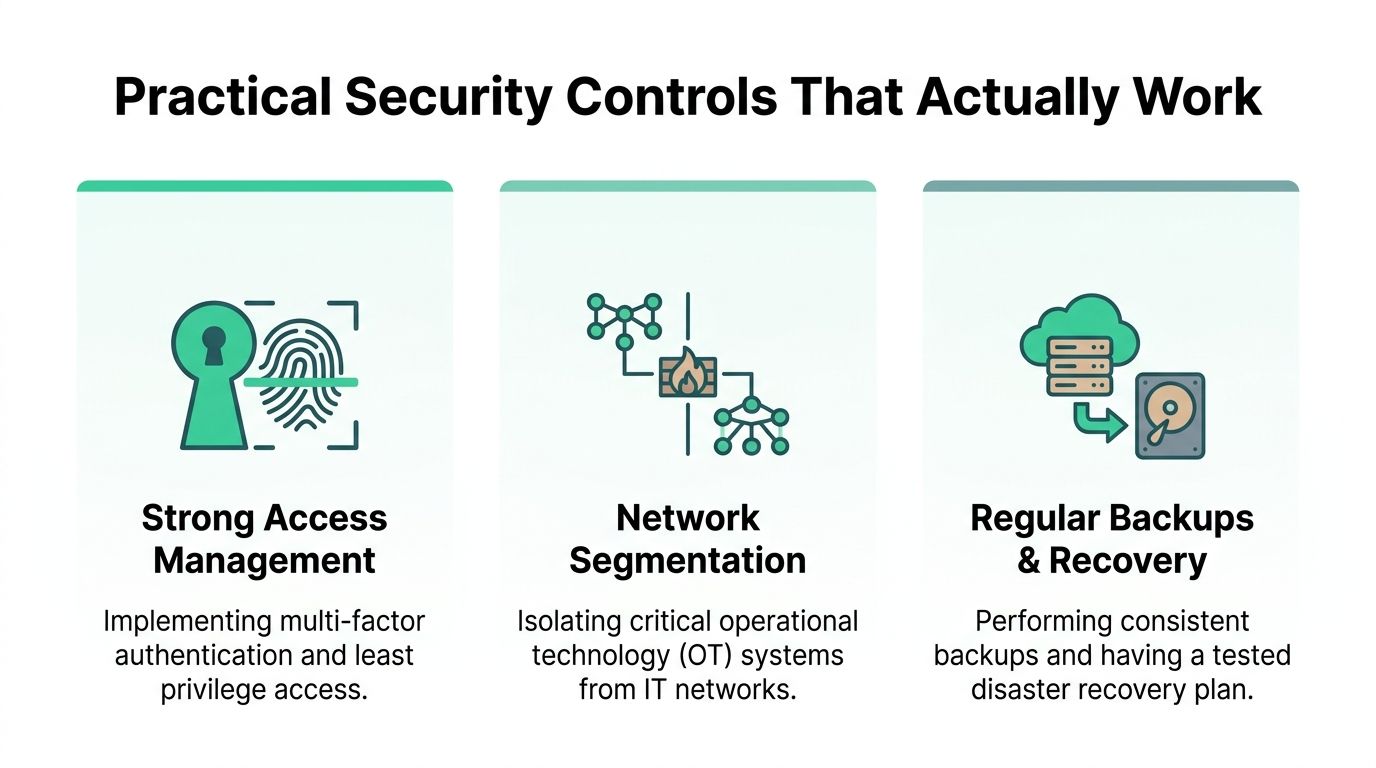
If you want the biggest security payoff for the least drama, focus on controls that stop lateral movement, reduce blind spots, and make recovery possible.
Segment IT from OT
This is the most important control in manufacturing. Strict network segmentation between IT and OT is the key technical defense because it contains breaches before they reach production, and 27% of malicious incidents are rooted in unpatched vulnerabilities in OT environments that often can't support modern endpoint protection, as explained in SentinelOne's manufacturing security guidance.
Think of segmentation like interior walls in a building. If a fire starts in the front office, you don't want open doors all the way to the control room.
Good segmentation means:
- Controlled pathways: Traffic between business and plant systems goes through defined choke points.
- Limited trust: A user or machine in IT shouldn't get broad access to OT by default.
- Documented rules: Engineers and IT should both understand what can talk to what.
For a more practical walkthrough, these network segmentation strategies are a solid reference.
Build an asset list you can use
You can't protect what you can't name. In many plants, nobody has one reliable list of PLCs, HMIs, engineering workstations, remote connections, and supporting servers.
Start small and stay accurate.
- List critical assets first: Begin with systems that can stop production or affect safety.
- Map communication paths: Note which systems talk to each other and which ones connect back to IT.
- Flag unsupported gear: Legacy systems deserve extra attention because they usually need compensating controls.
Patch carefully and protect what you can't patch
OT patching is never as simple as “update everything tonight.” Some systems can't be touched without downtime, retesting, or vendor approval.
That doesn't mean you ignore them. It means you wrap protection around them.
- Use maintenance windows wisely: Patch what you can during planned downtime.
- Harden access: If a system can't be patched soon, make it harder to reach.
- Prepare recovery: Backups matter only if you've checked that you can restore them.
Don't wait for perfect OT patching. Reduce exposure first, then patch where operations allow.
For cyber security manufacturing to be practical, segment the network, know your assets, and lock down access around fragile systems. That's how you lower risk without ripping out equipment that still runs your plant.
How Penetration Testing Secures Your Plant
Controls on paper don't mean much until someone tries to break them. That's what a real pentest does.
A good penetration test for manufacturing isn't just an automated scan with a fancy PDF. It's a manual process where certified ethical hackers look for the exact weak spots an attacker would use, then show you what worked, what failed, and what needs to change.
What a real pen test looks like
In a factory setting, the scoping matters. You don't want a tester crashing production just to prove a point. You want a disciplined manual pentest that respects safety and uptime while still finding serious weaknesses.
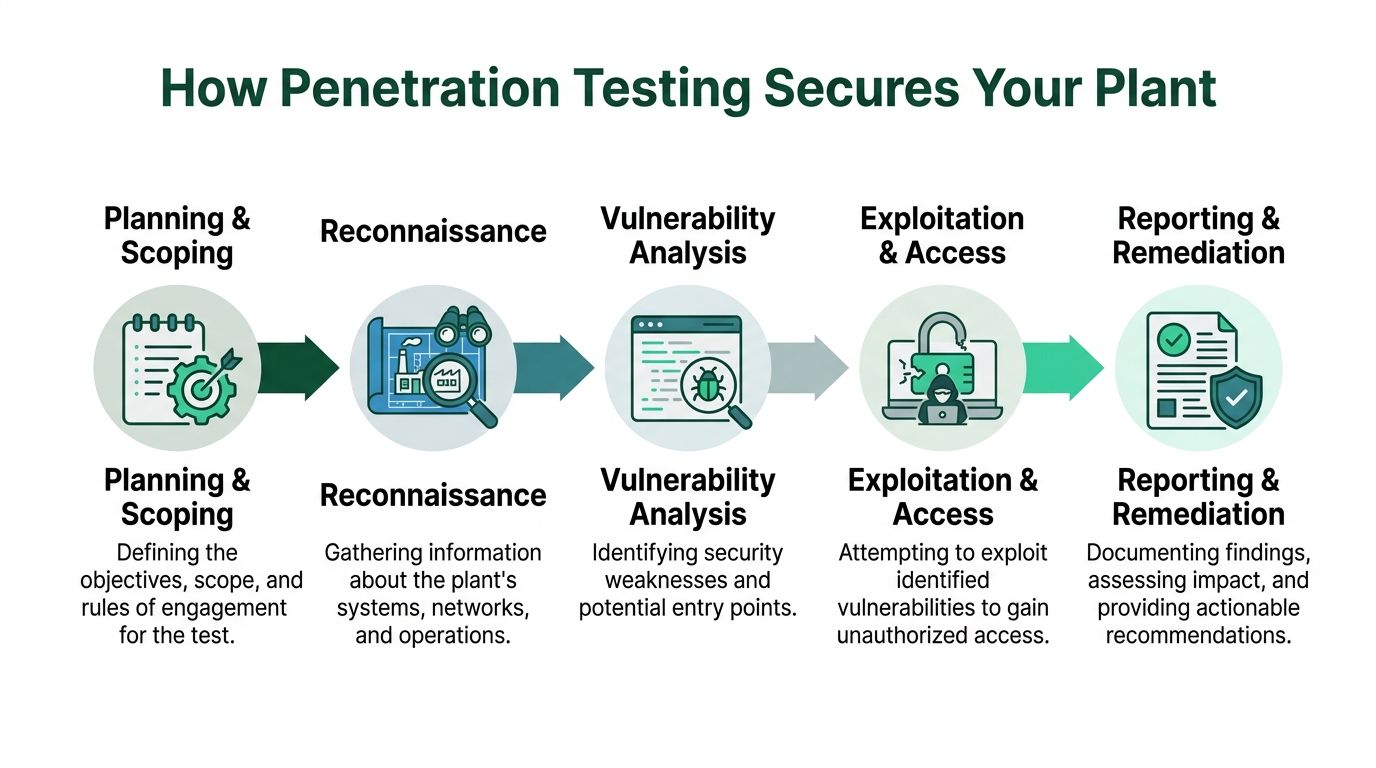
A typical engagement covers:
- Planning and scope: Define which systems are in bounds and what methods are safe.
- Reconnaissance: Identify exposed services, weak pathways, and trust relationships.
- Vulnerability analysis: Check where poor segmentation, weak authentication, or misconfigurations create openings.
- Controlled exploitation: Confirm whether those openings are exploitable.
- Reporting: Deliver clear findings with remediation steps your team can act on.
Why manual penetration testing matters
Automated tools are useful for basic visibility. They are not enough for factory environments with mixed protocols, old systems, and weird exceptions built up over years.
A manual penetration test finds things scanners often miss:
| Scanner output | Manual pentesting catches |
|---|---|
| Open ports | Whether those ports lead to real attack paths |
| Missing patches | Whether attackers can chain that weakness with other mistakes |
| Weak credentials | Whether those credentials expose sensitive workflows |
| Network exposure | Whether segmentation actually blocks movement |
That's why penetration testing works so well as a proof step. You don't have to guess whether your controls hold. A skilled tester shows you.
What good reporting should give you
The report should be clear enough for leadership and specific enough for engineers. If it just dumps generic severity labels without showing business impact, it's not helping.
Look for findings that explain:
- How the issue was reached
- What an attacker could do next
- Which system owners need to fix it
- What to retest after remediation
Field advice: The best pentest report doesn't try to impress you. It tells you exactly what's broken and how to close it.
For compliance teams, that report is often the evidence they need. For IT and OT teams, it becomes the fix list that turns assumptions into verified security.
Finding an Affordable and Fast Pen Test
A lot of firms still sell penetration testing like it's a luxury project. Big kickoff call. Long wait. Expensive scope. Thin findings. That model wastes time.
If you run an SMB factory, you need a pen test that is affordable, manual, and fast enough to support an audit or vendor request without dragging on for weeks.
What pricing should look like
A manual penetration test can start as low as $5,000, while traditional firms often charge between $10,000 and $35,000 for standard engagements. Professional hourly rates commonly run $250 to $300, and affordable pentest work can still be performed by certified experts such as OSCP and CEH, according to Blaze Information Security's pricing breakdown.
That matters because too many buyers assume “cheap” means low quality. It doesn't. What usually drives cost up is bloated process, oversized teams, and a lot of time spent on presentations instead of testing.
What to demand from a provider
Speed matters. If you're waiting forever for a report, the findings are stale by the time they arrive.
Look for a provider that gives you:
- Certified testers: Ask about OSCP, CEH, and CREST backgrounds.
- Manual work: Confirm they're not just running scanners and reformatting the output.
- Fast reporting: You should be able to get your report within a week, not after a long consulting cycle.
- Clear scope: Know exactly what systems, apps, or external assets are being tested.
A good provider should also make quoting simple. If it takes endless calls just to understand cost, that's a warning sign.
Red flags that waste your money
Some firms are expensive because they're built for giant enterprises. Others are cheap because they do almost nothing. Neither helps.
Watch for these problems:
- No real findings: A penetration test that finds little or nothing in a messy environment often wasn't deep enough.
- Slow turnaround: Delayed reports slow remediation and compliance work.
- Vague credentials: If they can't explain who is doing the work, don't buy.
- Automated-only delivery: That's not the same as a proper manual pentest.
If you're comparing options, start with providers that keep scope clear and timelines short. These Affordable Pentesting services show the kind of focused external testing model many SMB teams need.
Your Next Steps to Secure Manufacturing
Don't overcomplicate this. Most factories can make meaningful security progress without buying a giant platform or launching a year-long transformation.
Start with the controls that block the most damage. Segment IT from OT. Tighten remote access. Build a usable asset inventory. Put guardrails around systems you can't patch easily.
Then verify everything with a real pentest. A manual pen test or penetration testing engagement tells you whether your network separation works, whether access controls hold up, and whether someone can still find a path into production. It also gives you evidence you can hand to auditors, customers, and leadership.
Use a simple three-step approach:
- Fix the fundamentals: Access control, segmentation, and asset visibility.
- Run a manual penetration test: Validate what an attacker can reach.
- Retest after remediation: Prove the fixes worked, not just that tickets were closed.
The biggest mistake in cyber security manufacturing is delay. Not because your team is careless, but because every factory has competing priorities and old systems that never seem like the right place to start.
Start anyway. The practical path is clear, and it doesn't require a massive budget. It requires discipline, a focused pen test, and a provider who can move quickly enough to help instead of slowing you down.
If you need a fast, affordable way to verify your factory's security controls, Affordable Pentesting offers manual pentest, pen testing, and penetration test services built for real-world budgets and timelines. Their certified pentesters, including OSCP, CEH, and CREST professionals, deliver clear findings and audit-ready reports within a week. Use the contact form to get a same-day quote and stop guessing what's exposed.